
Audience overlap: how many customers are you targeting twice?
Managing audience overlap helps you keep marketing pressure in check and give each customer the most relevant offer at the right time.



Summary
Audience overlap is measured by the people shared by two lists and the share they represent of each list.
In paid media, deduplicated reach and frequency show whether a campaign reaches a new audience or adds repeat exposure.
Contact history tells you who can receive another message. Recent behaviour helps you choose the right offer and timing.
An agentic CDP can identify over-contacted customers and prepare audiences or exclusions for the team to review.
The loyalty team has a VIP offer lined up for Friday. CRM wants to win back dormant customers on the same day. The lists share 3,000 customers. Some of them have already had three messages this week. Others have heard nothing for a month.
The two lists already overlap. Nobody has seen Friday’s campaign yet, but both teams are planning to contact some of the same people. Spotting that overlap gives them time to choose an offer, check what each customer has received and decide whether Friday is a good time to get in touch. That is where customer segmentation starts to shape the customer’s experience.
How do you measure audience overlap?
Both teams see the same overlap count. For a useful comparison, each divides the number of shared customers by the size of its own audience. The result shows how much of each campaign is at stake if the other team takes priority.
In this example, the VIP offer targets 12,000 people and win-back targets 4,000. Both teams take their audience snapshot at the same time and compare records using a common customer ID. Each person counts once per segment. The two lists have 3,000 people in common.
Measure | Calculation | Result |
|---|---|---|
Share of the VIP audience also eligible for win-back | 3,000 ÷ 12,000 | 25% |
Share of the win-back audience also eligible for the promotion | 3,000 ÷ 4,000 | 75% |
Unique people across both audiences | 12,000 + 4,000 − 3,000 | 13,000 |
The same 3,000 customers account for 25% of the VIP audience and 75% of the win-back audience. If loyalty gets first pick, CRM loses three quarters of its list. If win-back takes priority, loyalty loses a quarter. Those figures explain why the teams may disagree. A recent purchase or a visit to the promoted category is a better guide to which offer a particular customer should receive.

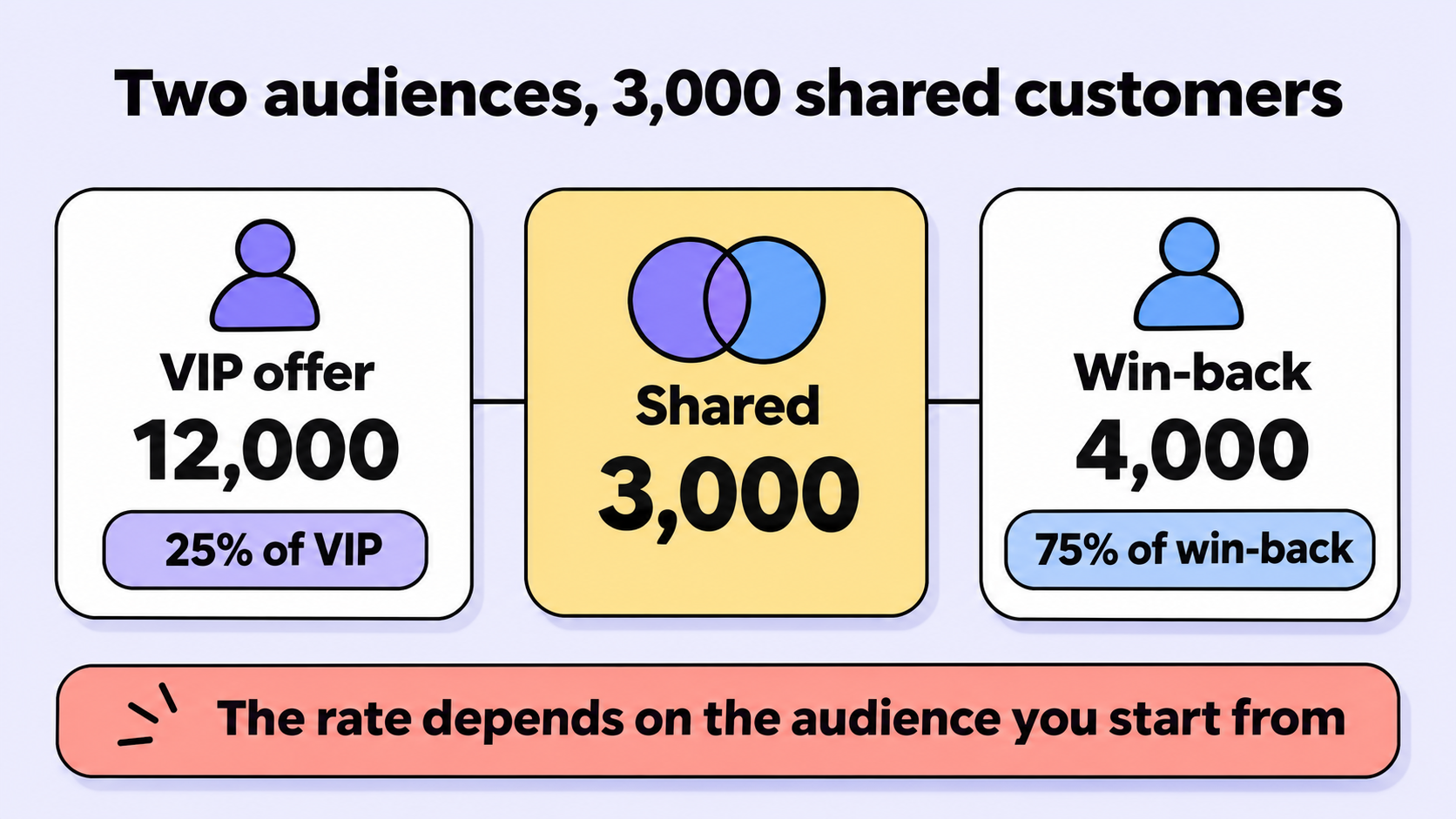
The same group of customers represents a different share of each audience.
Audience overlap in paid media: from targeting to delivery
CRM overlap tells the media team who is eligible for both campaigns. The platform decides which ads it serves. Two ad sets with similar target audiences can still reach different people. After launch, the deduplicated total for both campaigns minus the reach of the first tells the team how many extra customers the second one reached.
Before launch, where do the ad sets overlap?
On a fixed budget, two ad sets promoting the same offer can leave less money to reach new customers. Someone who browsed the website might also be on a CRM list uploaded to the platform. Allocating those buyers to just one ad set leaves more budget for the rest of the audience.
From the customer’s side, the email and the ad are part of the same day. An offer that was welcome at breakfast can wear thin by the third impression that afternoon. Different offers can cause as much trouble. A loyal customer who sees a more generous acquisition discount has good reason to question the value of the VIP deal.
Before launch, an agentic CDP can identify customers on both lists and bring recent orders, browsing and contact history into the decision. Someone who bought this morning can drop out of win-back. Someone who browsed the VIP range may still welcome the promotion, provided there is room under their contact cap.
The same issue comes up in media planning across publishers. A sports brand might compare a running website with a competitor’s site. Estimates of shared website traffic can flag duplication before it buys either placement. Both sites need to count unique visitors in the same market over the same dates. Comparing page views for one publisher with visitors for its competitor gives a misleading estimate.
After launch, how many people saw both campaigns?
Suppose the VIP ads reach 8,000 people and the win-back ads reach 6,000 over the same week. A combined report shows 11,500 people reached after deduplication. That means 2,500 people saw both (8,000 + 6,000 − 11,500). The second campaign contributed 3,500 in incremental reach.
All three figures have to cover the same dates, market and definition of an exposure. Separate reports from Meta and LinkedIn cannot show how many people saw ads on both. In the UK, a cross-media measurement service such as Origin offers deduplicated coverage estimates for the placements it supports.
An average of three impressions per person can mean one shopper saw the ads six times and another saw them once. The team can count an impression against a shopper’s contact cap only if the platform links it to that individual.
Where Google Ads reports how often users saw an ad, a media buyer can check the share who saw it five times or more. If that share climbs while audience size barely grows, reviewing the frequency cap makes sense for a campaign intended to find new customers.
When is a second paid contact worth the budget?
At £2,100 for the win-back ads, the 3,500 extra people reached cost £0.60 each. For a buyer aiming for incremental reach, that figure is a useful benchmark for other placements. Whether the reminder helped someone who had already seen the offer is a separate budget decision.
When buying a publisher placement, site traffic can help a buyer estimate audience overlap during planning. After delivery, cross-media measurement estimates how many saw an ad in the digital inventory actually bought. Someone can visit both publishers’ websites without seeing either ad. Counting all site visitors would understate the cost per person reached.
Sometimes the shared audience is exactly who the team wants. An email can announce a sale and a social ad can show the product in use, or remind an interested shopper when the offer ends. The extra contact earns its place if enough customers do something they would otherwise have put off.
To test that, the team randomly splits eligible customers before launch. Both groups get the same email. Only one is eligible for the paid reminder. The purchase rate in each group includes everyone assigned to it, even a shopper who never opened the email or saw the ad. Looking only at visitors who clicked would favour shoppers who were already interested.
Margin after discounts per customer puts a value on the reminder. Does the extra margin cover the cost of the extra campaign? If the group eligible for both channels also records more unsubscribes, the team needs to allow for the future email margin those opt-outs put at risk. A reminder can pay for itself this week and still cost the business money over six months.
Which customers are already receiving too much?
Two customers are eligible for both Friday offers. One received two emails and a text in the last seven days. Under a cap of three messages in a rolling week, that customer is due a break, even if each individual tool would still allow another send. The other customer has had no messages this week and could still benefit from one of the offers.
A marketing pressure policy works across channels when the team can join contact histories to the same profile. Confirmed deliveries give you the clearest measure where available. If the only record is of accepted sends, the count can use that measure after removing retries. An order confirmation follows transactional rules. A promotion in an automated journey still counts as marketing.
A first text message this week might be the fourth marketing contact a customer has received. The CDP can join email, SMS and push histories by customer ID. Aggregate social reports still help a media buyer judge frequency on that channel. An impression belongs in an individual contact count only when the platform supplies exposure data that can be reliably linked to that person.
Which offer fits, and when?
Channel permission, opt-outs and the contact cap determine what can go out. A customer who bought again this morning drops out of win-back. A text already scheduled for Friday can use the last available contact slot, even before it shows up in the sending history.
From there, marketing targeting is about what has changed for the customer. Someone who recently looked at the promoted category may welcome the VIP offer. A longer-inactive customer with no interest in the category may respond better to a win-back message connected to their previous purchase. If both still fit, the offer that expires sooner can take priority.
Applying those rules to the 3,000 people on both lists gives the CRM team three distinct groups to activate.
Decision | Customers | Rule applied |
|---|---|---|
Win-back only | 1,800 | Confirmed inactivity, room within the contact cap and no recent interest in the promoted category |
VIP offer only | 700 | Recent interest in the promoted category and no contact restriction |
Pause marketing | 500 | The contact cap has already been reached |
The VIP group drops out of win-back, the win-back group drops out of the VIP offer and the 500 customers at the cap take a break. The customer reactivation strategy defines how long someone needs to be inactive and why it is worth getting back in touch.
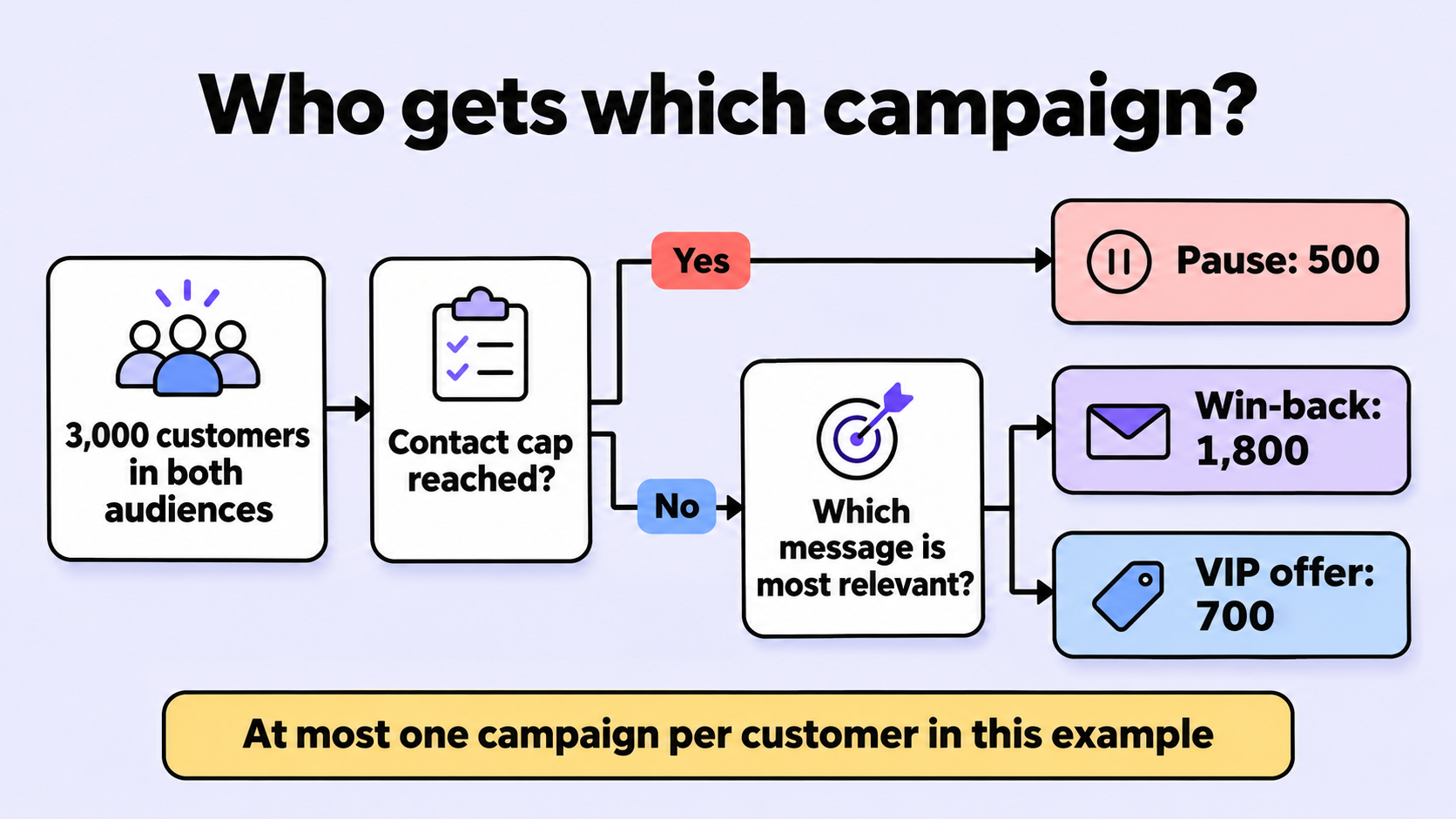
The contact cap puts some customers on pause. The priority rule assigns a campaign to the rest.
After launch, the team checks how many people received both offers despite the exclusions. If duplication persists on one channel, comparing send times with the last audience refresh can reveal a list that arrived too late.
A second A/B test can compare the rules themselves. Eligible customers are assigned at random to VIP-first or win-back-first. The team compares repeat purchases, margin after discounts and unsubscribes over the same period. An opt-out closes the email channel even if the customer keeps buying elsewhere.
Suppose one rule earns $120 more margin across 1,000 customers but produces 20 extra unsubscribes compared with another group of 1,000. If a previous email holdout test puts the additional future margin attributable to email at $8 per lost subscriber over six months, the estimated loss is $160. The rule that looked $120 ahead finishes $40 behind.
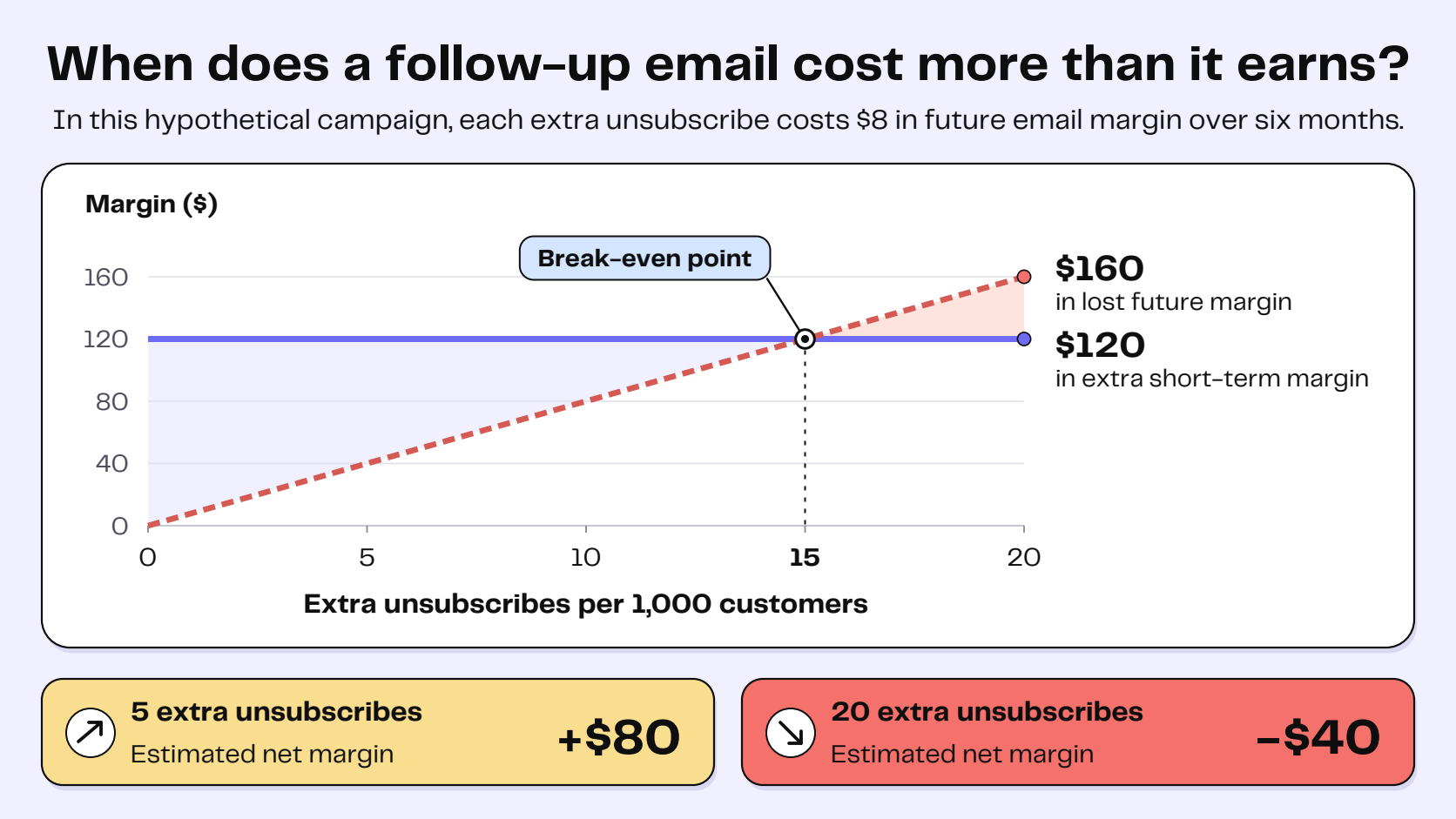
In this example, the follow-up email breaks even at 15 extra unsubscribes per 1,000 customers.
How does a CDP keep track of audience overlap?
In DinMo Audiences, the team can see which customers two segments share when both are built on the same customer model. As new orders come in, the audience changes. By Friday afternoon, CRM can see how much of the win-back list still overlaps with VIP and check that this morning’s buyers have dropped out.
An email, a text and a push notification may come from three tools. To the customer, they are three messages from the same brand.
The same customer history helps the team choose between offers. If both still look relevant, the CDP can randomly split the customers who qualify for both offers. One group gets VIP, the other win-back, on the same channel. An optional holdout gets neither. Comparing margin per customer and opt-outs gives the team a basis for its next decision.
How does an agentic CDP choose the next action?
Dan, DinMo’s AI agent, can review activation history to see which offers someone has received, when they were sent and how that customer responded. Given a repeat-purchase goal and a weekly contact cap, Dan can propose audiences, timing, channels and how the team will measure repeat purchases. The team approves the plan, then the rules can run for each customer as new data arrives.
A VIP customer who browsed the range yesterday and prefers in-app alerts might see the offer when the sale opens. If she buys that morning, the afternoon win-back email drops out. For a shopper who prefers email but has reached the cap, waiting until next week may make more sense. It gives a team a concrete test when evaluating customer segmentation software.
Conclusion
Two campaigns can help the same customer make a decision, or give them one more reason to unsubscribe. Measuring audience overlap shows where that choice arises. A holdout test shows what the second contact adds after discounts, media spend and the cost of losing an email subscriber. An agentic CDP can apply what the team learns to the next offer, the channel and the timing, including when to wait.