


How to choose customer segmentation software
9min • Last updated on Aug 21, 2026


Alexandra Augusti
Chief of Staff
Customer segmentation software turns fragmented data into customer groups that marketing teams can use. Yet products in this category solve very different problems. Some only filter the data held in a CRM. Others collect and store new customer profiles in their own database. More open platforms work directly with governed data in the organisation’s data warehouse.
Selecting a platform should therefore involve more than testing how quickly a user can build one segment. The full workflow matters: data quality, rule flexibility, team autonomy, refresh frequency, multichannel activation, governance and performance measurement.
Key takeaways
Effective software connects segment creation with activation across CRM, advertising and customer engagement tools.
Data coverage and fit with the existing stack matter more than the number of templates offered.
A no-code Segment Builder should empower marketers while respecting the models and permissions managed by data teams.
Segments need to be dynamic, explainable, measurable and refreshed at the frequency required by each use case.
A rigorous evaluation starts with three to five real use cases and a test using the organisation’s own data.
What is customer segmentation software?
Customer segmentation software is a platform that groups profiles according to shared characteristics, including demographics, transactions, behaviours, preferences, value, engagement or the predicted likelihood of an action.
It goes beyond a simple contact filter by combining multiple data sources and time periods. A retailer might, for example, build an audience of customers who purchased online twice in the past six months, recently visited a shop, browsed a particular product category and did not engage with the last three campaigns.
This capability sits within the broader discipline of customer segmentation. The pillar page covers methods and criteria; this guide focuses on selecting the technology that can apply them reliably.
From static lists to dynamic audiences
A CSV export is a snapshot that quickly becomes outdated. Modern software recalculates segment membership as customer data changes. A person enters an audience when they meet its conditions and leaves when they no longer qualify.
Dynamic membership is essential for onboarding journeys, lapsed-customer reactivation, recent-buyer suppression and marketing pressure management.

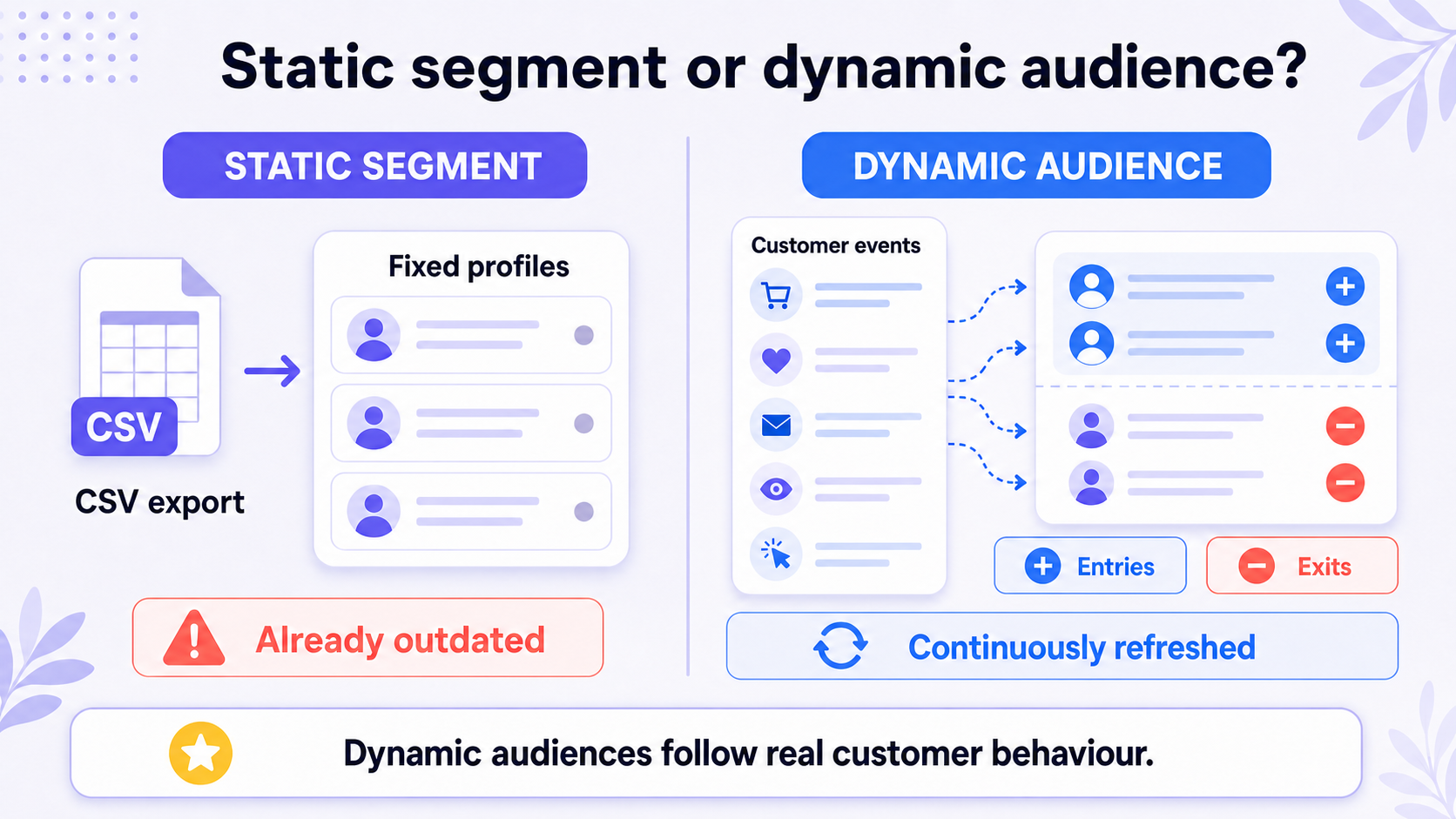
A static segment becomes outdated; a dynamic audience evolves with customer events.
Why use a dedicated segmentation tool?
CRMs, advertising platforms and email tools already offer filters. They work for straightforward requirements, but usually hold only part of the customer picture. Rebuilding the same audience separately in every destination creates inconsistent definitions and repetitive manual work.
Dedicated software offers four advantages.
Shared audience definitions
Teams use common rules. A ‘high-value customer’ segment no longer means something different in the CRM, advertising platform and customer service tool.
A more complete customer view
The platform can combine purchases, browsing, campaign interactions, support tickets, consent and calculated attributes. This supports behavioural segmentation, RFM segmentation and customer scoring.
Faster activation
A useful segment must reach the destinations where action takes place. Synchronisation removes manual extracts, file transfers and the delay between decision and execution.
More rigorous measurement
Persistent, documented audiences make it easier to monitor size, movement and performance. They also support consistent control groups and suppression rules.
Eight criteria for choosing customer segmentation software
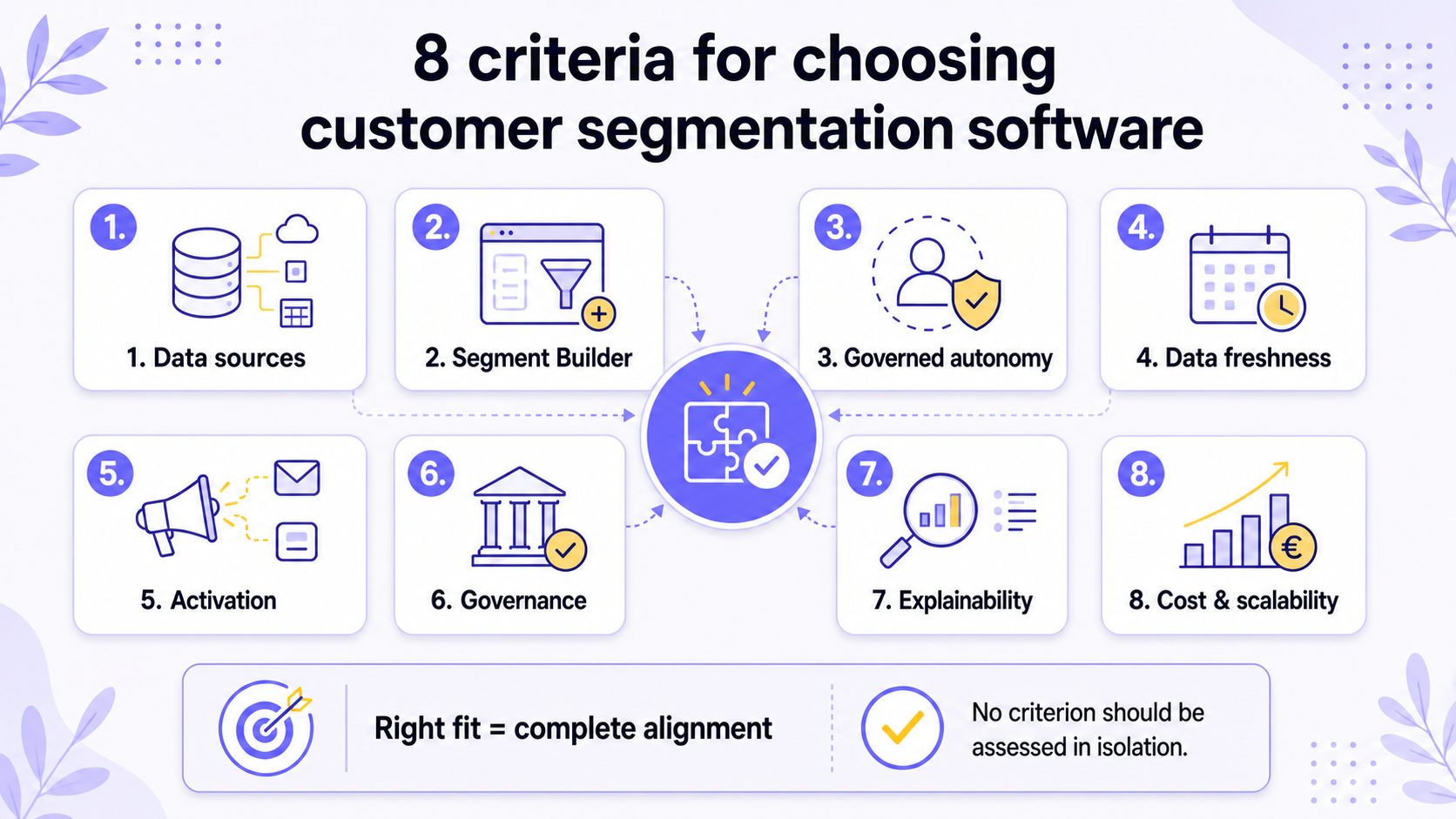
The right choice depends on eight complementary criteria assessed together.
Data-source coverage
Begin with the data needed for priority use cases: CRM profiles, orders, products, web and app events, consent, marketing interactions, shop activity and support information.
Then establish whether the platform can access these sources without creating another fragmented repository. A data-warehouse-connected architecture uses models that the organisation has already validated, limits unnecessary copies and keeps the warehouse as the source of truth.
Segment Builder flexibility
The interface should support AND/OR logic, exclusions, time windows, aggregations and relationships between business objects. A CRM manager should be able to express ‘at least two purchases in this category during the last 90 days, but no return and no support contact in the past 30 days’ without writing SQL. More and more tools are making it possible to create segments using natural language, which makes them easier for marketing teams to use.
Ease of use must not reduce precision. Ask vendors to reproduce your most demanding segment definitions during a demonstration.

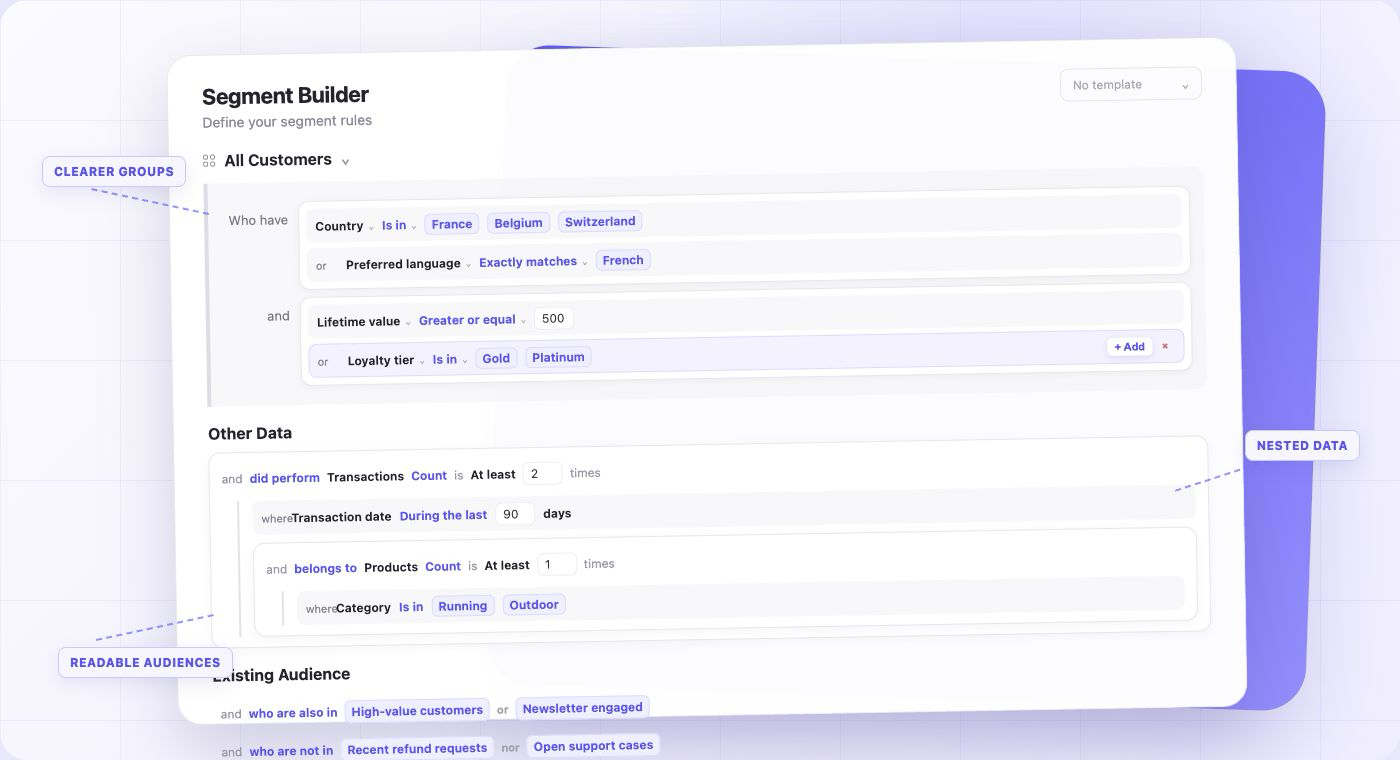
Governed marketing autonomy
No-code segmentation is valuable when it relies on understandable, governed data. Fields need business-friendly names, descriptions and access rules. Free previews should show estimated audience size and explain why a profile qualifies.
The data team retains control of models and permissions while marketing teams gain the speed to explore, build and activate.
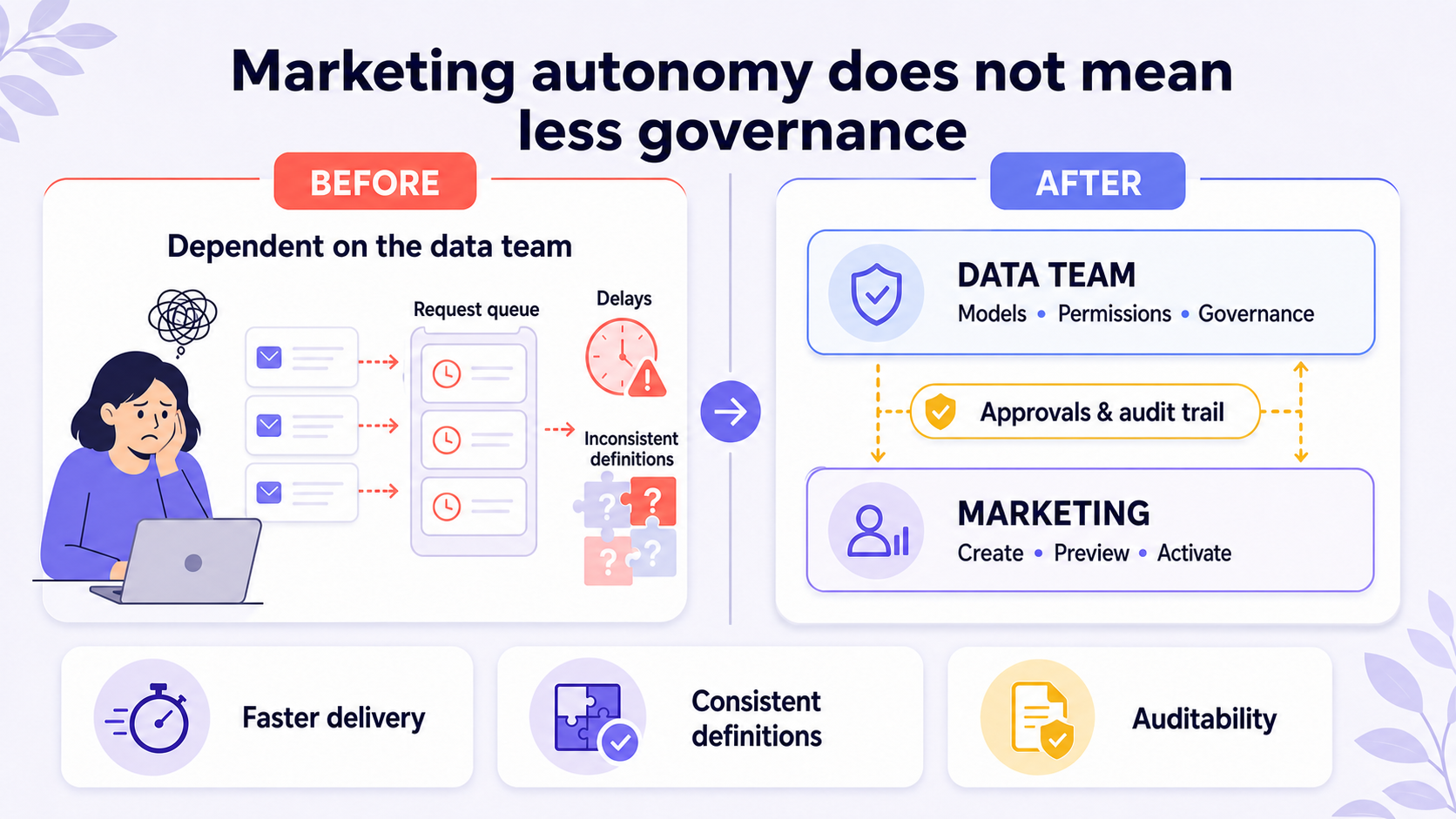
Marketing autonomy works when models, permissions and approvals remain governed.
Refresh frequency and calculation model
Not every audience requires real-time processing. A weekly retention campaign might accept a daily refresh, whereas cart-abandonment messaging or advertising suppression needs much fresher data.
Assess recalculation delays, scheduling, incremental processing and synchronisation frequency for each destination. Treat ‘real time’ cautiously if the claim only covers one stage of the flow.
Connectors and multichannel activation
List the destinations actually in use: CRM, ESP, engagement platform, advertising networks, onsite personalisation, contact centre and analytics tools. Check which identifiers and attributes each connector accepts, as well as how removals are handled.
A data activation platform should do more than send an audience once. It should keep membership current and surface synchronisation failures.
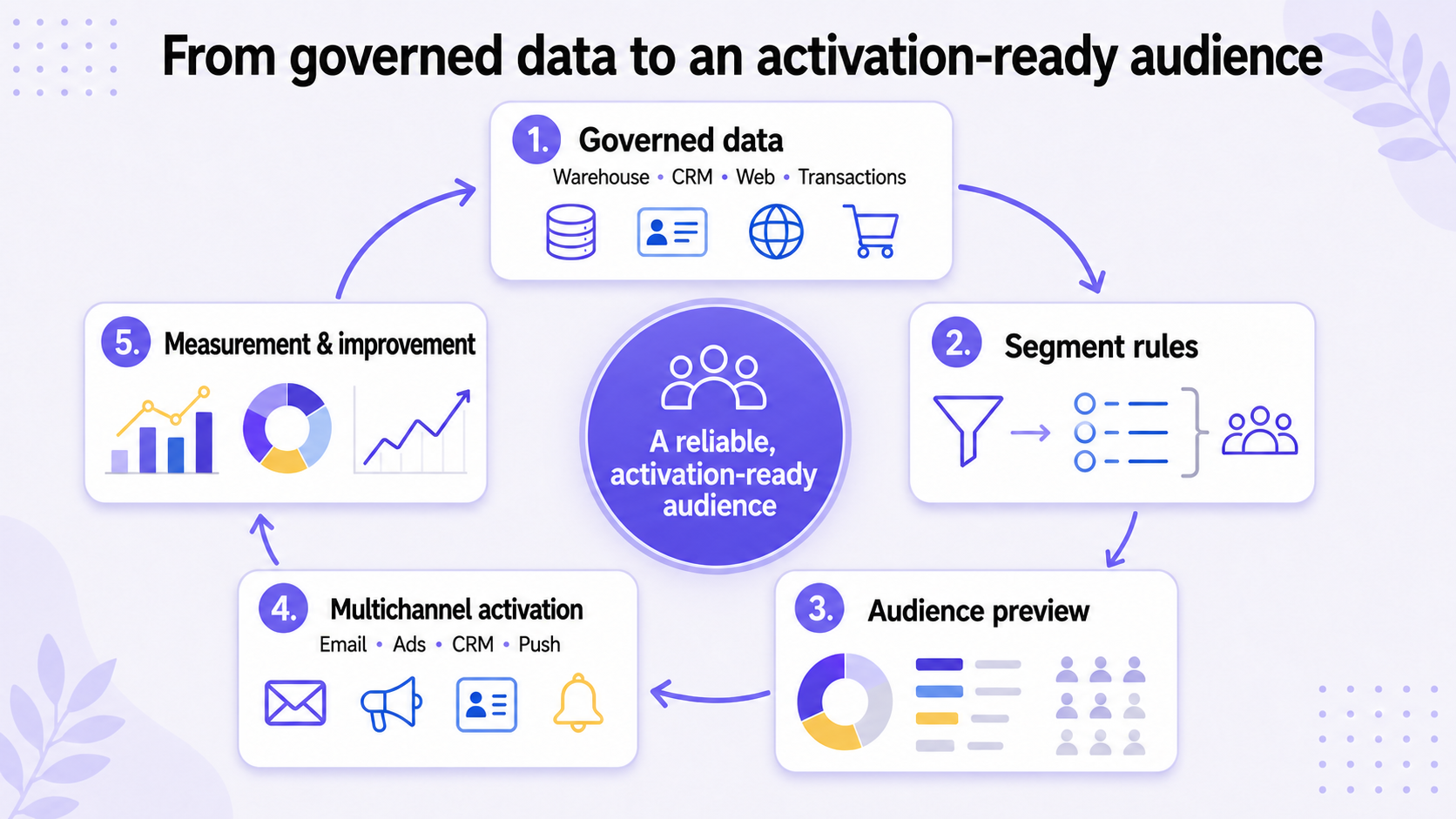
Effective software connects governed data, rules, preview, activation and measurement.
Governance, security and compliance
Review roles, permissions, audit logs, environments, approval workflows and retention policies. The platform should respect consent and prevent sensitive attributes from being activated in unauthorised destinations.
European organisations should also assess hosting and processing locations, subprocessors, deletion mechanisms and how much data leaves the existing infrastructure.
Analysis and explainability
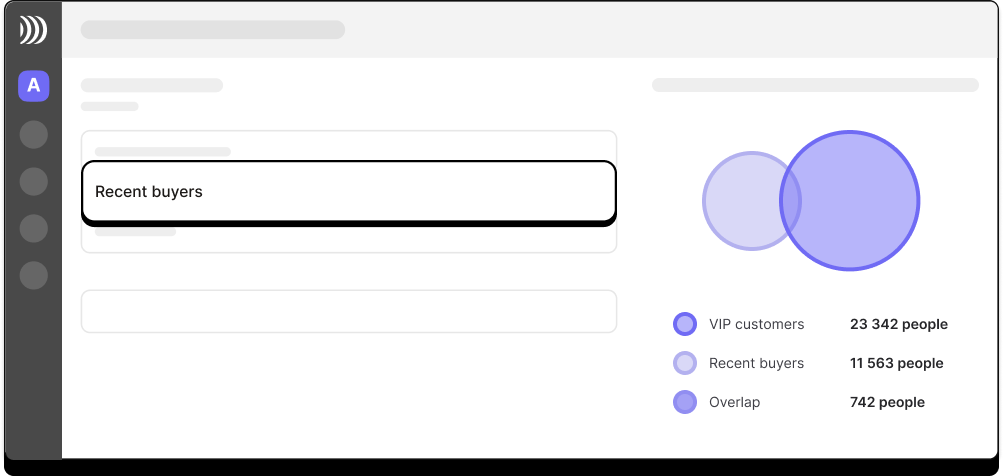
Before activation, users should be able to explore audience composition: size, movement, attribute distribution, overlap with other segments and sample profiles.
These capabilities help uncover rules that are too broad, biased outputs and missing data. They also create a better working language between marketing and data teams.

Total cost and scalability
Compare licence fees, billable volumes, connectors, environments, implementation and maintenance. Include the time saved on data requests, exports and rebuilding audiences in each channel.
The platform should accommodate growth in profiles, events, users and destinations without forcing a complete redesign.
Which segmentation criteria should the platform support?
The platform should cover the principal types of customer segmentation without forcing the organisation into rigid templates. Demographic and geographic criteria help adapt an offer to a market. Behavioural criteria use purchases, visits, clicks and interactions. Psychographic and preference data can improve personalisation when it is available and used with appropriate consent.
These dimensions can be combined for specific goals: improving campaign conversion, strengthening customer retention, personalising messages by channel or identifying profiles similar to the best customers. The software should also calculate measures such as purchase frequency, spend, engagement and customer tenure.
Artificial intelligence can supplement these rules with churn, propensity and value scores. It does not remove the need to understand the underlying data, test the output and keep criteria explainable. Effective software lets teams compare a rules-based audience with a predictive segment and measure the real impact on campaigns and customer experience.
Comparing the main categories of segmentation platform
Platform category | Data model | Rule depth | Activation scope |
|---|---|---|---|
CRM and email platforms | Customer profiles and campaign data stored in the application | Basic attributes, lists and campaign filters | Mainly email, CRM and native campaign channels |
Customer engagement platforms | Events and profiles collected in a vendor-managed customer store | Behavioural rules, journeys and real-time triggers | Cross-channel messaging across email, mobile and web |
Traditional CDPs | Unified profiles copied into a separate CDP database | Broad segmentation across profiles, events and identities | Multiple marketing and advertising destinations |
Warehouse-native activation platforms | Governed models queried directly in the cloud data warehouse | Custom attributes, behavioural rules, RFM and reusable audiences | CRM, email, mobile, advertising and other operational tools |
Product analytics platforms | Product events and user behaviour stored in the analytics workspace | Cohorts, funnels and behavioural discovery | Analytics-led activation through integrations or exports |
Comparison of the main customer segmentation software categories.
The table shows the central trade-off: application-led tools are quick to use within their own channel, while broader solutions add cross-channel depth at the cost of a duplicated profile store or more integration work. Warehouse-native activation is strongest when the organisation already governs data centrally. DinMo follows this model: marketers build and preview audiences from trusted warehouse models, then synchronise them across operational destinations without creating a second profile repository.
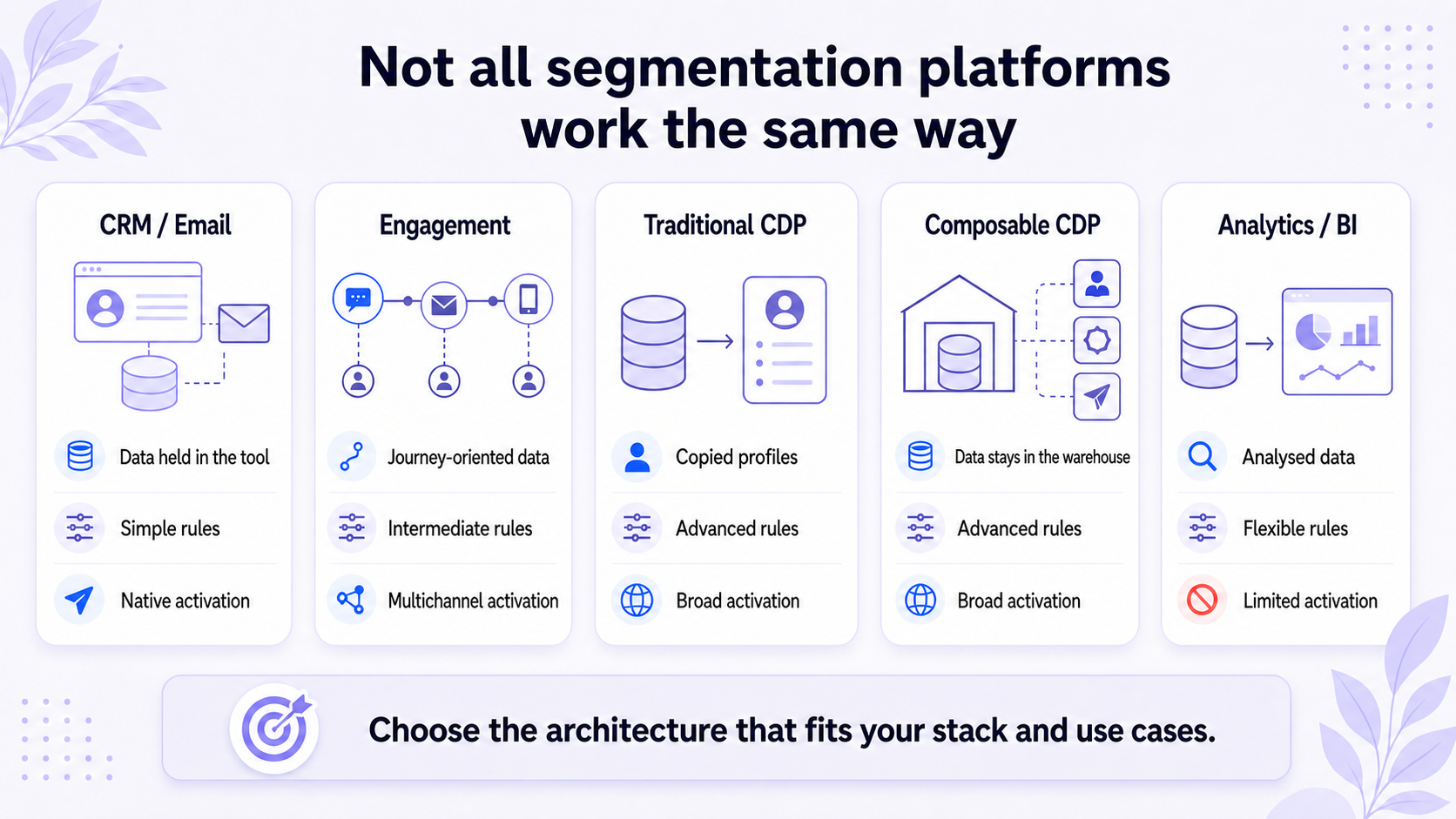
Platform categories differ in their data model, rule depth and activation capability.
During the selection process, ask each vendor to complete the same test: connect a representative dataset, build a behavioural segment, send it to the email or engagement platform, and show how it refreshes. A free trial supports real-world interface testing for teams, but it cannot replace testing real-time events, custom cross-channel rules, access controls and error handling. This gives enterprise teams the best way to compare different segmentation options against one marketing outcome.
How to compare specific tools without relying on a generic ranking
Start with fit, not reputation. Define the customer data, activation channels, refresh frequency, governance needs and users that the platform must support.
CRM and email platforms suit teams whose customer view already lives in the CRM and whose main requirement is campaign segmentation.
Customer engagement platforms suit cross-channel journeys. Test event handling, consent, frequency caps and consistent segment membership across channels.
Product analytics platforms suit behavioural discovery. Verify that cohorts can reach activation destinations reliably, with measurable refresh times and no manual exports.
Warehouse-native activation platforms suit organisations that already govern customer data in a cloud data warehouse. DinMo follows this model: marketers use a no-code Segment Builder to create and preview audiences from trusted models, while synchronisation and destination monitoring keep activation operational.
A practical feature checklist for the shortlist
Use the same checklist for every platform so that commercial demonstrations remain comparable:
Segmentation and audiences: Can teams create RFM conditions, reusable groups, exclusions and segments based on both attributes and events? Can the interface explain why individual customers belong to an audience?
Behavioural and RFM logic: Can the platform calculate recency, frequency and monetary value, combine those RFM measures with product behaviour, and update customers’ membership over time?
Web, mobile and event data: Does it accept web events, mobile app events, purchases and support interactions? What is the delay between an event arriving and an audience changing?
Activation channels: Can the same audiences reach CRM, email, mobile, advertising, analytics and customer-support tools? Does each integration support additions, removals and custom attributes?
Personalisation: Can marketers use segments to select an offer, message, channel or timing? Are personalisation features available across the required destinations or only inside the vendor’s own product?
Testing and measurement: Can users create a testing holdout, compare segment performance and connect campaign results back to the source data? Are testing features included in the proposed pricing tier?
Administration and support: Are roles, approvals, audit logs and data controls suitable for enterprise users? What customer support, documentation and implementation assistance are included?
Commercial model: Is pricing based on stored customers, tracked events, monthly active users, destinations or messages? A free plan or free trial is useful for interface testing, but projected production volumes should determine the final comparison.
This approach turns a crowded tools market into an evidence-based decision. It keeps the focus on whether teams can find the right customers, build trustworthy segments, activate them in time and learn from the result. For a wider view of value-based modelling, review customer scoring.
Seven scenarios for a balanced vendor scorecard
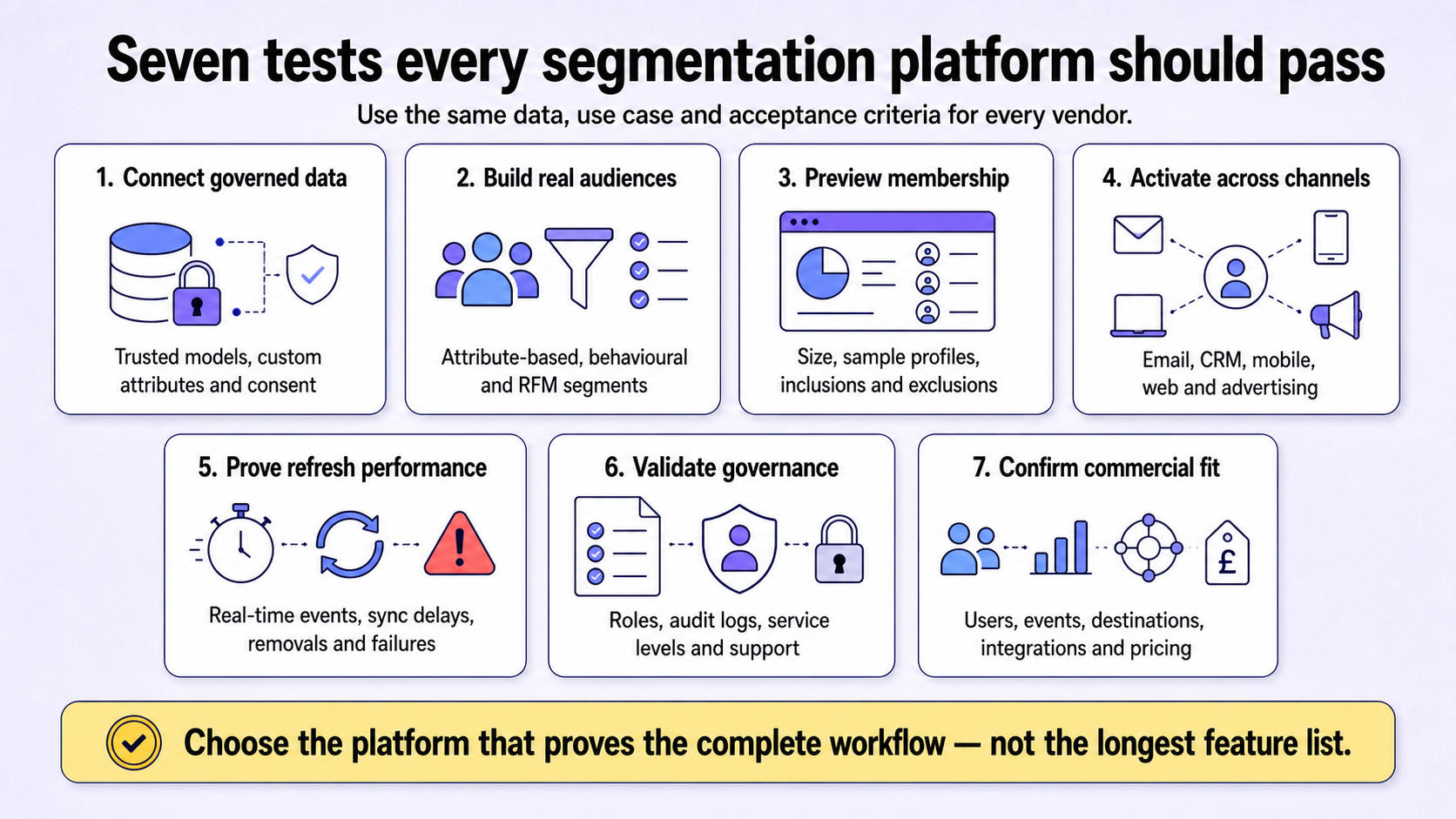
Seven tests every segmentation platform should pass
Use seven practical scenarios to balance functional depth, operational resilience and commercial fit. Set the weighting before any demonstration, use the same dataset and acceptance criteria for every vendor, and record only observed evidence.
Attribute-based segmentation: Build an audience from account status, geography, consent, lifecycle stage and governed custom attributes.
Evidence: rule documentation, preview accuracy, permissions and approval steps.
Behavioural segmentation: Create an event-based audience spanning web and mobile activity, with a time window and an explicit exit rule.
Evidence: event fidelity, refresh delay and explainability.
RFM segmentation: Create recent high-value, regular low-spend and lapsed-customer groups from agreed transaction fields.
Evidence: calculation ownership, customisable thresholds and update frequency.
Cross-channel execution: Activate the same audience across email, mobile, advertising and service destinations.
Evidence: consent handling, channel priority, suppression and removals.
Product analytics activation: Build a behavioural cohort from product events and send it to two activation destinations.
Evidence: hand-off quality, synchronisation, alerts and the experience for analytics teams.
Integration and support failure: Disconnect a destination, change a field and submit an invalid record.
Evidence: error visibility, retry behaviour, audit history and support response.
Commercial validation: Reproduce at least one scenario in a trial or sandbox and model twelve months of production volumes.
Evidence: feature limits, integration costs, scaling thresholds and support commitments.
Review the evidence with marketing, CRM, product, analytics, security and data stakeholders. Agree who builds segments, validates them, monitors integrations and supports time-sensitive campaigns before selecting a platform.
Score consistently:
Use identical data and acceptance criteria for every vendor.
Score each scenario from 1 to 5 and attach observed evidence.
Weight scenarios according to business priorities and operational risk.
Reject claims that cannot be demonstrated in the proposed pricing tier.
For warehouse-centric organisations, assess DinMo through one complete governed flow: expose trusted warehouse models, let marketers build and preview audiences, synchronise them to destinations and monitor updates without creating a second customer store.
Run a like-for-like test:
Use the same inputs — customer data, event history, business objective and production volumes. Ask every platform to build one attribute-based segment, one behavioural segment and one RFM audience.
Run the same activation — email, CRM, mobile and advertising channels. Record real-time segment updates, customer previews, consent, custom attributes, exclusions, web and mobile events, synchronisation time, roles, audit logs and customer support.
Score the same commercial scope — built-in features versus integrations, analytics products, custom apps, pricing tiers and service levels. Use a free trial for usability and a proof of value for production-scale segmentation, activation and measurement.
Normalise vendor terminology before scoring:
Behavioral segmentation: confirm that the software can build a customer segment from web, mobile and app events, combine custom attributes with behavioural and RFM rules, and update customers in real time across email, CRM and advertising channels.
Personalisation: confirm whether the feature is built into the platform or delivered through integrations with an email, CRM or customer engagement tool. Test how customer data, audiences, consent and cross-channel personalisation are governed, previewed and measured.
Cross-channel: test the same audiences across email, CRM, mobile, web and advertising channels. Record how the tools handle consent, personalisation, frequency, additions, removals, real-time events and synchronisation failures.
Product analytics: verify that a behavioural cohort can move from the analytics product to marketing activation without a free export or manual step. Compare segment refresh time, customer previews, custom event rules, integrations and support when production data changes.
Custom data: test custom customer attributes, custom event logic and a custom RFM model rather than relying on preset segments. Confirm that marketers can build, preview and activate those segments while data teams retain governance, permissions and a trusted warehouse source.
Enterprise support: record the support model, response time, implementation support, service levels, roles, audit logs and help available when integrations fail. Test this with enterprise users, real production volumes and a documented business use case.
Pricing tier: compare the proposed tier at real production volumes, including users, customers, events, audiences, segmentation features, mobile and web app connections, custom data, every required integration, implementation time, total pricing and customer support. A free trial should test usability; a proof of value should test activation and measurement.
A like-for-like test should use the same data, the same customer segment, the same marketing objective and the same acceptance criteria for every tool. This makes the best fit easier to identify without calling any one platform the best tool for every business. The score should reflect demonstrated segmentation features, testing evidence and operational support, not a generic tools ranking.
Decision summary for the shortlist:
Customer segmentation software must turn governed customer data into usable segments for real marketing use cases.
Each tool must build the same segment, process the same event and update the same customers within the required time.
The best tool is the software that fits the data model, users, channels, integrations and business operating model.
The best customer experience depends on reliable audiences, not on the number of features in a tool.
Segmentation teams need clear customer data, explainable segment rules, practical tools and responsive support.
Marketing users need software that supports testing, analytics, email, CRM, mobile and web activation.
Data teams need a platform that keeps customer data governed while business users create segments and audiences.
Enterprise buyers should compare implementation time, pricing, support time and the support process for every tool.
Use this decision summary after the demonstrations. It keeps customer needs, segmentation quality, data governance, tool usability and support evidence visible when the final software score is discussed.
For each customer segment, record customer data, customer events, segment membership, event time, tool time, marketing users, data users and customer support. This makes the best segmentation software choice evidence-based. Compare support, segments, tools, customers, event time and software.
Want to test the scorecard against your own data and use cases? Talk to DinMo and review our customer segmentation guide.

Free guide
Go deeper on warehouse-native activation
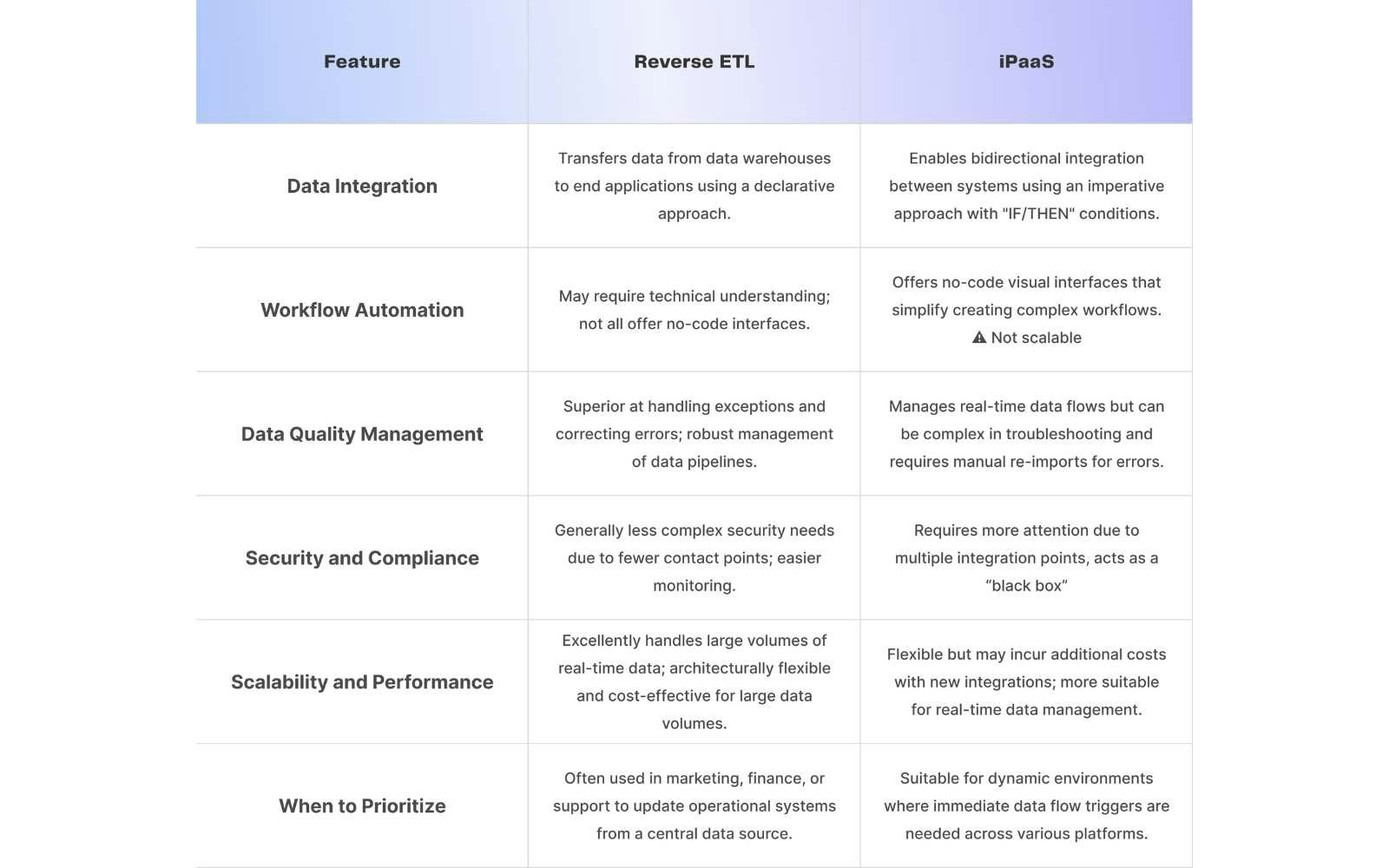
Download the definitive guide to Reverse ETL to compare activation models, use cases and tool-selection criteria.
Which use cases should you test?
Abstract requests for proposals reward long feature lists. Tests based on real scenarios reveal capabilities and limitations much more clearly.
Lapsed-customer reactivation
Build an audience of historically active customers who have not purchased recently, have valid consent and show a recognisable product affinity. Check whether the platform can exclude open complaints and synchronise the audience to several channels.
High-value customer retention
Use an RFM or customer lifetime value score to identify priority profiles. Users should be able to adjust thresholds, understand audience composition and monitor changes.
Acquisition and advertising suppression
Create a seed audience of high-value customers for lookalike modelling, followed by a suppression audience of recent purchasers. Review refresh frequency and the match-rate reporting returned by advertising platforms.
Onboarding journeys
Identify new customers who have not completed a key action within a defined period. This scenario tests event handling, time windows and automatic exit from the segment.
Predictive segmentation
Evaluate the use of churn, purchase or product-affinity probabilities. Predictive segmentation should remain explainable and directly actionable rather than replacing business controls.
How to run an effective selection process
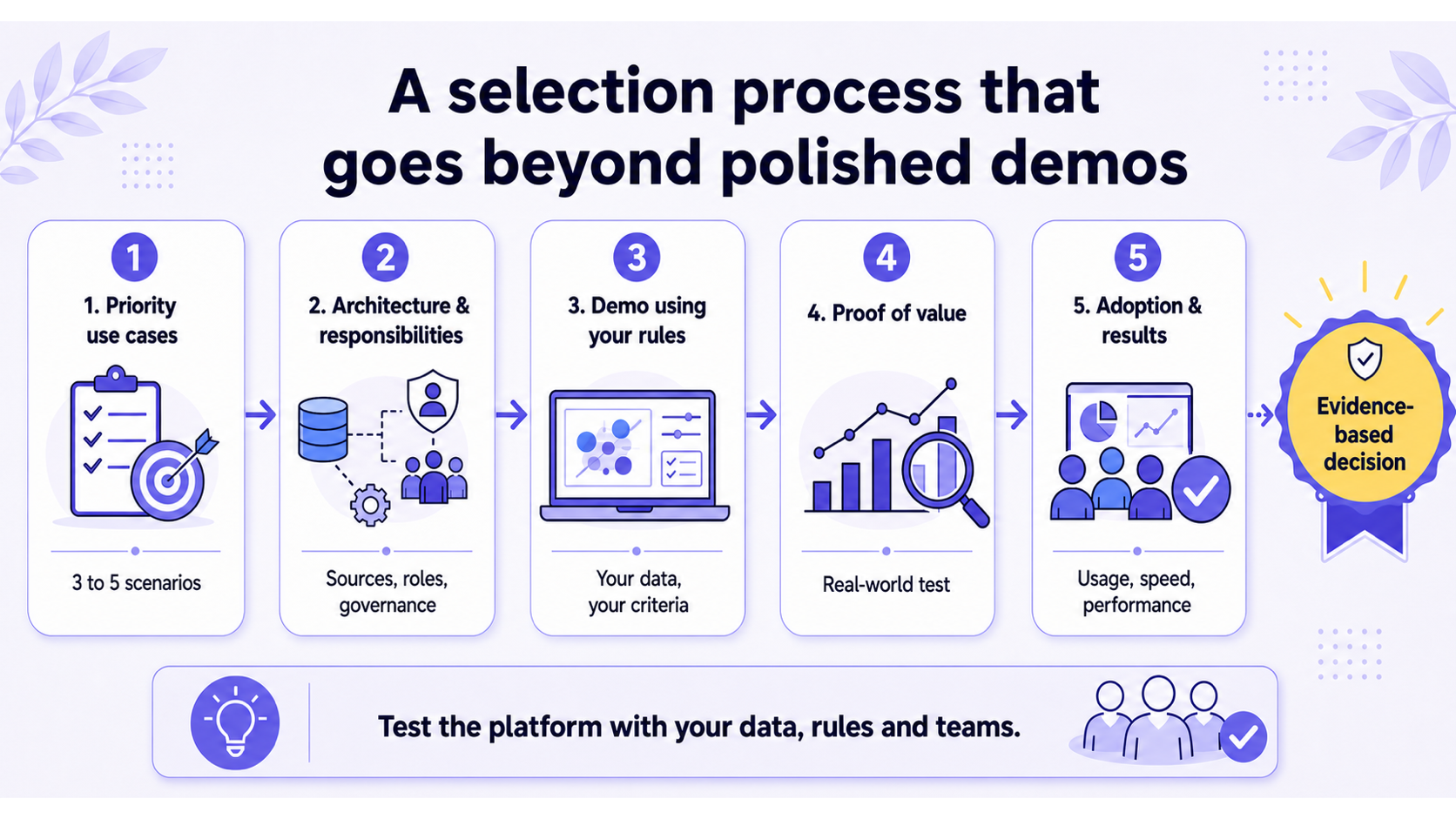
A rigorous selection process tests use cases, data and adoption in real-world conditions.
Prioritise three to five use cases
For each one, document the objective, required data, segment logic, destination, refresh frequency and success metric. These short briefs become the basis of comparison.
Map the architecture and responsibilities
Identify where data resides, who models it, who builds audiences and who approves activation. The segmentation system must fit this operating model rather than establish a competing source of truth.
Demonstrate your own rules
Give vendors two or three segment definitions. Ask them to build each segment live, explain the output and show the workflow through to a destination.
Run a proof of value
Test connection, usability, calculation, synchronisation and campaign monitoring. A short proof of value should validate the riskiest assumptions rather than imitate the entire deployment.
Measure adoption as well as performance
ROI depends on campaign outcomes, but also on fewer data-team requests, shorter launch times and the number of users who become self-sufficient.
Common mistakes to avoid
Selecting an attractive interface without testing data coverage.
Confusing the advertised number of connectors with integration depth.
Moving governed data into another repository without a clear reason.
Offering no-code access without a catalogue, permissions or shared definitions.
Creating hundreds of segments without owners or naming conventions.
Testing audience creation without verifying updates and removals in destinations.
Purchasing predictive features before stabilising data and use cases.
Turn segmentation into an operational capability
The best customer segmentation software is not the offering with the most filters. It is the platform that helps teams build reliable audiences from the right data, understand them, activate them quickly and measure their impact.
DinMo gives warehouse-centric organisations a governed route from trusted customer data to activation. Data remains in the warehouse; business teams use a no-code Segment Builder to create and preview audiences; and synchronisation workflows keep those audiences current across activation tools. DinMo connects governed warehouse data to activation without creating a second customer store.
Choose with evidence, not feature volume. Start with your highest-value use cases, test the complete data-to-activation workflow and measure both operational effort and campaign impact. To review your architecture and design a focused proof of value, contact DinMo.