

Agentic CDP: from customer data to action, with marketers in control
8min • Last updated on Sep 14, 2026


Alexandra Augusti
Chief of Staff
Repeat purchases are falling. Your team has the data, but someone still needs to identify the customers affected, examine their behaviour and prepare a relevant response. Several analyses and manual steps stand between the question and a campaign.
An agentic CDP aims to connect that work. It brings together information about customers, the operational capabilities of a Customer Data Platform and AI agents that can investigate a situation, propose a plan and help carry it out.
For marketers, the opportunity is to move more easily from an objective to a verifiable action, within a clear decision-making framework.
Key takeaways
An agentic CDP combines customer data, business context and AI agents.
Agentic capabilities concern analysis and action; composability describes architecture. A CDP can have both.
The scope can extend across audiences, activation, journeys and customer analytics.
Reliable operations depend on data quality, access permissions and appropriate approvals.
What is an agentic CDP?
An agentic CDP is a Customer Data Platform (CDP) where AI agents can draw on the available context and platform capabilities to work towards an objective. Depending on the product, they may investigate data, prepare segments or help execute marketing actions.
Agentic describes how a task is performed. An agent can select steps and tools in response to what it finds, while a workflow follows a predefined path. Anthropic’s explanation of agentic systems sets out this distinction.
Consider the request: “Find loyal customers whose purchases are slowing down.” Answering it requires a definition of loyalty, a relevant period and a comparison of purchasing behaviour. The agent should produce something the team can check, or seek clarification when a definition is missing.
Autonomy operates within an authorised scope. An agent might investigate and prepare work independently, while activation still requires approval.
In practice, an autonomous agent needs more than a language model. It needs customer intelligence it can inspect, tools it can call and a record of completed work. The agentic layer connects these elements: a model interprets the objective, the platform supplies context and native capabilities perform the approved operations. This is how autonomous workflows can be built around existing CDPs, with intelligence embedded in the platform rather than isolated in a chat window.
Traditional, composable and agentic CDPs: what changes?
Two questions help distinguish these approaches: where is customer data organised? and how do teams work with it?
A traditional CDP typically includes its own profile database. A composable CDP works with data organised in the company’s data warehouse. Agentic capabilities introduce a way of working in which certain tasks are delegated to AI agents.
Approach | What it describes | What to examine |
|---|---|---|
Traditional CDP | An integrated customer data platform | Supported data and capabilities |
Composable CDP | An architecture built around the data warehouse | Models, connections and data responsibilities |
Agentic CDP | Analysis and action performed through AI agents | Tasks the agents can perform and how they are supervised |
A composable platform can therefore be agentic. An integrated platform can also provide agentic capabilities: the label alone cannot explain its architecture.
It also helps to distinguish different uses of AI. Predictive AI estimates an outcome, such as the likelihood of churn. Generative AI produces content, such as a summary. An agent can draw on these capabilities and use tools to advance a task.
AI decisioning concerns the choice of an action against objectives and constraints. It can form part of an agentic system, without covering every task involved in exploring, preparing and managing work within the CDP.
How does an agentic CDP work?
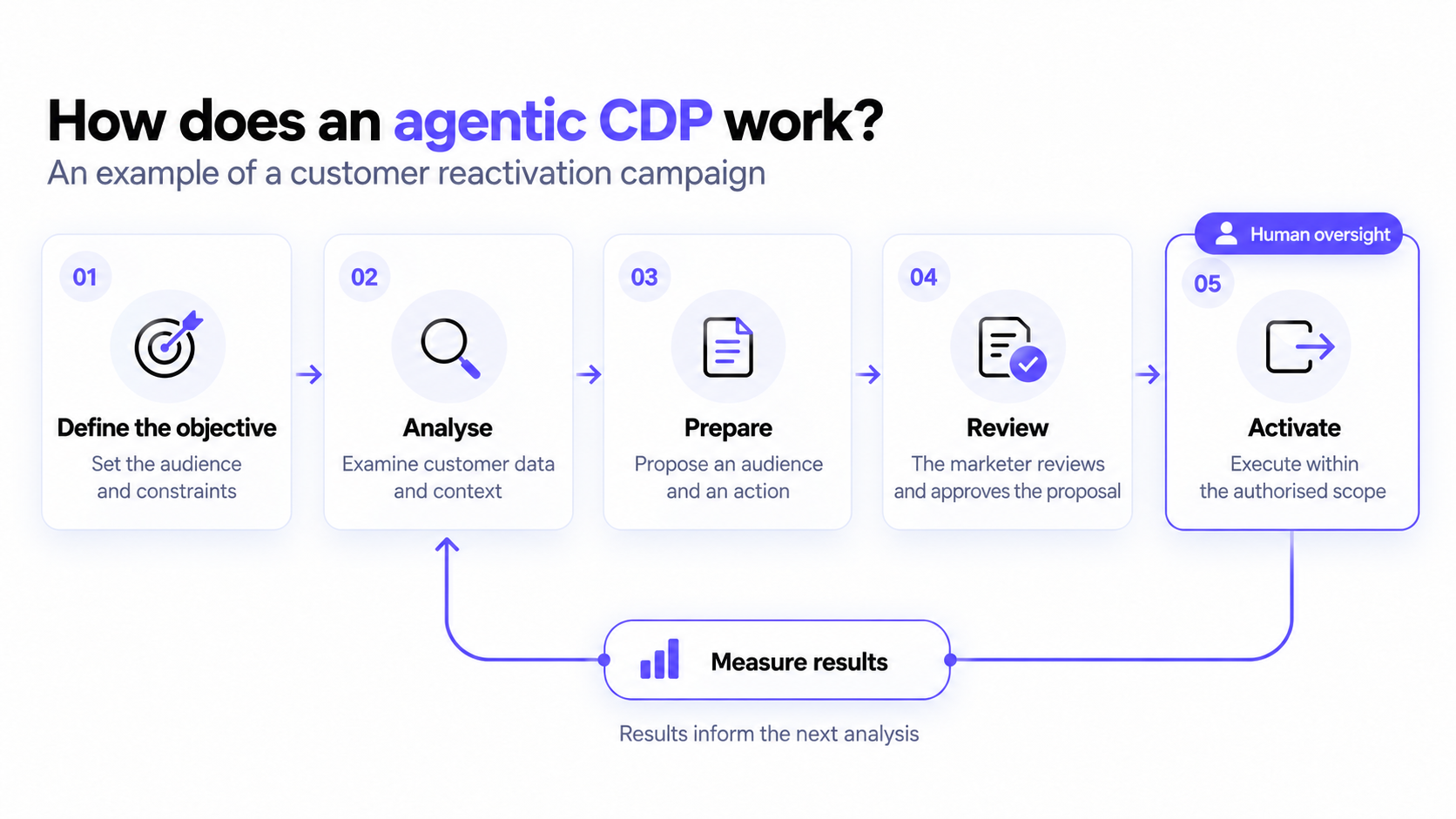
The following sequence provides a framework for evaluating a solution. Individual platforms may support different parts of it.

How does an agentic CDP work?
1. Establish the objective and context
“Improve retention” leaves too much undefined. The team needs to specify the population, period, desired result and constraints.
A more actionable request might be: “Prepare an action for customers who have purchased repeatedly but are now ordering less often, excluding anyone contacted recently.”
The agent needs access to the agreed shared definitions. An “active customer” might mean a recent buyer or someone who has signed in: the distinction changes the resulting audience.
2. Examine the relevant data
The agent investigates profiles in the warehouse, bringing together purchases, interactions, profile attributes and, where relevant, product data.
Check the comparison periods, profile freshness and exclusions. An apparent decline may reflect a delayed data load or a change in the population being measured.
3. Prepare an actionable proposal
The platform should produce more than a general explanation. For a reactivation campaign, ask for a proposal that includes segment criteria, audience size, exclusions and the suggested action.
Marketers should be able to inspect the selected profiles and understand why the agent chose those customers. If the analysis uses a predictive score, its meaning and calculation date need to be clear.
4. Review and execute
Before activation, the marketer reviews the audience, channel, schedule and stopping conditions. Checks should reflect the consequences of the action.
Creating a draft, activating an audience and sending a message are separate operations. A useful demonstration should show where each happens, which permissions it requires and who approves it.
5. Observe the results
First, separate technical completion from marketing performance. A successful synchronisation confirms that an operation completed; it cannot demonstrate additional sales.
To evaluate the campaign, agree the metric, observation period and comparison method in advance. Depending on the design, a control group can help estimate the effect of the action.
What architecture do agentic CDPs need?
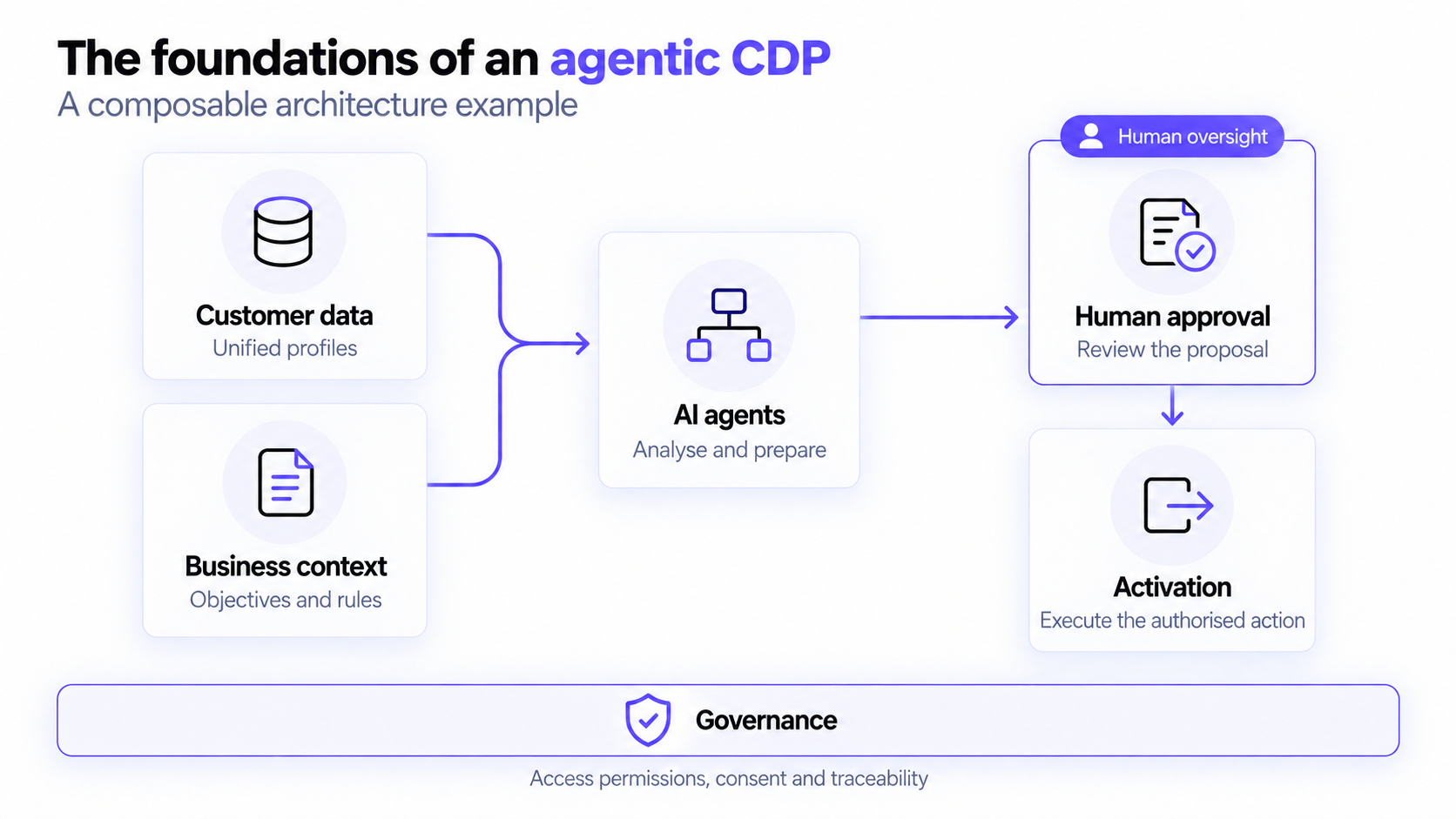
These platforms need reliable customer profiles, shared business context and connections to the tools that carry out agents’ proposals. In a composable architecture, these capabilities build on the company’s existing data warehouse.
The foundations of an agentic CDP
Unified customer profiles and reliable identity
Order systems, CRM records and website events may describe the same customer with different identifiers in the warehouse. Identity resolution connects those records so agents can work with consistent customer profiles.
Customer profiles should include purchases, interactions, preferences and engagement signals that agents need for the scenario. Data teams define matching and quality rules; marketers establish which information they need to build relevant audiences.
The data warehouse and the context layer
In a warehouse-native architecture, the warehouse provides the data foundation, with agreed models and access permissions for agents. A lakehouse can also combine analytical workloads and data processing within shared infrastructure.
A context layer gives agents business meaning: customer definitions, segment rules, campaign objectives and commercial constraints. For example, “high value” may refer to past revenue or predicted lifetime value. Those definitions can produce different audiences, so teams need a clear way to review and correct them.
Real-time data, profiles and activation
Real-time collection cannot guarantee real-time profiles or immediate activation. An event may reach the platform quickly but wait for profiles in the warehouse to refresh before the next synchronisation.
For a post-purchase journey, measure the delay between an order, the profile update and removal from the campaign. A weekly analysis of profiles can tolerate a different refresh rate from real-time campaign suppression. Marketers should set the required speed for each scenario. Comparing retention with last year, for instance, needs a consistent historical baseline rather than a real-time response.
Connectors and APIs must support the intended operation, report errors and allow recovery. Following one customer through the complete process reveals whether the activation infrastructure can carry out the proposal.
Use results to inform the next decision
A feedback loop connects audience profiles and activation with results from the warehouse, CRM or marketing platform. Record the approved action, observation period and outcome so the team can review what happened.
For example, compare the campaign audience with an appropriate control group over the same period. A comparison with last year can help reveal seasonality, but cannot replace that control. The measurement loop should retain the original profiles and action date, even when real-time updates later change audience membership.
Reading campaign results, recommending the next action and automatically changing a model are separate capabilities. Establish which capabilities agents can access and which require human approval. The distinction between observed performance and incremental impact remains essential when interpreting results. This turns campaign reporting into reusable intelligence: marketers can test a new hypothesis and compare the next result.
DinMo’s approach to an agentic CDP: analyse, act and measure
DinMo is developing an agentic CDP approach that helps marketing and data teams analyse, act and measure. Starting with a objective, such as understanding a decline in repeat purchases, the ambition is to connect customer understanding with a decision, a usable audience and a measurable action.
Reliable records and business context provide the foundation. The warehouse remains the central source of information. Definitions of an active customer, an eligible purchase or a relevant audience retain their meaning as agents move from analysis through to activation.
Analyse: explore customer records, compare groups and identify opportunities through verifiable calculations.
Act: turn findings into an audience and action plan, then prepare activation through connected tools. Marketers review and refine agents’ proposals before approval.
Measure: connect actions with available results to understand what changed and inform the next decision.

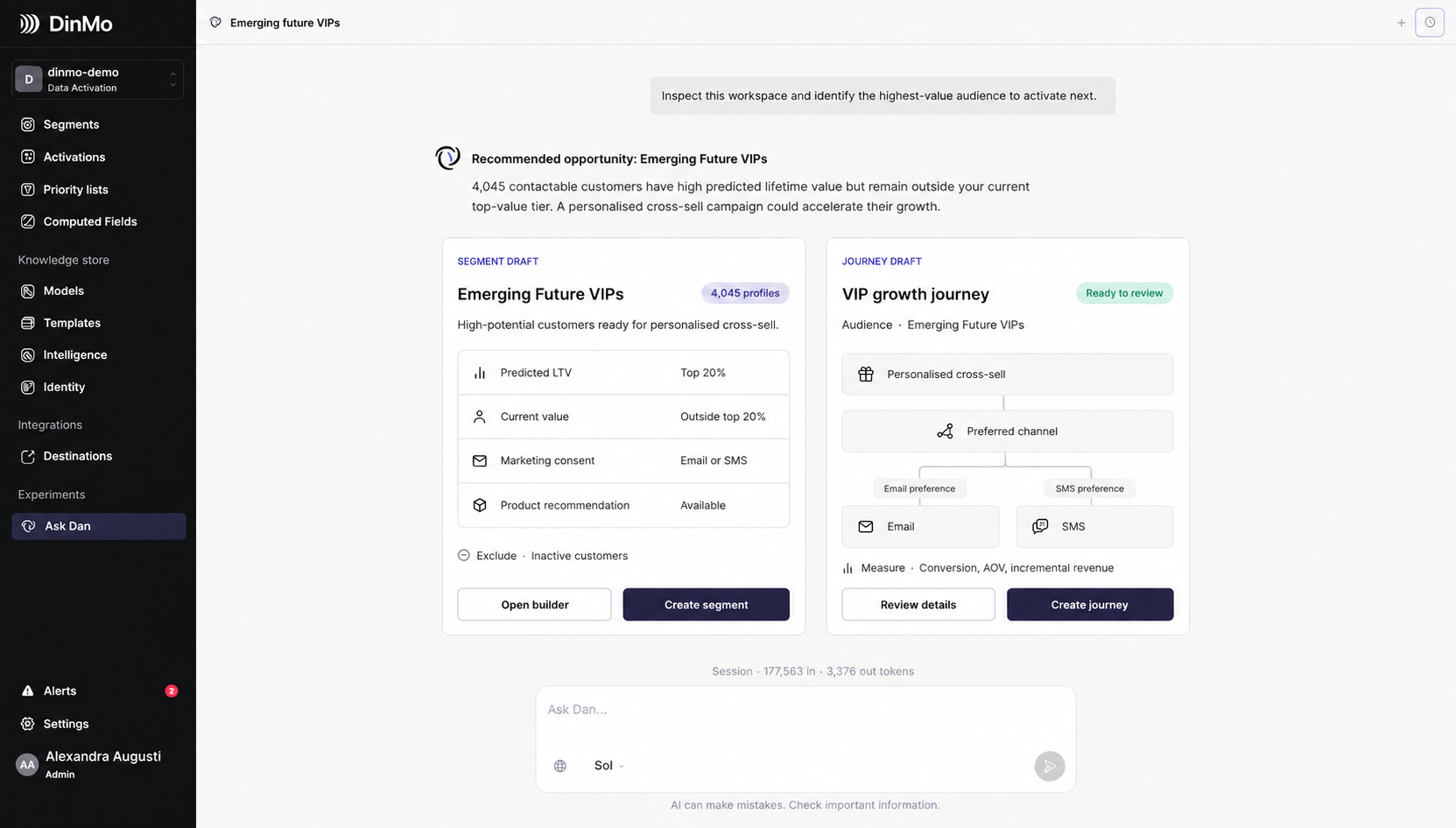
DinMo demo workspace: an audience and journey proposed for review. The displayed metrics have yet to be measured.
For reactivation, these findings can inform the audience, timing, channel and whether to include a discount code. DinMo prepares the required data and parameters and can trigger an action in a connected tool. Message creation and delivery remain within that tool.
This vision develops through concrete scenarios, with operating rules, permissions and human control governing decisions.
How should governance work in an agentic CDP?
Agentic capabilities may be embedded in a CDP or connected through an external agent. In both cases, permissions must follow the user: an autonomous agent should only access authorised profiles and operations. Native controls make proposals reviewable within the platform, while API access needs the same identity and approval boundaries.
Governance should cover both information and actions. An agent investigating engagement does not necessarily need access to every profile attribute or permission to change marketing destinations.
Assign rights by role and task: reading data, preparing segments, configuring journeys and activating campaigns. Those rules should apply to agents as well as human users. A campaign aimed at the whole customer base warrants checks that reflect its scale.
Customer preferences and consent should be available during audience selection and checked before activation against the organisation's rules. A suppression recorded in one system but missing from the data an agent uses can undermine the proposal.
Also examine the data flows to AI models. Which information reaches a model, for what operation and with what audit trail? Cloud infrastructure and warehouse storage do not, by themselves, answer those questions.
Governance also needs an owner and a stopping procedure. Marketers should be able to pause campaigns, trace decisions and correct the relevant rules. For recurring campaigns, record which profiles were eligible at each activation and keep that history available for the measurement loop.
What benefits should marketing teams look for?
Less manual work: reduce the steps between a question, customer analysis and an audience ready for activation.
Consistent context: reuse the same shared definitions across analysis, segments and actions, helping marketing and data teams work together.
Better-informed decisions: compare opportunities and results to choose the next action using evidence the team can check.
Evaluate these benefits in a pilot: time saved, corrections needed and decision quality, without assuming a particular revenue gain.
Three use cases for agentic CDPs
The following scenarios illustrate possible ways of working. They are neither customer results nor a list of guaranteed product capabilities.
Reactivating customers whose purchases are slowing
A retailer asks an agentic CDP to identify regular buyers whose purchasing activity has declined. Agents compare customer profiles against usual buying patterns to prepare a relevant follow-up.
From question to decision
Business question: Which regular customers are buying less often than usual?
Analysis: Compare recent purchase frequency with each customer’s history, using comparable periods and accounting for seasonality.
Decision: Prepare an audience and a follow-up proposal — channel, timing and whether to include an offer — for approval. Exclude customers who have already purchased again, were recently contacted or are ineligible for the selected channel.
Measurement: Track resumed purchasing over a defined period and compare with a control group to assess incremental impact.
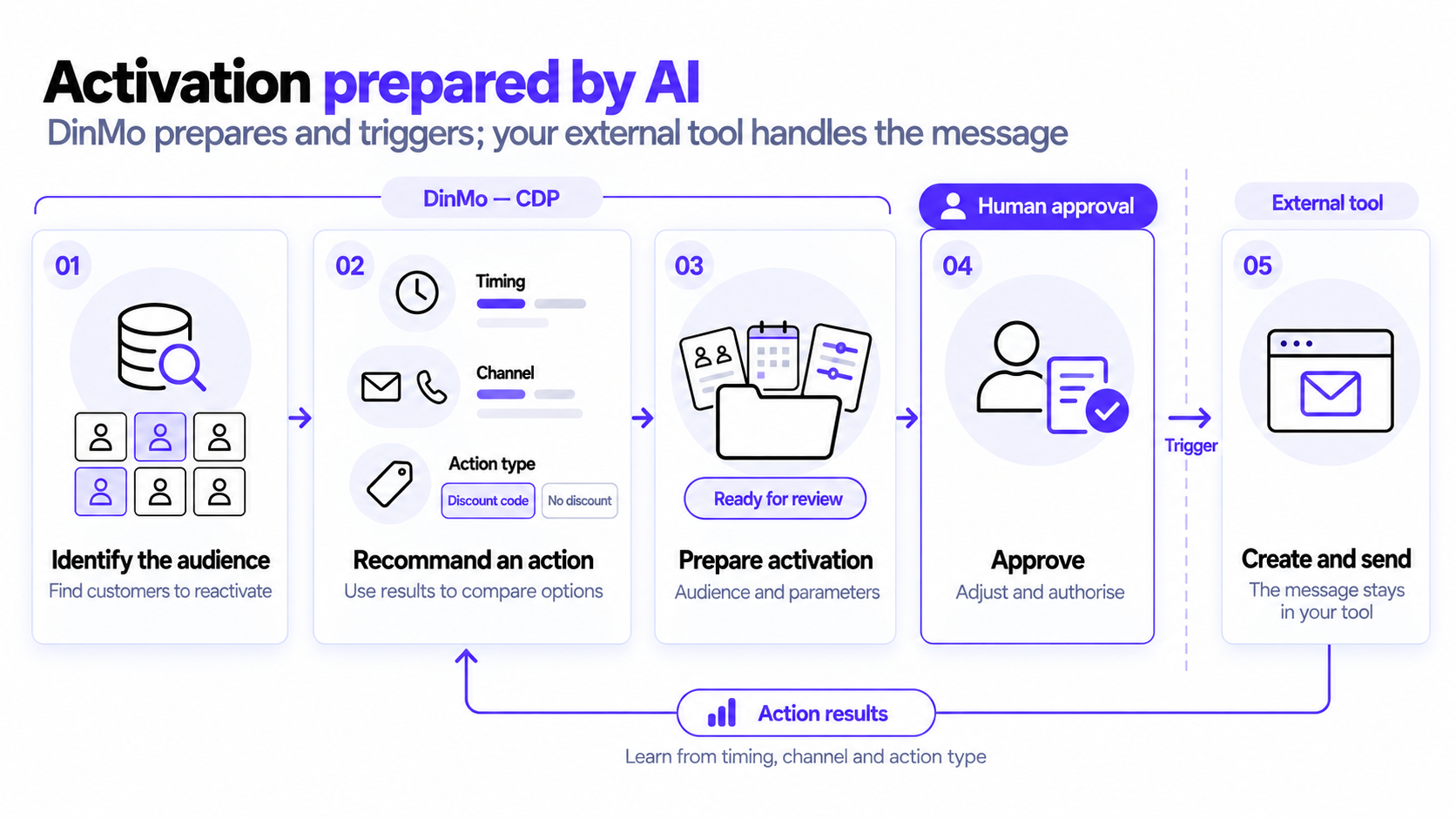
Activation prepared by AI
Preparing a cross-selling campaign
A brand uses an agentic CDP to identify profiles suited to complementary products. Agents use purchasing history and product information to prepare an audience for marketers.
From question to decision
Business question: Which customers might be interested in a category that complements their previous purchases?
Analysis: Examine purchasing patterns and customer preferences, then check product availability and margin.
Decision: Prepare an audience, offer and channel for approval, excluding customers who already own the relevant product or are ineligible. The connected tool handles message creation and delivery.
Measurement: Track purchases in the recommended category and the margin generated, then compare with a control group to distinguish additional sales from purchases that would have happened without the action.
Reviewing a journey before activation
A CRM manager asks an agent to check a follow-up after a first purchase. The agentic CDP prepares audience rules; marketers review the campaign before activation in their marketing automation tool.
From question to decision
Business question: Will the right customers enter the journey and leave as soon as they make another purchase?
Analysis: Check entry criteria, delays, consent and profile freshness. In particular, test what happens when a customer purchases again before the follow-up.
Decision: Prepare audience and exclusion rules for approval, then verify that the connected tool applies them correctly before activation. Message creation and delivery remain within that tool.
Measurement: Monitor journey entries and exits, update delays and follow-ups sent after a repeat purchase. Assess the second-purchase rate separately and compare it with a control group.
What should you check when comparing agentic platforms?
Evaluate an agentic CDP using a scenario that reflects your business. Compare platforms on completed work: a fluent conversation alone cannot demonstrate that the task will be completed correctly.
Ask how the agentic workflow is built into the platform. Can marketers inspect the profiles behind an audience, reopen an analysis and reuse the approved result? Native audiences should remain editable outside a conversation. If an external agent uses an API, it should create the same usable objects rather than leaving a campaign plan inside a chat. Platforms built for this workflow should preserve the link between analysis, profiles and activation, whether intelligence is embedded or accessed through an API.
Criterion | Question to ask during the demonstration |
|---|---|
Business context | Which definition of a “loyal customer” does the agent use? |
Data | Can the team check sources, filters and time periods? |
Output | Does it produce an explanation, a draft or a usable object? |
Permissions | Which operations are unavailable to this user role? |
Approval | Where does the team authorise activation? |
Monitoring | How can the team find execution results and errors? |
Include an ambiguous request and a task with missing information. A useful solution should make its limits visible: clarify a missing definition, report unavailable data or stop an operation it cannot complete.
Finally, compare the total effort: initial configuration, preparation, review time and maintenance. Faster audience creation may offer little benefit if frequent corrections are required.
How to get started with an agentic CDP
Start with a narrow objective and document the current process so you can assess what the agentic CDP changes.
To structure the first pilot:
Define the expected result: a documented audience with criteria and exclusions.
Check the available data: identifiers, transactions, time periods and operating rules.
Assign responsibilities: preparation, review, approval and monitoring.
Test edge cases: missing data, ambiguous requests and empty audiences.
Measure effort and quality: total time to approval, corrections and errors detected.
Connect marketing intent to a verifiable action
An agentic CDP brings data exploration, audience preparation and marketing operations closer together. Its value should be judged through a concrete result: a relevant, understandable action that is correctly executed.
For your next project, start with a question the team already handles. Examine what the agent can take on, which outputs it produces and which decisions still require approval.
Want to explore what an agentic CDP could bring to your team?
Practical questions about agentic CDPs
Can you keep your existing data warehouse with an Agentic CDP?
Can you keep your existing data warehouse with an Agentic CDP?
Yes. With a composable agentic CDP such as DinMo, you can keep your existing data warehouse as your central source of customer data. The customer profiles, purchase histories and interactions it holds provide the context AI agents need to analyse behaviour, identify audiences and prepare recommendations. The agentic layer builds on your existing data foundation.
Do agentic CDPs require real-time customer profiles?
Do agentic CDPs require real-time customer profiles?
Not every task needs real-time profiles. A weekly analysis can use scheduled data refreshes, while removing a customer from a campaign after a purchase requires a shorter delay. Set an acceptable response time for each use case and test the complete path through to the connected tool.
How do autonomous agents differ from decisioning models?
How do autonomous agents differ from decisioning models?
A decisioning model helps choose between eligible options, such as an offer or channel. An autonomous agent can also investigate a request, select tools and prepare the steps needed to act. It may use a decisioning model as part of that work, within the organisation’s rules and approval requirements.