


Marketing pressure: how to balance growth and customer experience
8min • Last updated on Jun 30, 2026


Alexandra Augusti
Chief of Staff
Marketing teams have never had so many ways to reach customers. Email, SMS, push notifications, paid media, retargeting, CRM journeys, in-app messages and sales outreach can all be used to drive engagement.
That is a major opportunity for marketing strategies. It is also a risk.
When several campaigns target the same customer at the same time, the experience can quickly become overwhelming. A message that looks relevant in isolation may feel excessive when combined with five other communications during the same week.
This is why marketing pressure has become a key topic for CRM, retention, acquisition and data teams.
The objective is not simply to send fewer messages. It is to send the right messages, to the right customers, on the right channels, at the right frequency.
Key takeaways
Marketing pressure refers to the number of marketing touchpoints a customer or prospect receives over a given period, across all channels.
Excessive marketing pressure can damage customer experience, reduce engagement, increase unsubscribes and affect email deliverability.
The right contact frequency depends on the industry, the buying cycle, the channel, the level of engagement and the customer lifecycle stage.
A CDP helps teams centralise customer data, detect overexposed profiles and orchestrate activation rules across channels.
What is marketing pressure?
Marketing pressure refers to the volume and frequency of marketing communications received by a customer or prospect over a given period.
It can include:
marketing emails
SMS campaigns
push notifications
paid ads
retargeting campaigns
CRM messages
loyalty communications
sales follow-ups
product recommendations
in-app messages
For example, a customer may receive a newsletter, a basket abandonment email, a promotional SMS, two retargeting ads and a push notification within a few days.
Each campaign may have a valid business objective. But from the customer’s point of view, the overall experience can feel repetitive or intrusive.
This is why marketing pressure should be measured at customer level, not only at campaign level.

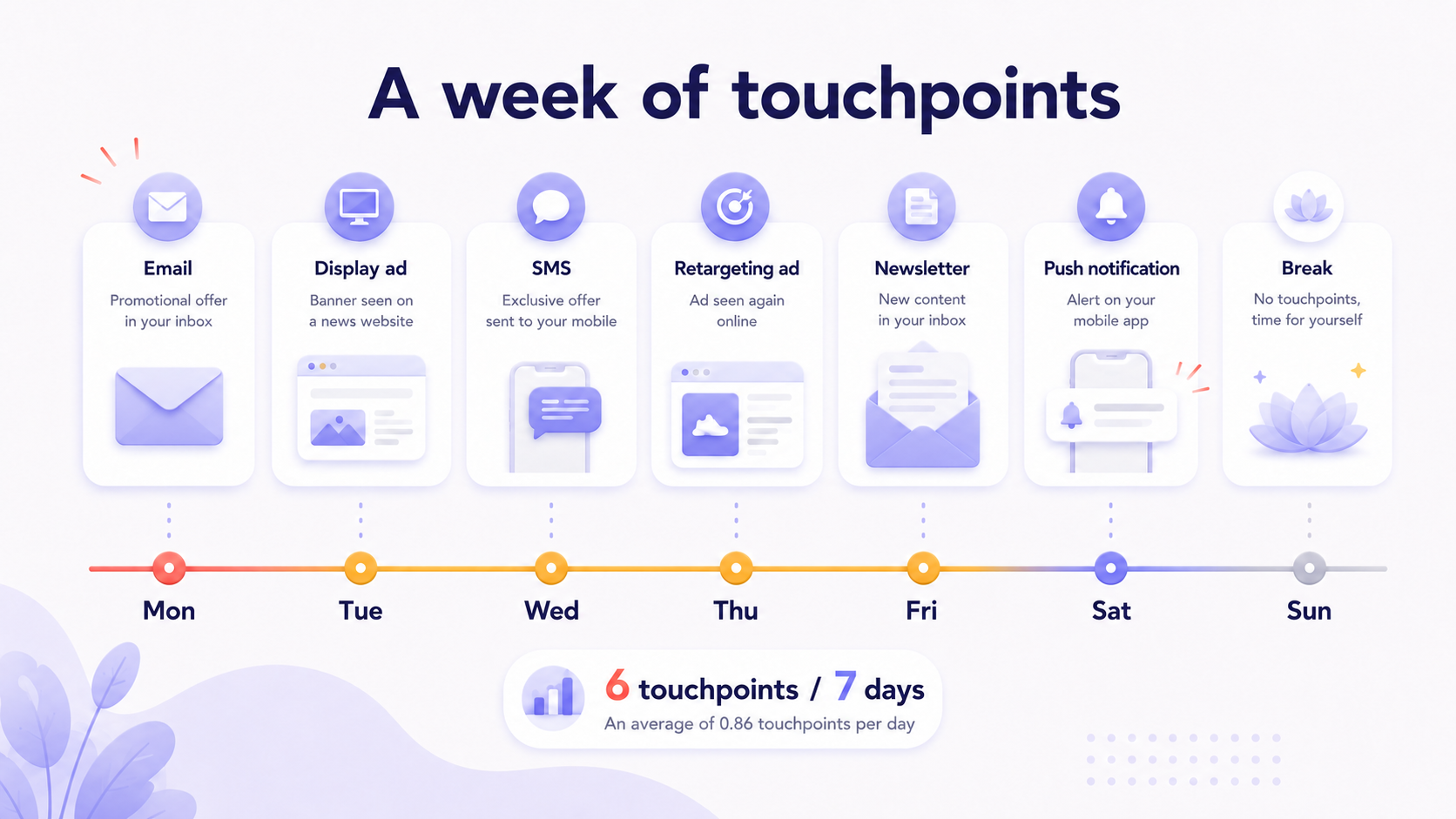
A week of customer touchpoints
Why does marketing pressure matter?
Customers are exposed to more messages than ever
Consumers are constantly exposed to marketing messages across digital channels. As a result, attention has become scarce.
Increasing communication frequency may generate short-term results, but it can also create fatigue. Customers may stop opening emails, ignore ads, disable push notifications, unsubscribe or mark messages as spam.
In the long run, excessive marketing pressure reduces the effectiveness of the entire customer relationship.
Marketing teams often work in silos
In many organisations, marketing channels are managed by different teams or tools. The CRM team sends newsletters, the acquisition team runs paid campaigns, the e-commerce team launches promotional journeys, and the sales team sends follow-up messages.
Each team optimises its own campaign. But the customer experiences all these messages together.
Without a shared view of customer exposure, brands can easily over-contact the same profiles.
Personalisation raises expectations
Customers are more tolerant of frequent communication when messages are useful, relevant and timely. They are much less tolerant when messages feel generic or disconnected from their context.
This means that frequency cannot be managed separately from relevance. A highly relevant message may be welcome. A generic message sent at the wrong moment can increase fatigue.
How to calculate marketing pressure
The simplest way to calculate marketing pressure is to count the number of communications received by a person over a given period.
Marketing pressure = number of touchpoints received by an individual over a defined period
The period can be a day, a week, a month or a campaign cycle. The right period depends on your business model and customer journey.
For example:
6 marketing emails in 7 days
3 SMS messages in 10 days
12 paid retargeting impressions in 48 hours
1 email, 1 SMS, 1 push notification and 4 ads in the same week
The most useful measurement is usually cross-channel. A customer does not distinguish between internal teams. They experience all touchpoints as one relationship with the brand.
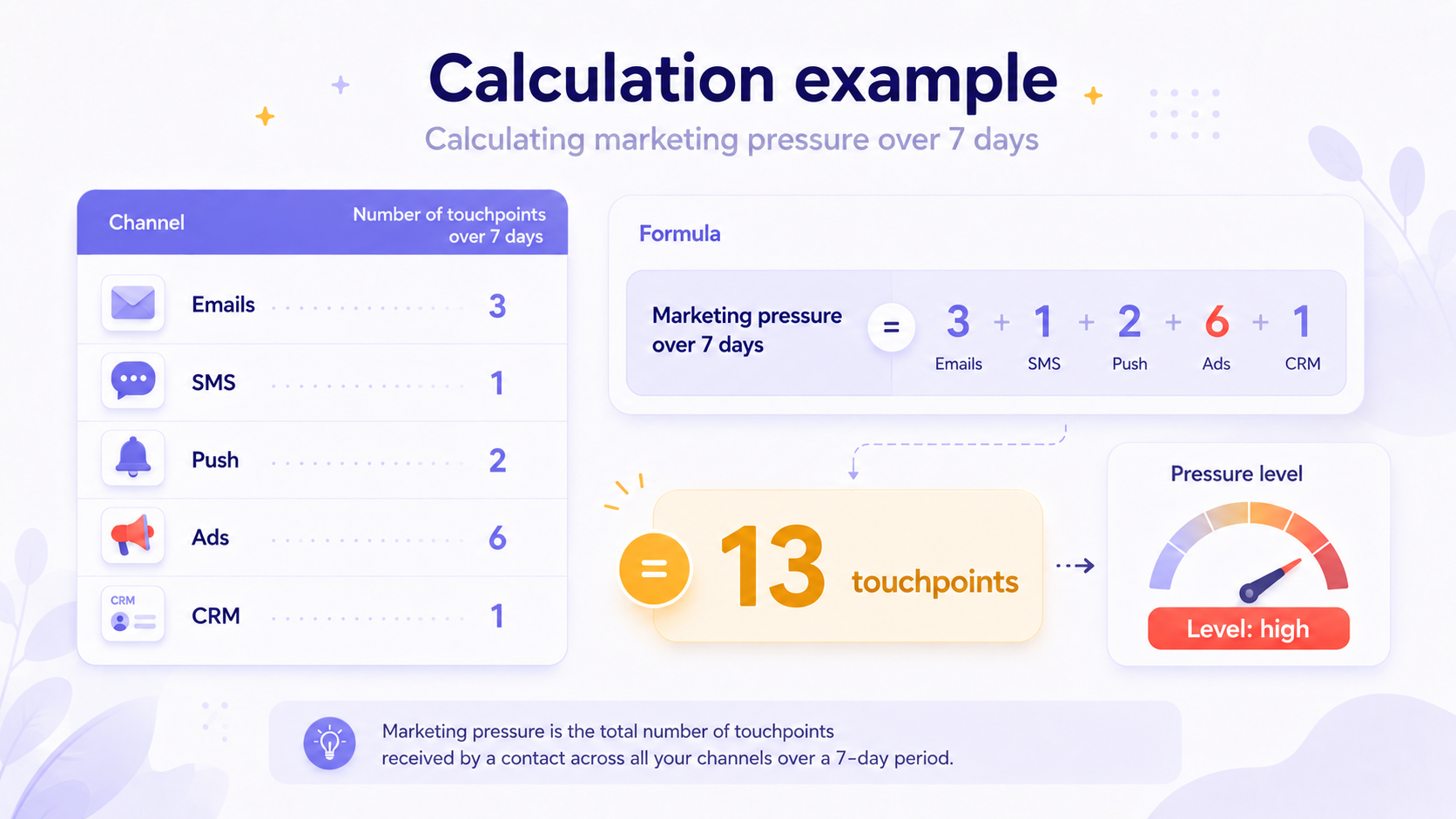
The different ways to measure marketing pressure
Measure pressure by channel
The first level is to measure frequency by channel. This helps teams understand whether email, SMS, push or paid media is creating too much exposure.
For example, a brand may decide that a customer should receive no more than three promotional emails per week or one SMS every ten days.
Measure exposure by segment
Not every audience should receive the same number of messages. A highly engaged customer may accept more frequent communication than a dormant customer.
Useful segments include:
new leads
first-time buyers
active customers
VIP customers
inactive customers
churn-risk customers
high-intent visitors
low-engagement users
customers with recent purchases
Measure cumulative pressure
The most advanced approach is to measure cumulative pressure across all channels. This creates a customer-level view of total exposure.
For example, a profile may be considered overexposed if they receive more than eight touchpoints across email, SMS, push and paid media in seven days.
This view is harder to build, but it is much more representative of the real customer experience.
What are the risks of excessive marketing pressure?
Lower engagement
When customers are contacted too often, they may stop paying attention. Open rates, click rates and conversion rates can decline even if campaign volume increases.
This often creates a negative loop: performance drops, so teams send more messages, which increases fatigue further.
More unsubscribes
Excessive pressure can lead customers to unsubscribe from email, opt out of SMS or disable push notifications.
Once a customer has opted out, the brand loses a valuable relationship channel. Reducing pressure is therefore not only an experience topic. It is also a retention topic.
Poorer deliverability
If too many recipients ignore emails, delete them without opening or mark them as spam, email deliverability can suffer.
This can affect future campaigns, even those that are relevant and well targeted. Managing marketing pressure helps protect sender reputation.
Lower customer lifetime value
Over-communication can harm long-term customer relationships. A customer may still buy once, but feel less attached to the brand over time.
For retention and loyalty teams, this is critical. The objective is not to maximise short-term campaign volume. It is to build durable engagement.
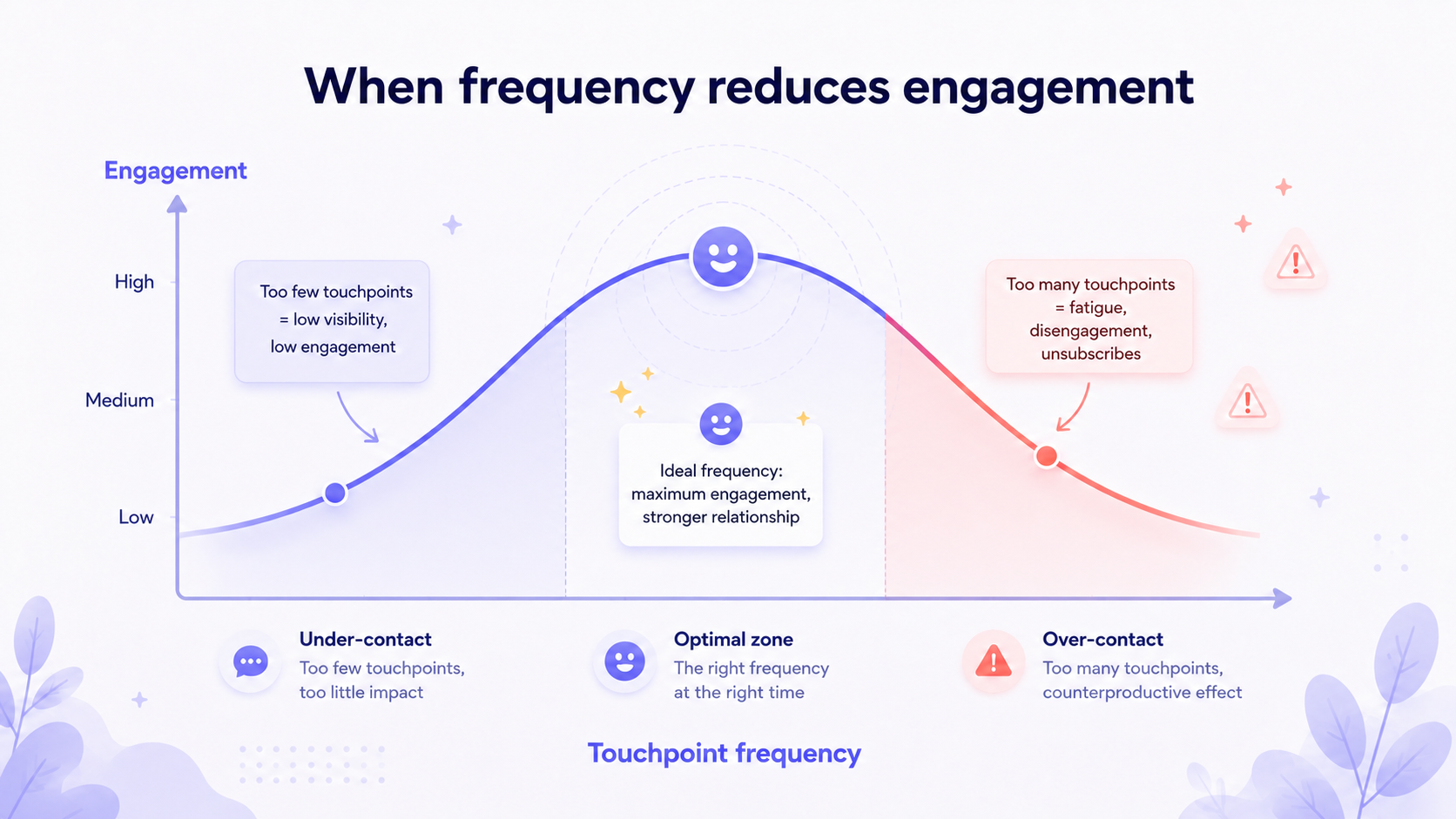
When frequency reduces engagement
How to define the right level of marketing pressure
There is no universal threshold. The right level depends on several factors.
The industry matters. A media brand may contact users daily, while a luxury brand may need a more selective rhythm.
The channel also matters. Customers may accept more emails than SMS messages because SMS is perceived as more intrusive.
The customer lifecycle stage matters too. A new lead, a recent buyer and an inactive customer should not receive the same volume of communication.
The best approach is to combine business rules, customer behaviour and performance data.
A good contact policy should define:
maximum frequency by channel
maximum cumulative exposure
priority rules between campaigns
suppression rules
cooldown periods after purchases or complaints
exceptions for transactional messages
rules by segment and lifecycle stage
Best practices to reduce marketing pressure without reducing performance
Build a contact policy
A contact policy defines how often a brand can contact a customer, through which channels and in which situations.
It should be shared across CRM, acquisition, e-commerce, sales and customer success teams.
Prioritise campaigns
Not all campaigns have the same value. Some messages are strategic. Others are secondary.
When a customer is eligible for several campaigns at the same time, priority rules help decide which message should be sent first.
Create suppression rules
Suppression rules prevent customers from receiving irrelevant or excessive messages.
For example, a customer who has just purchased a product should not immediately receive an acquisition message promoting the same product.
Move from campaign logic to customer logic
Traditional campaign management starts from the campaign: who should receive this message?
Customer-centric orchestration starts from the customer: what is the best next message for this person, if any?
This shift is essential to reduce unnecessary communication while improving relevance.
Build a fatigue score
A fatigue score combines signals such as recent exposure, declining engagement, unsubscribes, complaints and inactivity.
It can help teams identify customers who should receive fewer messages or be temporarily excluded from certain campaigns.
Adapt frequency to the lifecycle stage
A new lead may need educational content. A loyal customer may expect personalised recommendations. An inactive customer may need fewer but stronger messages.
Frequency should evolve with the customer relationship.
The role of a CDP in managing marketing pressure
A CDP helps marketing teams manage pressure by centralising customer data, contact history, consent, preferences and engagement signals.
Instead of managing frequency separately in each tool, teams can build a shared view of customer exposure.
With a CDP, marketers can:
identify customers who are overexposed
create suppression audiences
orchestrate journeys across channels
prioritise campaigns
activate fatigue scores
respect consent and communication preferences
synchronise rules with email, SMS, advertising and CRM platforms
This is especially important in complex marketing stacks. When customer data is fragmented across tools, it is difficult to understand total exposure.
A CDP provides the foundation for better orchestration. It does not replace marketing strategy, but it makes it easier to apply rules consistently.
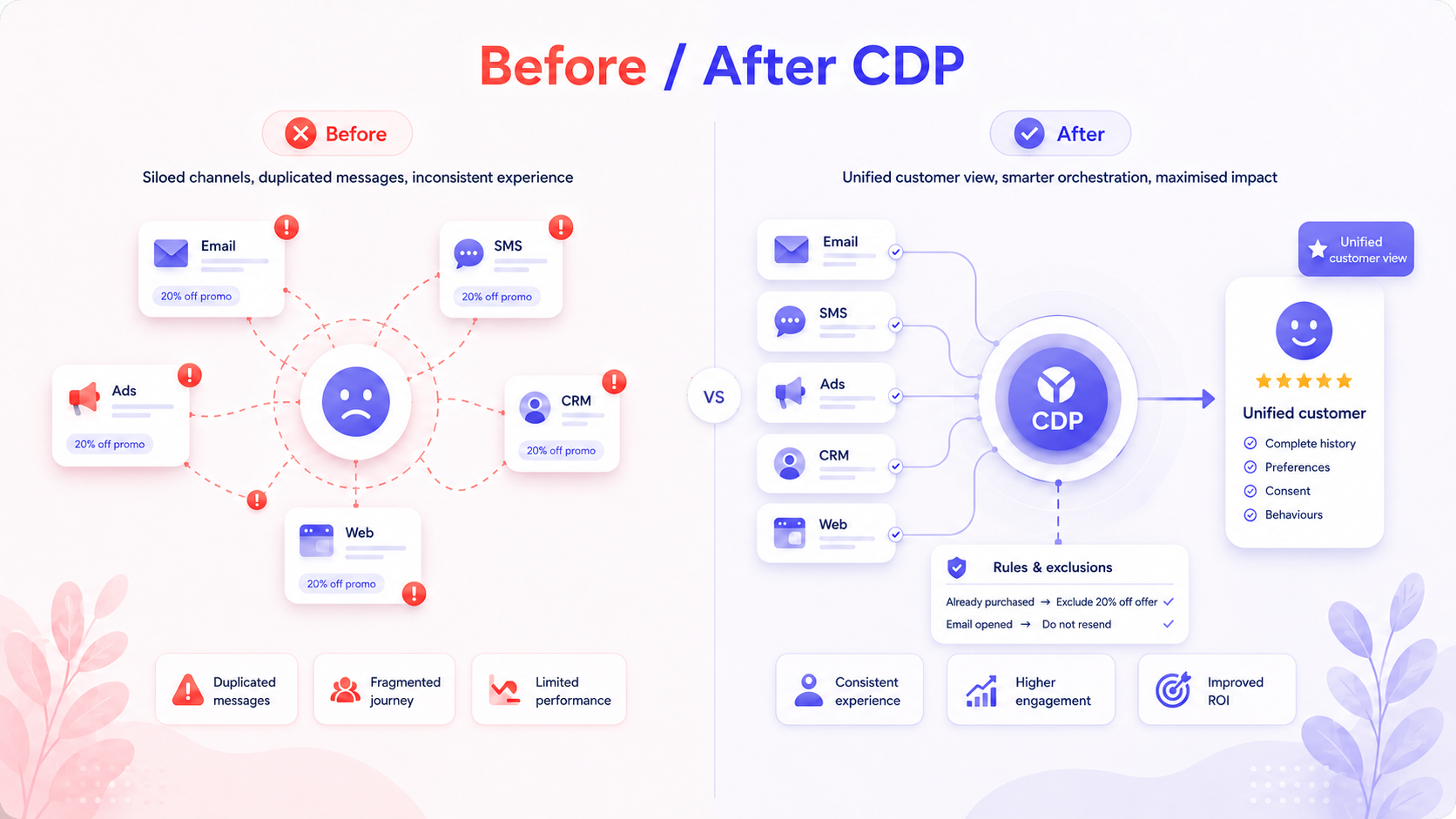
Before and after CDP orchestration
Practical examples of marketing pressure management
An e-commerce brand can exclude recent buyers from acquisition campaigns for seven days after purchase.
A retail brand can limit promotional SMS to one message per customer every two weeks, while allowing transactional messages at any time.
A B2B company can reduce email frequency for leads who have not opened the last five campaigns, then prioritise high-value content instead of generic newsletters.
A media company can adapt push notification frequency based on reading habits and recent engagement.
In each case, the objective is the same in data marketing: protect the customer relationship while improving marketing efficiency.
Conclusion
Marketing pressure is not only a question of volume. It is a question of customer experience, relevance and orchestration.
Sending more messages does not always create more performance. In many cases, better prioritisation, stronger segmentation and clearer frequency rules produce better results.
The challenge is to understand how many messages each customer receives, across which channels, and with what level of engagement.
Brands that manage marketing pressure effectively can reduce fatigue, protect deliverability and build stronger long-term relationships.
A CDP makes this easier by centralising customer data and enabling consistent activation rules across the marketing stack.