

Marketing Doesn’t Need More Channels. It Needs Better Decisions.
8min • Last updated on Feb 19, 2026


Oussama Ghanmi
Founder, CEO, and CPO
Most of what we call “AI marketing” today is still just fancy plumbing.
We automate exports, orchestrate triggers, add another layer of scoring, wrap it with a nicer UI — and hope that somewhere inside all this machinery, intelligence will emerge. But the truth is simple: the next generation of marketing won’t be built on campaigns. It will be built on systems that can decide.
For years, we believed a reassuring story.
If we could centralize our data, build a Customer 360, plug in a CDP, and connect the right channels, the outcomes would follow. Personalization would scale. Retention would improve. AI would finally have something to “work with”.
Fast-forward to today.
Most companies now have a modern warehouse. Many have a CDP layered on top. Almost everyone has a stack that keeps growing — new channels, new journeys, new tools. And yet one question remains surprisingly hard to answer:
“Given everything we know about this person, what should we do next — right now — and what is the expected impact?”
This is no longer a data collection problem. It’s not a tooling problem either.
It’s a decision problem.
That gap — between tracking everything and deciding intelligently — is where modern marketing stalls. And as AI becomes embedded in every part of the stack, that gap becomes impossible to ignore.
AI doesn’t expose weak data. It exposes weak decision systems.
And that’s exactly where the shift begins.
👇

Setting up your Modern Marketing Stack
The First-Gen CDP Hangover
Let’s be honest for a second.
First-generation CDPs solved real pains:
They made it easier to get events out of websites and apps.
They gave marketers a UI to build segments without waiting for engineering.
They shipped connectors so you didn’t have to brief a developer for every new sync.
But we also inherited a lot of baggage:
Yet another copy of the data: Data already lives in Snowflake, BigQuery, Databricks… and then again inside the CDP. Two schemas, two governance models, two sets of bugs.
Profiles as a product, not an outcome: We obsessed about stitching identities and filling tables, then struggled to prove that a “richer profile” actually moved revenue, LTV or margin.
Campaign-first, decision-last: Most of the work happens in journey builders, not in the logic that decides if we should talk to a customer, how, about what, and why now.
AI as a feature, not a fabric: Scoring and recommendations live in a corner of the tool, disconnected from most decisions. A model that doesn’t shape decisions might as well not exist.
It worked when channels were simple, cookies still powered half the ecosystem, and “personalization” meant adding a first name in the subject line.
It doesn’t work in a world where:
The warehouse is already the system of record for customer data.
Privacy, consent and governance live closer to data teams than to martech.
AI agents start to decide how budgets, content and touchpoints are allocated.
The stack evolved. The operating model didn’t.
The Warehouse Changed the Game. AI Finished It.
The moment your company chose Snowflake, BigQuery or Databricks as its analytical backbone, something fundamental happened:
The “source of truth” for customers stopped being a SaaS tool and became a data platform.
That’s not a slogan. It has consequences:
Identity graphs can be built and governed centrally.
Events can be modelled once and reused everywhere.
Customer and product data can live under the same logic and access controls.
Predictions can be trained and served next to the data, not off CSV exports.
👉 Now add AI.
AI — especially agents — doesn’t need another UI. It needs:
Consistent, queryable context. All transactions, behaviours, products, content.
Clear objectives and constraints. Margin targets, frequency caps, legal rules.
A reliable way to act. Connectors to channels that actually execute decisions.
A feedback loop. Outcomes logged back against the original decision.
A CDP that owns its own data store fights against this reality.
A warehouse-native, composable CDP works with it.
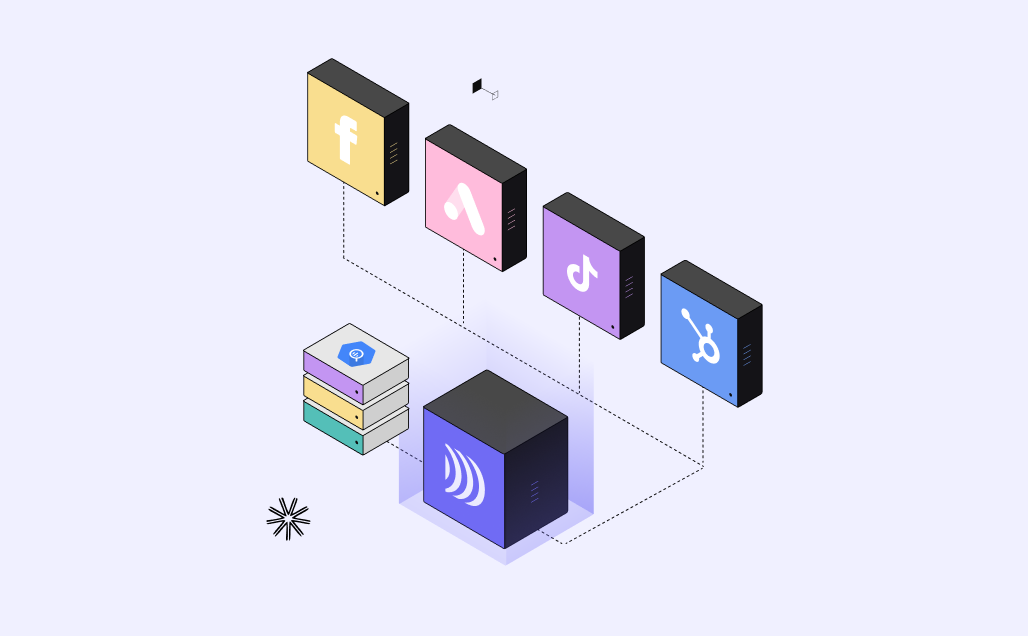
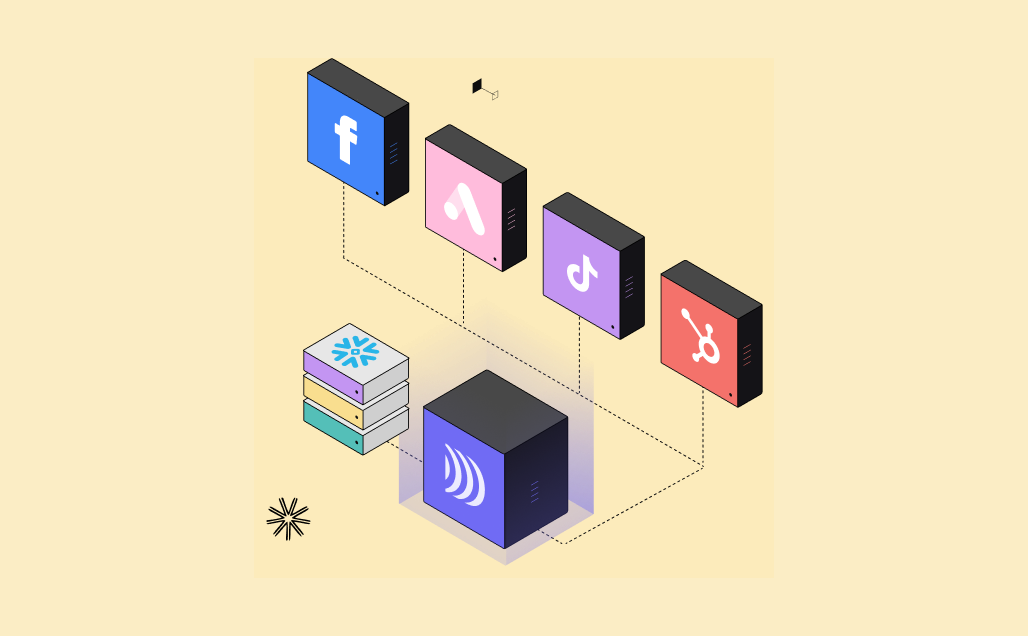
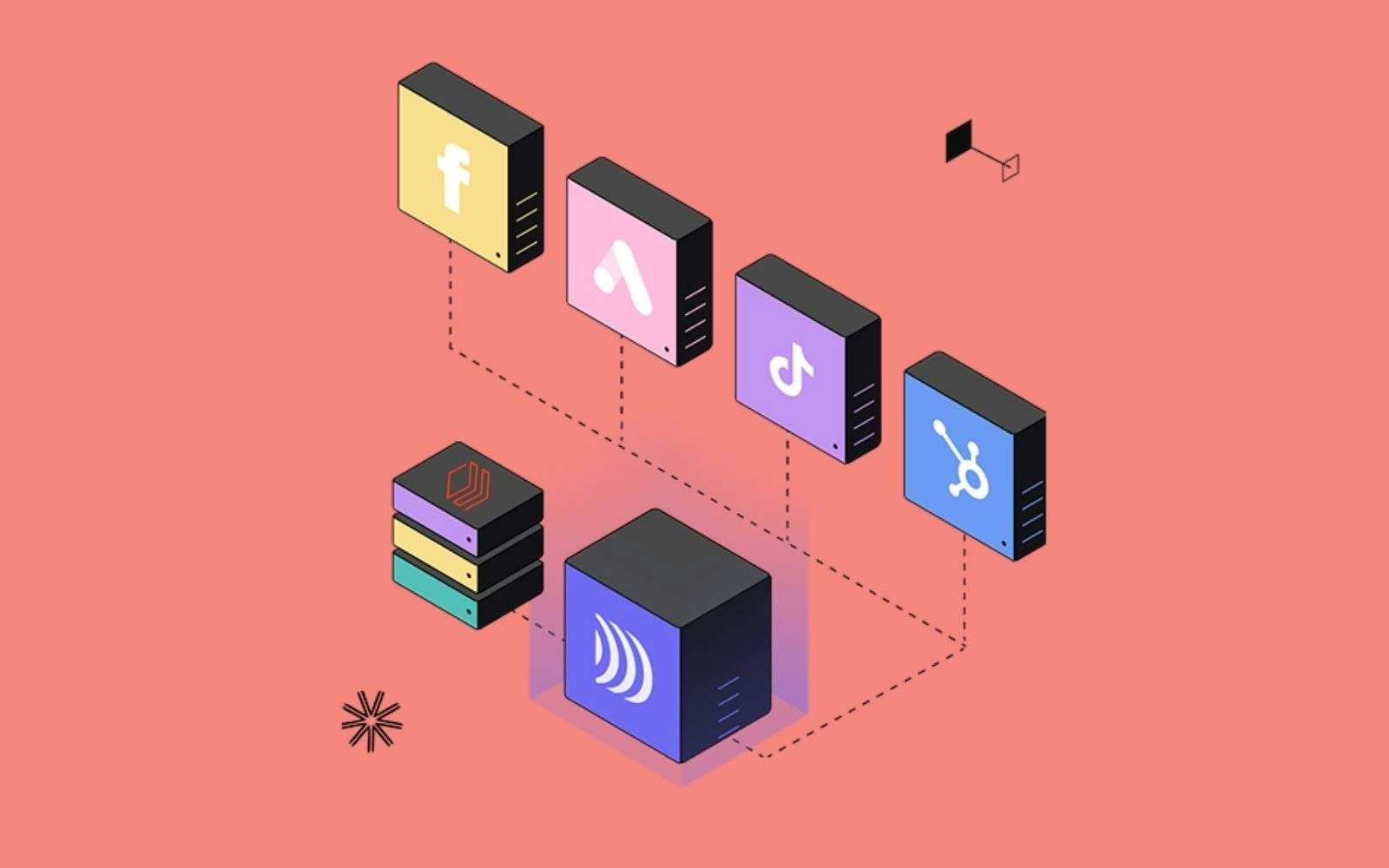
That’s the bet we’re making at DinMo: the warehouse is your data layer; the CDP becomes the decision + activation layer built on top of it.

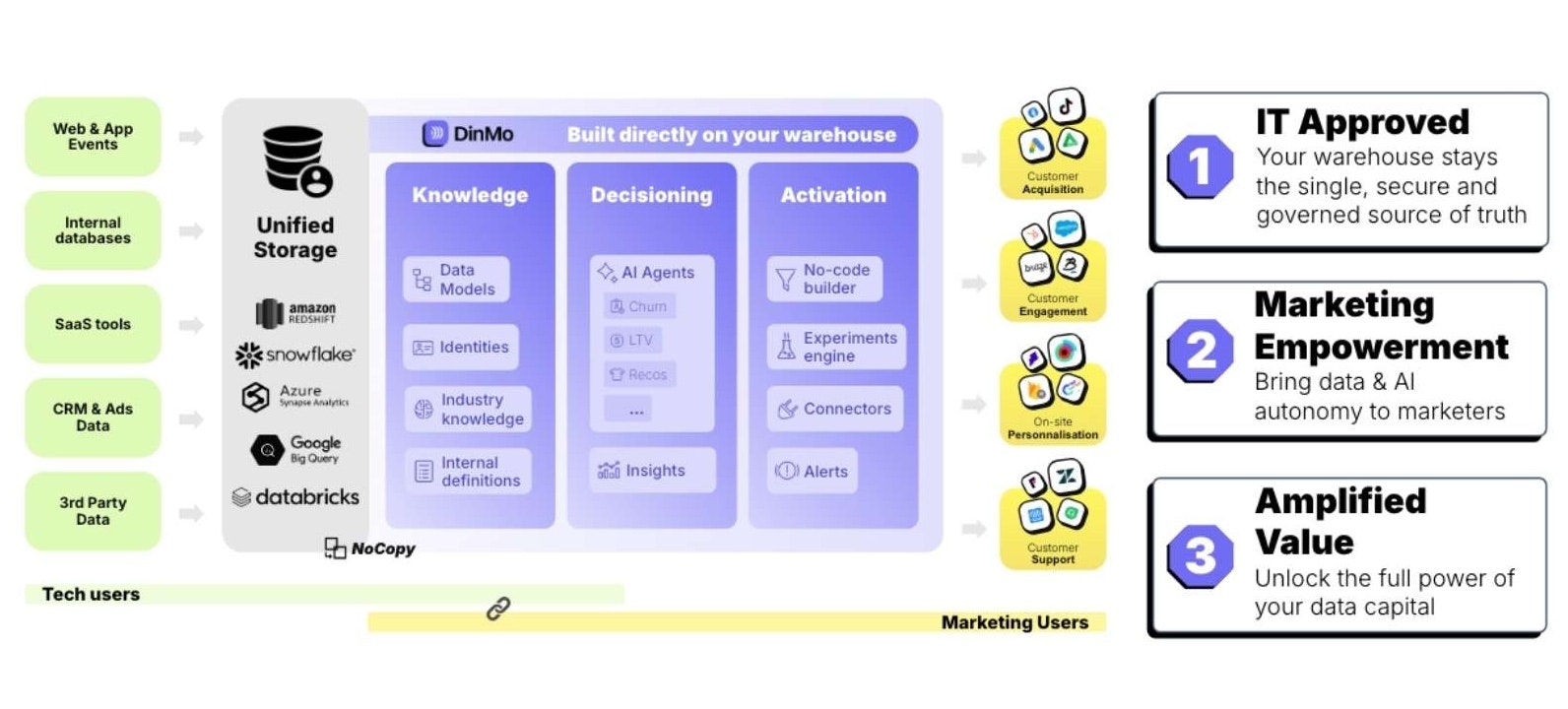
Turning data & AI into everyday marketing tools
From Customer 360 to Customer Understanding
Collecting every click and purchase is not the goal.
The real asset is a Knowledge Store: a structured way to represent what you know about a customer and a product so that humans and agents can reason on top of it.
In practice, we see three layers emerging:
Signals (What happened?) :
• Events: views, clicks, opens, logins, add-to-carts, support tickets.
• Transactions: orders, returns, store visits, subscriptions, renewals.
• Product graph: categories, attributes, price changes, stock, bundles.
Business context (What does it mean?)
• Lifecycle: new, activated, at risk, dormant, lost, reactivated.
• Value: contribution margin, predicted LTV, price sensitivity.
• Preferences: channel affinity, category affinity, content themes.
• Constraints: consent, contact policy, exclusions, stock limits.
Intelligence (What should we do?)
• Future value / churn models: when a customer is drifting away from their usual pattern.
• Propensity: likelihood to buy category X, reactivate, upgrade, downgrade.
• Next-best-offer / next-best-action: item or action with highest expected value.
When this lives in the warehouse, you don’t try to rebuild it in every tool.
DinMo’s role (and tools like ours) is to make this knowledge usable by marketers and agents without asking data teams to write SQL for every idea.
That’s the foundation. On top of it, we can finally talk about agents.

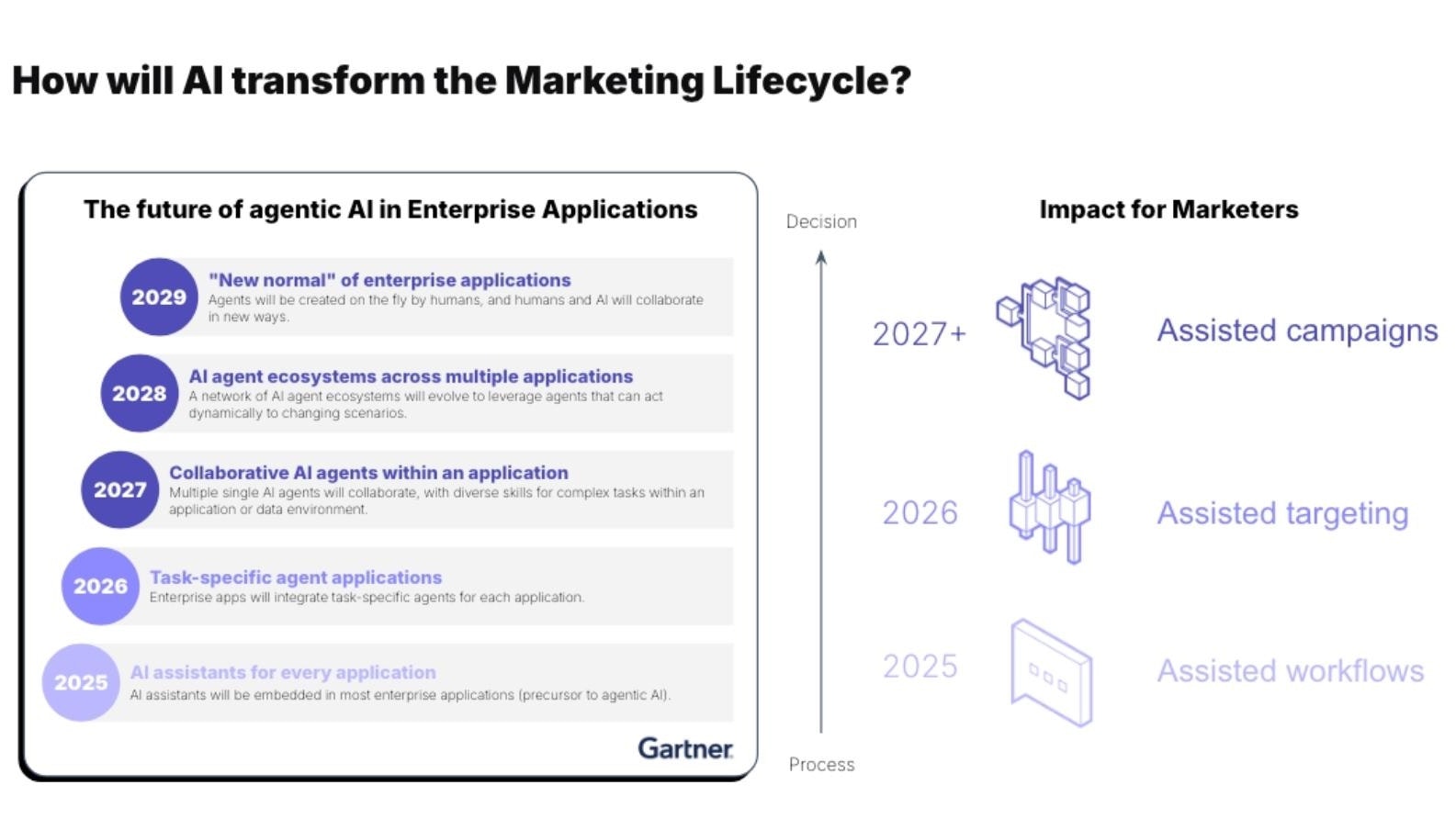
How will AI transform the Marketing Lifecycle
Mono-Agents, Meta-Agents and the Decision Fabric
Most “AI in marketing” I see in the wild is still one of two things:
A model making a prediction (“churn score = 0.87”).
A rules engine with nicer branding (“IF churn_score > 0.8 THEN send voucher”).
Useful, but not transformative.
The next step — and where we spend a lot of our thinking at DinMo — is building a decision fabric made of specialized agents:
Mono-agents: experts on one question
Each mono-agent focuses on a very narrow decision, for example:
Eligibility agent – Should we talk to this person at all?
Takes into account consent, fatigue, legal constraints, VIP status, and conflict rules between brands or business units.
Channel agent – Where should we talk to them?
Email vs SMS vs push vs ads vs on-site, based on past response, cost and reach.
Timing agent – When should we talk to them?
Predicts optimal window, but also respects global pressure and operational constraints.
Content / offer agent – What should we propose?
Picks from recommendations, campaigns and incentives given margin and business rules.
Budget agent – How much are we ready to spend?
Controls aggressiveness of discounts and bids based on LTV and predicted payback.
Each of these agents can be quite simple at first: a model, a set of rules, or a mix of both. The important part is the contract: input features and output decision.
Meta-agents: orchestrating under real-world constraints
Above that, you can build meta-agents that arbitrate between mono-agents, align them with business objectives and adapt over time.
For example:
“Maximize long-term contribution margin on this customer, under a maximum of 4 contacts per month, without cannibalizing high-margin categories, while respecting consent and brand rules.”
That’s where reinforcement learning, bandits, or more advanced agentic patterns become interesting. Not as a demo, but as a way to:
Test policies continuously, not twice a year.
Learn which strategies work for which customer archetypes.
Move from static journeys to continuously negotiated decisions.
We’re still early as an industry, but the direction is clear: from segment-level campaigns to decision-level optimization at customer level.
Marketers as Pilots, Not Operators
All of this is useless if the marketer’s life becomes more complex.
The end-state I care about is simple:
Marketers stop spending their week building segments and exports.
They spend it setting objectives, tuning constraints and supervising agents.
In practical terms, that means:
A cockpit view that shows: What are we trying to achieve? What policies are live? What trade-offs are we making? What did we learn this week?
The ability to say: “For high-value customers at risk of churn, I’m ok to increase discounts this month within this budget envelope” — and let the system execute and learn.
Transparency: seeing why a certain decision was taken for a customer (“not contacted: frequency cap reached”, “offer changed: higher margin alternative available”, etc).
That’s the product philosophy behind DinMo: the machine runs thousands of micro-decisions; the human sets the mission and keeps control of the rules of the game.

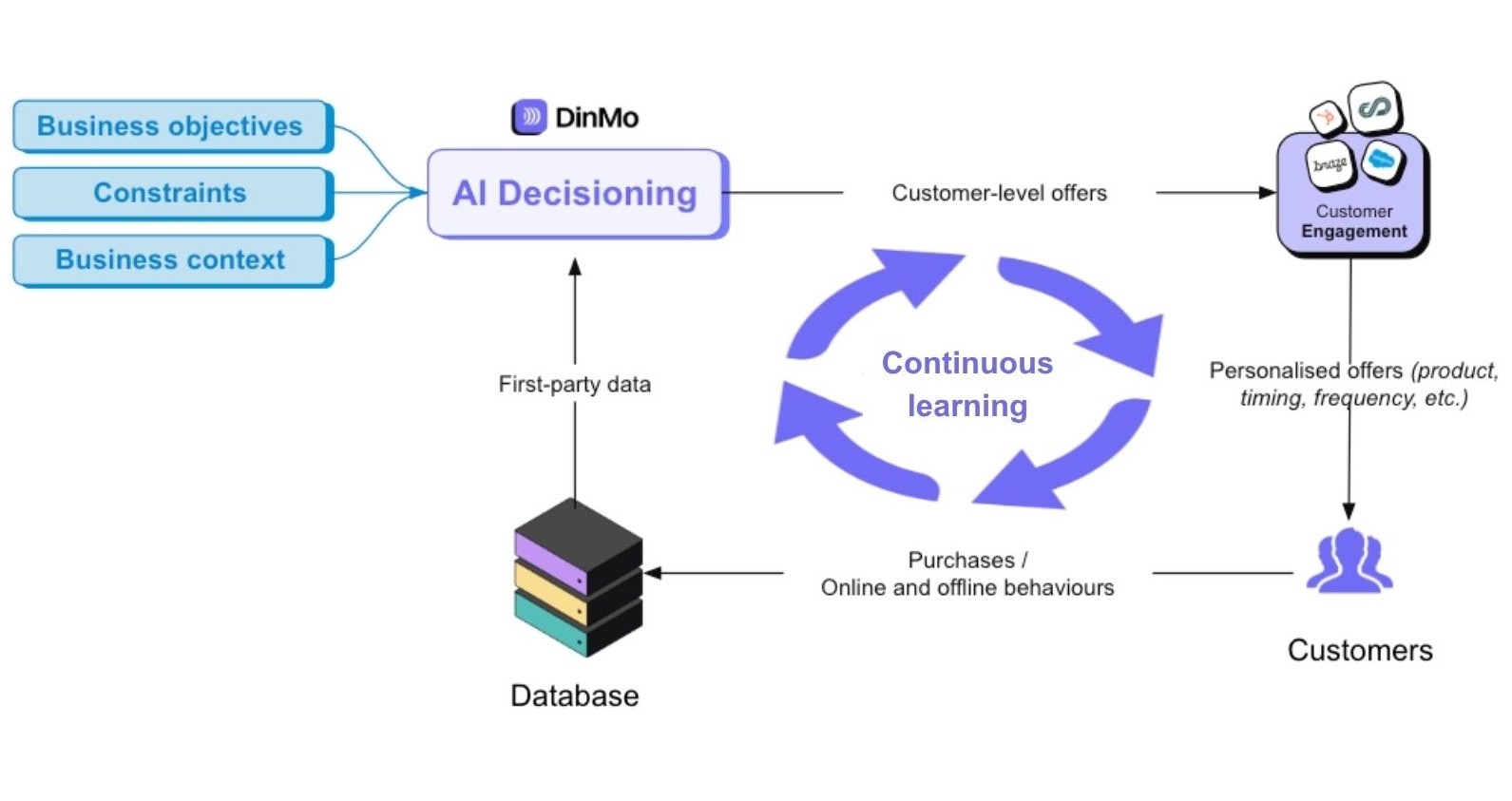
AI decisioning with DinMo
What We’re Seeing in the Field
Working with retailers, publishers and digital businesses across Europe, a few patterns keep repeating:
The winning teams made the warehouse non-negotiable.
They stopped creating new customer databases in SaaS tools. Everything important lives in the warehouse; tools are interfaces and execution layers.
Fuse marketing, data and engineering around decisions, not projects.
When “who owns the CDP?” turns into turf war, nothing moves. When a small fusion team owns a clear scope — “we are responsible for contact strategy and LTV” — things accelerate.
Start narrow, but connect end-to-end.
The most successful projects didn’t start with “reinvent all journeys”. They picked one beachhead: reactivation, onboarding, high-value retention, or paid media efficiency. But they wired the full loop: data → knowledge → decision → action → measurement → learning.
Governance is a feature, not an afterthought.
As soon as agents start making decisions, the questions change: Who can change policies? How do we roll back? How do we audit decisions?
That’s another reason to anchor everything in the warehouse and not in opaque black boxes.
At DinMo, this is what we are building towards: a composable, warehouse-native CDP that acts as the knowledge and decision layer for both human marketers and agents.
Not a new place to copy your data. A way to finally use it to take better decisions, at scale.
What You Can Do This Quarter
You don’t need to “replatform to agents” in one go. But you can absolutely start moving in the right direction in the next 90 days.
Here’s a pragmatic checklist I’d use:
Make the warehouse the single source of customer truth.
• Stop spinning up new SaaS “profile stores”.
• Route new projects to Snowflake/BigQuery/Databricks as the base.
Define your first version of a Knowledge Store.
• Agree on 10–20 core customer attributes everyone will use (value, lifecycle, risk, preferences).
• Materialize them in the warehouse with dbt or equivalent.
• Document them so marketing, product and data speak the same language.
Choose one decision to “agentify”.
• Example: “Who should receive our reactivation campaign this month?”
• Make it explicit: which signals, which constraints, which outcomes matter?
• Implement it as a mono-agent (simple model + rules is fine).
Wire the full loop.
• Log not just the event (“email sent”) but the decision context (“churn_score, reason, expected value”).
• Measure outcomes back in the warehouse.
• Review results regularly with a cross-functional group.
Tidy up your martech garden.
• List every tool storing customer data.
• Identify overlaps and places where you can simplify by using your warehouse + a thin activation layer instead.
This is exactly the kind of work we do with customers at DinMo — but you don’t need us to start. You just need clarity of direction.
The Shift Ahead
The point of all this is not to build more sophisticated architectures.
It’s to change the default question from:
“Which campaign should we run next month?”
to:
“Given our objectives and constraints, what is the best next decision for each customer — and how do we learn from every interaction?”
The companies that make this shift will not just send better emails. They’ll:
Allocate spend dynamically based on real expected value.
Treat every touchpoint as an experiment.
Give marketers a cockpit instead of a to-do list.
Let agents do the repetitive work and keep humans focused on strategy, creativity and brand.
That’s the future we’re building for at DinMo.
Warehouse-native. Data-first. AI- and agent-ready.
Less about managing campaigns.
More about operating a decision system.
The question is not whether that future is coming. It is.
The real question: do you want your team to be operating that system, or competing with the ones who do?