Next Best Action: How data enhances customer relationships?
5min • Last updated on Sep 23, 2026


Olivier Renard
Content & SEO Manager
[👉 Summarise this article using ChatGPT, Google AI or Perplexity.]
A customer abandons their basket, explores an offer or stops using a service. Should you send a message, offer help or wait? Next Best Action (NBA) marketing helps teams select the most relevant intervention for that customer’s profile and current context.
Generic campaigns cannot address every situation along the customer lifecycle. Personalising engagement at scale requires reliable data, a choice of available actions and clear priorities that balance customer needs with business objectives.
Key Takeaways:
Next Best Action (NBA) involves recommending the most suitable action for each customer, based on their data and context.
It goes beyond Next Best Offer (NBO): it may be an offer, but also a message, a piece of content, or a tailored service.
Artificial intelligence (AI) and first-party data support personalisation across connected channels, subject to data freshness.
DinMo’s Composable CDP enables marketing teams to prepare the audiences and predictive scores used in an NBA strategy.
🔎 Discover what Next Best Action is, its use cases, and its role in customer relationships. How can data and AI help select a relevant action for each customer? 💡
What is Next Best Action (NBA)?
Next Best Action is a marketing approach designed to identify, for each customer, the most relevant action to take at a given moment.
This ‘best next step’ may be a commercial offer, a personalised message, tailored content, or even a proactive service.
The aim of NBA is straightforward: turn every interaction into an opportunity to strengthen the customer relationship. Instead of relying on generic campaigns, companies focus on the most appropriate initiative according to the user’s profile, behaviour, and context.
This approach differs from traditional planned campaigns, which often ignore individual signals. Next Best Action leverages customer data and Artificial Intelligence to continuously adapt decisions.
It enhances the customer experience, drives engagement, and supports efforts to improve marketing return on investment (ROI), all within a customer-centric vision.
NBO vs NBA: What’s the difference?
Next Best Offer and Next Best Action are sometimes confused, but the two strategies have key distinctions. NBA is broader, as it also encompasses interactions and services.
Criteria | Next Best Offer (NBO) | Next Best Action (NBA) |
|---|---|---|
Definition | Recommending the most suitable product or service to a customer. | Strategy that recommends the most appropriate initiative for each customer at a given moment. |
Objective | Select a suitable offer to support conversion or retention. | Select a relevant intervention for conversion, service or retention objectives. |
Data | Transactional and product data: past purchases, browsing history, stated preferences. | Complete customer profile: history, behaviours, churn signals, channel preferences. |
Examples | Suggesting a complementary product (cross-sell) or a promotional offer. | Proactive reactivation of an inactive customer, loyalty message, personalised tutorial. |
Comparison between NBO and NBA
The distinction is what the system selects: NBO chooses an offer, whereas NBA considers a wider range of options, including content, service or no contact. Both can support conversion and retention through omnichannel orchestration.
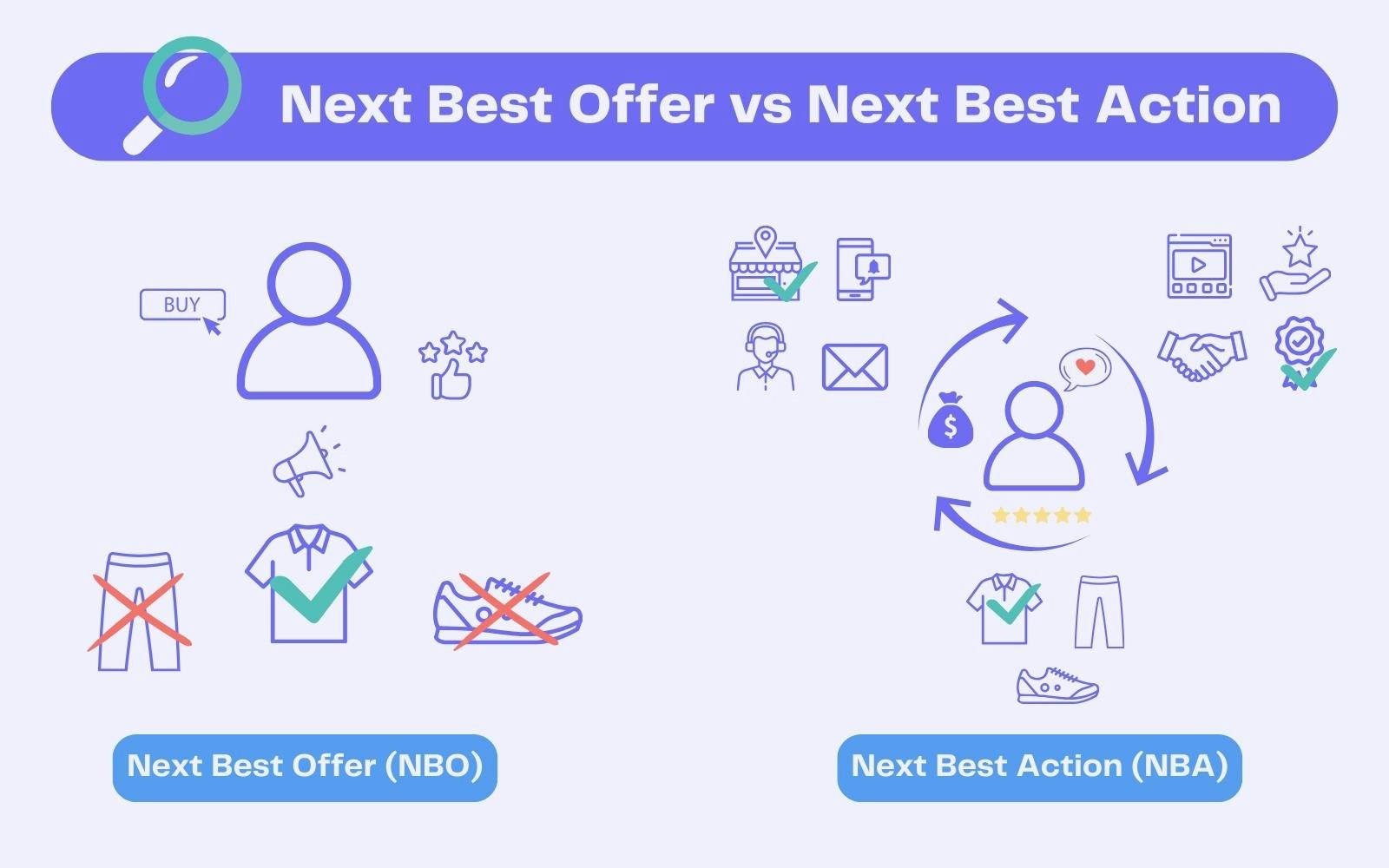
The differences between Next Best Offer and Next Best Action
A must-have approach made accessible
Several factors are driving the adoption of NBA strategies:
Limits on third-party tracking increase the value of first-party data collected through direct customer relationships. Its quality and permitted uses still need to be checked; first-party data is not automatically accurate or compliant.
Tools have become more accessible. What once required complex projects is now achievable thanks to the democratisation of AI tools and increased server processing power.
Rising customer expectations. Generic campaigns are losing effectiveness. Brands must deliver personalised, consistent experiences across all channels in an increasingly competitive environment. Triggering the right action at the right time has become a true differentiator.
Business impact to measure. Next Best Action aims to increase customer lifetime value, reduce churn and improve marketing ROI. Its contribution to business performance should be tested.
Levers across industries
Special offers, targeted communications, proactive services, or loyalty opportunities: NBA can take many forms depending on the context. A few examples:
E-commerce: A customer abandons their basket. The company compares a reminder, an offer or support based on context and recent contact.
Banking & Insurance: A churn risk is detected. The advisor reaches out proactively with an appropriate solution.
SaaS: A user remains inactive after signing up. A personalised tutorial is offered to help them get value from the product.
Retail: A loyalty programme identifies regular customers. Tailored product recommendations strengthen their engagement and attachment to the brand.
How does an NBA strategy work?
Implementing NBA relies on three pillars: data, technology, and methodology. Together, these allow the most relevant intervention to be recommended at the right time, on the right channel.
What data to use?
An NBA-oriented process requires reliable, comprehensive, and up-to-date data. The goal is to build a 360° view of each customer to anticipate expectations. This means combining multiple sources, including:
Customer data: demographic information (age, location, gender), purchase history, online behaviour.
Product and transactional data: product features, preferred categories, average basket size, spending patterns, sales seasonality.
Satisfaction and interaction data: campaign responses, customer reviews, NPS scores, churn or engagement signals.
To process this information, companies leverage machine learning and predictive AI techniques. Certain tasks can be handled by AI marketing agents.
Next Best Offer can use collaborative filtering or content-based recommendations to select products. NBA can start with explicit business rules and then incorporate predictive scores. Model selection depends on the task: estimating churn risk, predicting a response or interpreting a service request. Reinforcement learning is an option, not a requirement for every implementation.
In AI decisioning, data freshness should match the use case. An on-site recommendation may require a real-time decision, while a renewal campaign may work with scheduled updates. Refreshing the information used to make a decision is different from retraining a model after every event.
How do you choose between competing actions?
A prediction is not a decision. A high churn score highlights a risk, but does not tell the marketing team whether a discount, a call or practical support will make the greatest difference.
Define the available options: an offer, reminder, tutorial, service interaction or pause.
Check eligibility: consider channel consent, product availability, contract status and recent contact frequency.
Rank the remaining options: combine context, response likelihood, cost and the business objective. Resolving a service issue may take priority over a purchase.
Activate and observe: send the recommendation to the selected channel and record the outcome to inform subsequent decisions.
Illustrative example: a user abandons a basket while a complaint remains unresolved. Rather than automatically sending an email followed by an app push notification, the company pauses the promotion and offers support. Once the issue is resolved, it reassesses whether a reminder would be useful. Sometimes, the right next step is to leave the customer alone.

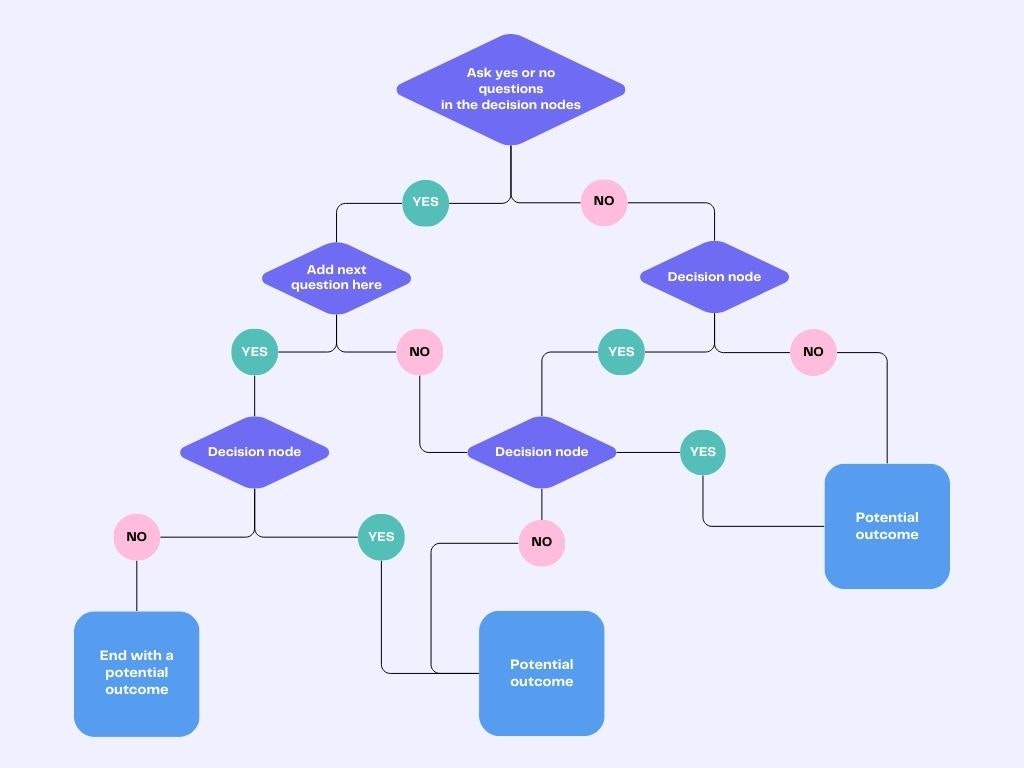
Example of decision tree
Implementation steps
Deploying NBA involves a straightforward, step-by-step approach:
1️⃣ Centralise data to eliminate silos. This creates a single source of truth for unified customer profiles.
2️⃣ Segment audiences and define scenarios tailored to key moments in the customer journey (basket abandonment, inactivity, subscription renewal).
3️⃣ Set clear objectives: increase conversions, boost loyalty, reduce churn, grow average basket size.
4️⃣ Orchestrate activations across multiple channels (email, push, social, on-site) to ensure consistent experiences.
5️⃣ Measure and optimise continuously by tracking key performance indicators: retention rate, engagement, lifetime value (LTV).
To assess whether these interventions create additional value, compare customers assigned to the new strategy with a randomly selected control group receiving the usual treatment. Define the evaluation period and primary outcome before testing: conversion, retention or margin after discount costs. Monitor unsubscribes and complaints as well. More clicks do not, on their own, prove incremental business value.
This shifts businesses from a standardised logic to a dynamic, customer-centric strategy.
The role of a CDP in Next Best Action
A Customer Data Platform (CDP) fits seamlessly with the NBA model.
In many organisations, data remains scattered across tools: CRM, analytics, email solutions, and ad platforms. This fragmentation hinders data-driven decision-making and limits personalisation.
The role of a CDP is to unify customer data into a 360° profile view. Marketing teams gain a reliable, up-to-date foundation to activate personalised scenarios.
With dynamic segmentation and activation features, it becomes possible to deliver the right message at the right time, on the right channel. Marketers can sync audiences with platforms and manage campaigns once data and integrations are configured.
How DinMo connects predictions with customer actions
DinMo brings together the building blocks of a Next Best Action strategy: customer data from the warehouse, predictive insights from DinMo Intelligence, audience creation and activation journeys through DinMo Journeys.
Anticipate behaviour with Event Propensity Scoring
Event Propensity Scoring estimates a profile’s propensity to complete a defined business event within a 3–90-day window. Targets can include making a purchase, starting a trial or viewing premium content. A dedicated subscription mode can also anticipate cancellation requests using lifecycle history and, where available, behavioural signals such as product usage.
Marketing teams can use these scores to prioritise audiences around a specific objective. For retention, anticipating a cancellation request creates an opportunity to intervene before the subscription actually ends.
Alongside each score, DinMo provides propensity bands and up to three explanations grouping the signals that raise or lower the result. Changes in usage or subscription history can help teams understand why a profile has received its ranking.
Inform the choice of action
Teams can combine these insights with customer lifetime value, eligibility criteria and relationship context. When a commercial offer is appropriate, DinMo Product Recommendations can identify relevant products or offers based on each profile’s interactions and preferences.
For example, a subscription business can identify customers with a high propensity to request cancellation. Depending on the available signals, it might test product guidance, a service conversation or a relevant offer. The score helps prioritise customers; business rules and experiments determine which response to favour.
Orchestrate the journey with DinMo Journeys
Once the relevant scores and attributes are available in the Customer Hub profile model, DinMo Journeys lets teams configure branches, delays and progression conditions. A journey can wait for an event, route profiles according to their circumstances and synchronise audiences with connected marketing tools.
Connecting prediction, segmentation and activation makes model outputs usable in campaigns. Teams should then measure the effect of each intervention: a high propensity score does not establish that a discount or message will change the customer’s behaviour.
Challenges and best practices
Such a strategy may seem complex to implement, but a few best practices can turn your NBA project into a value-creating initiative.
The first challenge is ensuring data reliability. Without it, recommendations lose relevance. It’s better to centralise sources and start with simple scenarios before scaling.
Compliance is crucial. Personalisation must comply with regulations (GDPR, CCPA) and be accompanied by transparency towards customers.
On the technical side, numerous integrations can slow teams down. A composable CDP simplifies deployment by leveraging the existing infrastructure and embedding artificial intelligence modules. Delivery time depends on data readiness, available connectors and the approvals required.
Internal adoption is also key: marketing and data teams should collaborate from the outset around shared objectives. Regular KPI monitoring helps identify improvements to test.
Conclusion
Next Best Action is a powerful lever to personalise every interaction, strengthen loyalty, and increase the profitability of marketing campaigns. By harnessing data and AI to enhance the customer experience, companies move from generic campaigns to a customer-centric strategy.
At DinMo, we believe this capability should be accessible to everyone. Our composable CDP democratises data activation, giving business teams greater autonomy: no-code segmentation, multichannel orchestration, and integrated artificial intelligence models.
👉 Discover how DinMo helps you activate your data to trigger your Next Best Actions!