

Campaign orchestration: definition and best practices
8min • Last updated on Sep 23, 2026


Alexandra Augusti
Chief of Staff
Marketing teams rarely lack channels. They lack coordination.
A customer may receive a promotional email after making a purchase, see an advert for a product that is no longer available, or receive several messages from different teams on the same day. Each campaign may work correctly in isolation, yet the overall customer experience remains fragmented.
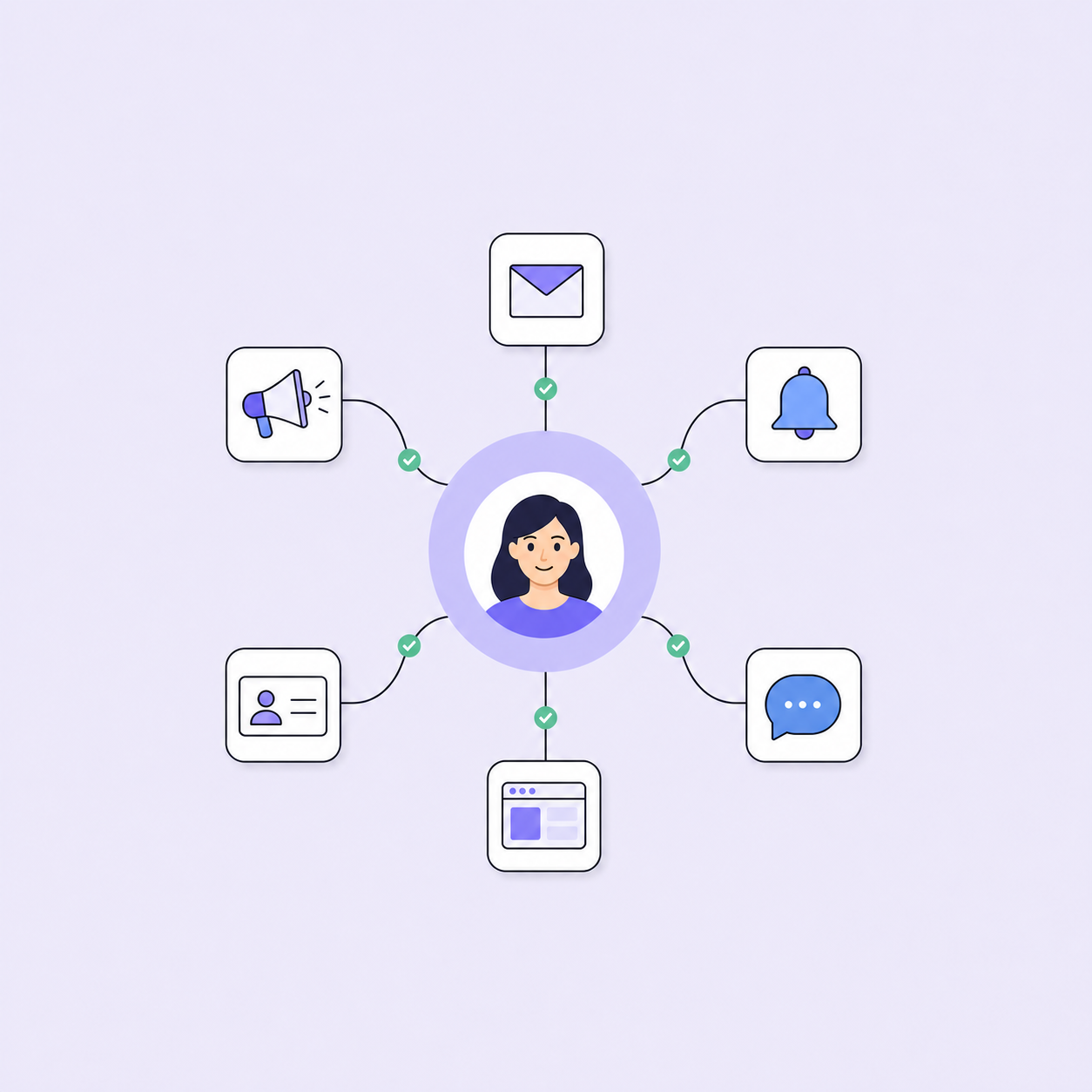
Campaign orchestration solves this problem by coordinating audiences, customer data, decision rules, timing and channels within a single marketing process. It is a practical application of data activation: turning customer information into consistent, timely and personalised actions across email, mobile, advertising, CRM, web and other touchpoints.
Campaign orchestration is not about sending more messages. It is about choosing the right interaction, at the right moment, on the right channel, based on the customer’s latest context.
What is campaign orchestration?
Campaign orchestration is the process of planning, coordinating and executing connected marketing actions across audiences, channels and customer journey stages.
It defines who should enter a campaign, what should happen next, when the next action should occur, which channel should be used and when communication should stop. It also helps decide which campaign should take priority when the same customer is eligible for several journeys at the same time.
For example, a retail customer browses a pair of shoes but does not buy. An orchestrated campaign could wait a few hours, check whether the product has been purchased, then send an email reminder. If the customer still does not convert, the journey could trigger a mobile push notification or a paid media retargeting audience. But if the customer buys in the meantime, the journey stops automatically.
Every step responds to a shared customer context. This is what makes orchestration different from a simple campaign workflow.

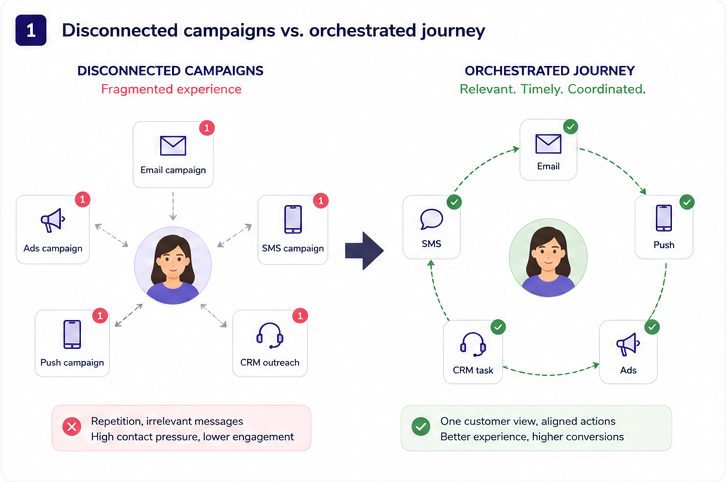
Disconnected campaigns vs. orchestrated journey
Why is campaign orchestration important?
Campaign orchestration helps brands create a more consistent customer experience. Customers do not perceive separate CRM, acquisition, ecommerce or loyalty teams. They perceive one brand. When these teams operate independently, the result can quickly become confusing or repetitive.
With orchestration, a customer who has already converted can be removed from retargeting audiences. Someone experiencing a service issue can be temporarily excluded from an upsell campaign. A high-value customer approaching renewal can be routed to a personalised retention journey instead of receiving a generic promotion.
This omnichannel coordination also reduces campaign conflicts. Without shared rules, several teams may activate overlapping audiences at the same time. Campaign priorities, suppression rules and frequency capping help control this pressure. A renewal reminder may take priority over a cross-sell campaign, while a customer service communication may suspend all promotional messages.
Finally, orchestration makes customer data more useful. Most organisations already hold rich information across their data warehouse, CRM, ecommerce platform, mobile application and service tools. The challenge is to use this data at the right moment. Campaign orchestration connects these signals to operational decisions, so that purchase history, browsing behaviour, churn scores, customer value and consent status can all influence the next best action.
How does campaign orchestration work?
Effective campaign orchestration starts with a clear business objective. A journey should not begin with “we need to send an email”, but with a question such as: do we want to convert a prospect, prevent churn, renew a subscription, increase repeat purchases or reactivate an inactive customer? The objective determines the audience, the journey logic and the performance indicators.
The next step is to define the target audience. This segment can combine profile attributes, transactions, behavioural events and predictive scores. For example, an ecommerce reactivation journey may target customers who purchased several times in the past year, have not bought for 90 days, still have valid marketing consent and are not already part of a customer service recovery journey.
The journey then needs an entry trigger. Some campaigns run on a schedule, while others start when a specific event occurs. Account creation, basket abandonment, product page visits, subscription expiry, a change in churn score or a period of inactivity can all trigger a journey. Real-time triggers are useful when timing strongly affects relevance, while scheduled audiences remain appropriate for many loyalty, renewal or reactivation campaigns.
Once a customer enters the journey, decision rules determine the next step. These rules can consider lifecycle stage, customer value, channel consent, campaign priority, previous exposure, product availability or contact pressure. This is where a static workflow becomes a dynamic customer journey.
The orchestration layer then activates the most relevant channel. The objective is not necessarily to use every channel, but to select the right sequence. A customer who often opens mobile notifications may receive a push message first. Another may respond better to email. A high-value account approaching renewal could be assigned to a sales or customer success task instead of receiving an automated message.
A strong journey also needs clear exit rules. A customer should leave the campaign once they purchase, renew, withdraw consent, become ineligible, enter a higher-priority journey or reach the maximum number of attempts. These rules prevent irrelevant communications and make campaign performance easier to analyse.

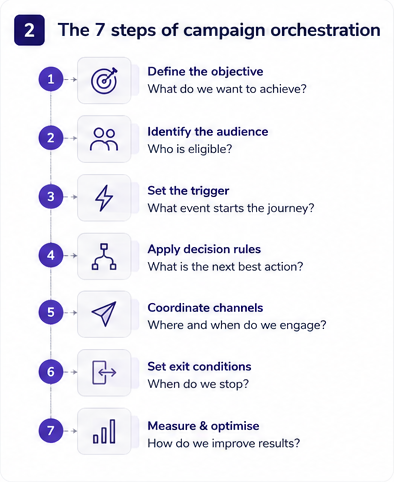
The 7 steps of campaign orchestration
Campaign orchestration vs marketing automation
Marketing automation and campaign orchestration are closely related, but they are not the same thing.
Marketing automation usually refers to the execution of predefined tasks, such as sending a welcome email after registration or triggering a follow-up message after a form submission. It is very useful, but it can remain limited when every channel runs its own logic separately.
Campaign orchestration adds a coordination layer. It takes into account customer behaviour, channel preferences, consent, previous campaign exposure, business priorities and contact pressure. A campaign is no longer just a fixed sequence of messages. It becomes a dynamic journey that adapts as customer data changes.
Customer journey orchestration is often used to describe an even broader approach, covering interactions across the full customer lifecycle: acquisition, onboarding, engagement, retention, reactivation and loyalty. Campaign orchestration is more focused on the coordination of specific marketing initiatives within that wider lifecycle.

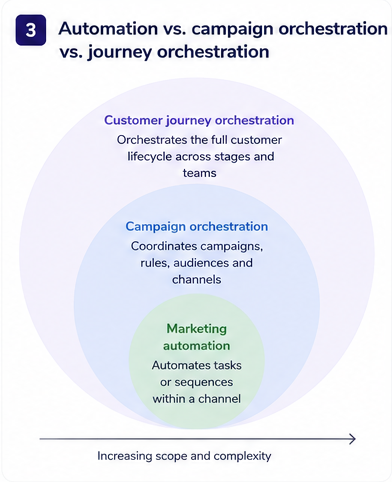
What role does a CDP play in campaign orchestration?
Campaign orchestration depends on a reliable understanding of the customer. This is where a Customer Data Platform becomes particularly valuable.
A CDP connects customer information from multiple systems and makes it available through a consistent profile. Identity resolution can reconcile identifiers such as an email address, CRM ID, loyalty number, device ID or anonymous visitor ID. The orchestration logic can then recognise that activities across different touchpoints belong to the same person.
This unified customer view is essential. Without it, the same individual may enter duplicate journeys, receive contradictory messages or be treated as a new prospect after already becoming a customer.
A CDP also enables marketing teams to build dynamic segments. Unlike static uploaded lists, dynamic audiences evolve as the underlying data changes. Customers can enter or leave a campaign after a purchase, a new event, a consent update or a change in predictive score. This keeps campaigns aligned with the customer’s current situation.
The CDP can also centralise reusable business rules. For example, a company may want to exclude recent purchasers from acquisition campaigns, limit customers to two commercial messages per week, prioritise renewal over cross-sell, or suppress customers with an unresolved service request. When these rules are managed centrally, every channel works from the same logic.
In a composable architecture, the data warehouse remains the source of truth. The CDP uses governed warehouse data to build audiences and coordinate activation without creating another isolated marketing database.

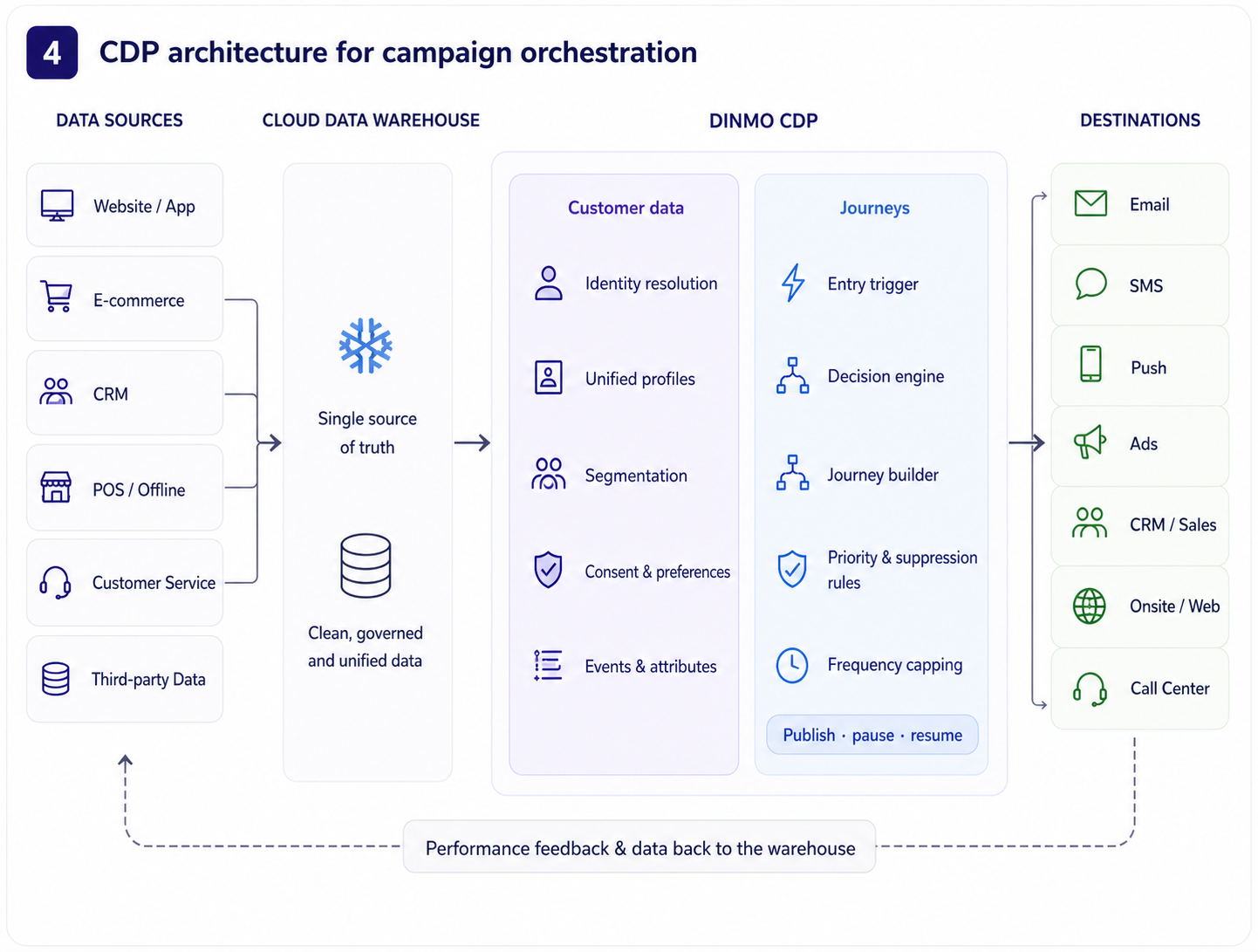
CDP Architecture for campaign orchestration
Controlling journey lifecycle with DinMo
DinMo combines customer segmentation, data activation and journey orchestration in a no-code environment.
Marketing teams can prepare and review a journey before publication. Once published, the journey starts operating according to its configured triggers and rules. If execution needs to stop temporarily, the journey can be paused. This can be useful when a product is out of stock, a compliance review is required, campaign priorities change, or the team needs to investigate unexpected results.
The journey can then be resumed when the campaign is ready to continue. These explicit journey states give teams operational control without forcing them to rebuild the orchestration from scratch. They also make the difference clear between a journey that is still being designed, one that is live, and one that is temporarily suspended.
For marketing teams, this is a key part of orchestration maturity. A journey should not only be easy to launch. It should also be easy to control, monitor and adjust over time.

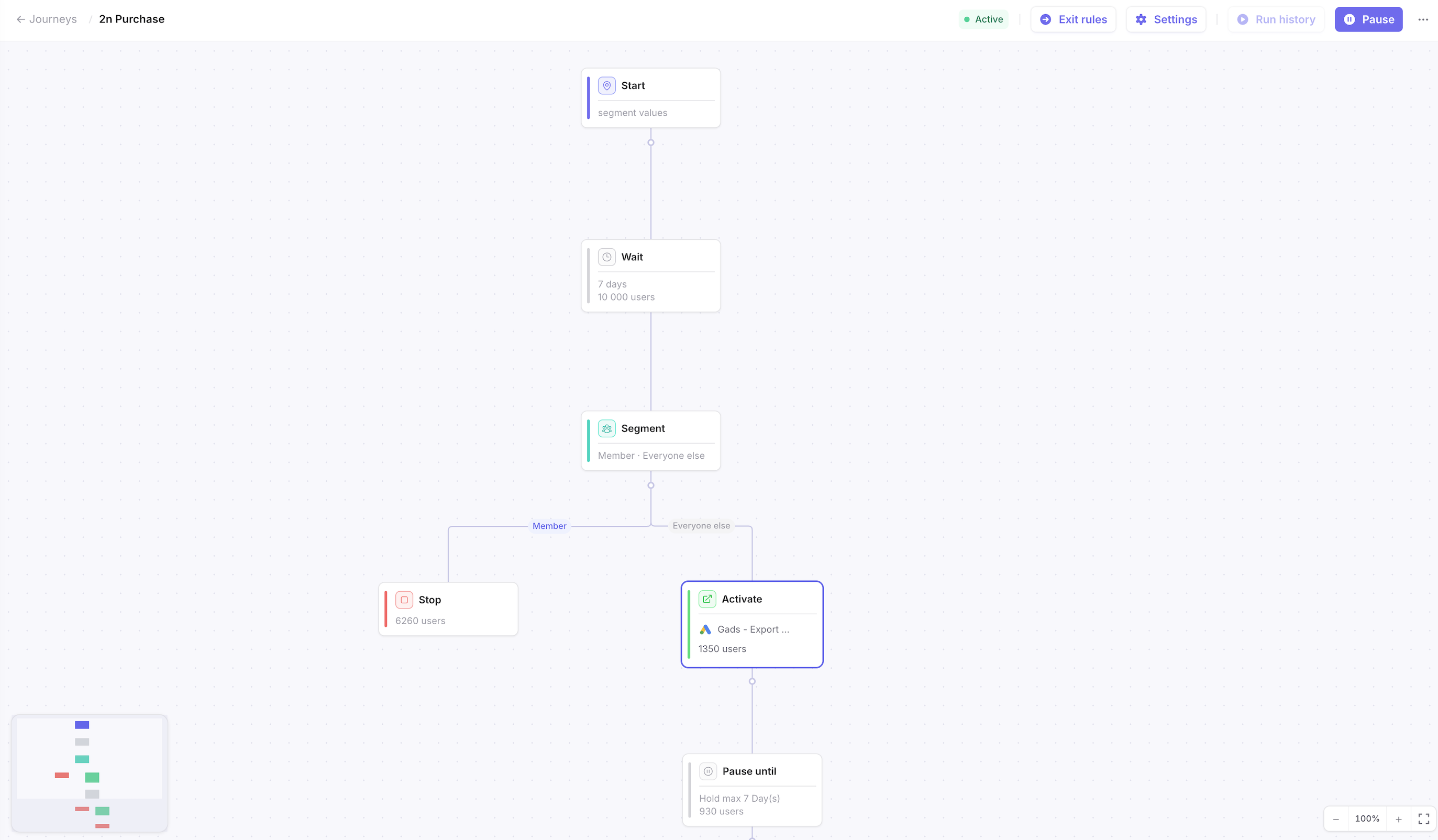
Check our documentation if you want to learn more about Journey orchestration.
Examples of campaign orchestration
In ecommerce, campaign orchestration is often used for abandoned browse or abandoned basket scenarios. A customer who views a product several times without purchasing can enter a journey that combines email, push notifications and paid media. If the customer purchases, all reminders stop. If stock becomes unavailable, the journey can switch to similar product recommendations.
In subscription businesses, orchestration can help prevent churn. A customer whose engagement is decreasing and whose renewal date is approaching can receive a different journey depending on their churn score, subscription type and customer value. Low-risk customers may receive a standard reminder, while higher-risk customers may receive tailored content, a retention offer or a human follow-up.
In B2B, campaign orchestration can connect marketing and sales. A prospect who downloads a guide, attends a webinar and visits the pricing page may move from an educational nurture journey to a sales follow-up task. Once an opportunity is created in the CRM, generic lead nurturing stops.
... And many more data activation use cases!
How to implement campaign orchestration successfully
The best way to start is to focus on one valuable use case. Trying to orchestrate every campaign at once usually creates complexity before value. Basket abandonment, renewal, churn prevention or customer reactivation are good candidates because they rely on clear signals and measurable outcomes.
Here are a few tips:
Each journey should be documented before launch. The team should know the objective, eligible audience, exclusions, trigger, channel sequence, delays, exit conditions and priority compared with other campaigns. This documentation reduces ambiguity when several teams manage overlapping customer communications.
Contact pressure should also be addressed from the beginning. Frequency capping is not a technical detail; it is a customer experience rule. A brand may decide that promotional messages should be limited to a certain number per week, while transactional or service communications remain exempt.
Reusable components are another success factor. Definitions such as “active customer”, “recent purchaser”, “valid CRM consent” or “high churn risk” should not be recreated differently in every journey. Shared segments, calculated attributes and templates make orchestration faster and more reliable.
Automation should not remove governance. Teams need to review journey logic, test audience volumes, monitor execution, measure performance and pause campaigns when necessary. The goal is controlled automation, not a black box.
Which KPIs should be used?
Campaign orchestration should be measured at both campaign and customer level.
Relevant indicators include:
conversion and incremental conversion rate;
revenue or margin generated;
time to conversion;
retention or renewal rate;
etc.
Operational metrics such as audience volume, processing delays and activation errors are also important. A well-designed journey cannot perform if the underlying data or destination synchronisation is unreliable.
Conclusion
Campaign orchestration turns separate marketing actions into a coordinated customer experience.
It connects customer data, segmentation, decision rules, timing and channels so that each interaction reflects the customer’s current context. Marketing automation executes individual tasks; orchestration ensures that those tasks work together.
A CDP provides the shared data and activation layer needed to make this coordination scalable. With DinMo, marketing teams can use warehouse data to build audiences, create journeys and control their publication, pause and resumption through a no-code interface.
👉🏼 Contact us if you're ready to turn customer data into coordinated journeys with DinMo. 🚀