

Combining marketing and data to boost performance
7min • Last updated on Feb 4, 2026


Olivier Renard
Content & SEO Manager
[👉 Summarise this article using ChatGPT, Google AI or Perplexity.]
How can you build a modern marketing stack that aligns data, AI and business performance without adding technical complexity? That’s the question we explored with Snowflake, Batch, In Digital and CustUp during our Modern Marketing Stack event.
As generative AI and agentic AI are shaking up marketing practices, the number of tools is increasing, at the risk of creating friction, technical heaviness and frustration for teams. At the same time, privacy concerns, the widespread move to the cloud and cost pressures are forcing companies to make technical choices aligned with their business priorities.
“The goal is to give marketing teams back their ability to innovate, while simplifying life for data teams,” recalls Mickaël Avoledo in his introduction to the event.
👉 What key lessons can you take from these discussions to rethink your marketing stack in 2026? Let’s walk through the main ideas shared during the DinMo event. 🔎
1️⃣ Moving from closed platforms to a composable marketing ecosystem
The limitations of monolithic suites
Since the rise of relationship marketing in the 1980s, “all-in-one” suites have often appeared to be the ideal solution: a single vendor to manage both data and activation. But as organisations grow, these monolithic platforms struggle to keep up.
Despite their feature sets and promise of centralisation, they often remain difficult to integrate with the rest of the information system. Seen as expensive and hard to evolve, they create strong technical dependency and ultimately end up re-creating silos.
As new channels emerge and data & AI requirements grow, marketing and IT teams are looking to regain agility.
👇

Marketing stack: The ultimate guide
Towards an ecosystem of specialised components
We’re seeing a major shift in Martech from platforms to open ecosystems of interconnected tools.
With the move to cloud data warehouses, data returns to a neutral foundation, owned and controlled by the company.
Romain Lhote, In Digital
The current trend is to move towards a composable model, where probabilistic, network-based ecosystems are replacing linear, deterministic stacks. In practice, this means assembling several specialised components: data warehouse, composable CDP, Customer Engagement Platform (CEP), analytics tools, and so on.
Each tool plays a specific role and is integrated via open standards. This approach makes it easier to implement AI decisioning and gives more autonomy back to marketing teams.
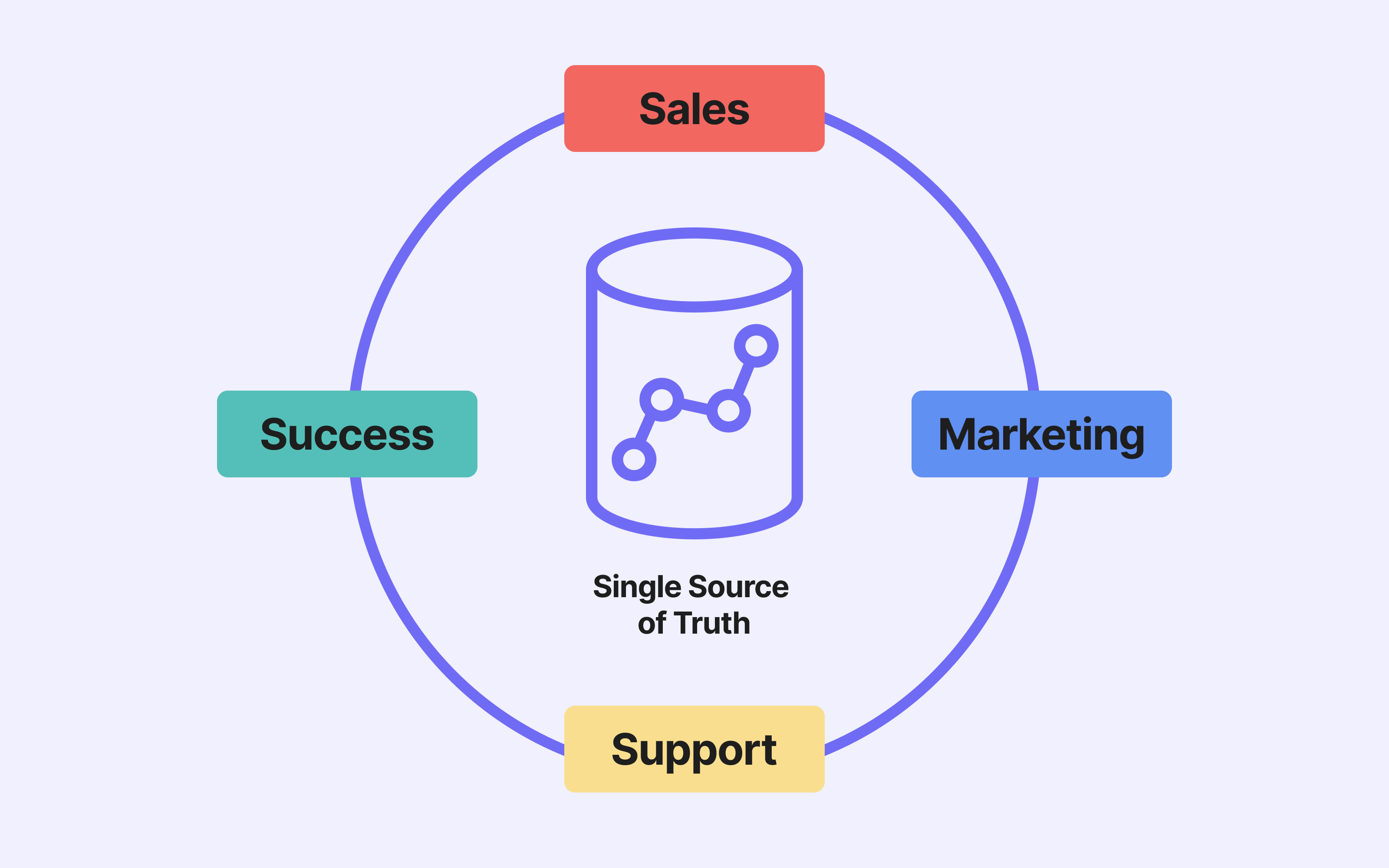
The data warehouse as the source of truth
In such an environment, the data warehouse becomes the neutral Single Source of Truth for customer data. Marketing tools connect to it instead of maintaining their own copies in separate databases.
More open, scalable and accessible, this ecosystem provides the foundation needed to deliver a personalised customer experience and to measure marketing performance.
2️⃣ Data & AI as the backbone of modern marketing
AI is not a gadget but a strategic pillar
In just a few years, artificial intelligence (AI) has moved from experimental projects to a topic impacting every company. Acquisition strategies, customer loyalty, creativity, positioning: marketers need to adapt and make the most of these new opportunities.
Snowflake’s work on the Modern Marketing Data Stack highlights three key forces:
The widespread adoption of AI as a strategic accelerator,
The growing importance of confidentiality and privacy,
The need to bring data together on a single, open architecture platform.
AI now fuels the value chain end to end. It allows marketing teams to “converse with data” and extract insights more quickly.
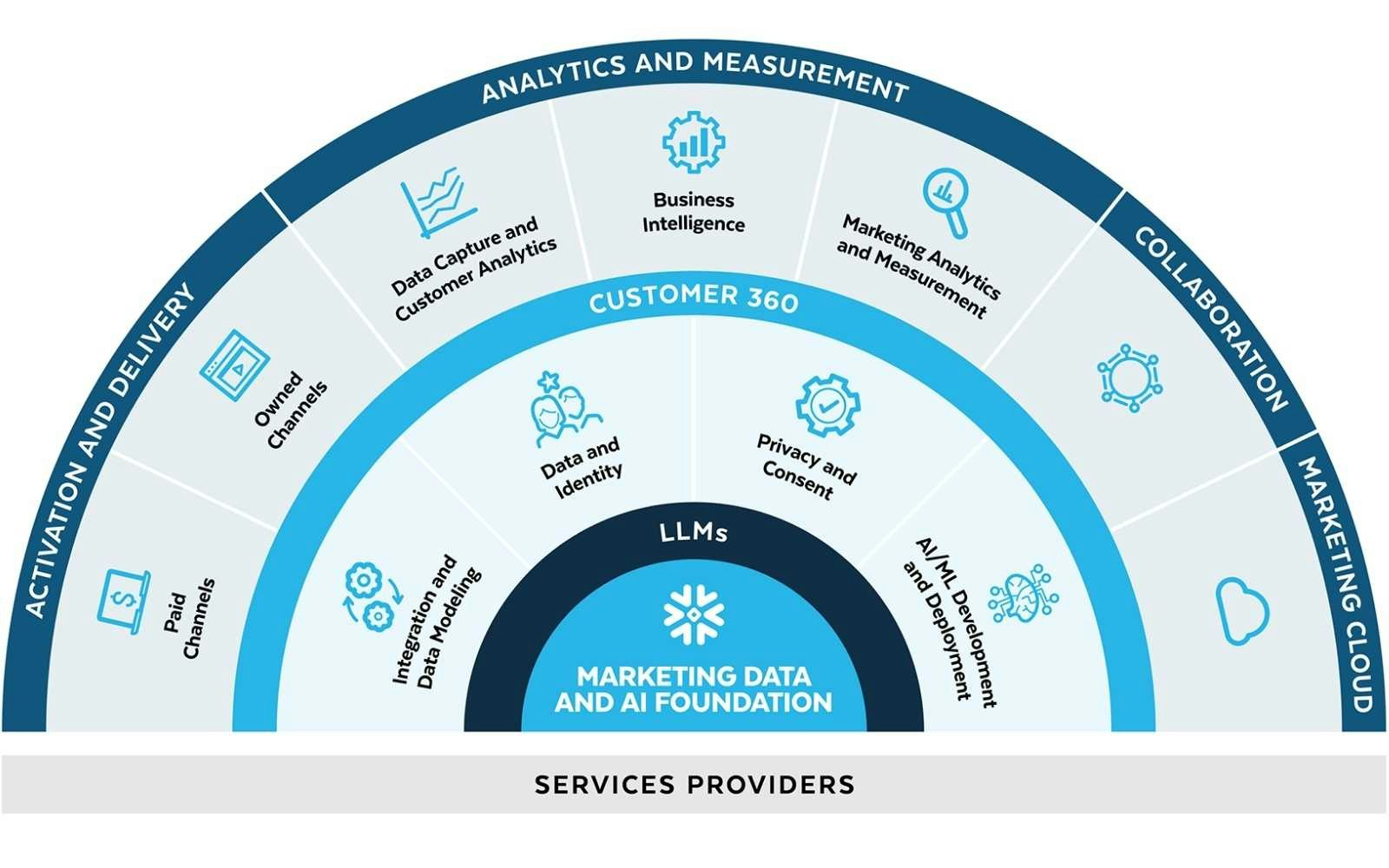
Marketing Data and AI foundation (Credit: Snowflake)
A unified data foundation to power AI
For these promises to materialise, you need a solid data foundation. The data warehouse centralises information from different channels (CRM, Ads, points of sale, product, support) in a governed, secure environment.
By avoiding data duplication, it reduces infrastructure costs, lowers the risk of leaks or errors, and simplifies compliance.
The idea is to bring applications closer to the data, rather than moving the data to every application.
Cecil Bove, Snowflake
Preparing now for the agentic era
Over the coming years, we’ll see the rise of AI agents capable of testing variants, optimising journeys and continuously adjusting. For this to be possible, data must be unified, accessible and up to date to make decision-making easier.
A modern marketing architecture therefore needs to anticipate this shift now.
👉 By choosing an open, composable, well-governed stack, companies are preparing for future AI use cases and avoiding the risk of building up medium-term technical debt.
3️⃣ A Modern Marketing Stack that serves teams
The limits of current stacks
In many organisations, the marketing stack has been built in layers over time. The result is a stack that’s difficult to operate day to day: time-consuming for data teams and offering limited autonomy to operational teams.
Multichannel campaigns take a long time to design and deploy. The customer view remains partial, and CRM teams too often depend on IT to build audiences.
This lack of agility is compounded by a siloed way of working: each channel operates with its own data and its own rules.
The contribution of a modern CEP
A Customer Engagement Platform (CEP) aims to simplify this landscape. It provides a visual builder to orchestrate omnichannel journeys: email, push, SMS, in-app, WhatsApp, web.
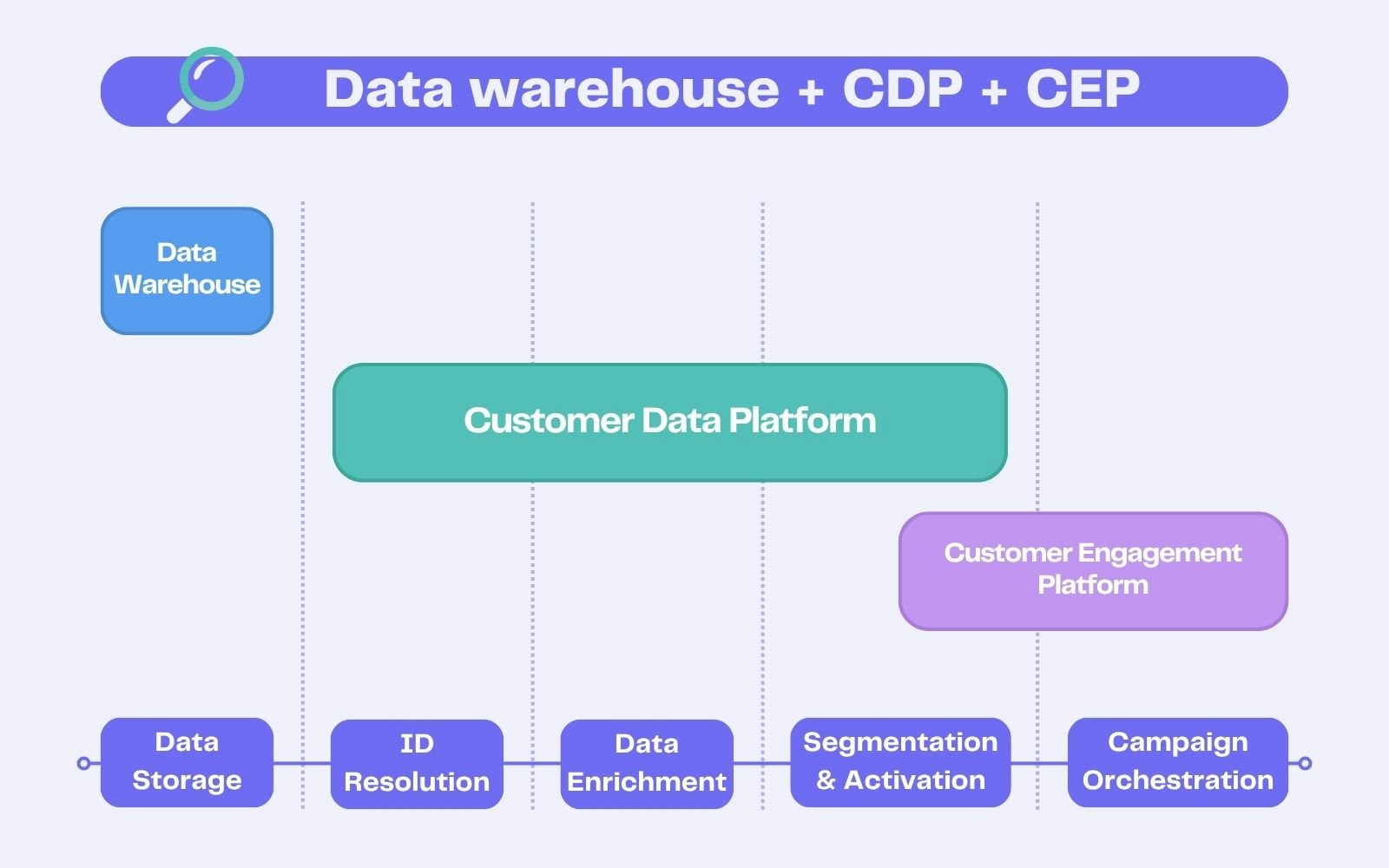
Data warehouse, CDP and CEP
Teams design full journeys from a single interface, based on audiences synchronised with the data foundation. They also have access to the main KPIs: performance by channel, by segment, by journey.
The activation platform becomes a genuine growth lever, driven by data.
Rebalancing roles between marketing and data
The Modern Marketing Stack is about giving CRM teams more agility, efficiency and autonomy through data, automation and AI.
Antoine Guénard, Batch
The one-size-fits-all model that creates dependency and heaviness is no longer fit for purpose. With a modern stack, marketing can build audiences, configure journeys and run A/B tests without raising a ticket for every request.
Data and IT teams can refocus on higher-value topics: data quality and reliability, AI models, flow management, security. Collaboration becomes smoother and everyone contributes where they are most useful.
4️⃣ The composable CDP as the pivot between data warehouse and activation
An extension of the data warehouse, unlike packaged platforms
Traditional Customer Data Platforms (CDPs) appeared in the early 2010s with a similar model: copy the data into their own database, transform it, then send it back to business tools. In practice, this approach creates new silos, complicates governance, and blurs the notion of a true “source of truth”.
With a composable (or modular) CDP, the logic is different. DinMo relies on the company’s data warehouse, based on the principle of True No-Copy: the data foundation remains the single source of reference, and the CDP extends it.
It structures, enriches and activates the data, while letting technical teams retain control over infrastructure and governance.
The shift happened with the massive adoption of cloud data warehouses (CDWs) by companies.
DinMo presents itself as an extension of the CDW, with on-demand services that business teams can use.
Oussama Ghanmi, DinMo
Unify, enrich and activate in no-code
In concrete terms, the DinMo composable CDP is built around three complementary layers:
A unification layer: data model, identity resolution, 360° customer view, calculated fields.
An intelligence layer: churn scores, LTV, product affinity, recommendations, channel or timing affinity — all compatible with AI decisioning and agentic marketing use cases.
An activation layer: advanced no-code segmentation, automatic sync to the CRM, CEP, Ads platforms, product tools or support solutions. All omnichannel scenarios are powered by accurate, up-to-date information.

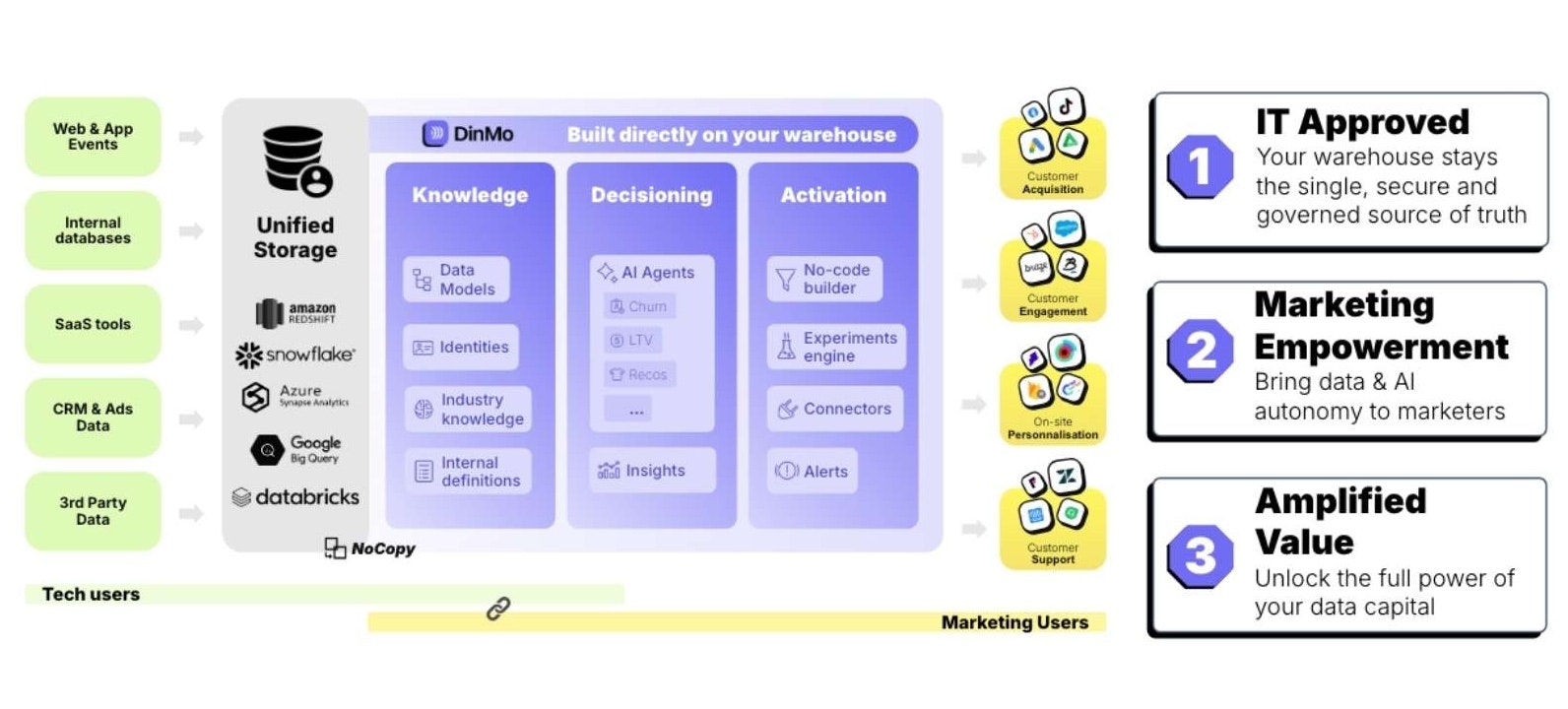
Turning data & AI into everyday marketing tools
Towards a true data-driven marketing cockpit
Integrated at the heart of the Modern Data Stack, DinMo V2 gives marketing teams more autonomy and intelligence, while offering better governance for data teams.
Alexandra Augusti, DinMo
Our composable CDP fully plays its role as a pivot between the data foundation, AI and activation tools. It provides personalisation solutions for each channel, and a combination of advanced AI agents for truly data-driven marketing.
Our latest feature, the Customer Hub, becomes your real marketing cockpit. Les équipes suivent la performance par segment et par use case, comparent les résultats via des groupes de contrôle et des tests A/B, et mesurent l’impact incrémental de leurs actions.
5️⃣ How to successfully deliver a Modern Marketing Stack project?
Start from the vision, not the technology
The first question isn’t which tool to choose, but how to get all the teams aligned.
Antoine Coubray, Custup
A Modern Marketing Stack project starts with a clear vision. What are your top priorities: improving acquisition, increasing LTV, reducing churn, personalising the customer experience? What resources do you have, and what is your target timeline?
On that basis, it becomes easier to prepare and organise the data, then define the role of each component.
Build on solid foundations
At this point, it’s essential to ensure data quality and to prioritise sources. Governance and security must be considered from the very beginning: access management, compliance, traceability.
Stack design should bring together marketing, product, data and IT in order to avoid blind spots and misunderstandings.
Move step by step and iterate
Rather than a “big-bang approach", successful projects follow a progressive path.
👉 Start with a handful of high-value use cases, and measure the results. Then progressively expand to new segments, channels or AI models.
This approach requires allocating the right resources (skills, budget, steering) to scale up over time. The Modern Marketing Stack is a continuous evolution project, serving your business.
Conclusion: building a truly performance-driven marketing stack
In 2026, a high-performing Modern Marketing Stack relies on a few simple principles. Its effectiveness is built on a composable, open ecosystem, centred around a unified data foundation.
Each component has a clear role: CDP for unification and activation, CEP for journey orchestration, and analytics tools for measurement. Marketing teams gain autonomy over activation, while data teams focus on data quality, models and governance.
The DinMo Customer Data Platform becomes the pivot between data, AI and engagement platforms. The challenge is not simply to replace existing tools, but to rethink how data and marketing work together to address your business objectives.
Want to assess or modernise your stack? Let’s talk: book a demo or chat with the DinMo team.