CDP pricing: customer data platform costs and budgeting
7min • Last updated on Nov 2, 2026


Alexandra Augusti
Chief of Staff
CDP pricing covers the platform charge. A CDP implementation also includes the work that makes customer data usable: source connections, data preparation, processing within the existing stack and time from the teams involved. Together, these costs provide a consistent basis for comparing customer data platform solutions.
Companies can choose the same CDP software and end up with different budgets. Their data, infrastructure and marketing campaigns may require different capabilities and service levels. A useful CDP budget starts with a defined operating scope, then considers how that scope will develop.
Key takeaways
The platform price and the project cost measure different things. The project includes implementation, infrastructure and ongoing operation.
Each CDP capability creates its own requirements. Collection, storage, unification, segmentation, enrichment and activation all contribute to the cost.
The billing unit matters as much as the quoted amount. Profiles, events and credits represent different forms of consumption.
A time-limited proof of concept can measure three costs: the platform, its effect on the internal stack and the work required from teams.
Why CDP costs vary between projects
One company wants to reactivate lapsed customers using purchase data already available in its warehouse. Another wants to personalise website interactions, while records remain spread across its CRM, customer service software and commerce systems. These are different projects, even if the customer populations are similar.
The first difference is the condition and location of the data. Documented tables, consistent identifiers and reliable pipelines reduce preparation work. New collection requirements, duplicate records and conflicting definitions create tasks before the profiles can support a campaign. That effort depends on the existing foundation as well as the chosen platform.
The use case also changes the scope. A loyalty campaign, an advertising exclusion and a product recommendation require different information, rules and destinations. Complexity comes from the relationships between customer records, as well as the number of sources.
Refresh frequency is another cost driver. A daily update may be sufficient for a lapsed-customer audience, while an interaction on the website may require a response during the visit. Real-time processing introduces additional delivery and monitoring requirements. Its value depends on the delay that the customer experience can tolerate.
This is why profile volume alone cannot establish the budget. The relevant CDP features become clearer once they are connected to the intended campaigns, available data and operating responsibilities.

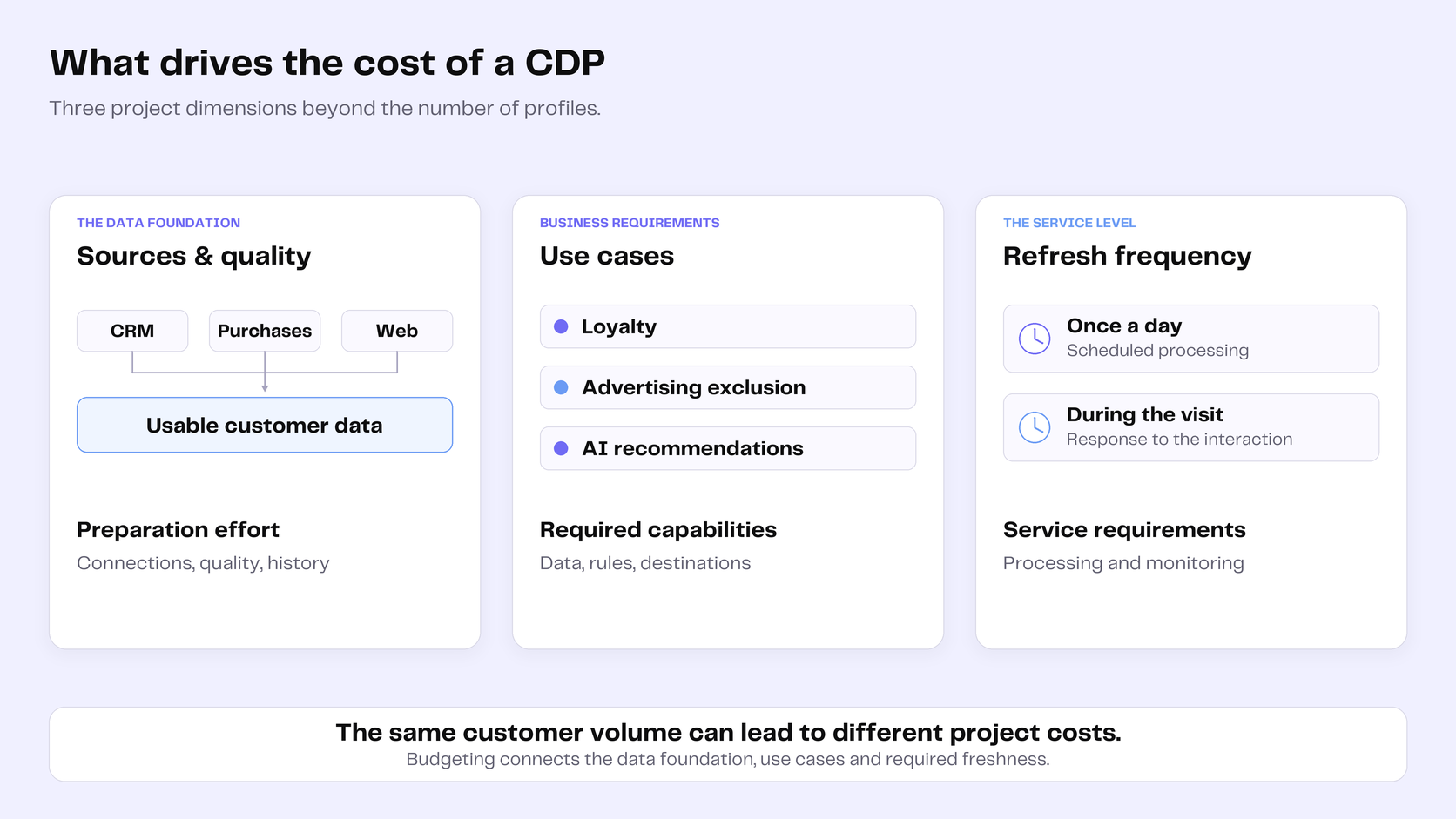
The budget depends on available data, use cases and the required refresh frequency.
The six CDP capabilities behind the budget
CDPs combine several data management functions. They may sit within one product or be distributed across components. CDP costs depend on the capabilities already available and the work the implementation needs to add.
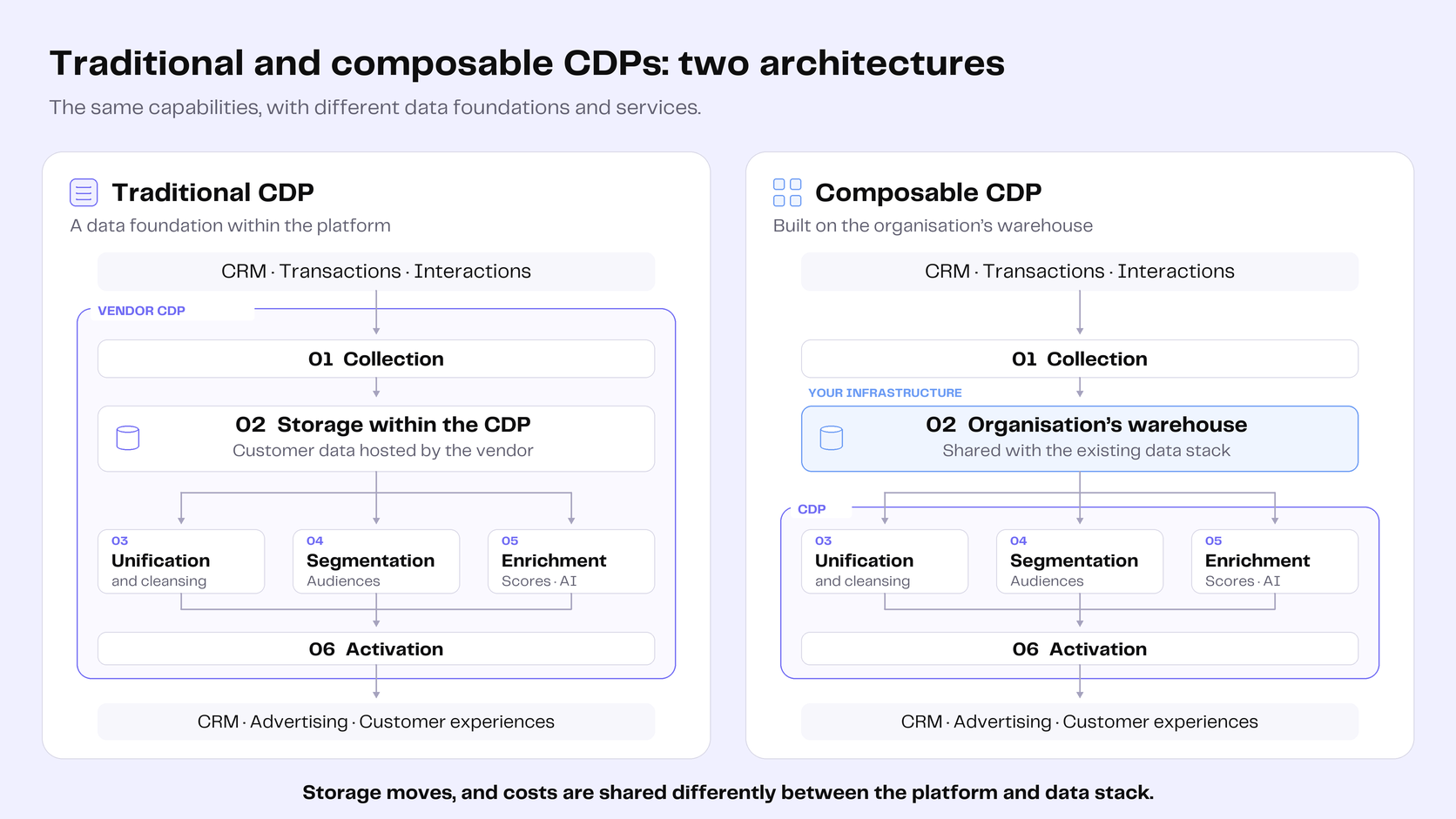
Collection, storage, unification and cleansing, segmentation, enrichment and activation are six capabilities to include in the budget.
1. Data collection
Collection brings together transactions, CRM information and the interactions needed for the use case. It can draw on customer data already centralised, new source connections or a tracking plan that still needs to be implemented.
The budget includes configuration, integration and maintenance. Website events can also require tracking changes and validation. The depth of collection affects subsequent processing volume: an additional event needs a purpose in customer analytics or marketing campaigns to justify the work it creates.
The initial historical load and ongoing updates represent different stages of a CDP implementation. A first load may create more processing than subsequent changes. For companies connecting sales, CRM and website data, this distinction separates one-off data collection work from the recurring service needed by marketing teams.
2. Data storage
In a packaged CDP, the vendor generally manages customer data storage within the platform. This may sit alongside storage already present in the company's information systems. Retained history and profile volume can therefore affect the proposed package.
A composable CDP can use the organisation's warehouse as its storage and processing foundation. Costs are then shared between software components and the internal data stack. Reusing a warehouse still creates processing costs: additional computation, storage and any transfers remain part of the project estimate.
In a composable architecture, storage and processing may also support customer analytics or other business tools. Attributing additional queries to the CDP helps isolate its consumption. For companies with an established cloud data stack, this avoids assigning the entire cloud bill to one marketing workflow. It also makes the division of costs between platforms more explicit.
3. Unification and cleansing
This capability connects information belonging to the same customer and makes it consistent. It covers formats, identifiers, duplicates, precedence rules and business definitions. An email address, loyalty account and browser identifier cannot always be matched without ambiguity.
Costs include identity resolution features, rule preparation and the handling of exceptions. Data quality depends on both the platform and the operating teams. Unification and cleansing rules also need to remain reliable when source systems change.
During CDP implementation, a sample of customer profiles can reveal the matches and exceptions. A customer might appear in sales data, CRM records and website activity. The expected output is usable customer data, with rules that marketers understand. The correction work observed provides evidence about the ongoing data management effort, alongside the software charges.
4. Segmentation
Segmentation turns customer data into usable audiences: recent purchasers, customers at risk of leaving or profiles eligible for a campaign. It combines business criteria, exclusions and an update frequency.
The cost depends on the software features, processing volume and operating model. Marketers who create audiences independently still need reliable definitions. Autonomy in the interface and preparation of the customer data model are separate requirements, with different workloads for marketing and data teams.
Composable CDPs can build on customer data models maintained in the warehouse. Marketers define which customers belong in a campaign, while the data team maintains the calculations. The number of active audiences and the processing they require provide a more useful cost measure than a catalogue of unused segments. This connects marketing requirements to data management work.
5. Data enrichment
Enrichment adds useful information to a customer profile, such as calculated value, a propensity score, likelihood to repurchase or AI-generated product recommendations. These outputs can become segmentation criteria or support a personalised customer experience.
The cost can include an additional module, computation, data preparation and model monitoring. Recommendations depend on the available history and the frequency of recalculation. The value of an enriched profile comes from how it is used, connecting this part of the budget to a marketing requirement and an activation workflow.
A customer score and personalised recommendations for a product catalogue involve different requirements. Frequency, output volume and availability in marketing tools define the service. CDPs may provide these insights directly or send data to another analytics platform. The budget needs the route from data preparation to the personalised customer experience, including any additional processing.
6. Activation
Activation sends audiences and attributes to CRM software, advertising platforms and customer engagement channels. It requires compatible destinations, usable identifiers and agreed update rules.
The number of destinations, synchronisation frequency and error handling can change the workload. A profile update, exclusion and deletion may involve different operations. Email, SMS and advertising spend remain separate from the cost of preparing and activating customer data.
An activation implementation also includes checking the result in the destination. An audience that is correct in the CDP may need adjustments in CRM or advertising software. Testing the full journey helps a company allocate work between its data team and the marketers responsible for campaigns across those channels.
Customer data platform pricing models
The same capability can be charged in different ways. The billing unit and its contractual definition matter as much as the volume on the quote.
Model | What changes the bill | What needs to be clear |
|---|---|---|
Profiles or contacts | Population retained or processed | Anonymous, inactive and merged profiles, plus the measurement period |
Monthly tracked users | People or identifiers observed within the month | Deduplication and the definition of a tracked user |
Events or volume | Interactions collected, rows processed or data transferred | Historical loads, seasonal peaks and additional processing |
Credits or actions | Queries, calculations, enrichment or activation | Consumption for the complete workflow and overage charges |
Modules and scope | Features, destinations, environments and services | Included capabilities, optional components and implementation support |
A price per profile cannot be compared directly with a price per event. A small customer population can generate many interactions; a large database can be activated infrequently. A cost estimate becomes more useful when it connects the billing unit to the way the marketing campaign will operate.
Prices do not always grow in a straight line. Tiers, committed minimums and several measures can apply together. A 20% increase in customer records does not automatically produce a 20% increase in the bill. Overage and renewal terms are part of a meaningful comparison.
From the platform price to the complete project cost
Total cost of ownership, or TCO, includes the spending needed to implement and operate the solution. Looking at when costs arise helps distinguish budgets and responsibilities.
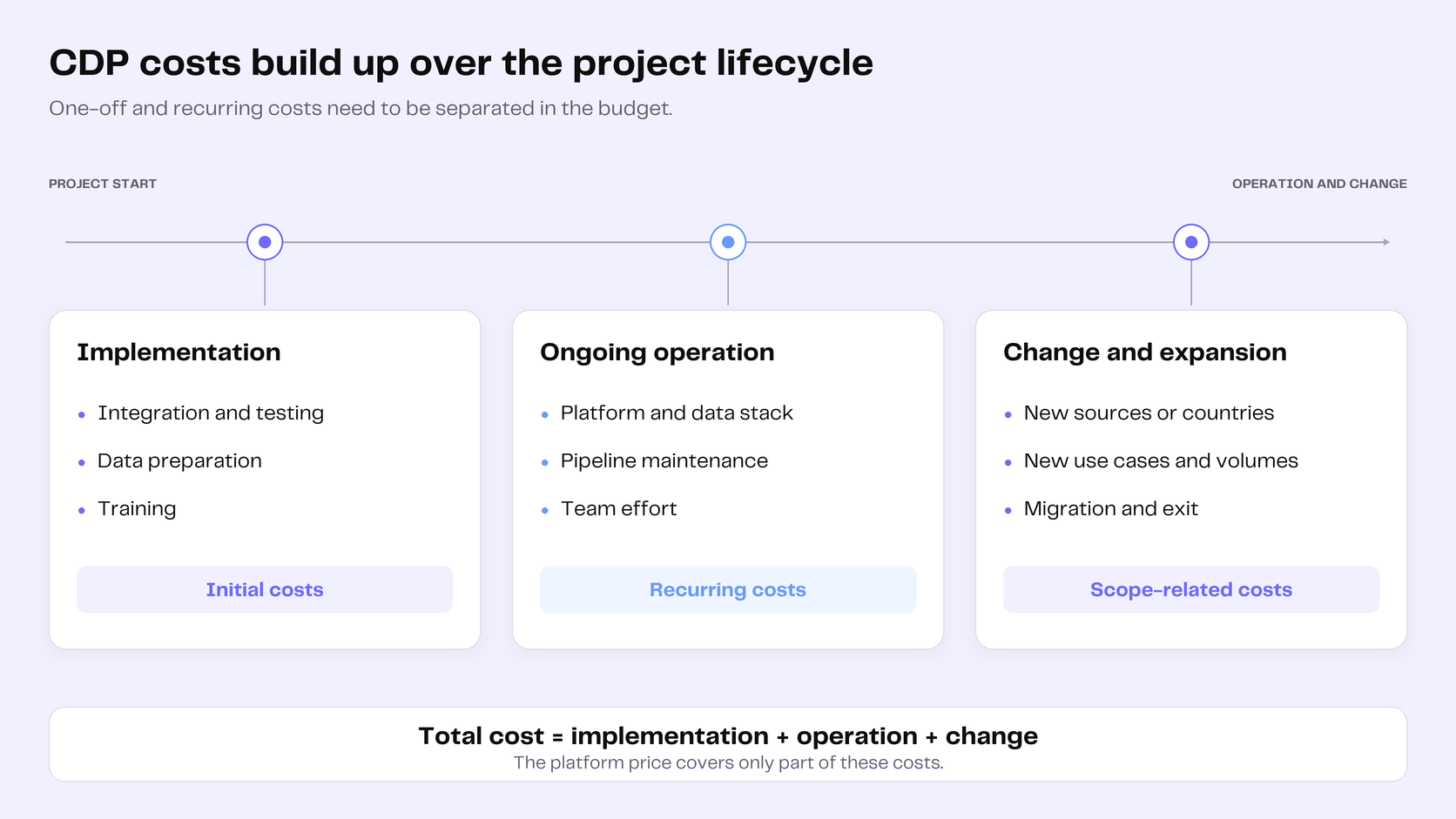
Total cost of ownership includes implementation, ongoing operation and changes in scope.
Initial implementation costs
Implementation covers scoping, data preparation, integration, permissions, acceptance testing and training. The vendor or an implementation partner may deliver some tasks, while others remain with internal teams.
An available connector still needs validation of identifiers, field mappings, exclusions and expected outputs. Internal effort has an economic cost, even where no external supplier issues an invoice.
Recurring costs
After implementation, the project needs a platform subscription, processing in the data stack and operational support. Schema changes, synchronisation failures and updates to segmentation rules can require further work.
Software support and day-to-day operation cover different requirements. Clear responsibilities across marketing, data and IT make that recurring effort easier to estimate. Where a warehouse already exists, the project can show the additional cost of the new workload, with a separate allocation of shared resources if that helps compare architectures.
Growth and transition costs
A new market, source system or campaign frequency can change the scope. Growth affects volume, but can also add connectors, customer data models and environments.
Replacing an existing tool may involve overlapping subscriptions, migration and the retirement of old flows. These costs belong separately from the recurring estimate because their duration and ownership are different.
A coherent starting scope
A useful first scope describes a complete business workflow, rather than a feature list. A lapsed-customer reactivation campaign connects purchase history, an inactivity definition, exclusions and a campaign destination.
The scenario establishes which data is needed, whether it is available and how frequently the audience must change. It also identifies who prepares models, validates segments and monitors activation. A daily update may be sufficient initially, even where later customer experiences require fresher information.
Reusable work becomes visible: unification rules, the customer model, segmentation criteria and a destination connection. Extending the workflow to another channel can reuse some components while adding testing and operational tasks. This gives practical meaning to the initial budget and the expansion budget.
Worked example: a three-year CDP budget
The following is a fictional budgeting example, in euros excluding VAT. It is neither a DinMo price nor a market average. It illustrates external spending and internal effort for an organisation that already has a warehouse.
Cost item | Illustrative assumption | Year 1 cost | Type |
|---|---|---|---|
Software | Assumed annual subscription | €24,000 | Recurring external spend |
Implementation | Assumed initial service | €12,000 | One-off external spend |
Data preparation | 12 internal days valued at €500 | €6,000 | One-off internal effort |
Additional infrastructure | Assumed annual estimate | €3,000 | Recurring external spend |
Ongoing operation | 12 internal days valued at €500 | €6,000 | Recurring internal effort |
Training | Assumed initial service | €3,000 | One-off external spend |
Total | Sum of the items above | €54,000 | €42,000 external + €12,000 internal |
The €24,000 software subscription is only one part of the first-year cost. The €500 daily amount values internal effort; it is not a supplier charge to add to the same task again.
With scope and prices held constant, recurring costs reach €33,000 a year. The three-year total is €54,000 + €33,000 + €33,000 = €120,000, including €96,000 of external spending and €24,000 of valued internal effort.
A growth scenario can replace the constant annual figures. At €41,000 in year two and €49,000 in year three, the total becomes €144,000. This calculation tests the budget against different assumptions; it is not a forecast.
A time-limited proof of concept to measure the costs
A proof of concept (POC) tests the intended scope in a working setting over a short, agreed period. It uses sources, a customer population and a scenario that are representative enough to reveal the workload, with shared acceptance criteria.
Its value for budgeting comes from three complementary measurements. The first concerns the platform: profiles processed, events, credits consumed, features used and destinations activated. The POC terms establish the scope, implementation support and financial arrangements.
The second concerns the internal stack. A composable project may change warehouse queries, computation, storage or transfers. A consumption baseline before the POC, followed by measurements during operation, makes these effects easier to estimate.
The third concerns the teams: time spent preparing customer data, configuring the software, validating outputs, learning the workflow and resolving errors. A simple action in the interface can depend on substantial preparation elsewhere. The POC makes that division of work visible.
For a reactivation POC, a company can follow an audience from CRM and sales data through to the intended marketing channels. The evidence then connects customer volume, CDP and warehouse consumption, refresh time and manual interventions. A larger implementation retains the same measurements, with assumptions adjusted to the intended number of customers and campaigns.
The findings also show what a user needed to learn: missing rules, difficult customer matches, errors and monitoring work. These details help companies compare CDPs on the service delivered as well as the software features. CDP vendors can then cost the same operating scope. The findings support a more specific discussion about the resources needed to create a reliable personalised experience for customers.
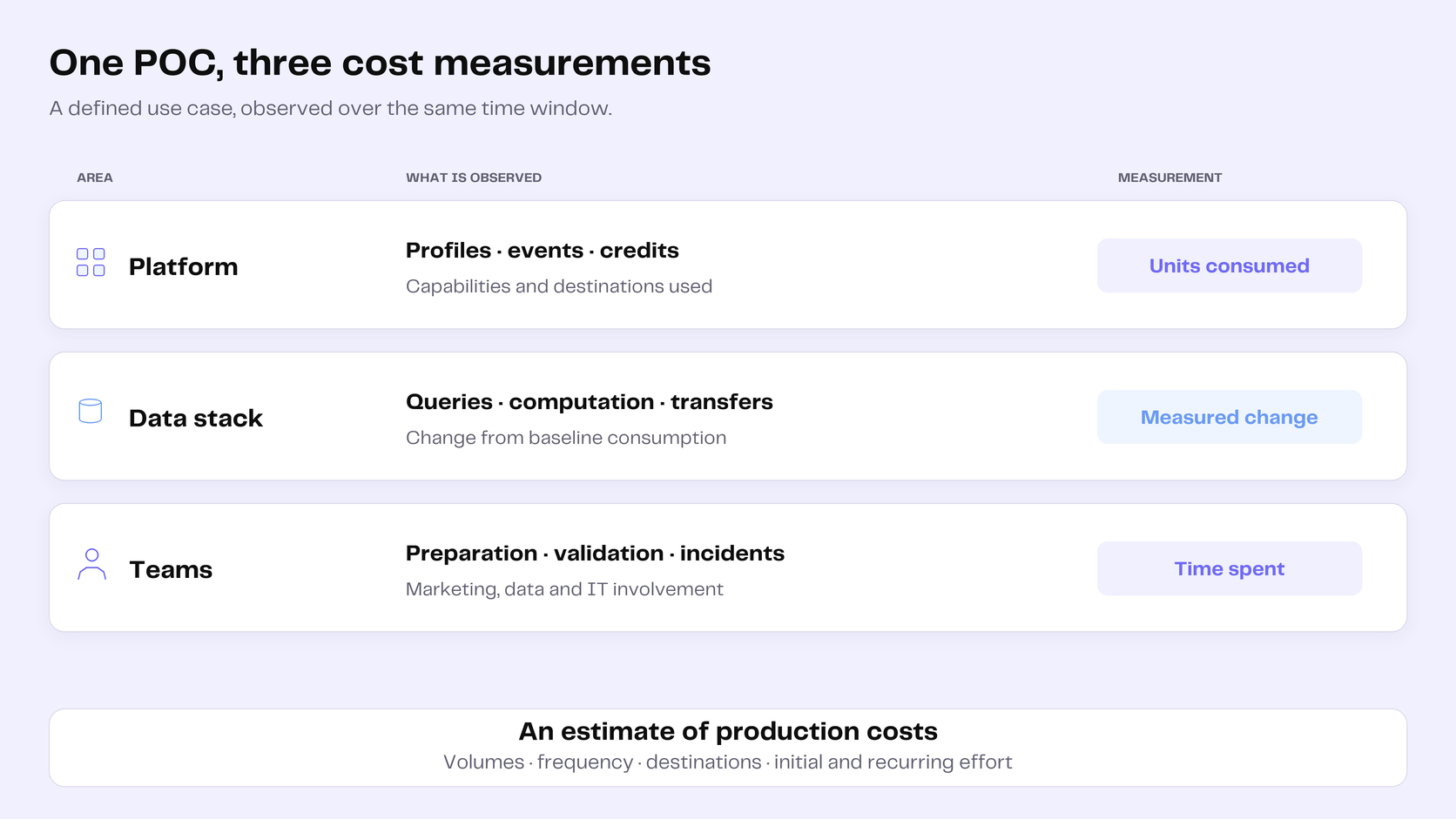
The POC measures platform consumption, its effect on the internal stack and the time required from teams.
Extrapolation to production accounts for target volumes, update frequency and destinations. A POC covering one campaign does not automatically measure peak traffic, every channel or the effort needed for continuous operation. Its findings refine the estimate, alongside the assumptions that still need confirmation.
Comparing proposals on the same basis
A reliable comparison uses a shared sizing brief and the same expected service level. CDP vendors then have equivalent information about sources, populations, frequency and use cases.
Comparison point | Information required |
|---|---|
Price and commitment | Amount, currency, billing frequency, term and renewal |
Billable population | Definition, measurement period and deduplication |
Included scope | Features, connectors, environments and support |
Implementation | Integration, data preparation, testing and training |
Ongoing operation | Platform, internal stack, maintenance and team effort |
Growth | Target volumes, next tier and additional workflows |
Contract exit | Export, assistance and transition costs |
This grid belongs in a CDP request for proposal, alongside functional and organisational criteria. A public price and a bespoke quote need the same clarity of scope before they become comparable.
Expected savings then belong in the business case. Retiring an existing tool may remove a cost; releasing internal time may support other work. The gross budget and expected benefits remain easier to assess when presented separately.
DinMo in a composable architecture
DinMo enables teams to prepare warehouse data and activate it in business tools. An organisation with purchase data, customer profiles and business rules already available can build its project around that foundation.
For an initial reactivation scenario, work then focuses on the reliability of the customer model, audience preparation, destination connections and activation checks. Where information is still missing, preparing it remains part of implementation. The budget depends on what can be reused and what still needs to be built.
The software scope, implementation support and internal resources can then be costed around the same workflow. This connects CDP costs to the expected service and provides measured assumptions for the next set of customer data use cases.
CDP pricing questions
Does the budget include the CRM and email platform?
Does the budget include the CRM and email platform?
The additional cost of the CDP project and the full marketing technology budget answer different questions. The first includes new spending caused by the project. An existing subscription that continues unchanged is not counted for a second time.
What budget is useful before receiving a proposal?
What budget is useful before receiving a proposal?
A provisional estimate can separate the platform, implementation, internal stack and team effort. Each amount has an assumption and an owner. CDP vendor proposals and POC findings then provide evidence to refine the estimate.