


CDP APIs: connecting and activating customer data at scale
7 min • Last updated on Jul 27, 2026


Alexandra Augusti
Chief of Staff
A customer data platform API allows a CDP to exchange data with the systems involved in a customer journey: websites, mobile apps, CRMs, data warehouses, service platforms, advertising channels and engagement tools.
The API is not a CDP in itself. It is the interoperability layer through which the platform can receive events, update customer profiles, expose audiences and send usable data to downstream tools.
Within a Customer Data Platform, API quality therefore affects integration speed, synchronisation reliability and the organisation’s ability to scale use cases without accumulating bespoke pipelines.
Key takeaways
A customer data platform API connects data sources, customer profile functions and activation destinations.
Ingestion, profile, audience and activation APIs solve different problems.
An API is not always the best option: a native connector or Reverse ETL platform can remove a significant maintenance burden.
Buyers should assess security, rate limits, idempotency, versioning, observability and error handling.
In a composable architecture, the CDP should adapt to the existing data model instead of creating another source of truth.
What is a customer data platform API?
An application programming interface defines how two systems exchange information and trigger actions. It specifies accepted data, request formats, authentication rules and possible responses.
A CDP API applies this contract to customer data. Different CDPs expose different API types, but each endpoint should define its input data, response format and the information available to a client application. Depending on the product and architecture, it may allow a team to:
send a browsing or purchase event;
create or update a customer profile;
associate several identifiers with the same person;
retrieve attributes or audience membership;
send an audience to a marketing platform;
notify another system when an event occurs;
propagate a deletion request or consent change.
This technical layer supports the essential features of a CDP: collection, unification, segmentation, activation and governance.

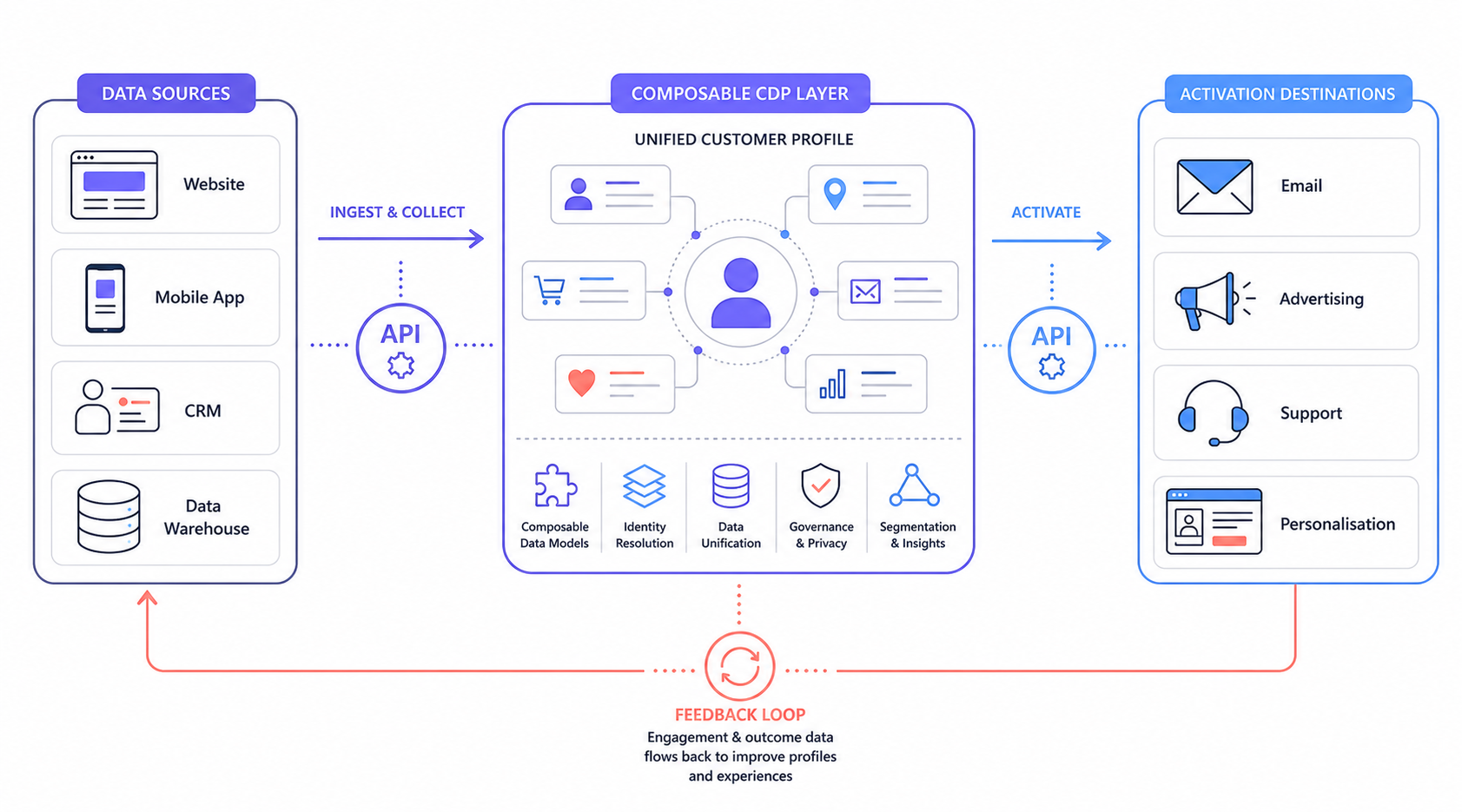
A composable CDP unifies data from multiple sources, activates it across operational tools and uses outcome data to continuously enrich customer profiles.
APIs, SDKs and connectors serve different needs
An SDK provides components that developers can embed in a website or application. It usually simplifies event collection and hides some of the underlying API calls.
A native connector is a prebuilt integration between the CDP and a particular tool. It will often handle authentication, field mapping, rate limits and common errors.
An API offers more control. It is useful when no connector exists, when a flow follows organisation-specific logic or when an action must be requested on demand. That flexibility comes with additional design, testing and maintenance.
The main types of CDP API
Vendors do not all use the same names, but their APIs can be grouped by function.
Good API documentation should provide a complete list of endpoints for each API type, including a sample input, response format and error example. REST is common, but some CDPs also provide GraphQL for profile views or analytics queries. The documentation should explain which sources can use each endpoint, whether calls are real time or batch based, and how the client is expected to handle pagination, consent and retries. It should also state whether the API is used to create profiles, update customer information, send content or return a specific value. These details help teams compare platforms and determine whether the integration can support customers at the required scale.
An API catalogue should state which data type each endpoint accepts, which platforms are supported and how long information remains available. Teams also need a list of limits for each use case: maximum batch size, event throughput, profile fields and audience refresh time. A specific client may need a customer view for support, while a marketing user may need content and analytics signals for a personalised journey. Clear examples make these differences easier to evaluate.
Data ingestion and collection APIs
These APIs bring data into the CDP. They receive events such as page views, logins, basket additions, purchases or customer support interactions.
They may also import profile attributes, transactions or product catalogues. Data can be sent one record at a time, in batches or as a stream, depending on the volume and freshness required.
Teams should check schema validation, deduplication, timestamps, event ordering and the handling of late-arriving data. Fast collection is of limited value if the resulting dataset is inconsistent. For example, an event API can be used to collect email, product and content interactions for analytics, while a profile API can provide a unified customer view. Teams should test a sample payload before moving a new source into production.
Profile and identity APIs
The same person may be represented by an email address, CRM ID, first-party cookie, loyalty number or application ID.
Profile APIs create and update these records. Identity functions link identifiers according to defined rules so that one customer is not treated as several unrelated people.
A simple upsert — create the profile if it does not exist, otherwise update it — is not the same as identity resolution. A robust identity service also handles conflicts, source priority and the ability to separate profiles that were merged incorrectly. These profile views help teams understand customers and support identity management using first-party data.
Audience and segmentation APIs
These APIs make segments available to other systems. They may expose audience membership, create an audience from a definition or check whether a profile belongs to a segment.
They are particularly useful for personalised experiences requested at runtime. A website could retrieve an attribute or audience membership to adapt a banner, recommendation or loyalty benefit.
Latency and calculation mode matter. An audience refreshed overnight does not support the same experience as a decision made when the request arrives.
Activation and destination APIs
Activation APIs send profiles, attributes, events or audiences to operational tools, including CRMs, email platforms, advertising channels, support systems and personalisation engines.
The challenge is not simply to transmit data. The integration must meet each destination’s schema, avoid unnecessary updates and recover cleanly after failures.
Webhooks and feedback APIs
A standard API request is initiated by the system that wants to read or write data. A webhook reverses that relationship: the CDP notifies another system when a defined event occurs.
A webhook can report that a sync has completed, a customer has entered a segment or an error requires attention. It avoids constant polling, but still needs authentication, retries and protection against duplicate delivery.
Where does the API sit in a CDP architecture?
A CDP architecture has three broad areas:
Sources that produce data, including applications, websites, CRMs, points of sale, support tools and data warehouses.
The customer data layer, which standardises schemas, reconciles identities, calculates attributes and builds audiences.
Destinations that use the data in campaigns, journeys, sales or customer service.
APIs can operate at each boundary. They ingest source data, expose platform functions and deliver results to destinations.
In a composable CDP, the data warehouse or lakehouse remains the source of truth. The platform reads models defined in that environment and activates the data without imposing a separate proprietary store. APIs can then focus on bespoke flows, low-latency decisions and systems for which a managed connector is not yet available.
Batch, streaming or on-demand flows
The right mode depends on the use case:
a daily refresh may be enough for a retention audience;
hourly updates may suit most CRM campaigns;
an abandoned basket event may need to arrive within minutes;
in-session personalisation may require a response within a few hundred milliseconds.
“Real time” should therefore be treated as a measurable requirement rather than a product label. Define expected data freshness, processing time and availability for every use case.
API, connector, webhook or Reverse ETL?
These mechanisms are complementary.

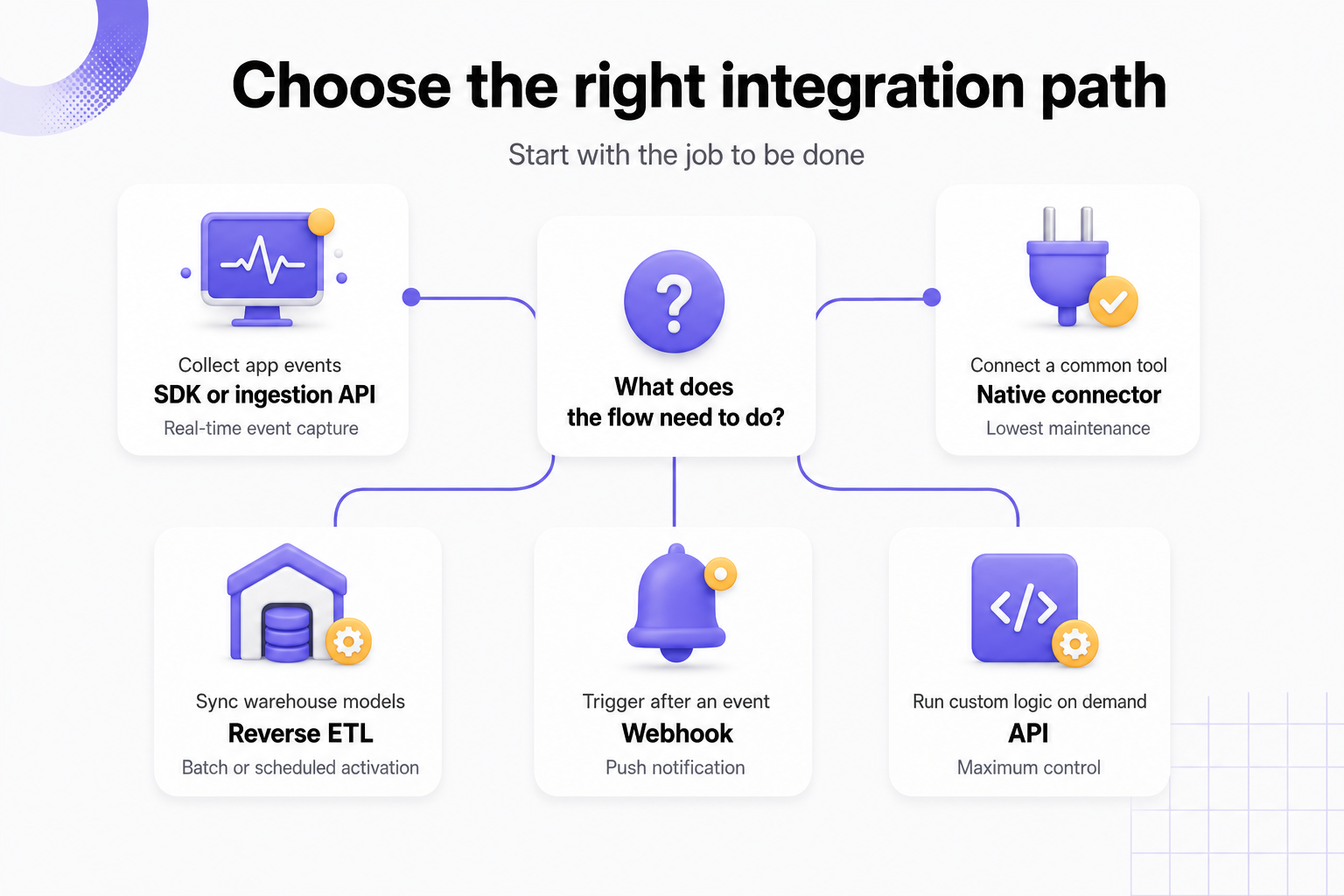
Choose the integration mechanism according to the job the flow must perform.
Requirement | Best-fit option | Why |
|---|---|---|
Connect a common marketing tool quickly | Native connector | Mapping, authentication and maintenance are already managed |
Send warehouse models to several operational tools | Reverse ETL | Differential syncs, orchestration and observability |
Notify a system after an event | Webhook | The receiving system is alerted without constant polling |
Perform a bespoke action or on-demand read | API | Fine-grained control over the request and response |
Collect application events | SDK or ingestion API | Integration designed for the application context |
Comparison of CDP integration mechanisms.
The distinction between Reverse ETL and CDP also matters. Reverse ETL is a synchronisation mechanism from a central database to operational tools. A CDP covers a wider customer-data scope: identity, segmentation, governance and activation.
Building directly on APIs can look economical for the first flow. The long-term cost tends to appear later through endpoint changes, renewed authorisations, changing rate limits, error recovery and the monitoring of multiple pipelines.
Practical customer data platform API use cases
Enriching the CRM with product signals
A B2B business can send product usage behaviour, feature adoption and intent signals to its CRM. Sales teams can then optimise account prioritisation or identify expansion opportunities.
An API is useful when enrichment must be requested on demand. For regular updates across many accounts, a managed synchronisation is often more robust.
Responding to basket abandonment
An abandonment event can add a customer to an audience and trigger a message in an engagement platform. The system must suppress the message if the order is completed, the customer has opted out or marketing pressure is already high.
This flow combines events, identity, consent, business rules and activation. Speed only creates value when those controls remain consistent.
Personalising a digital experience
An application can ask whether a profile belongs to a loyalty segment or has a strong affinity for a product category. The response then adapts the in-session experience.
This use case needs a low-latency service, a caching strategy and a fallback when the API is unavailable. The customer experience should not fail because an external service does not respond.
Supplying an advertising platform
The CDP can synchronise a consented audience to a media platform, update exclusions and return conversion outcomes to the data warehouse.
Data should be minimised, hashed where appropriate and restricted to authorised purposes. Traceability is as important as the resulting match rate.
Technical criteria to assess
Teams should compare API coverage by use case, not only by endpoint count. A profile API may provide a current view of identifiers and consent; an event API may support real-time analytics; and an audience API may be used by marketing platforms to create a personalised user experience. Different CDPs expose different levels of information, and the value of an API depends on how easily a client can use it with existing data sources. Ask for sample requests for each type, a list of supported formats and specific examples involving CRM, email and content activation. This helps teams assess whether the available interfaces support customers, profiles and events without adding bespoke data management.
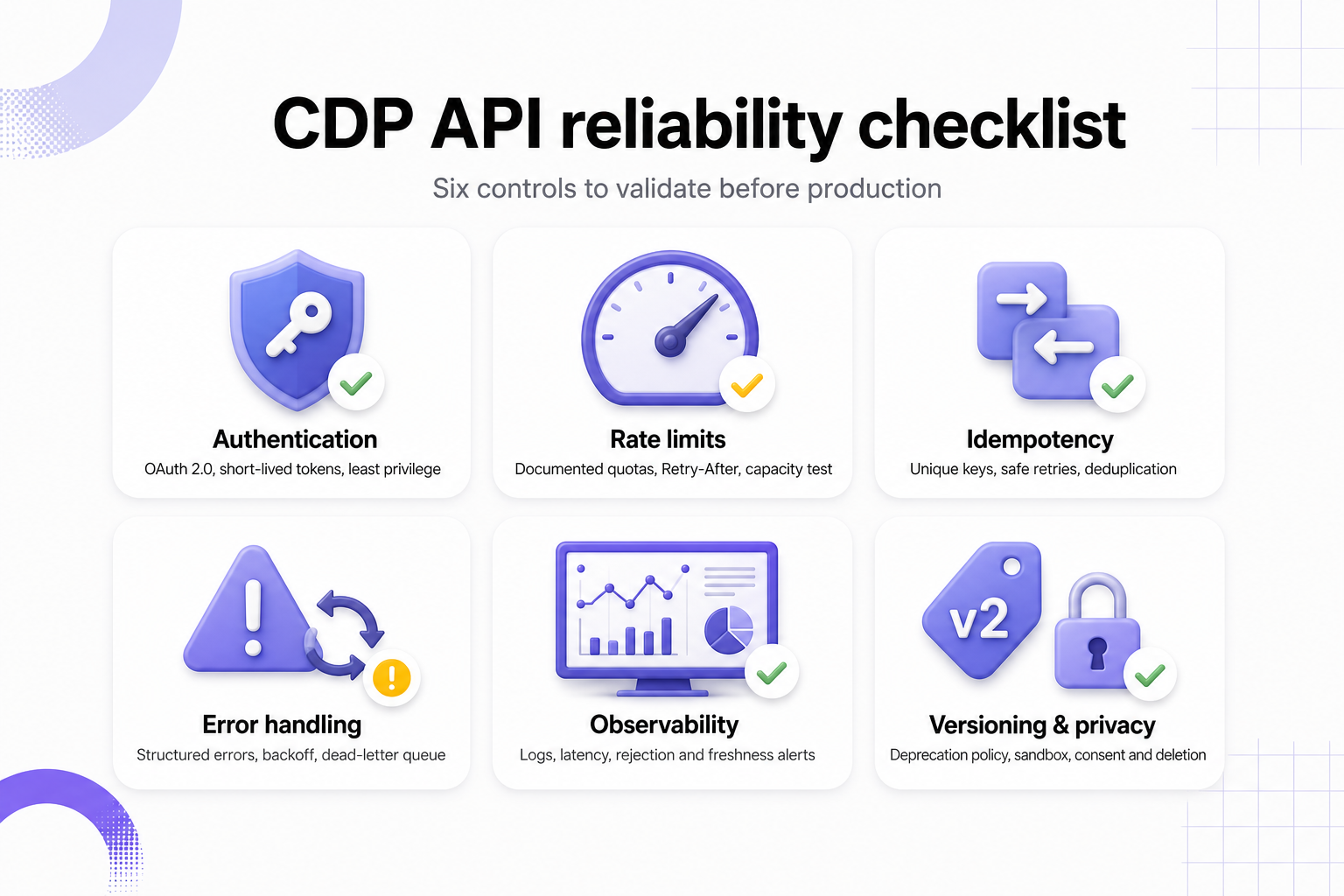
Six controls to validate before moving a CDP API flow into production.
Authentication and authorisation
An API should provide authentication suited to the context, such as OAuth 2.0, service accounts, short-lived tokens or protected API keys. Permissions should be limited by environment, resource and action.
Secrets should not be embedded in code or shared across teams. They must be renewable without interrupting every flow.
Idempotency and deduplication
A request may be repeated after a timeout or network interruption. Idempotency ensures that retrying it does not create two purchases, two profiles or two activations.
Look for documented support for idempotency keys, event identifiers and deduplication windows.
Rate limits and scalability
Limits should be explicit: requests per second, batch size, maximum payload and account-level quotas. The platform should explain how it signals throttling and when a client should retry.
A scalable architecture does not ignore these constraints. It distributes load, batches operations and applies progressive backoff.
Error handling and observability
A usable response distinguishes a validation error, an authorisation problem, temporary throttling and a service outage.
Teams should be able to see processed, rejected and pending records, inspect error messages and replay only the affected items. Correlated logs with consistent identifiers make diagnosis far easier.
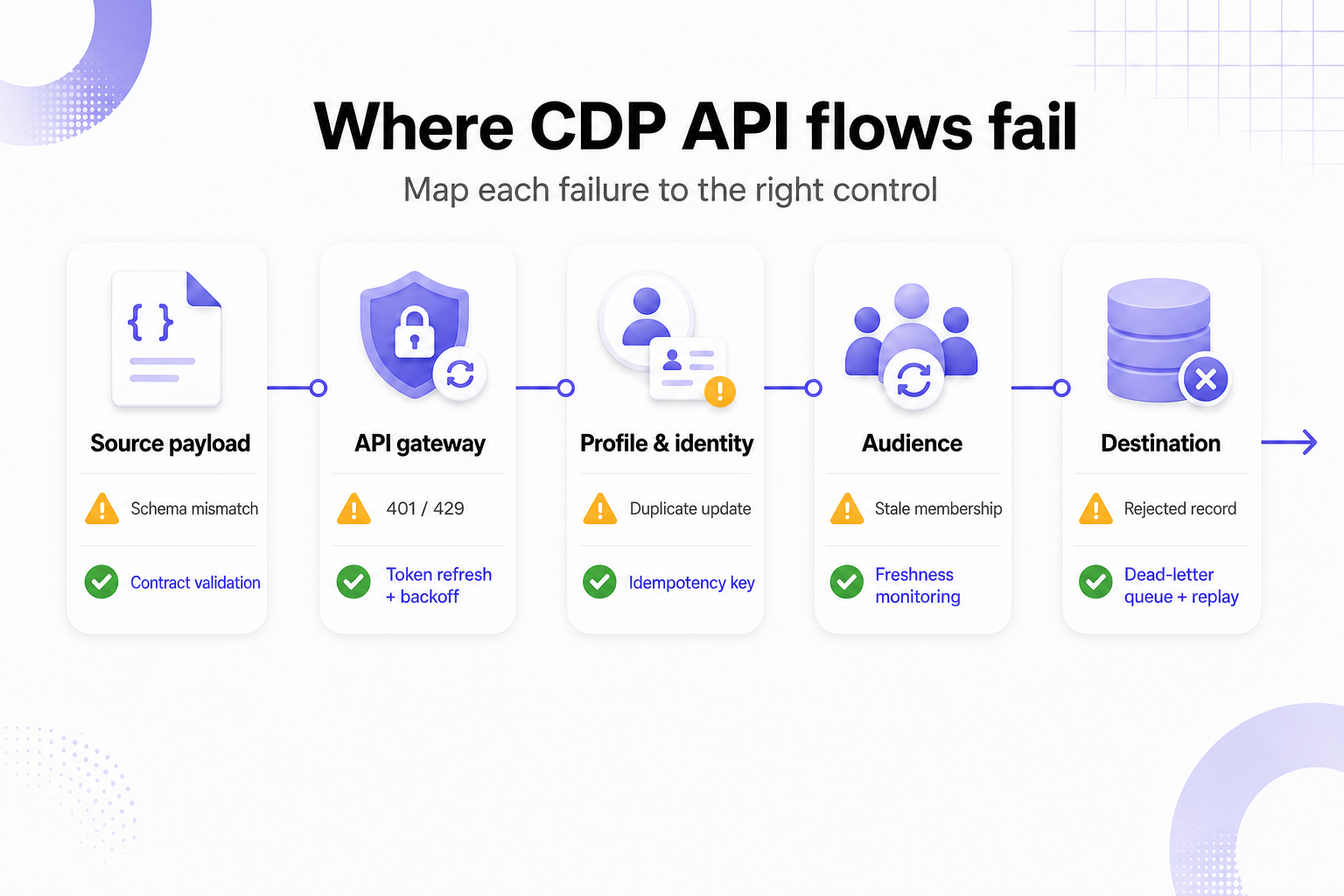
Each failure point in a CDP API flow requires a specific control.
Versioning and compatibility
APIs change. Check how long each version is supported, how much notice is provided before a breaking change and whether a sandbox is available.
Documentation should contain request examples, schemas, error codes and a clear change history.
Security, consent and governance
Data security in a composable CDP depends on both architecture and access controls. Flows should be encrypted, permissions audited and payloads limited to necessary data.
The API must also propagate consent changes, access requests and deletions. Assess where data travels, where it is logged and how long those traces are retained.
How to assess a customer data platform API
A feature demonstration is not enough. Ask to test a representative flow and examine:
sources and destinations covered by maintained connectors;
functions that are genuinely available through the API;
protocols, formats and authentication methods;
rate limits and availability commitments;
support for batch, streaming and on-demand requests;
schema mapping and field evolution;
errors, retries, alerts and logs;
consent, deletion and audit mechanisms;
sandbox access, documentation and versioning policy;
charges linked to calls, volumes and warehouse compute.
The central question is straightforward: does the API reduce integration time without creating a disproportionate maintenance burden?
Before choosing a CDP, teams need to test how the API behaves using their own customer data. For example, a first-party event can be submitted as a sample input, then traced through profile management, real-time audience calculation and activation. The test should confirm that the response format is defined, that GraphQL or REST views return the expected value, and that each client application receives only the information its user needs. It should also show how different API types support a personalised interaction without creating a second platform of record.
Implementing a CDP API integration in six steps
Define the business outcome. Start with the required decision or activation, not a list of data to move.
Choose the right freshness. State the acceptable delay between data production and use.
Define the data contract. Document fields, identifiers, formats, quality rules and ownership.
Secure the flow. Restrict permissions, protect secrets and incorporate consent by design.
Test degraded scenarios. Simulate duplicates, invalid data, throttling, token expiry and downtime.
Measure in production. Monitor freshness, success rate, latency, rejections, cost and business impact.
Begin with a representative but contained use case. A well-observed integration becomes a reusable pattern for future flows.
A CDP API should enable activation, not complicate the stack
A good API makes customer data available to the right system, at the right time and under explicit rules. It does not replace governance, the data model or managed activation capabilities.
In a composable architecture, the objective is to keep the data warehouse as the source of truth and use the simplest mechanism for each flow: a connector, Reverse ETL, webhook or API.
DinMo helps data and marketing teams activate their existing models in operational tools while limiting the bespoke pipelines they need to maintain. If you are assessing a CDP architecture or a first use case, let's discuss!
Customer data platform API FAQ
Can a CDP API replace a Customer Data Platform?
Can a CDP API replace a Customer Data Platform?
No. An API transports data or exposes a function. A CDP organises customer data, manages identities, builds audiences, applies governance rules and orchestrates activation.
What is the difference between a CDP API and a connector?
What is the difference between a CDP API and a connector?
A connector is a prebuilt integration for a particular system. It usually relies on APIs but already handles part of the mapping, authentication, rate limiting and maintenance.
Does a customer data platform API work in real time?
Does a customer data platform API work in real time?
It can, but the answer depends on the full architecture. Teams must measure collection, processing, audience calculation and availability latency, not merely the API response time.
What are the main risks of a CDP API integration?
What are the main risks of a CDP API integration?
Common risks include duplicate events, incompatible schemas, rate limits, incomplete error recovery, exposed secrets, consent failures and dependency on an obsolete API version.