

All DinMo product updates in 2025
12min • Last updated on Mar 3, 2026


Olivier Renard
Content & SEO Manager
[👉 Summarise this article using ChatGPT, Google AI or Perplexity.]
In 2025, marketing teams have had to contend with ever-increasing expectations around customer experience personalisation. At the same time, the role of the marketer is evolving, caught between privacy requirements and the rapid rise of artificial intelligence (AI).
Our goal is to give marketing teams back their ability to innovate, while lightening the day-to-day workload of data teams. A modern stack built around the data warehouse is the best way to achieve this, as it brings agility, efficiency and autonomy.
At DinMo, we remain committed to the same promise: a composable, zero-copy, AI-powered CDP, designed as a true control cockpit for business teams. In 2025, new brands such as Bayard, Huel, L’Équipe, The Bradery, Click&Boat, Respire, Premier Vet Alliance and Krüger have placed their trust in us, helping us significantly accelerate on the product side.
On the agenda:
More powerful no-code segmentation, powered by AI and the RFM method, to help you target your customers more effectively.
A data model that better reflects your business rules, with enhanced computed fields.
Our Customer Hub evolving into the marketing team’s cockpit, with an improved user experience.
Strengthened observability to monitor data flows, quality and performance in greater detail.
Advanced Enterprise and GDPR features to support the security of your use cases and full control over the data lifecycle.
An even richer activation and integration ecosystem to connect DinMo to your key tools.
Discover in detail how these new features have enhanced the way you use our Customer Data Platform. 👇
1️⃣ Segmentation, scoring and artificial intelligence
Segment Builder: new filters, new design, more insights
We’ve enhanced our Segment Builder with new types of filters and an improved interface. It now offers even greater precision and flexibility, making it easier than ever to refine your audiences.
A clearer interface
What’s changed:
Clearer buttons and more descriptive labels to improve usability.
Better readability with dynamic condition display and hover tooltips for truncated fields.
Redesigned dropdown menus to help you find fields and conditions more easily.
New filters, including percentile-based filters and dynamic date filters.
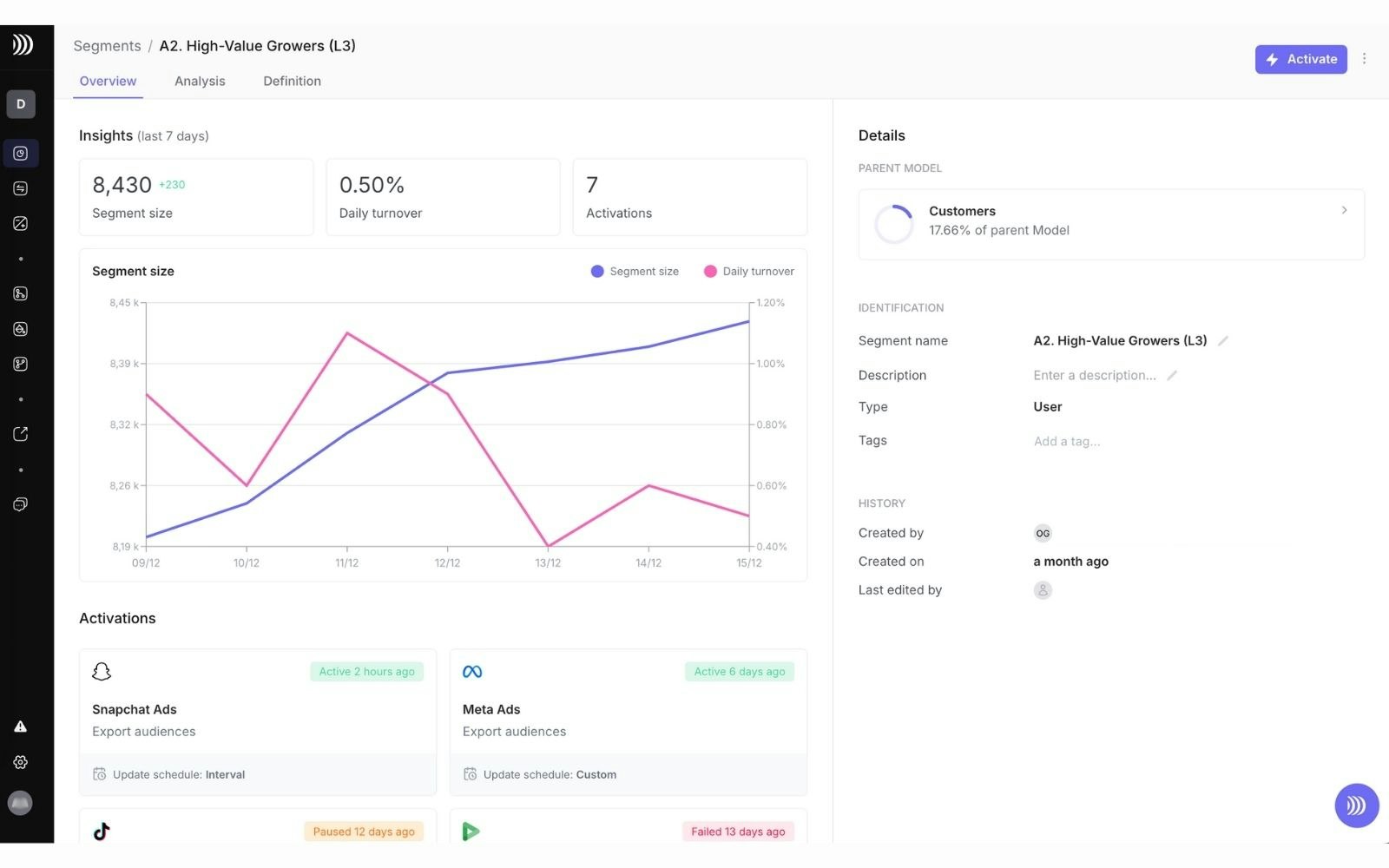
New Segment Builder interface
Built-in insights
It’s now easier to refine your audiences by understanding their composition. That’s the goal of the new insight features added to our Segment Builder:
Visualise segment distribution using interactive charts (pie or bar chart), directly available in the Breakdown tab. Perfect for exploring breakdowns by channel, region, or any categorical variable.
See the generated SQL query behind each segment. Read-only, but it lets you verify the applied logic and collaborate more effectively with technical teams.
Easily identify field types with new icons:
📅 Date field: before, after, during…
🔢 Numeric field: greater than, equal to, less than…
✅ Boolean field: true/false
These improvements, coupled with stronger observability, bring greater clarity, control, and confidence to your activations.
Predictive attributes: simpler and more powerful
Our AI prediction module has been enhanced to provide an even smoother experience and seamless integration into your workflows, with no technical knowledge required.
Create predictive attributes in just a few clicks, no-code needed: predict a customer’s future value (LTV), anticipate churn risk, or recommend the right product at the right time via an even more intuitive interface.

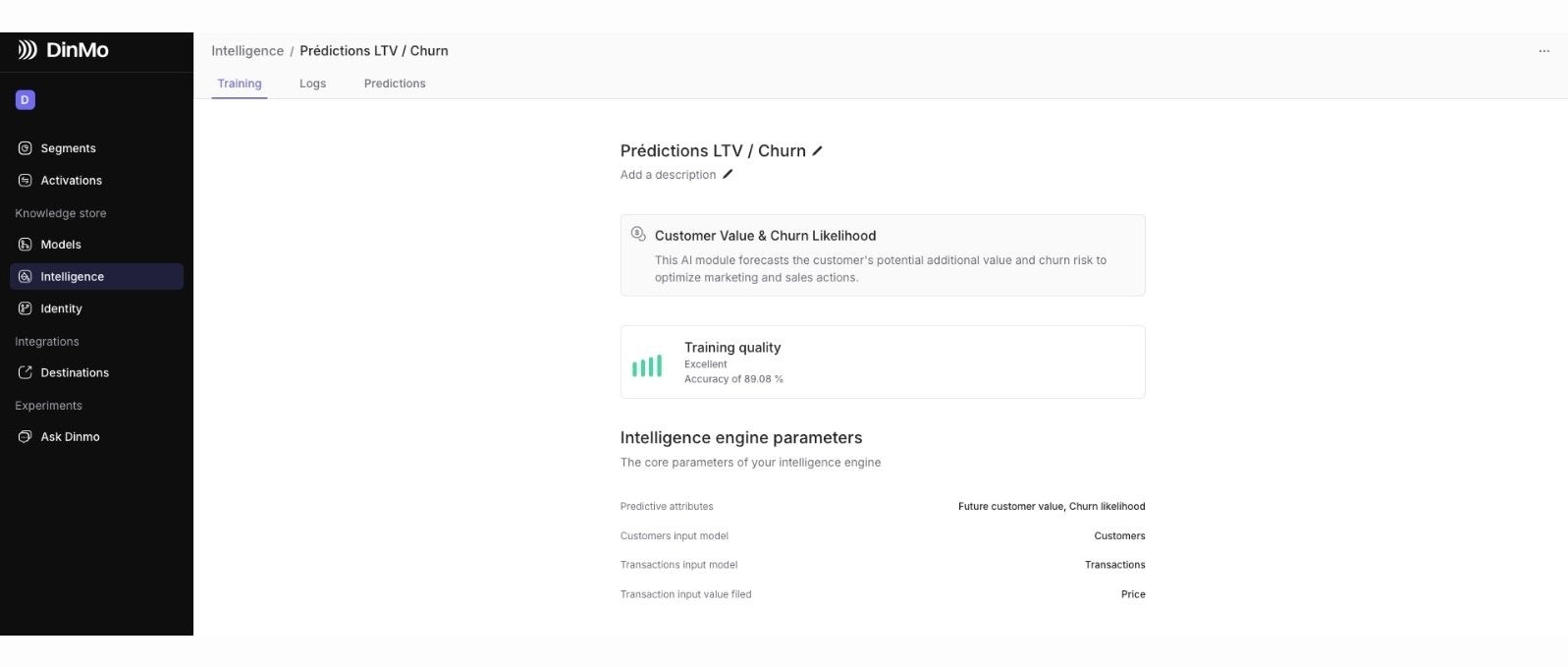
Predictive attributes LTV churn
Easily activate them anywhere: once created, these attributes can be used directly in your segments, activations, and reports. They allow for large-scale campaign personalisation with unmatched precision.
💡 Examples: target customers with a high churn risk and offer a tailored incentive to re-engage them.
Even more relevant recommendations: product recommendations now factor in user attributes (age, gender, profile…) for even more personalised suggestions.
Always up-to-date predictions: predictive values are automatically recalculated at the frequency you define, so you always work with fresh, reliable data.
RFM Segmentation
RFM segmentation (Recency, Frequency, Monetary) is a proven method for understanding your customers' purchasing behaviour. It is based on three simple criteria:
Recency: time since the last purchase. This reflects current engagement, though its relevance may vary by industry.
Frequency: number of purchases made over a given period.
Monetary: amount spent, which helps identify the most profitable customers.
By combining these dimensions, you generate an RFM score that facilitates the creation of strategic segments. For example: “Champions” (loyal and recent, high-value customers), “At-Risk” (those losing engagement), or “Promising” (new customers with potential).


Example of RFM segmentation
💡 Example use case: an e-commerce retailer might target VIPs with an exclusive offer to boost loyalty, while launching a reactivation campaign for those who haven’t ordered in several months.
With DinMo, RFM analysis is built directly into the platform.
No need to handle files or SQL: scores are automatically calculated and updated continuously.
Marketing teams can then leverage dynamic segments in just a few clicks and activate them across their preferred channels (email, push notifications, SMS, Ads…).
Improved product recommendations
Product recommendations are one of the most-used features in our CDP. They allow you to predict the next item a customer is most likely to buy, and activate these insights directly in your marketing channels.
AI-powered product-to-product recommendations suggest the most complementary items for each purchase or purchase intent.
Until now, predictions were generated across the entire catalogue. With this new update, you can now narrow the recommendation scope for even more relevant suggestions.

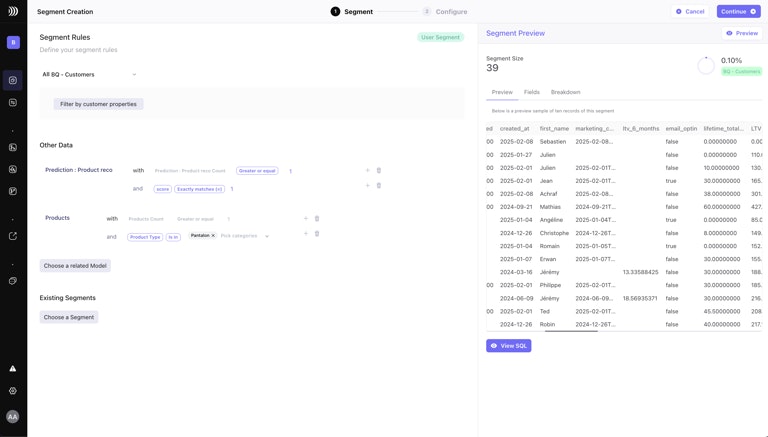
Example of product recommendation in DinMo
Specifically, you can:
Target a specific product category (e.g. beauty, electronics or fashion),
Exclude certain items (out of stock, not discounted, or reserved for another channel),
Focus recommendations on the strategic ranges you wish to promote — and send your customer the Next Best Offer.
💡 Example: suggest a fragrance from a new collection rather than letting the algorithm pick from the entire catalogue.
2️⃣ Data model and computed fields
Live or materialised models: the right balance between freshness and performance
DinMo relies on models built from your own data. They can run in live or materialised mode, each serving different needs.
In live mode, models and calculated fields are evaluated on demand, so you’re always working with up-to-date data. This mode is ideal for real-time insights, rapid experimentation or use cases where freshness is critical.
In materialised mode, models and calculated fields are pre-computed and stored. Queries are faster, the load on the data warehouse is reduced, and the experience remains smooth, even for heavy computations or repeated analyses.
The DinMo composable CDP acts as an extension of your data warehouse.
It lets you choose, for each use case, the right trade-off between freshness, performance and scalability.
Computed fields: create your own metrics without writing a single line of code
Some specific data isn’t always available in your tables. Want to target customers based on their average basket size, lifetime value or projected revenue? That’s now possible directly in DinMo, without needing help from your data team.
Thanks to the new Computed Fields feature, you can create custom fields using your existing data.

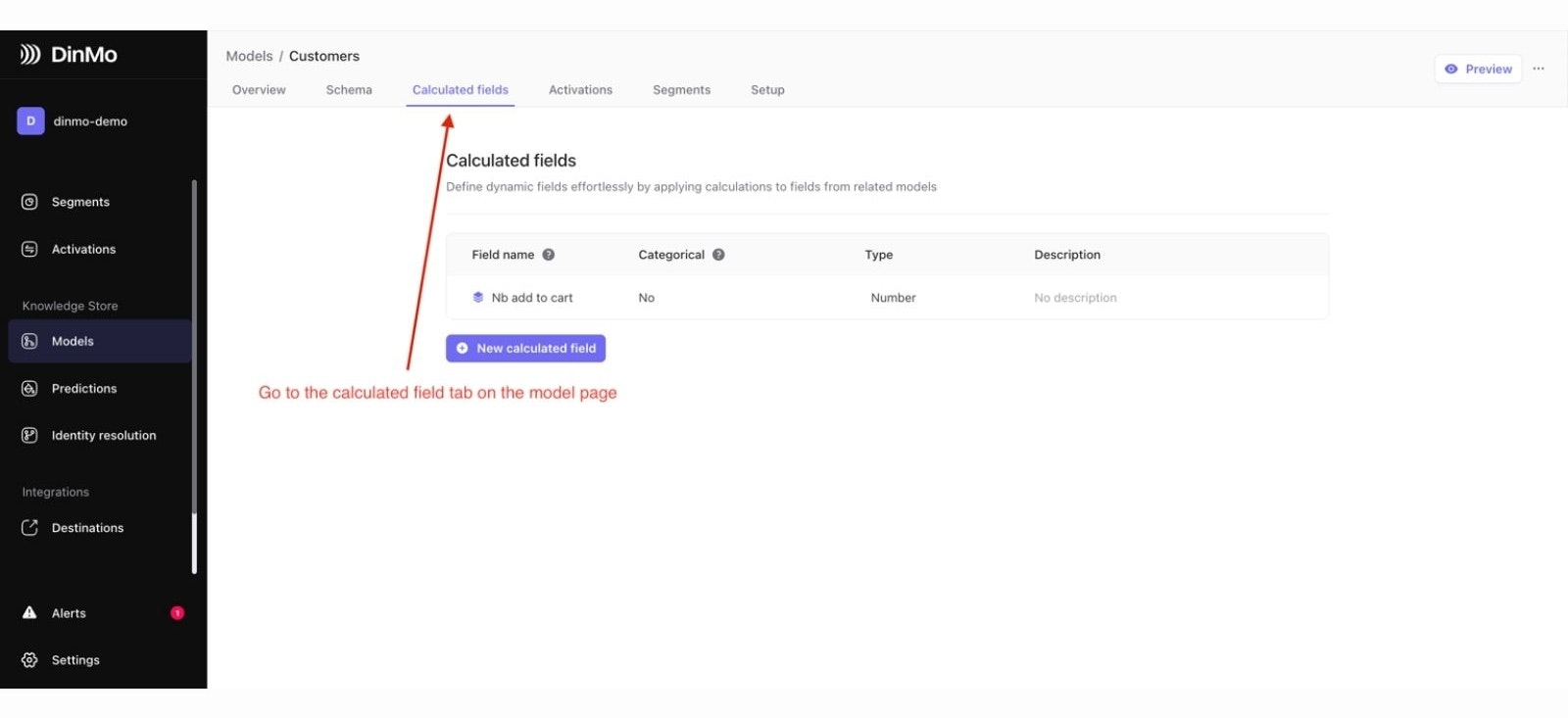
Calculated fields DinMo
These calculated fields naturally integrate into your DinMo data model. Once created, they can be used like any other field: to filter an audience, enrich a mapping, or refine your activations.
Two types of calculations are available:
Formula fields: perform simple operations between numeric fields (e.g. projected total = current revenue + forecast).
Aggregated fields: create a metric based on a related model (e.g. sum or average of a user’s purchases). Users can view a summary of the formula and a preview of the calculated values.
The interface is designed to guide users step by step, with a simple setup, real-time previews, and the ability to automatically refresh values.
This module gives marketing, product, and CRM teams greater autonomy, while improving analysis quality and activation precision.
During the year, new operators have been added, such as Minimum/Maximum functions and date-based calculations.
💡 Example: create a field « last order > 30 days » and automatically target inactive customers for a reactivation campaign.
Our calculated fields are gaining flexibility with the introduction of labelling. You can now turn any field into clear, actionable labels using intuitive if/then (case/when) logic — no SQL required.

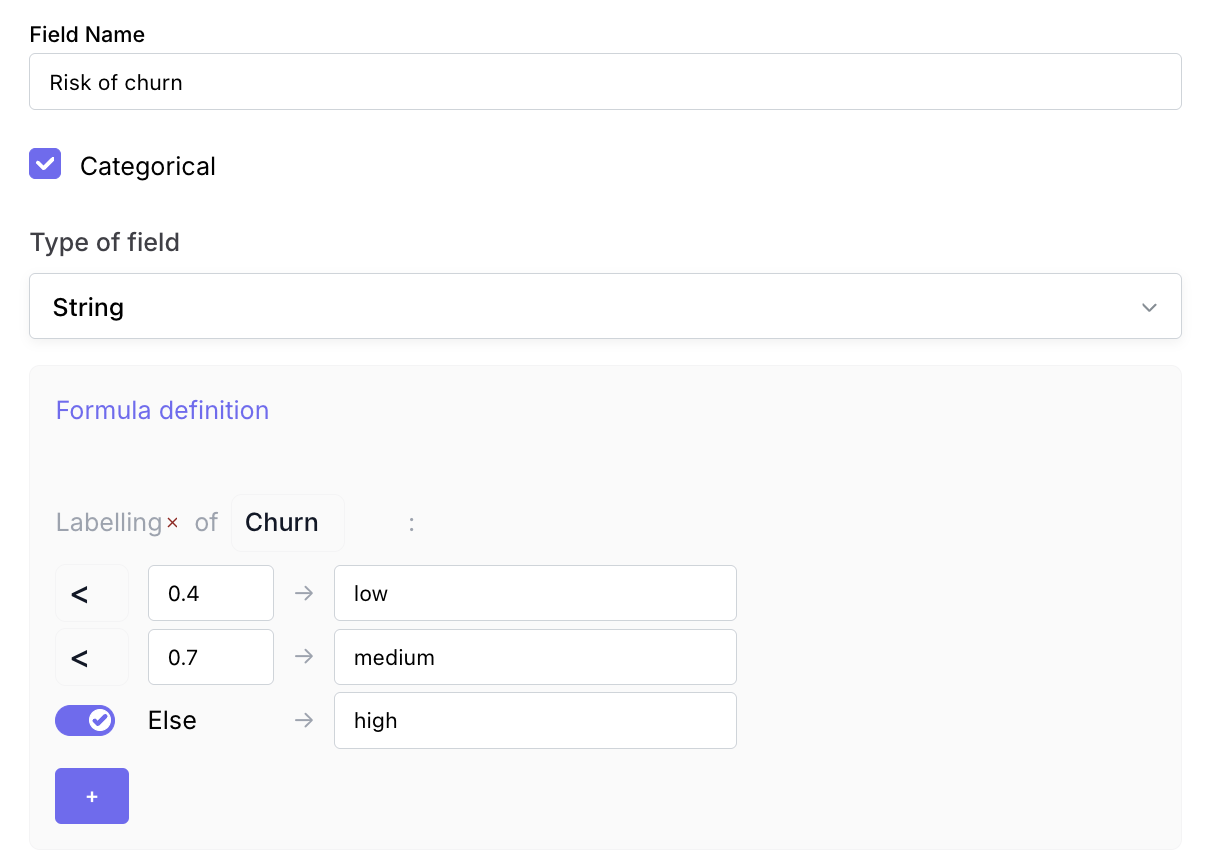
No-code labelling in calculated fields
Concretely, this allows you to create explicit categories from your data. For example, a churn score can be automatically classified as “low”, “medium”, or “high”.
Similarly, you can segment your customers by risk level, value or engagement based on simple rules.
This new function facilitates cross-team collaboration: everyone can understand and use data without relying on technical language. Analyses are faster, segments more accurate, and marketing activation smoother.
3️⃣ Customer Hub & user experience: the cockpit for marketing teams
In 2025, we turned the Customer Hub into the control centre for marketing teams. Its role is to turn data from the data warehouse into concrete decisions, without technical complexity.
A 360° customer view that business teams can use straight away
The Customer Hub provides a 360° customer profile bringing together identity data, transaction history and key behaviours. It also includes calculated fields, as well as membership of your main marketing audiences.
It also offers a clearer view of predictive attributes (AI scores such as churn, value or propensity). The goal is to provide an operational view connected to the composable CDP and the data warehouse, helping business teams make faster decisions with the right context.
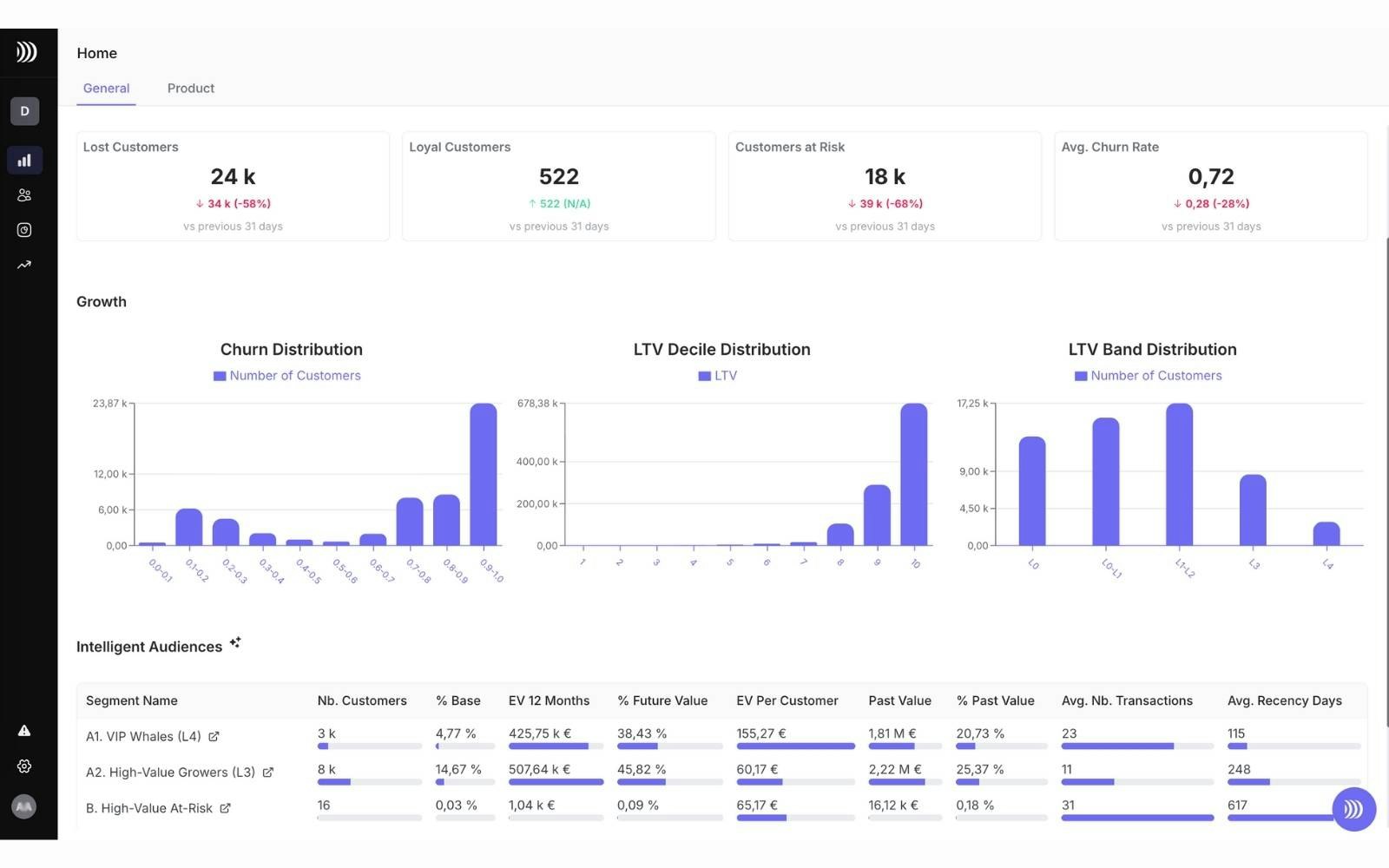
Customer Hub homepage
Measure performance by audience and run experiments
The Customer Hub isn’t limited to an individual view. It also lets you analyse audiences through a dedicated dashboard: size, growth over time, revenue, number of orders, average order value, and custom metrics.
You can compare multiple audiences side by side and track the real impact of your campaigns over time.
An experimentation module allows you to define treatment and control groups, then measure uplift on the metrics you choose – without writing a single line of SQL. Run more frequent, better-structured tests, and get a clearer view of ROI.
An experience designed for marketing teams’ day-to-day work
The Customer Hub offers a very easy-to-use interface built for operational teams. The new homepage highlights your key audiences, KPIs and signals to monitor, with smooth navigation between profiles, segments and activations.
Data teams remain in control of the models, while business teams gain autonomy to explore, segment, test and activate without relying on ad hoc queries.
4️⃣ Data observability and reliability
Enhanced observability
At the beginning of the year, DinMo introduced three new features to enhance workflow observability:
Impact analysis before deletion
Before deleting an object (model, field, activation…), the tool displays a complete impact analysis to avoid accidental loss.
🔔 Slack error alerts
Receive instant alerts in Slack when errors occur.
On-demand data lineage control
From the source interface, check in one click how your schema changes affect DinMo objects (models, fields, activations…).
Receive a summary every day automatically, or on demand. Ideal for avoiding errors in production.

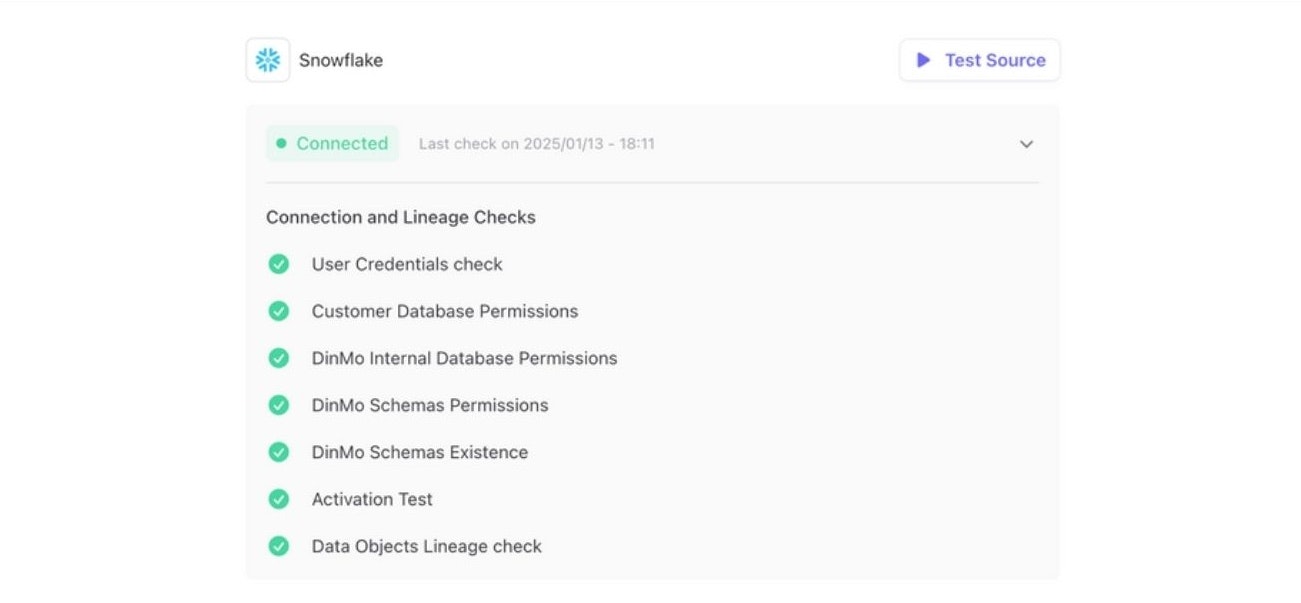
Data lineage DinMo
New alerts to monitor activations
You can now configure custom warnings for your activations to be alerted of unusual behaviour:
Activation failure: get notified if a sync fails completely.
Percentage of rejected rows: receive an alert if a high percentage of rows is rejected.
Jobs with no operations: identify inactive or broken segments if several runs send no data.
💡 Example: be alerted if more than 10% of rows sent to Meta Ads are rejected so you can act quickly and avoid losing reach.

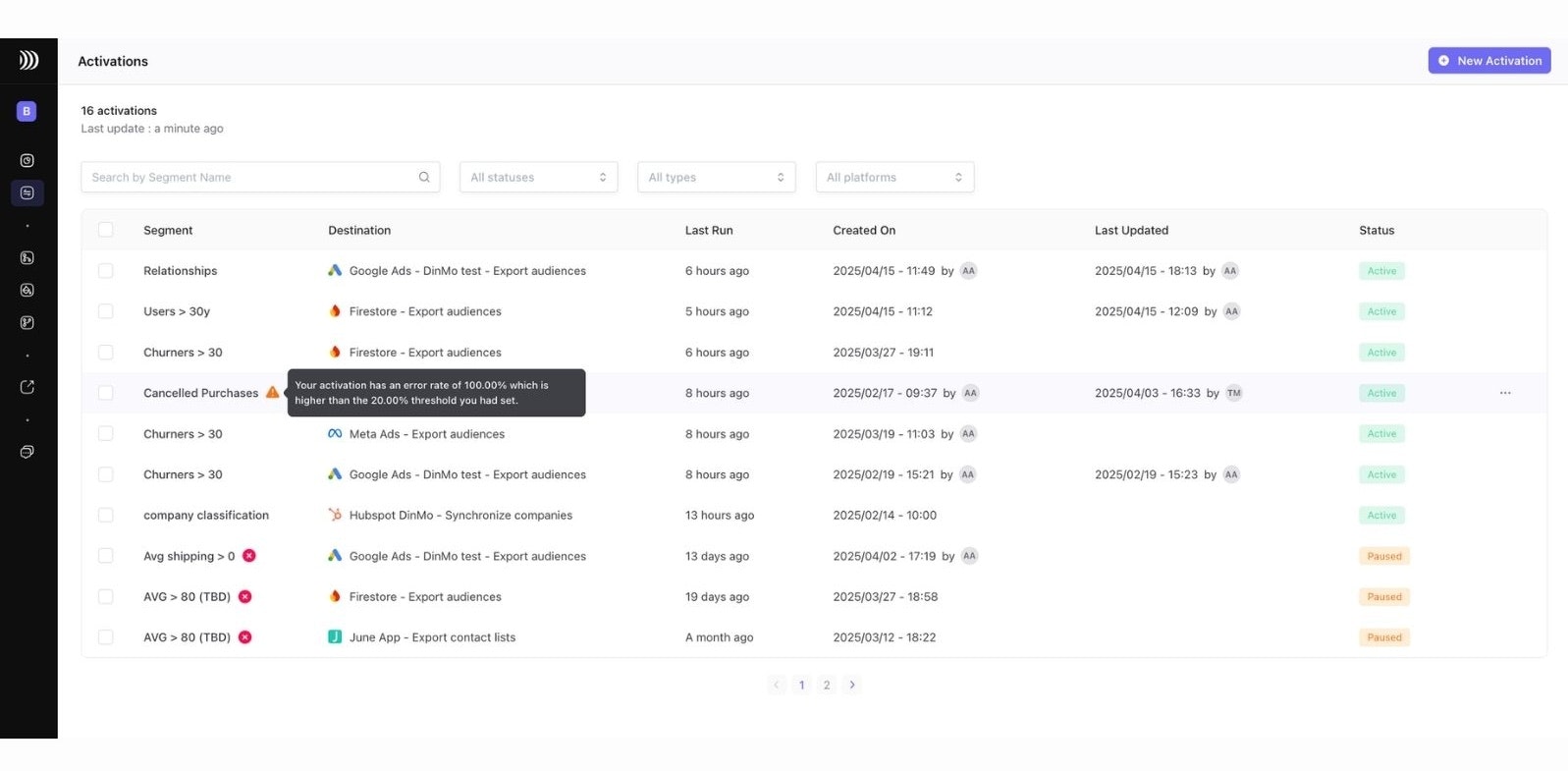
Monitoring activations in DinMo
5️⃣ Security, governance and compliance: an Enterprise-grade foundation
Fine-grained access control with SSO and RBAC
Security and ease of access are essential, regardless of the size of your organisation. SSO (Single Sign-On) is now available for Enterprise accounts.
It allows teams to log in via their identity provider (IdP) – such as Google Workspace – for centralised, more secure, and easier access management.
Okta integration lets team members access DinMo using the same credentials as their other tools – no need to manage new passwords. Okta centralises rights management: an admin can grant or revoke access in just a few clicks, while meeting the highest security standards.
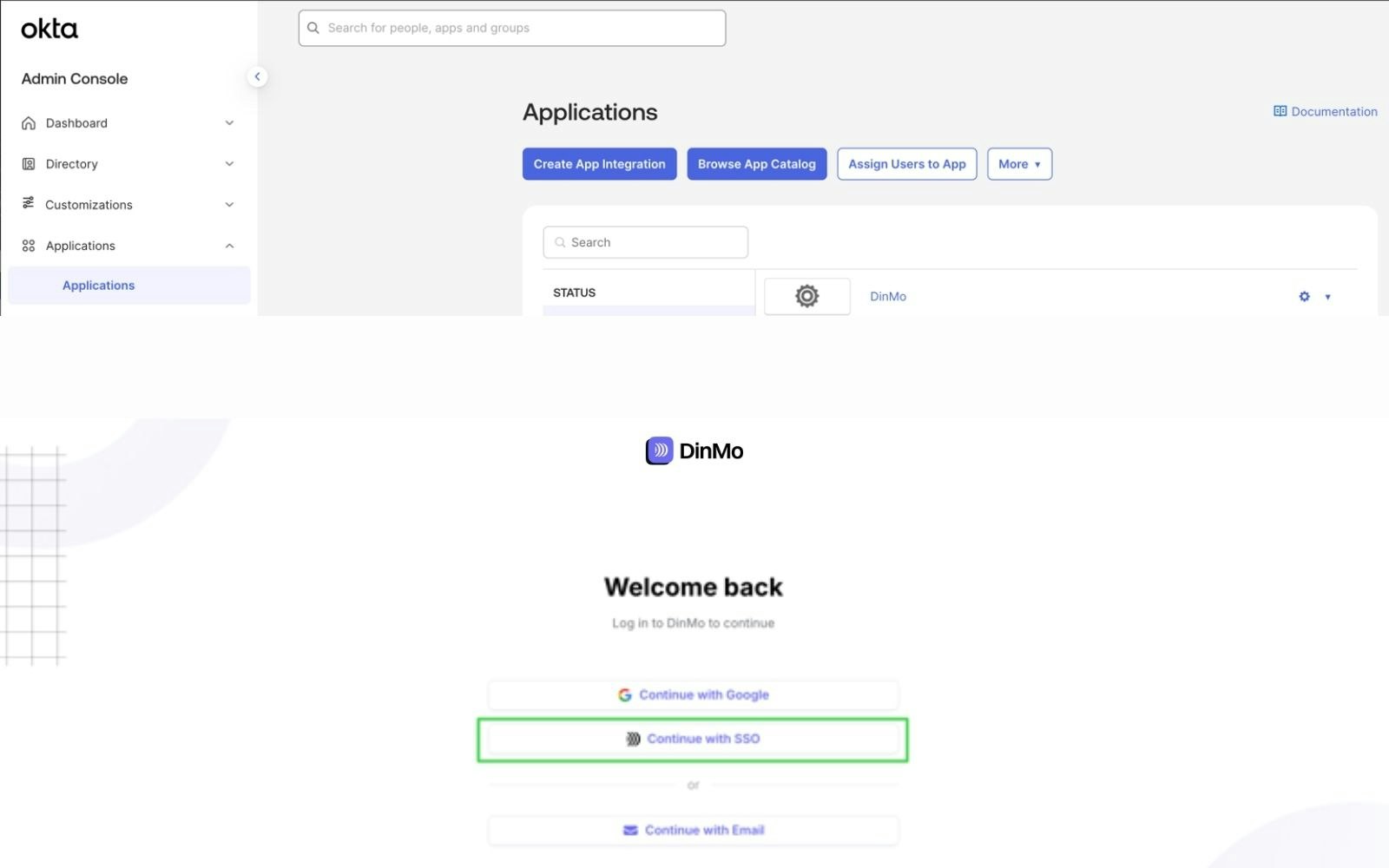
SSO login with Okta in DinMo
For teams, it means greater ease and efficiency. For the organisation, it adds an extra layer of compliance and data protection.
In addition, DinMo introduces a finely configurable role system (RBAC, or role-based access control). Permissions can be defined by module and by profile (marketing, data, ops), with multiple access levels.
DinMo aligns with the IT standards of large organisations. Each team only sees what it needs, while fully adhering to the company’s security policies.
Going further on GDPR compliance
In 2025, DinMo strengthened its capabilities to meet GDPR requirements in a practical way. Teams can now respond to right of access requests by exporting all data linked to an individual directly from the platform.
The right to erasure is also simplified: when a profile needs to be deleted, DinMo can remove it both from the platform and from the main connected business tools, preventing data from remaining active in an isolated destination.
Finally, you can configure automatic purges in destinations based on your retention rules. Adding Time to Live (TTL) fields in environments such as Firestore makes it possible to automate record deletion and align your data flows with your compliance obligations.
👇

Choose your CDP
6️⃣ Activation & integrations: a more complete ecosystem than ever
This year, we strengthened everything that connects customer data to your day-to-day tools. The goal remains the same: activate your segments everywhere, without technical friction.
A more flexible sync engine
The overhaul of the sync engine gives you much finer control over how data is updated in each tool.
Depending on the use case, you can choose between several modes:
insert to add new records only,
update to update existing records,
upsert to combine both,
mirror to keep an audience strictly aligned with DinMo,
snapshot to send a fresh “full snapshot” of your data.
This flexibility makes it possible to adapt data flows to the constraints of each destination, reduce errors, and keep your databases clean and aligned with your single customer view.
Remote segments: reconciling audiences created elsewhere
Many teams have already started building audiences in third-party tools such as Batch, Braze or Actito. With remote segments, DinMo can now pull these external segments back in, centralise them and reuse them.
You can enrich them with new attributes, analyse them over time, or push them to other destinations. DinMo therefore plays its role as an audience hub, even when the initial segmentation layer wasn’t created in the platform.
An integrations catalogue that keeps growing quarter after quarter
Throughout the year, we continued to expand our connector catalogue:
Marketing, CRM and messaging: Iterable, Actito, Klaviyo, Attentive, Dotdigital, Dialog Insight, HubSpot and Attio;
Ads and analytics: TikTok Events, Reddit Ads, Snapchat Offline Conversions, Google Store Sales Direct, The Trade Desk, Piano Analytics (including product catalogue sync);
Data and storage: Firestore, SFTP, Amazon S3, Azure Storage, Google Drive, Google Sheets, Zuora, and a Webhook connector for more specific use cases.
With this ecosystem, DinMo connects to your entire marketing and data stack for truly omnichannel activation.
Conclusion: 2025, a major year for DinMo
This year, DinMo reached an important milestone: a richer data model, AI-powered segments, a Customer Hub designed as the marketing team’s cockpit, improved flow observability, a strengthened Enterprise & GDPR foundation, and an even more comprehensive integration ecosystem.
All of this remains true to our vision: a composable CDP built around the data warehouse, where AI supports marketing decisioning and omnichannel activation – without complexity.
In 2026, we’ll continue in the same direction: AI decisioning, agentic marketing, and even greater control over your customer data.
Want to see more? Book a DinMo demo, or explore our Customer Hub, DinMo Intelligence and integrations pages.
👉 All DinMo product updates are available here: https://news.dinmo.com/