

Marketing in 2026: the trends that will change the game
8min • Last updated on Mar 3, 2026


Olivier Renard
Content & SEO Manager
[👉 Summarise this article using ChatGPT, Google AI or Perplexity.]
ChatGPT is now the 5th most visited website in the world, just ahead of Amazon (Similarweb). Three years after its public launch, OpenAI’s chatbot has transformed the way people search for information.
A new challenge for brands, long used to Google acting as the intermediary between them and users.
Artificial intelligence (AI) is a new channel like no other. It synthesises information scattered across the web to produce its own answer.
The buying journey is more fragmented than ever – across search, social, retail, and now AI. The pressure on performance keeps rising, without any drop in expectations around customer experience.
AI is accelerating everything. But trust and authenticity are once again becoming powerful differentiators, and traditional channels are far from obsolete.
🔎 Discover the key marketing trends, with examples, to adapt your strategies for 2026. 🚀
1️⃣ Shopping starts (and ends) in AI ecosystems
For many consumers, AI is seen as a neutral influencer they can turn to for advice. This true personal shopper compares offers with precision and guides your choices, without you having to visit dozens of websites.
OpenAI made waves this year by announcing the launch of ChatGPT Shopping. More than an assistant, AI is becoming a prescriber: it sorts options, summarises reviews, answers delivery questions, and then proposes a shortlist.
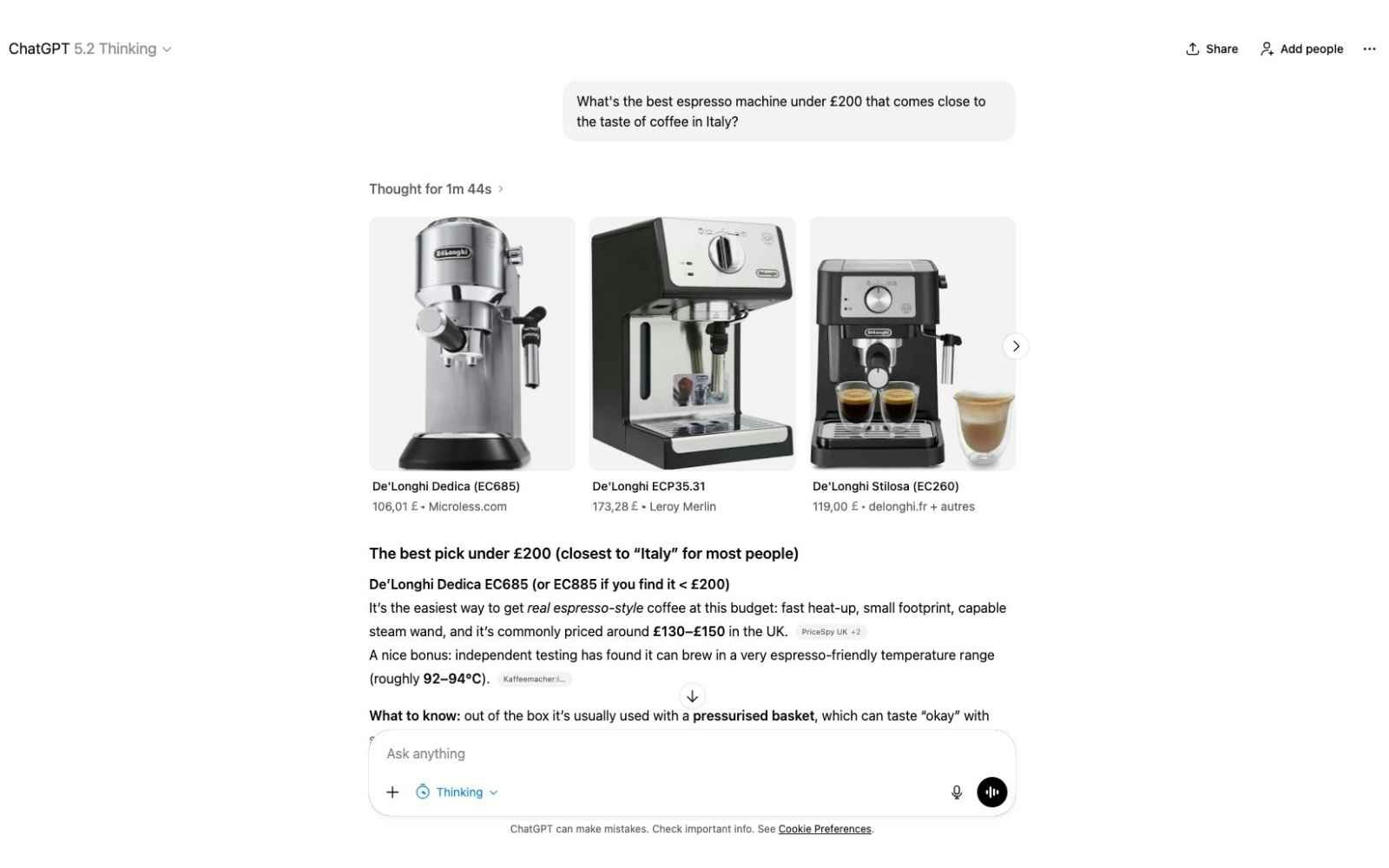
Shopping advice in ChatGPT
Product discovery now happens through conversation, with items surfaced based on the user’s need and customer profile. For brands, the challenge is clear: everything must be visible to LLMs (product pages, availability, reviews, and of course pricing) to minimise friction between intent and conversion.
And while the shift is likely to be gradual – initially affecting simpler purchases – some players are already ready. Instacart has just launched its Instant Checkout App Experience, enabling users to shop directly within ChatGPT.

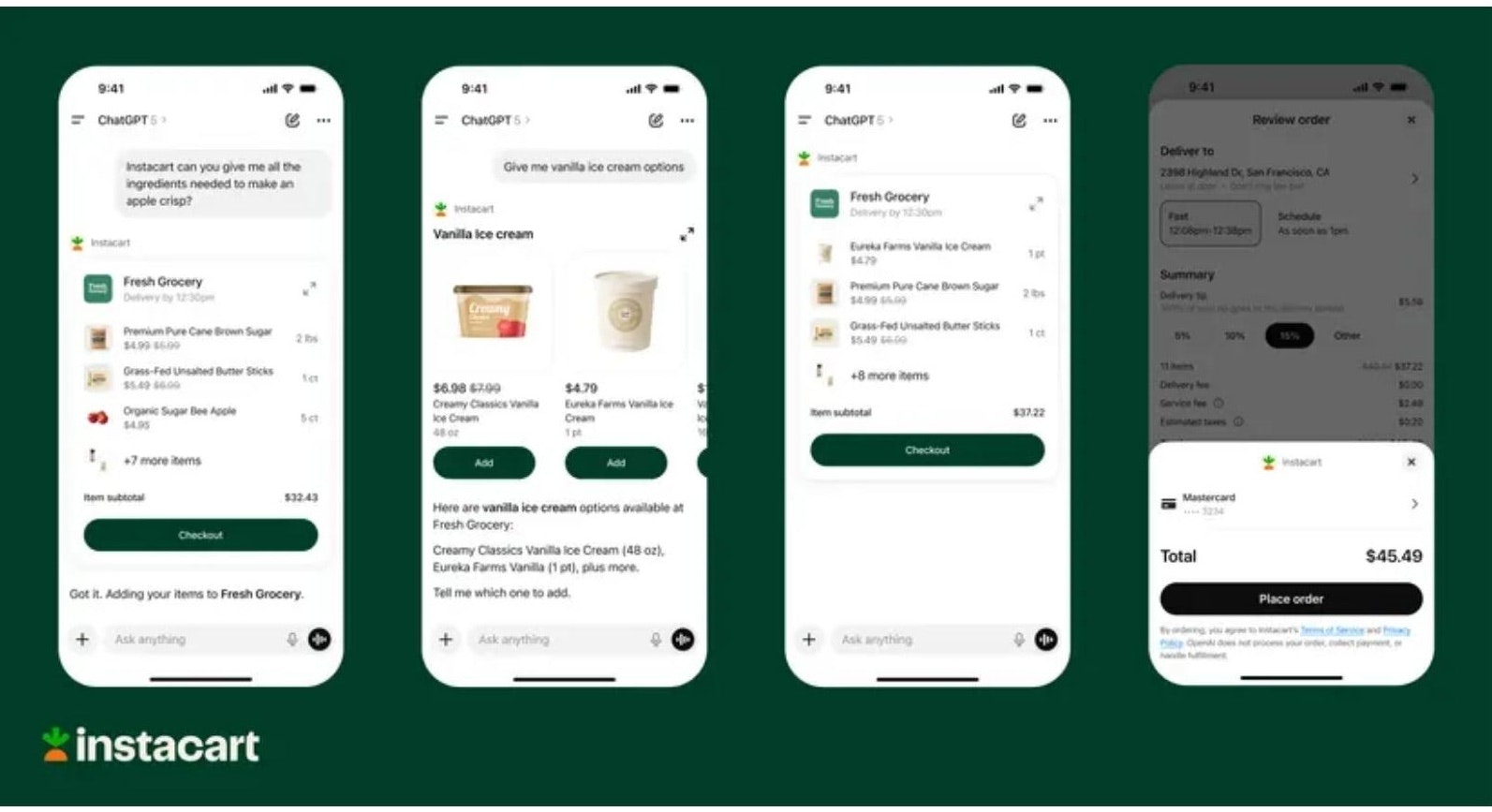
An integration made possible through the agentic commerce protocol (Credit: Instacart)
[Edit 11 January 2026] Google announced the Universal Commerce Protocol (UCP), a standard designed to connect AI agents to e-commerce systems, enabling purchases directly from interfaces such as Gemini or AI Overviews.
Where does paid advertising fit into all of this? The business model is still taking shape. The question is how long some AI players can keep going without ad revenue.
2️⃣ The era of agentic marketing
Artificial intelligence doesn’t only influence consumer behaviour. It is also reshaping how brands operate.
While some companies are only just beginning to integrate generative AI into their workflows, agentic AI is already emerging as the next revolution. Gone are the days of the “good old prompt”, painstakingly crafted for every conversation.
Agentic AI is built around AI copilots that don’t simply answer a question: they analyse, decide and act autonomously. An agent pursues an objective, monitors signals, chooses an action, checks the outcome, and then improves.
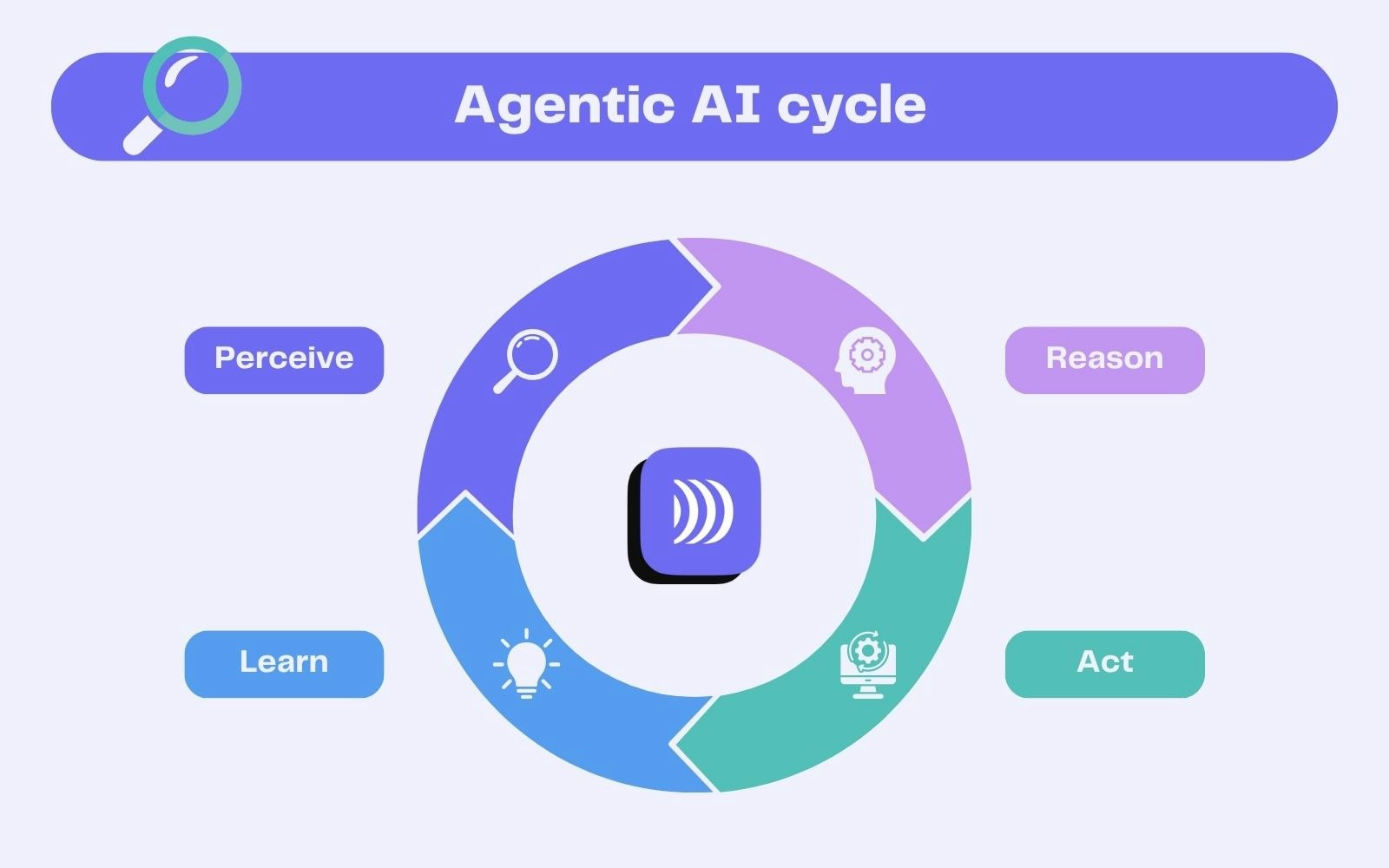
The cycle of agentic AI
For marketing teams, the impact is obvious. In this model, the marketer becomes a pilot, setting direction, arbitrating trade-offs and measuring performance.
Brands need to be agent-ready and make their offer accessible. Some are already talking about a Web 4, built around new protocols where agents communicate with other agents.
Stripe, PayPal and Shopify have in fact launched their agentic commerce offerings just weeks apart, so that a payment initiated by an agent can be recognised and securely authorised.
Stripe has spent the last 15 years optimising commerce for human buyers. Now, we are starting to do the same for agents.
Kevin Miller, Stripe.
3️⃣ Real-time hyper-personalisation of the customer experience
More than ever, consumers expect brands to deliver interactions tailored to their context, preferences and history. Those that don’t personalise recommendations lose significant conversion.
Ralph Lauren, for example, has blurred the line between physical and digital with its Ask Ralph app, a personal assistant that advises you as if you were in-store.
As algorithms become able to anticipate purchase intent before it even materialises, personalisation increasingly depends on a company’s ability to detect these signals. Brands must use data to deliver the right message at the right time to each customer, across channels.
Advances in AI now enable marketers to harness data at scale and move faster, without technical complexity. AI helps generate and test more ad variants, and adapt messaging based on the audience and the situation.
Campaigns adjust in real time to events, and the marketer becomes a conductor, setting the rules, objectives and guardrails. From there to prompt-to-campaign, it’s only a small step.

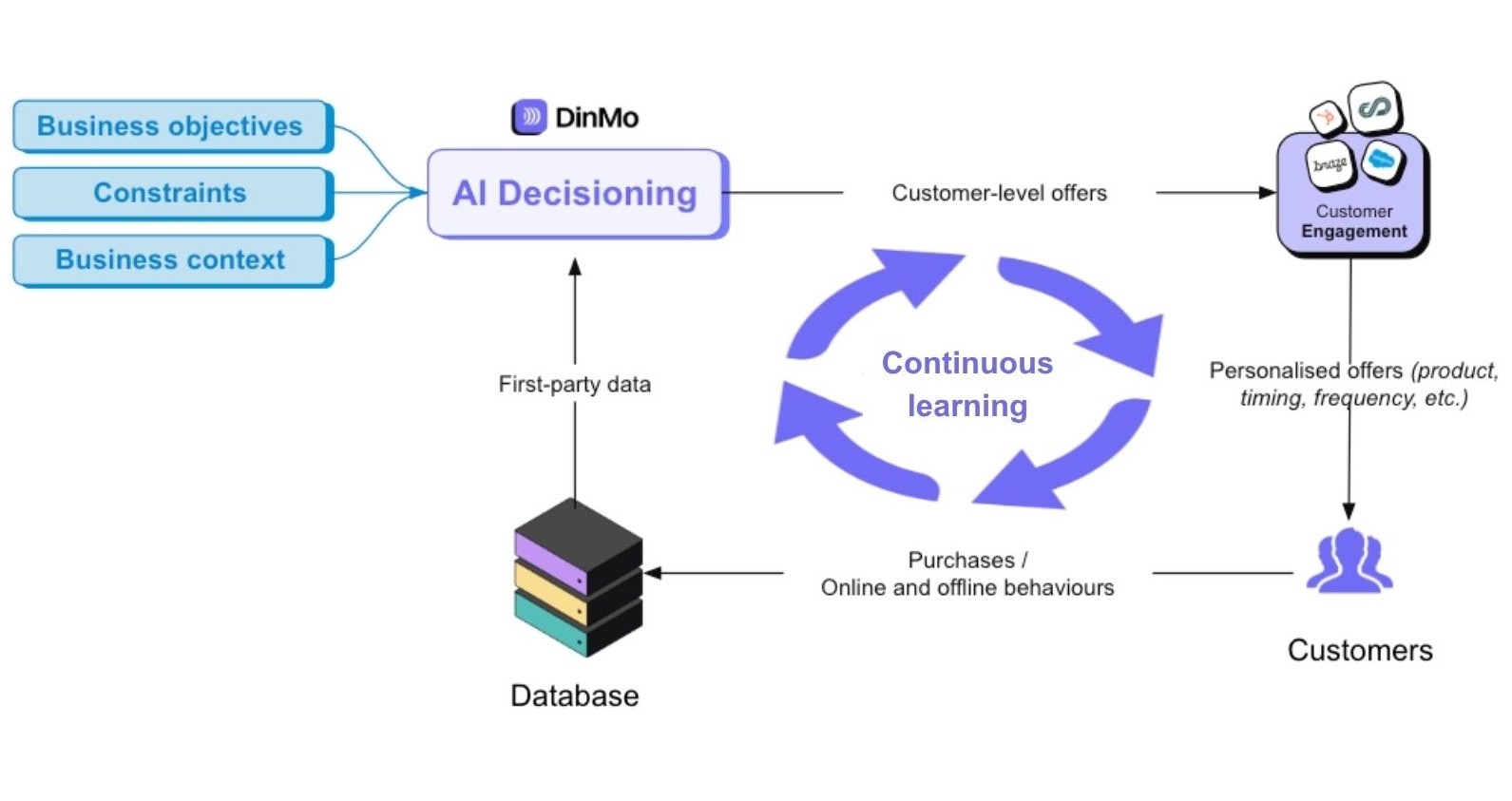
AI decisioning with DinMo
4️⃣ Google is back: GEO, the new battle for visibility
With ChatGPT’s market share in AI chatbots now above 80%, it’s easy to forget that Google remains the undisputed leader in Search. Nine out of ten queries worldwide still happen on its search engine, which has been integrating AI features for several years.
The launch of Gemini 3 in November was widely praised and pushed OpenAI to improve its models quickly. In more than 200 countries worldwide, AI Overviews provide users with a fast answer in a box above the traditional blue links.
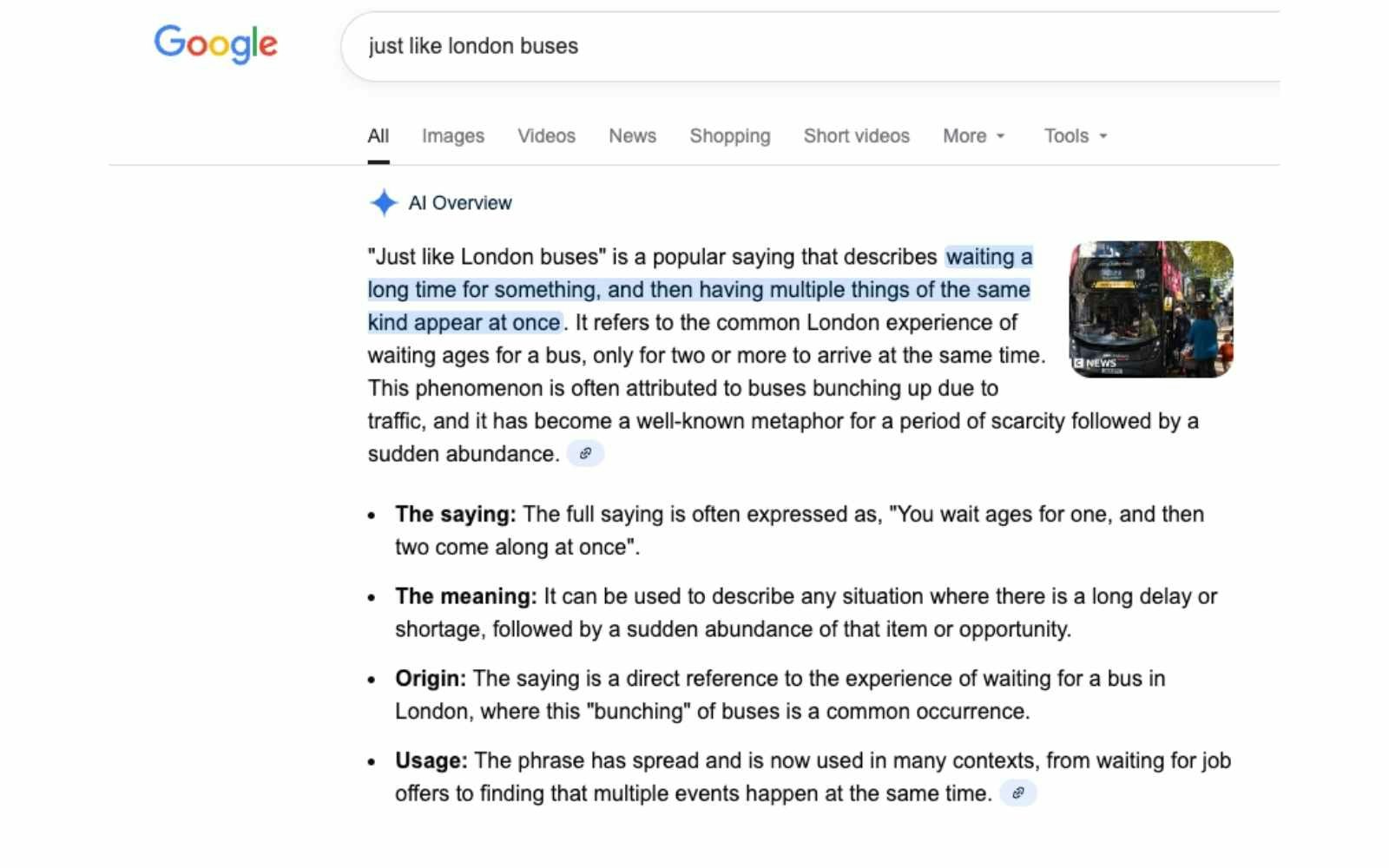
Another feature, AI Mode, offers a conversational interface directly built into the search engine. And while Chrome remains the most widely used browser, the Mountain View giant responded to the release of Atlas (OpenAI) and Comet (Perplexity) by announcing Disco, an experimental browser powered by Gemini.
Being cited more than clicked
For brands, this is a shift in paradigm: it’s no longer about being one of the answers, but the answer – the authoritative source that AI selects.
That’s the entire point of GEO (Generative Engine Optimisation), an evolution of SEO designed to increase visibility in these new generative engines, and capture the modest traffic that comes with them.
5️⃣ Social commerce: the TikTok Shop revolution
From TV shopping (one-to-many) to 2020s live shopping (one-to-few), selling “live” has long relied on a relatively limited broadcast model. TikTok Shop flips the model into many-to-many: brands, creators and a massive audience all within the same ecosystem.
Launched in France on 31 March 2025, it adds a decisive building block: discovery, proof and purchase within the same feed, with no break in the experience. And the traction is real: in the United States, TikTok Shop surpassed $500m in sales over the BFCM 2025 period (Black Friday–Cyber Monday), with 50% more buyers than in 2024.
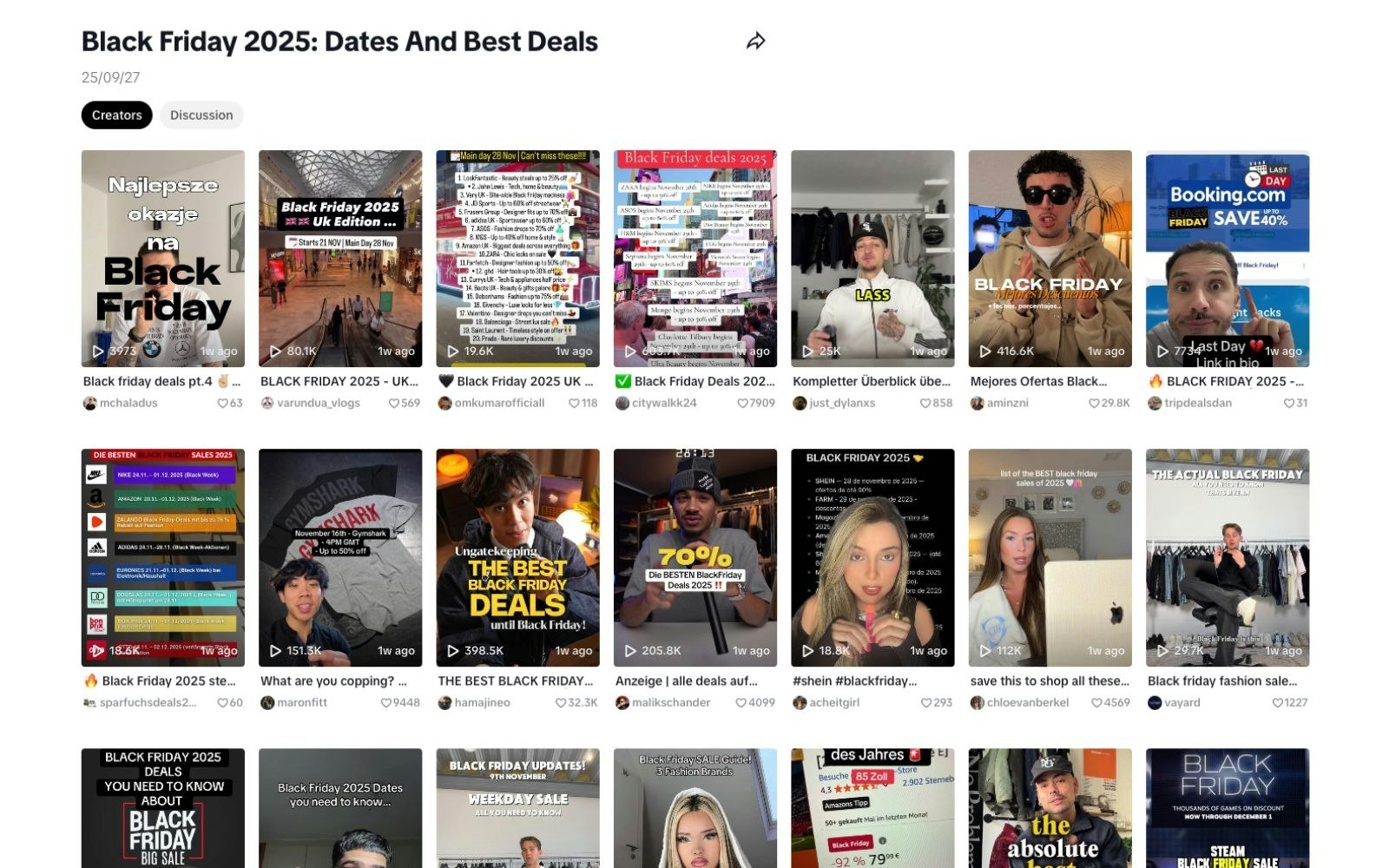
Increasingly, decisions are made within content. Demos, tests, reviews, objections handled live: user-generated content (UGC) boosts performance, provided consumer trust is maintained.
AI is also improving at the key moment of decision-making, delivering answers perceived as more neutral. In the same vein, AI influencers are emerging. They offer control and brand safety, but one limitation remains: emotional connection.
One last point: performance. Even if visibility can explode on TikTok Shop, profitability isn’t automatic. Beyond reach, you therefore need to track what truly drives sales and, above all, margin. 👉 Learn more about social commerce.
6️⃣ More and more video
Video content production is becoming almost limitless, and it’s now impossible to stand out without investing in it. Short formats, rapid creation and iteration: AI is driving costs down and accelerating everything.
Sora (OpenAI) and Veo (Google) can generate remarkably high-quality clips from a simple text prompt, complete with dialogue and sound effects. Amazon Ads, meanwhile, is already automating the creation of video ads from a product page, producing multiple variants in just a few minutes.
Brands that don’t produce enough content are losing ground to those moving fast and feeding the algorithms continuously. And this competition goes well beyond social platforms.
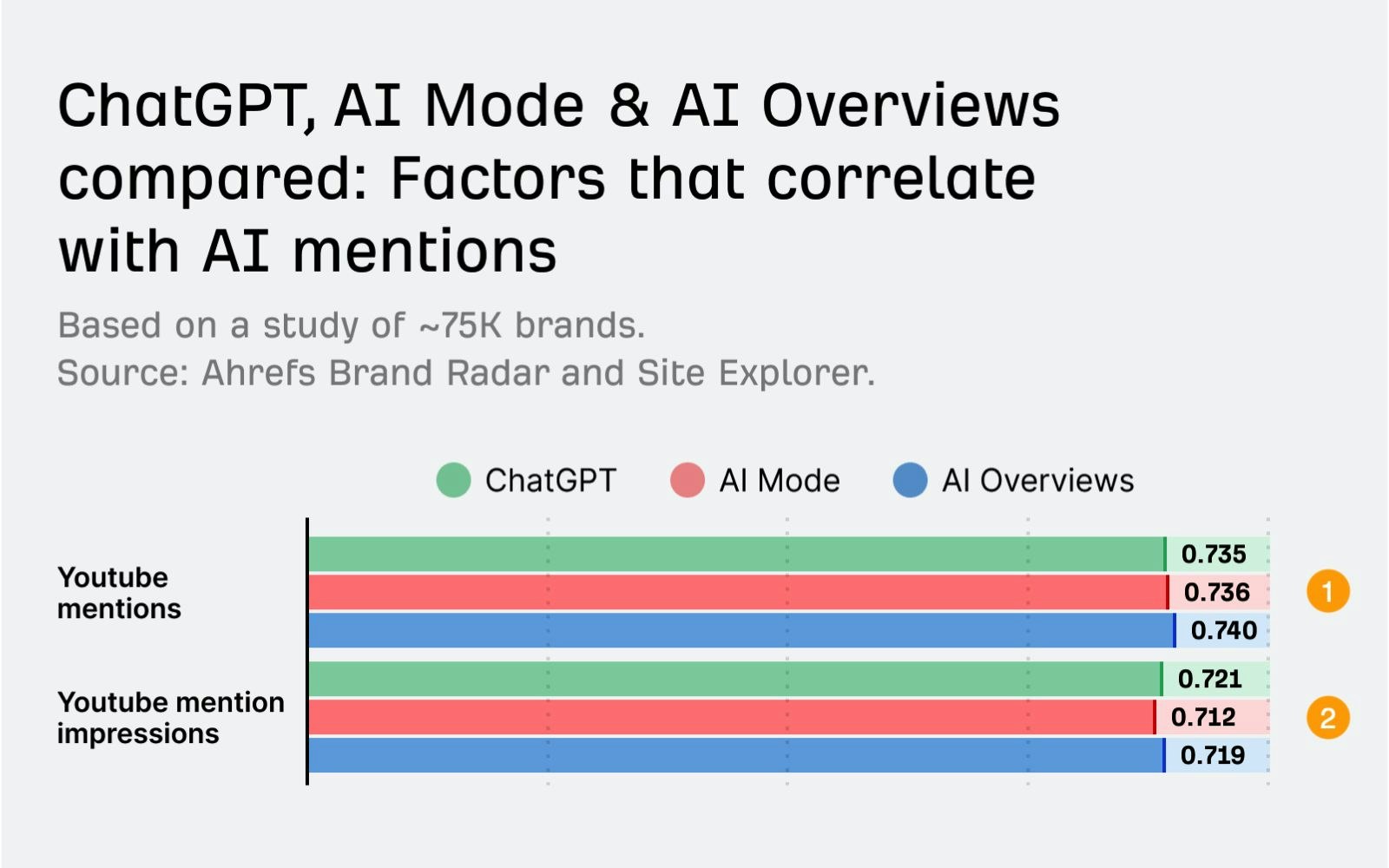
According to an Ahrefs study, a brand’s visibility in generative engines is directly correlated with mentions on YouTube. More than a format, video is becoming a must-have marketing asset.
Despite the presence of watermarks on videos generated by major AI platforms, the deepfake risk remains. The Disney–OpenAI agreement illustrates the emergence of a more formal framework.
Authenticity, storytelling and brand consistency will make the difference. And, notably, it was a three-minute video made without AI that won everyone over at the end of this year.
7️⃣ Enhanced retail
The store is a strategic channel undergoing rapid transformation. RFID, computer vision, smart trolleys: the point of sale captures what’s happening on the shop floor in real time.
Thanks to this digitisation, checkout becomes smoother, stock is managed more effectively, and the customer experience improves. Walmart has implemented an AI agent for replenishment, while Tesco is rolling out cameras to manage its aisles.
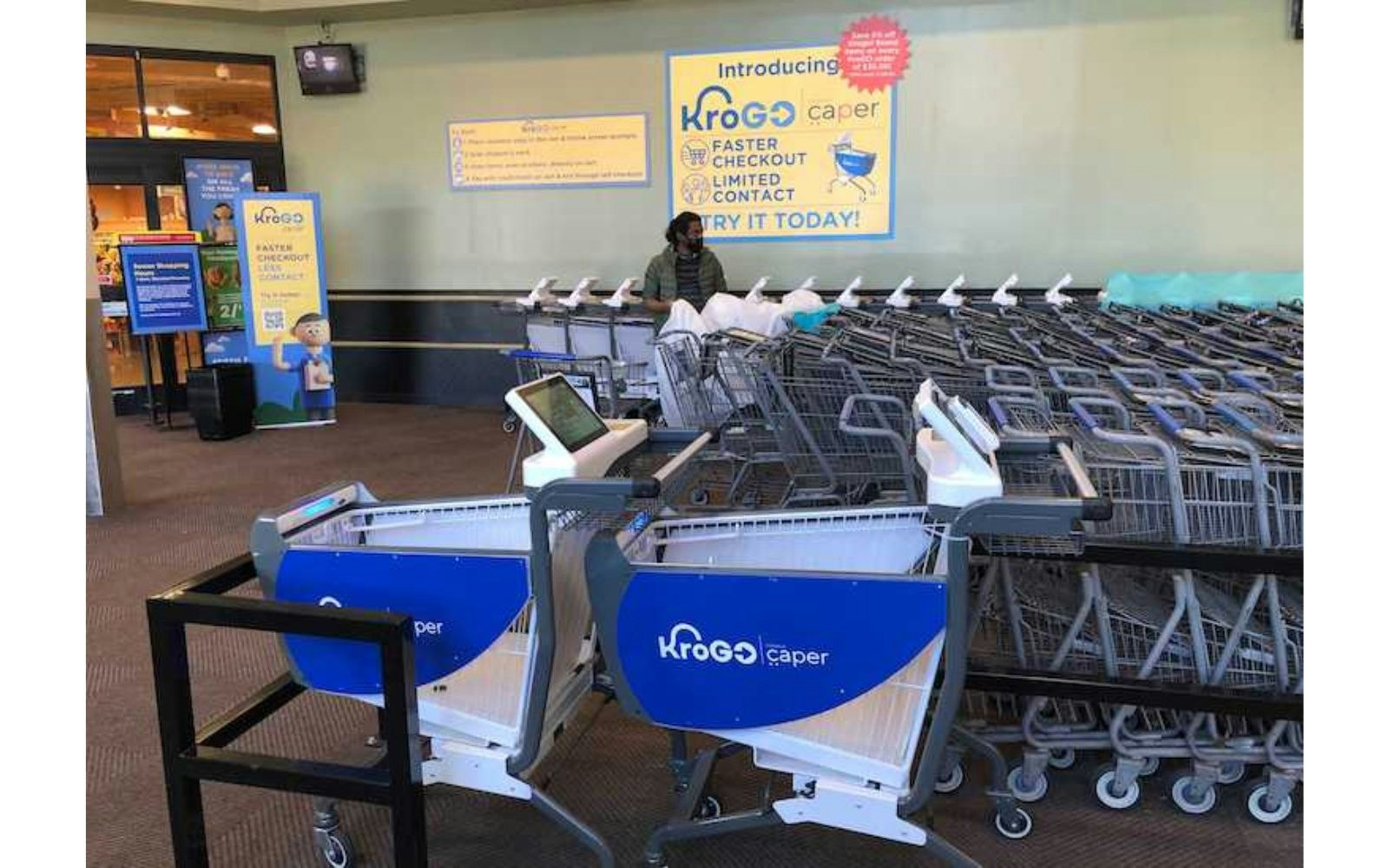
Smart cart KroGo (Credit: Kroger / Caper)
At the same time, the store is becoming a media channel. Screens, shop windows, checkout counters, interactive experiences: retail media is moving beyond digital and closer to the moment of decision. Phygital, powered by data.
The opportunity is to connect these signals and move towards truly omnichannel activation. That means linking data from different channels (CRM, website, app, transactions and in-store events) to deliver a consistent, end-to-end customer experience.
In-aisle recommendations, personalised offers, post-visit follow-ups, ad suppression after purchase, and data-driven campaign steering. Our composable CDP helps unify these flows, without duplicating data, in full compliance with GDPR.
8️⃣ Barbell effect: ultra low-cost vs premium brands
Shein made headlines towards the end of this year — and not always for the right reasons. Yet the wave of bad press surrounding the Chinese platform hasn’t slowed the rise of ultra low-cost.
We’re seeing brands become increasingly polarised, with mid-market positioning harder and harder to defend. On one side, an acquisition model driven by price and volume:
Amazon is pushing a dedicated experience with Bazaar (formerly Haul).
Temu continues to impose its deal-driven habits.
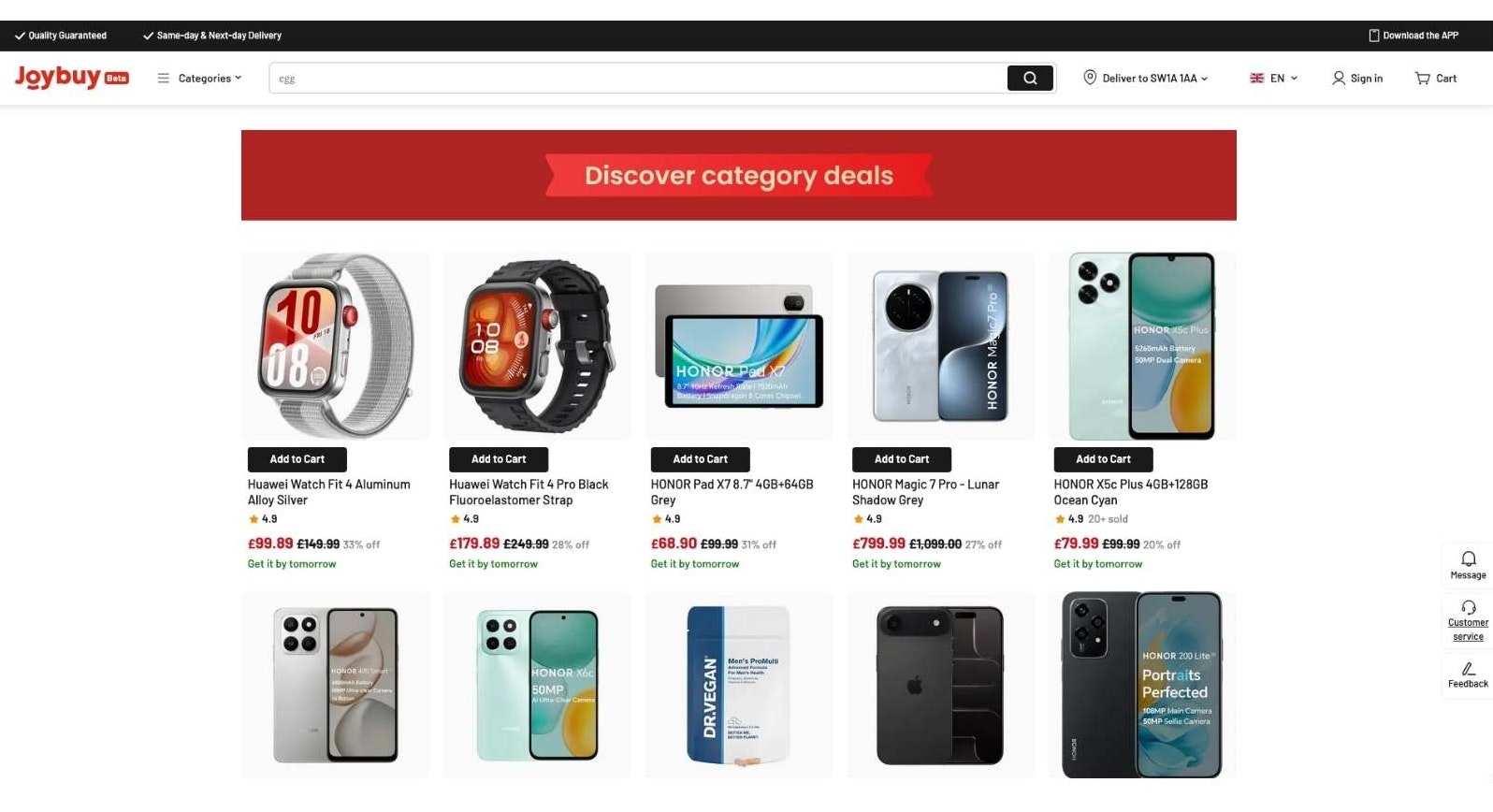
JD(. )com’s Joybuy is entering Europe with a platform promise close to Amazon’s and an ambitious logistics execution.

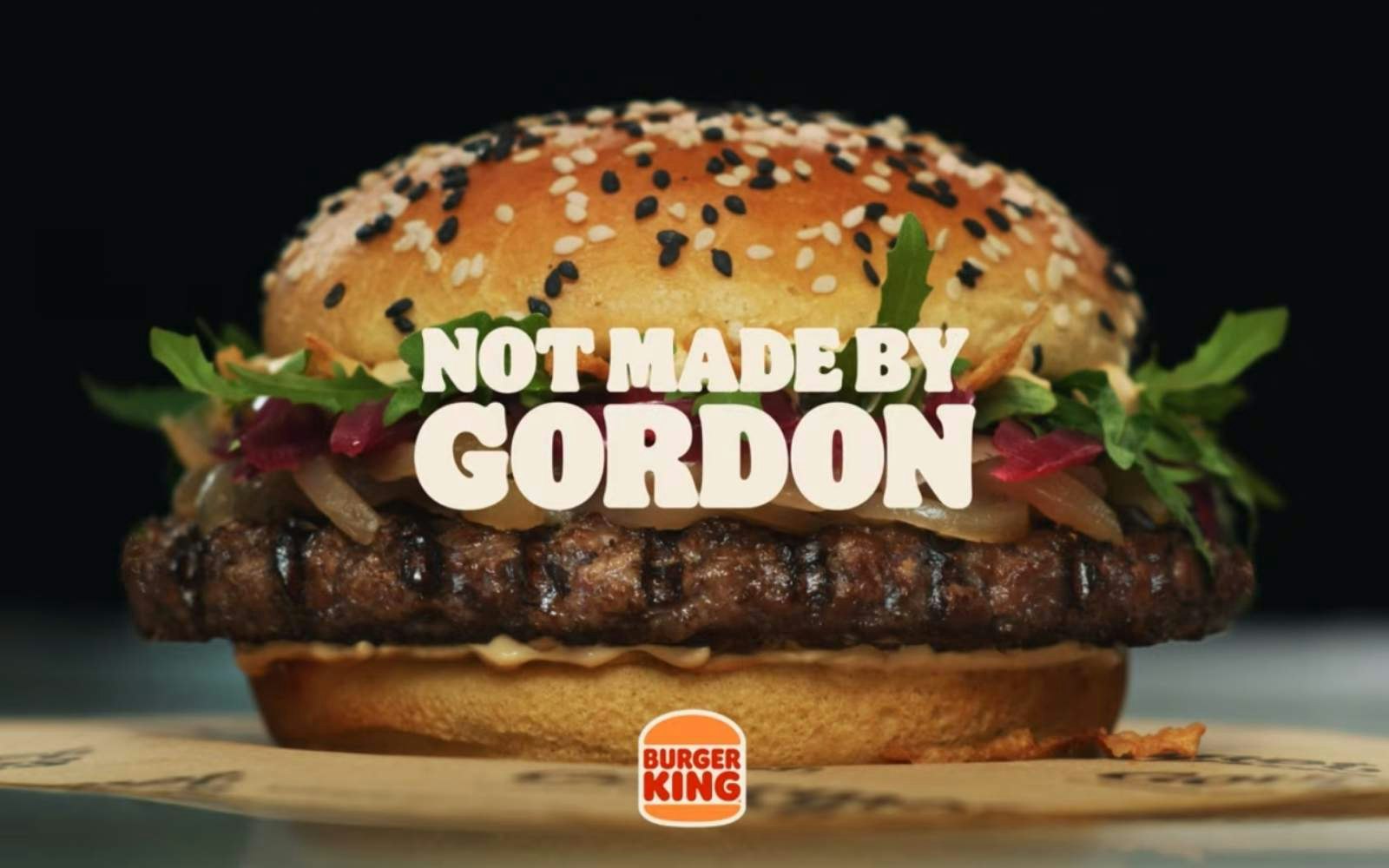
On the other side, the brands that hold their ground are built on clear values: originality, quality, durability, craftsmanship. Beyond storytelling, consumers want evidence they can verify, and controversies become costly fast when doubt sets in.
Branding is evolving: it’s no longer enough to promise, you have to prove it. Traceability, reviews and consistency build trust and create a lasting advantage.
8️⃣➕1️⃣ What AI can’t copy: your brand DNA
AI, AI, AI. What if the key to success was first and foremost within your own organisation?
It’s obvious that artificial intelligence will accelerate the production of content and offers, and make automation easier. But it can also generate polished, standardised, interchangeable messaging, which ultimately weakens performance.
Differentiation also comes from the connection between your brand and the consumer.
Leverage your first-party data (purchases, usage, preferences, reviews, frequency). These are your real signals. They enable true personalisation for your audience, and help you speak with accuracy and relevance.
Invest in authenticity and an emotional bond with your customers. Trust is built on tangible elements: tone of voice, customer service quality, and brand consistency. Your community will turn a strong experience into long-term brand equity.
The challenge is to connect these assets to deliver the best possible interaction across every touchpoint. AI amplifies, but you’re still in the pilot’s seat.
Happy New Year 2026!