



Next Best Offer: delivering the most relevant offer through data
6min • Last updated on Mar 3, 2026


Olivier Renard
Content & SEO Manager
[👉 Summarise this article using ChatGPT, Google AI or Perplexity.]
Consumers are exposed to an ever-increasing volume of marketing messages. At the same time, brands face a paradox: they have access to more data and more channels than ever, yet they must carefully manage marketing pressure and improve message relevance.
In response to this complexity, strategies are shifting towards more personalised approaches. The concept of the Next Best Offer sits squarely within this logic.
Key Takeaways:
The Next Best Offer (NBO) consists of identifying the most relevant offer to present to a specific customer at a specific moment.
It relies on analysing customer data, behaviours and context to personalise propositions. Artificial intelligence helps prioritise these offers.
NBO differs from Next Best Action (NBA), which encompasses a broader range of possible actions.
Its effectiveness depends on the quality and freshness of the data. A composable CDP makes activation easier.
🔎 Discover what Next Best Offer is, its use cases, and its role in marketing personalisation. How do data and AI help identify the most relevant offer for each customer? 💡
What is a Next Best Offer?
Next Best Offer (NBO) refers to the most relevant offer to present to a specific customer at a specific moment.
It is based on a simple principle: deliver the right message to the right person at the right time.
Unlike a traditional product recommendation, NBO does not simply suggest similar or popular items. Its purpose is to determine which commercial proposition will generate the greatest value, both for the customer and for the business.
This approach relies on analysing customer data and leveraging machine learning models. While closely related to the concept of Next Best Action (NBA), Next Best Offer has a more focused scope.
👇


Data activation driving growth: K-Way x DinMo
Importance in marketing
NBO addresses the rapid evolution of marketing environments. Brands now interact with customers across a wide range of channels: email, ads, mobile apps, social media, in-store touchpoints, and customer support.
In this context, simply increasing the volume of messages is no longer enough to capture attention or drive engagement. Consumers expect more personalised experiences and are less receptive to generic outreach.
An offer perceived as repetitive or poorly targeted can damage the customer relationship, fuel marketing fatigue, and increase the risk of churn. The purpose of Next Best Offer is precisely to reduce saturation and improve the relevance of commercial propositions.
Next Best Offer vs. Next Best Action: what’s the difference?
Next Best Offer and Next Best Action are closely related concepts, but they do not cover the exact same scope.
Next Best Offer focuses on a specific question: which offer should be presented to this customer? This could be a promotion, a product or service recommendation, or an upsell/cross-sell proposal.
Next Best Action takes a broader perspective: what action should be triggered for this customer? The intent can go beyond commercial objectives. For example:
sending informative content,
delaying a marketing message,
triggering a retention initiative,
offering assistance or a service.
While NBO aims to optimise immediate conversion, NBA focuses on improving long-term engagement.
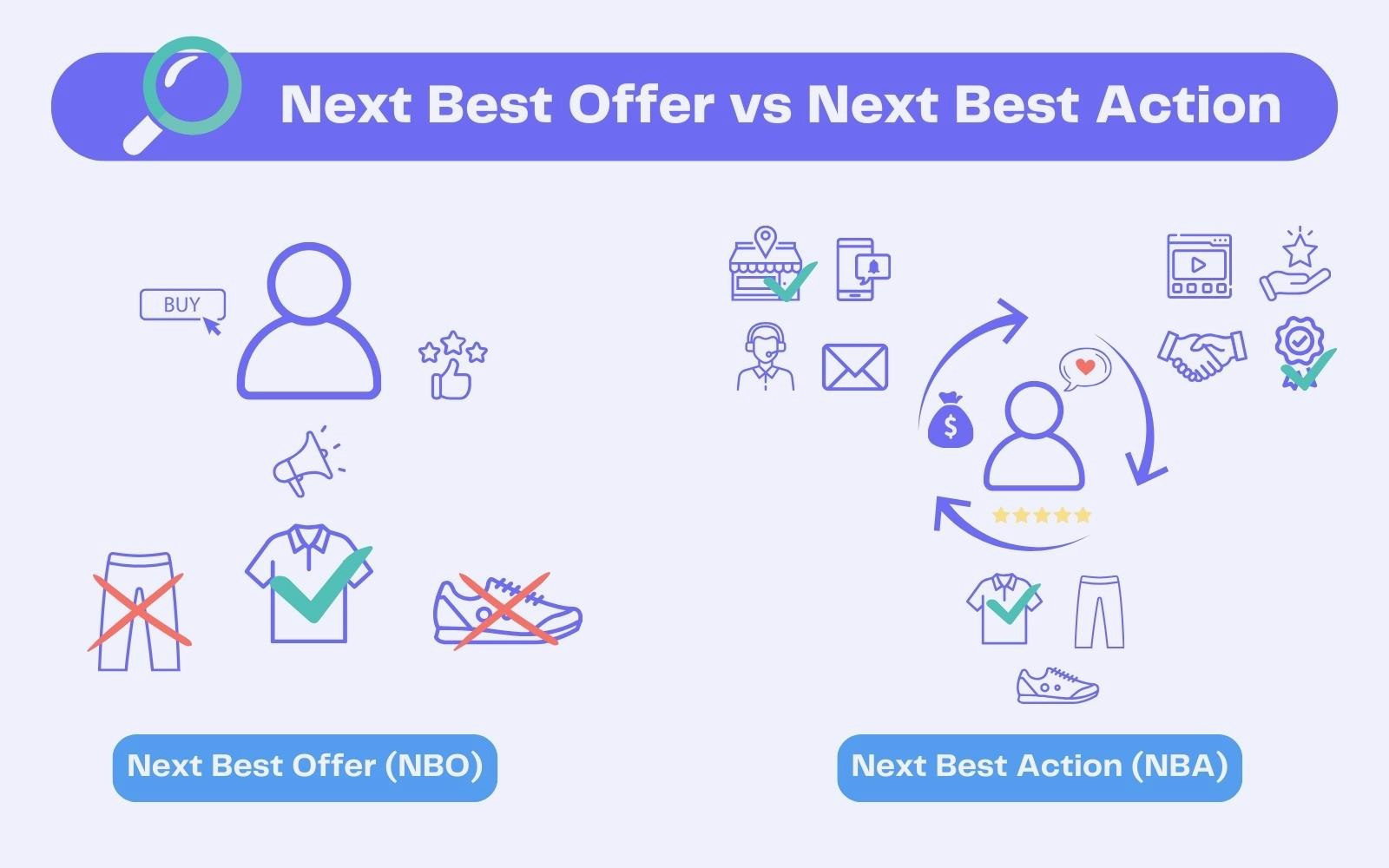
The differences between Next Best Offer and Next Best Action
How a Next Best Offer strategy works
To be effective, a Next Best Offer strategy relies on a clear methodology and business logic. The goal is to identify, among several possible options, the most relevant offer for each individual customer.
Key steps:
Data used. Decisions are based on multiple signals: purchase history, browsing behaviour, marketing interactions, context, and customer preferences. These first-party data points help build a clear understanding of each user’s individual situation.
Offer eligibility. Some offers may be excluded based on simple rules: customer type, product availability, commercial constraints, or contact policies. This step prevents inconsistent or irrelevant recommendations.
Scoring and prioritisation. Eligible offers are then compared. Analytical, statistical, or machine learning models can estimate response probability or potential value. Each offer receives a score to support prioritisation.
Arbitration. Business rules often complement the decision process: marketing pressure, revenue objectives, margins, strategic priorities, or overall customer experience considerations.
Activation. Once selected, the offer can be activated across different channels: email, advertising, website, mobile app, or CRM tools. The effectiveness of an NBO strategy also depends on the ability to activate quickly.
Across all these steps, one constant remains: customer data is the foundation of decision-making.
The role of data
The freshness and quality of the data directly impact campaign performance. Reliable, up-to-date information improves the relevance of the offers presented.
A recent signal, such as a product view or a purchase, can change the most relevant recommendation within minutes. A fragmented customer view prevents consistent decision-making, making data unification essential.
In a siloed stack, analysis becomes more complex and inconsistencies emerge. The best approach is to rely on a single source of truth capable of centralising and continuously updating customer signals.

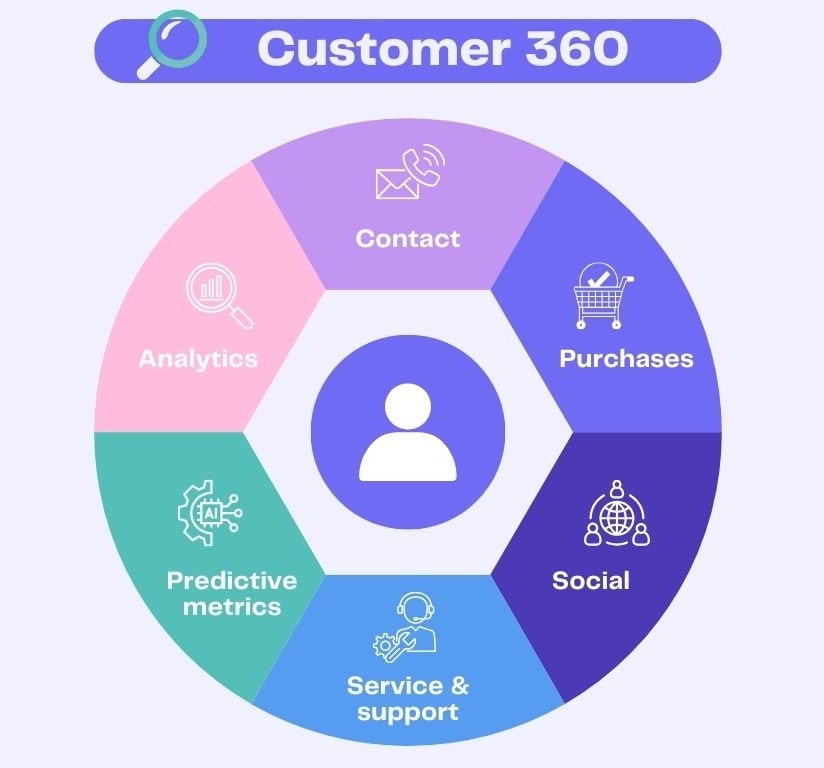
Customer 360
The value of a Composable CDP
Beyond models and algorithms, a Next Best Offer strategy depends on how customer data is stored, organised, and activated.
Many traditional marketing solutions operate from their own proprietary databases. Data is copied, transformed, and then replicated across multiple systems.
This approach multiplies silos and makes decision-making less consistent. By contrast, a composable (or warehouse-centric) Customer Data Platform follows a different logic.
The data warehouse becomes the central layer where data is stored and leveraged. Tools interact directly with this single source of truth rather than maintaining parallel storage environments.
In this type of zero-copy architecture, data no longer moves extensively between platforms. Calculations, segments, and scores are built directly on the information already available in the warehouse.
This shift toward open, interconnected ecosystems has very concrete effects on Next Best Offer strategies:
Segments evolve as customer behaviours change.
Scores can be recalculated more frequently, depending on use cases.
Recommendations more accurately reflect the customer’s current situation. This alignment between data, computation, and activation is a major driver of offer relevance.
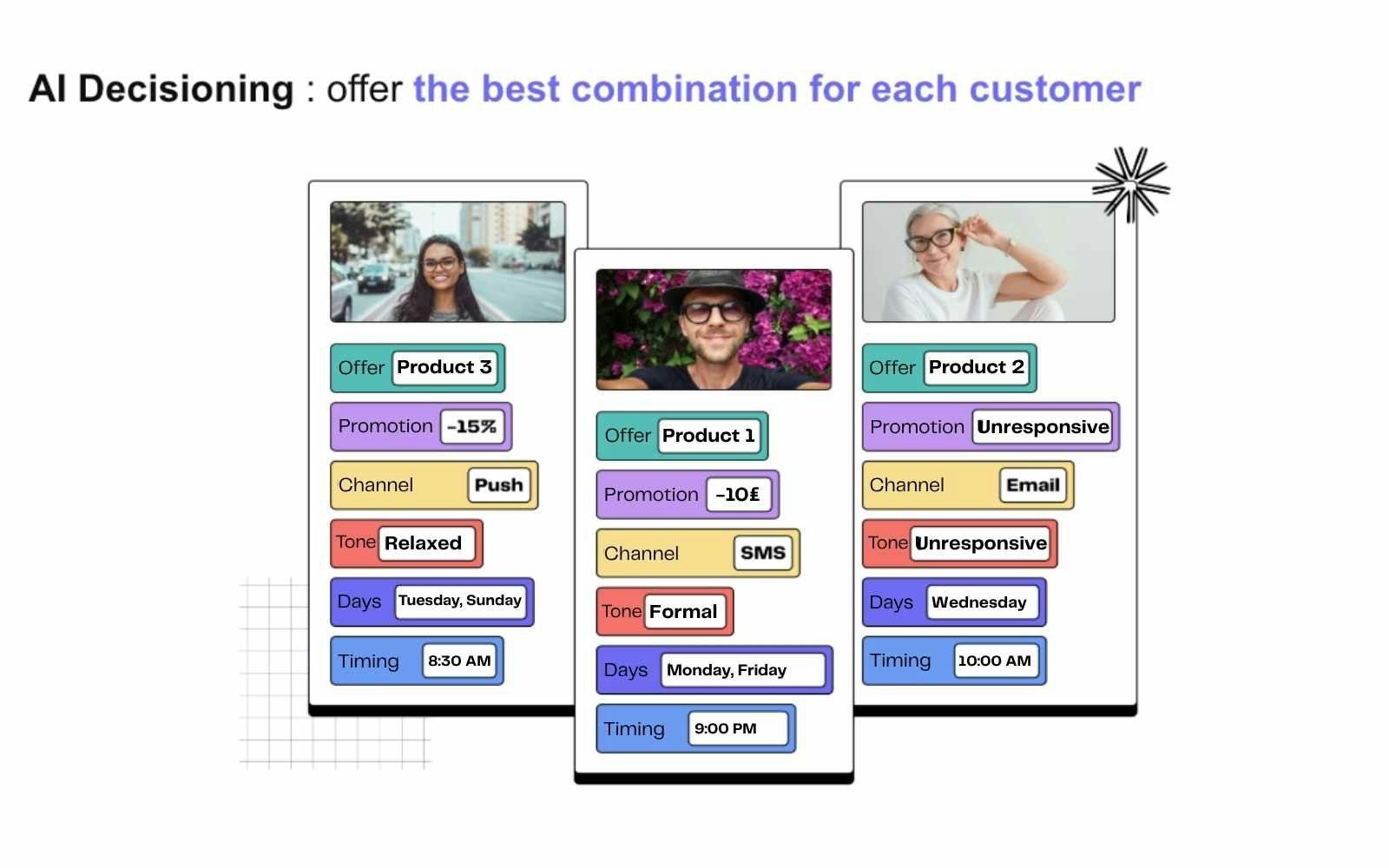
Offer the best combination for each customer based on their stage in the journey
Examples and use cases
Next Best Offer strategies apply to a wide range of business contexts. The principle remains the same: leverage customer signals to present the most relevant offer.
E-commerce: a customer regularly browses a product category without completing a purchase. The brand can prioritise a targeted discount, a product recommendation, or a bundled offer aligned with their purchase history and recent behaviour.
Subscription / SaaS: a user gradually adopts specific features. The company can suggest an upgrade, an add-on, or an expanded usage plan consistent with their level of engagement.
Retail / loyalty: a loyalty programme generates numerous transactional signals. Offers can be tailored based on purchase frequency, customer value, or observed preferences, rather than being distributed uniformly.
Reactivation / churn: a customer shows signs of disengagement. The NBO can prioritise a specific incentive: a price advantage, an exclusive benefit, or a contextual re-engagement proposal.
In all these cases, the logic is driven by data rather than fixed scenarios. The relevance of the offer depends on the ability to connect customer signals, scoring models, and activation.
Conclusion
Next Best Offer goes far beyond simple marketing recommendations. It is fundamentally a data activation lever, designed to improve relevance and consistency across customer interactions.
Artificial intelligence enhances the ability to identify and prioritise the most relevant offers. However, effectiveness ultimately depends on data quality, freshness, and the ability to orchestrate it efficiently within the stack.
Next Best Action complements this approach with a broader perspective. It is no longer just about selecting an offer, but about determining the best action to trigger for each customer.
Leveraging customer signals becomes a key performance driver. Discover how a warehouse-native approach makes it easier to implement advanced activation strategies.