

Best alternatives to Fivetran Activations (Census)
7min • Last updated on Sep 21, 2026


Alexandra Augusti
Chief of Staff
Using customer data in marketing operations is essential to stay competitive in an increasingly crowded landscape. For several years now, Customer Data Platforms (CDPs) have been seen as the go-to solution for collecting, consolidating, centralising, analysing, segmenting and activating customer data.
More recently, the data marketing ecosystem has been shifting towards more flexible, modular solutions, leading to the emergence of composable CDPs. Census is one of the leading players in this space.
What are the alternatives to Census, and what makes them different?
What is Census / Fivetran Activations?
A brief definition of Composable CDP
A Composable CDP is a flexible solution that collects, models, and activates customer data from your existing data infrastructure. It leverages the customer data repository of a data warehouse. Rather than functioning as a separate entity, the Composable CDP integrates seamlessly into your Modern Data Stack, addressing all the disadvantages of traditional CDPs while covering the same use cases.

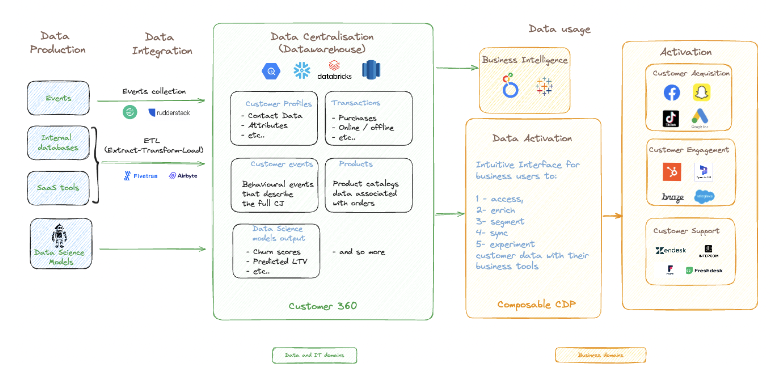
Diagram of a composable CDP
With a composable CDP, you can immediately put your data to use, crafting targeted campaigns across various channels. No more waiting for weeks—everything is prepped and ready for action.
A brief history of Census
Fivetran Activations, the new name for Getcensus, is a composable CDP that enables companies to sync data from their data warehouse to business tools such as CRMs, advertising platforms and marketing tools.
Founded with the mission to help companies better utilise their data, Census focuses on eliminating data silos and providing a unified, trusted source of customer data.
Since its creation in 2018, Census has positioned itself as the ultimate Universal Data Platform. Fivetran acquired Census in may 2025, with the aim of offering a unified data movement platform, from data ingestion through to activation.
The core of Fivetran Activations lies in its Reverse ETL technology, which makes it possible to pull data from a centralised data warehouse and distribute it in real-time to various applications across teams like marketing, sales, and product development. This approach helps businesses maintain a consistent and accurate view of customer data, improving decision-making and operational efficiency.
Historically, Census gained popularity among companies such as Canva, HubSpot and Uber. The solution helps them create personalised customer experiences and automate workflows without requiring technical expertise.
👇

Key differences between Census by Fivetran and DinMo
How does it work?
To start using Fivetran Activations (ex-Census), you just have to connect a source that centralises all your customer data (most often, a data warehouse). Originally, Census did not collect data. The solution focused on managing the data infrastructure by offering improved observability, simplified API management, enhanced security, and Git-based version control.
The platform allows you to create a 360° view of your customers, notably thanks to its identity and entity resolution capabilities. This customer view is directly actionable thanks to Census’s two flagship products:
Audience Hub: A suite of no-code features that allow you to build audiences and orchestrate campaigns
Reverse ETL: An activation platform that lets you sync your customer data with any destination (marketing, support, operations, etc.)

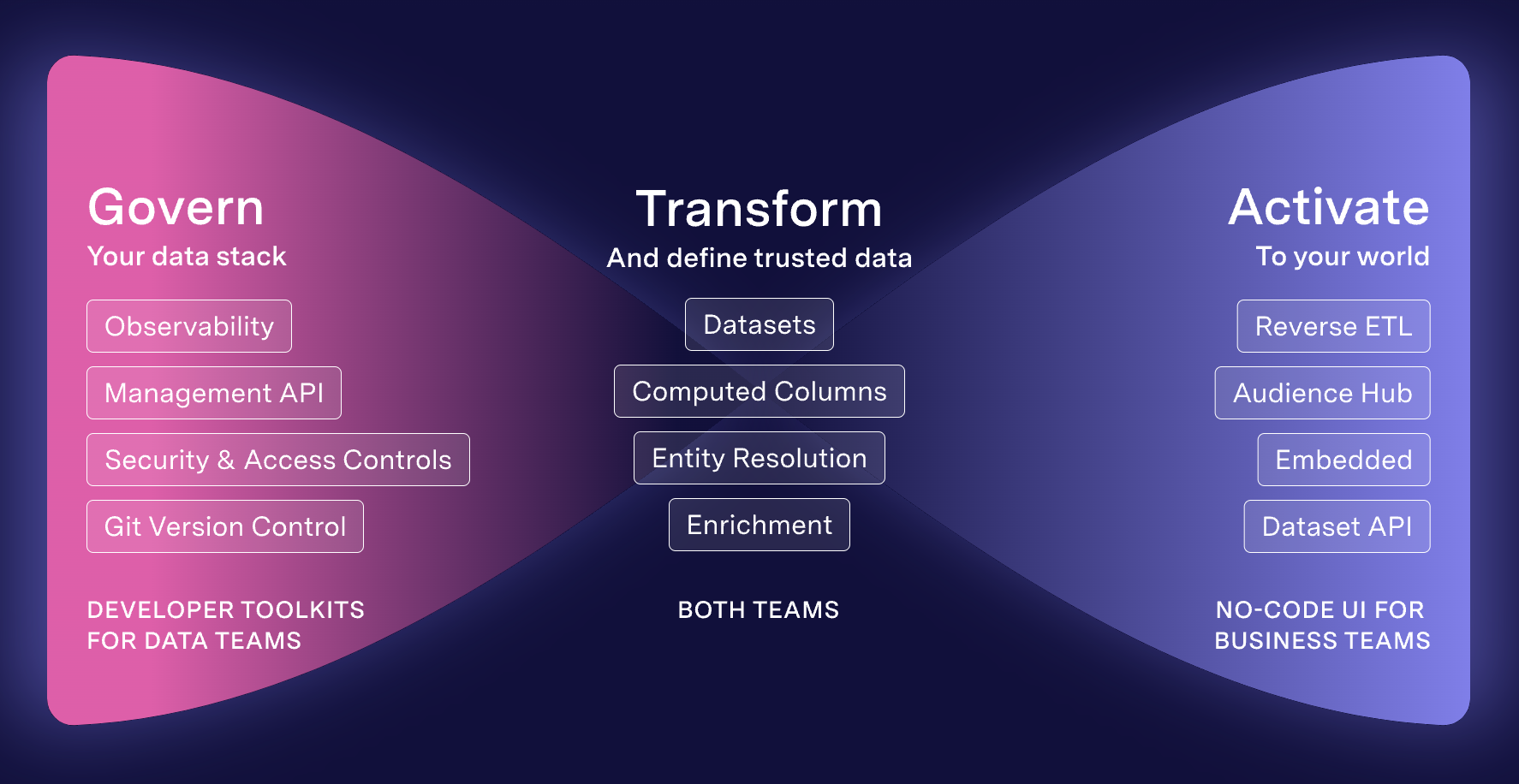
Credit: Census
Note that Census additionally offers several products to improve data and business operations:
Live syncs: A real-time Reverse ETL to cover specific use cases, including on-site personalisation
Embedded: A solution that allows data sharing with external clients and partners. The main objective is to enrich your data base with third-party data, to boost signals and matching rate.
It's also worth noting that Fivetran ensures the security and governance of your data, maintaining it within your existing infrastructure (most ot the time, your data warehouse) for optimal control and compliance.
Alternatives to Fivetran Activation (Census)
👉🏼 In this article, we compare the best-known CDP solutions and look at their key differentiators so you can make an informed choice for your business.
In the rest of the article, we detail the main competitors of Fivetran Activations, divided into different categories of CDP:
Composable CDPs, the closest alternative in terms of architecture
Infrastructure solutions, covering the full range of CDP use cases, but primarily aimed at data teams
Traditional CDPs
CRM suites

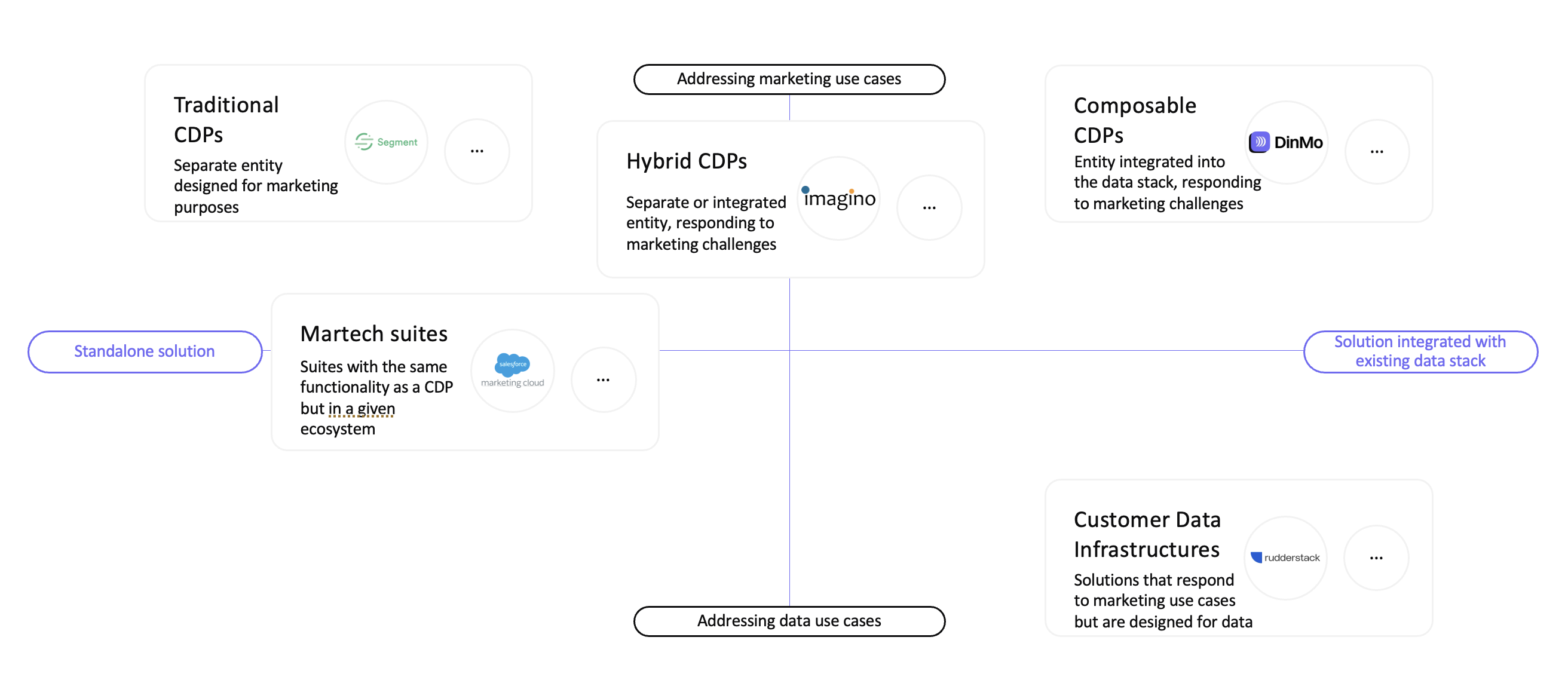
Categories of CDP
Disclaimer: Even if it's not Fivetran, we recommend using a Composable CDP if you want to overcome the limitations of traditional CDPs:
More expensive: Non-composable solutions are more expensive in two ways. First, you pay for everything, whether you use it or not. Second, it’s so hard to change your solution that they can keep raising prices without losing customers.
No best-of-breed: When you use a non-composable solution, you’re accepting that some parts of your stack aren’t the best.
Slow to build new use cases: The process of integrating new data sources / types, if possible, is slow. It can take months and months to modify non-composable solutions.
Data duplication: When you use a traditional CDP, it has its own data base for your data to sit. But obviously, you’ll still need a company-wide data warehouse for all your other use cases.
Alternative #1: Other Composable CDPs
DinMo
DinMo is a Composable CDP that offers essentially the same features as Census by Fivetran:
A Reverse ETL engine to send data from a data warehouse to underlying marketing destinations, with real-time capabilities for specific use cases.
A “Customer Hub” product, a suite of no-code features that allow you to build audiences and orchestrate campaigns.
That said, DinMo outperforms Census with its non-technical features (user-friendly interface, no-code segment builder, etc.), available for all pricing plans. Designed first and foremost for business teams, DinMo is more user-friendly for marketers, bringing it closer to the interfaces of traditional CDPs.
Indeed, Census "Audience Hub" is only available in the "Enterprise" plans, becoming rapidly expensive for marketing teams if they want to cover their use cases independently. Their reverse ETL is highly technical, requiring knowledge of SQL and the underlying APIs.
Additionally, DinMo differentiates itself with its artificial intelligence and machine learning capabilities, enriching its 360° view available in the Customer Hub with predictive attributes (LTV, Churn, etc.)
Criteria | DinMo | Fivetran Activations (ex-Census) |
|---|---|---|
No-code segment builder | ✅ No-code segment builder designed for business and marketing teams | ⚠️ Audience Hub / One-Click Audiences available on Enterprise / Business plans only |
Data model | Flexible data model with mapping and enrichment to easily activate warehouse data | Dataset-driven modelling using smart columns defined in the warehouse. Requires upfront setup by data teams |
Profile view | ✅ Customer Hub: unified profile view designed for business exploration and activation | 🚫 Primarily audience- and segment-centric experience, no dedicated customer profile hub |
Identity resolution | Identity resolution and unification to activate reliable audiences | Identity matching based on activation requirements |
Omnichannel activation / Reverse ETL | Reverse ETL to activate audiences across key marketing tools (CRM, CEP, email, ads, etc.) | Omnichannel activation via Reverse ETL |
User experience | ✅ Time-to-value-oriented experience built for marketing teams (fast segmentation → activation) | ⚠️ Strongly data-stack-oriented experience; marketing autonomy depends on the plan |
Specific destinations | Broad destination catalogue + ability to address specific needs depending on customer context | Broad destination catalogue (Fivetran Activations) |
Web & app tracking | Web & App Tracking (modern, privacy-first, server-side approach) | Events activated from the warehouse (Event Syncs), rather than a native tracking module |
Marketing AI | ✅ Predictive attributes (e.g. churn, LTV) + recommendations and decisioning to activate the best audiences and actions | ⚠️ AI columns / LLM-based enrichments focused on data preparation and enrichment. Requires data team involvement |
Security & compliance (GDPR, CCPA) | ✅ GDPR by design: native features to manage data subject rights (export, deletion, purge / right to be forgotten). CCPA, SOC 2 Type II | GDPR / CCPA compliant via configurable workflows |
Enablement & marketing expertise | Hands-on support and expertise across marketing use cases (retail, media, finance, D2C, B2B, etc.). Europe-based teams | Platform-first approach focused on data teams and large-scale activation |
Pricing | ✅ More transparent and predictable pricing model | ⚠️ Limited features and support on Standard plan. Audience Hub only available on Enterprise / Business plans |
Key differences between DinMo and Fivetran Activations (ex-Census)
Hightouch
At the beginning, Hightouch was a Reverse ETL, only designed for data teams. Over time, Hightouch has developed and now addresses both data teams needs (automating their data flows) and marketing teams needs (covering all marketing use cases). Hightouch has managed to capture significant attention as the Composable CDP of many leading businesses seeking top-notch data management solutions.
Like Census/Fivetran, Hightouch offers features that cover all CDP use cases (data collection, identity resolution, Reverse ETL, “Customer Studio” etc.). Their pricing models are quite similar and the capabilities/performance of each are at the same level.
However, Hightouch has expanded to a new set of AI features, allowing marketing teams to test and optimise strategies faster with AI.
Alternative #2: Data Infrastructure Solutions
Treasure Data
Originally launched as a Big Data platform, Treasure Data pivoted toward CDPs after noticing that most of its use cases were for marketing teams.
To meet these needs, they developed features for aggregation, segmentation, and audience activation.
Despite this shift, Treasure Data remains a technical solution for data management, requiring technical skills and data engineering for implementation and maintenance. As a result, it remains more challenging to use than Census.
Moreover, Treasure Data doesn't integrate smoothly with a company's existing data infrastructure and duplicates data on its platform, raising data security and governance issues.
That said, Treasure Data boasts advanced features in analytics and machine learning (particularly for predictive applications).
RudderStack
RudderStack provides a specialised infrastructure for collecting, processing, and storing customer data through its suite of products (collection, Reverse ETL, identity resolution, etc.). It covers many of the same use cases as Census and Traditional CDPs.
However, RudderStack is solely focused on building and maintaining a customer data infrastructure (CDI) and doesn’t focus on the marketing persona at all. Although RudderStack can handle traditional CDP use cases, it may be challenging for marketing teams to use autonomously (as it requires code, APIs knowledge).
💡 If your focus is on data activation only, Reverse ETL solutions may be a good fit. These allow sent data from a data warehouse to destinations without extra layers (Customer Studio, identity resolution, etc.). Popular solutions like Grouparoo or Rivery offer general Reverse ETL capabilities.
Composable CDP solutions (Fivetran Activations, DinMo, Hightouch, GrowthLoop) also allow the option to purchase just the Reverse ETL product.
Alternative #3: Traditional CDPs
This group includes the traditonal players in the CDP market. Having been around for several years, these CDPs often have highly advanced features and cover the full range of Census’s functionality, sometimes even including AI capabilities.
Twilio Segment
Segment gained early recognition for its event tracking capabilities, offering SDKs for companies to track customer behaviour on their websites and applications.
Over time, additional features were added, transforming it into a full-fledged CDP: a "Connections" module for data transfers, an identity resolution module, and most notably, "Twilio Engage," which focuses on audience-based customer engagement.
Census and Segment have similar features, but the key difference is in data storage: Census keeps data within your infrastructure, while Segment stores it in a separate external database.
mParticle
mParticle is another traditional CDP, initially specialised in mobile event collection. It now offers a full range of CDP features: collection, storage, audience management, personalisation, as well as real-time applications and predictive attributes via its "Cortex" product.
mParticle was designed as an alternative to Segment, and as such, shares many similarities. However, it generally offers more robust capabilities across the board.
⚠️ Both mParticle and Segment are primarily designed for technical users and may take time to be fully adopted by marketing teams.
ActionIQ
ActionIQ began as a traditional CDP, much like Segment or mParticle. However, as the demand for composable approaches (such as "data warehouse first") has grown, ActionIQ has reengineered its architecture to better integrate with data warehouses. Now, it presents itself as a “hybrid” solution, offering the flexibility to store data either with the vendor or directly in a data warehouse.
⚠️ The “Composable” solution is less mature than other Composable CDPs on the market.
Alternative #4: CRM Suites
Recognising the growth of the CDP market, many CRM and Marketing Automation platforms have started offering CDP modules.
These modules are typically less mature and offer fewer features compared to traditional CDPs. However, they allow for a quicker return on investment due to shorter implementation times, enabling deployment of initial use cases within a few weeks.
Keep in mind:
These solutions are often less effective in data security and governance.
Switching CRM or Marketing Automation tools would also mean switching CDPs, which can lead to a long and costly process.
They tend to be less mature, offering fewer effective features overall.
If you want to learn more about DinMo and its advantages over Fivetran Activations (ex-Census), feel free to contact us!
Frequently asked questions
What is the best Fivetran Activations (Census) alternative in 2026?
What is the best Fivetran Activations (Census) alternative in 2026?
DinMo is a Census alternative for companies that want a composable CDP connected to their existing data warehouse, with Reverse ETL, a Customer Hub and no-code audience creation. The right choice still depends on required destinations, real-time use cases, governance and whether marketing teams need autonomy. Census, renamed Fivetran Activations after its May 2025 acquisition, remains a strong data-stack-oriented option.
Is there a cheaper alternative to Fivetran Activations?
Is there a cheaper alternative to Fivetran Activations?
DinMo presents a more transparent and predictable pricing approach than Fivetran Activations. The guide says Census limits features and support on its Standard plan and places Audience Hub or One-Click Audiences on higher-tier plans, while DinMo’s no-code segmentation is available across its plans. This does not prove one vendor is always cheaper, so compare equivalent modules, destinations, support and usage.
What is the difference between Fivetran Activations and DinMo?
What is the difference between Fivetran Activations and DinMo?
DinMo uses the existing data warehouse as its source and activates data through Reverse ETL, as Fivetran Activations does. DinMo adds a Customer Hub, a unified profile view, flexible data modelling, no-code segmentation and predictive attributes. The guide describes Fivetran Activations as an experience structured more around datasets and activation at scale.
Which Census alternative is best for marketing teams?
Which Census alternative is best for marketing teams?
DinMo is designed for marketing teams that need to build audiences and orchestrate campaigns without writing SQL or relying on data engineers for daily activation. Its Customer Hub combines a unified profile view with no-code segmentation and predictive attributes such as churn and lifetime value. The 2026 guide says access to Census’s audience experience depends on the selected plan.
What happened to Census after the Fivetran acquisition?
What happened to Census after the Fivetran acquisition?
DinMo is presented in the guide as a composable CDP alternative after Fivetran acquired Census in May 2025. Census was renamed Fivetran Activations and became part of a broader platform spanning data ingestion through activation. The product still centres on Reverse ETL, with Audience Hub for no-code audiences, Live Syncs for selected real-time use cases and Embedded for external data sharing.