

Single Customer View: the key to usable data
6min • Last updated on Mar 3, 2026


Olivier Renard
Content & SEO Manager
[👉 Summarise this article using ChatGPT, Google AI or Perplexity.]
According to Salesforce’s State of Marketing report, companies use an average of 15 different customer data sources to run their campaigns, a number that continues to grow.
At the same time, consumers expect brands to deliver a personalised and consistent experience across every channel. This is a major challenge for marketing teams, who need a reliable, unified foundation to activate this scattered data.
Key Takeaways:
The Single Customer View (SCV) centralises customer data into a common foundation, providing a reliable and consistent view at company level.
Although the two concepts are related, it differs from a Customer 360: the SCV is the data reference, and the Customer 360 is the business view that results from it.
The SCV helps improve personalisation, marketing performance, service quality and governance.
In a Modern Data Stack, it is built on top of the data warehouse and connected to a composable CDP to enable segmentation, activation and AI use cases.
👉 What is a single customer view and what role does it play? Discover how to build it in your data warehouse and turn it into a personalisation lever with a composable CDP. 🔍
What is a single customer view?
A single customer view (SCV) is the reference system that brings together and harmonises all data about each customer in one place.
This may include identity and contact data (name, email, phone), profile information (segment, status), purchase and interaction history, consent, as well as calculated scores or indicators (churn, propensity, CLV).
The goal is to obtain a unified, consistent and up-to-date view for each customer, regardless of the channel through which they interact with your brand.


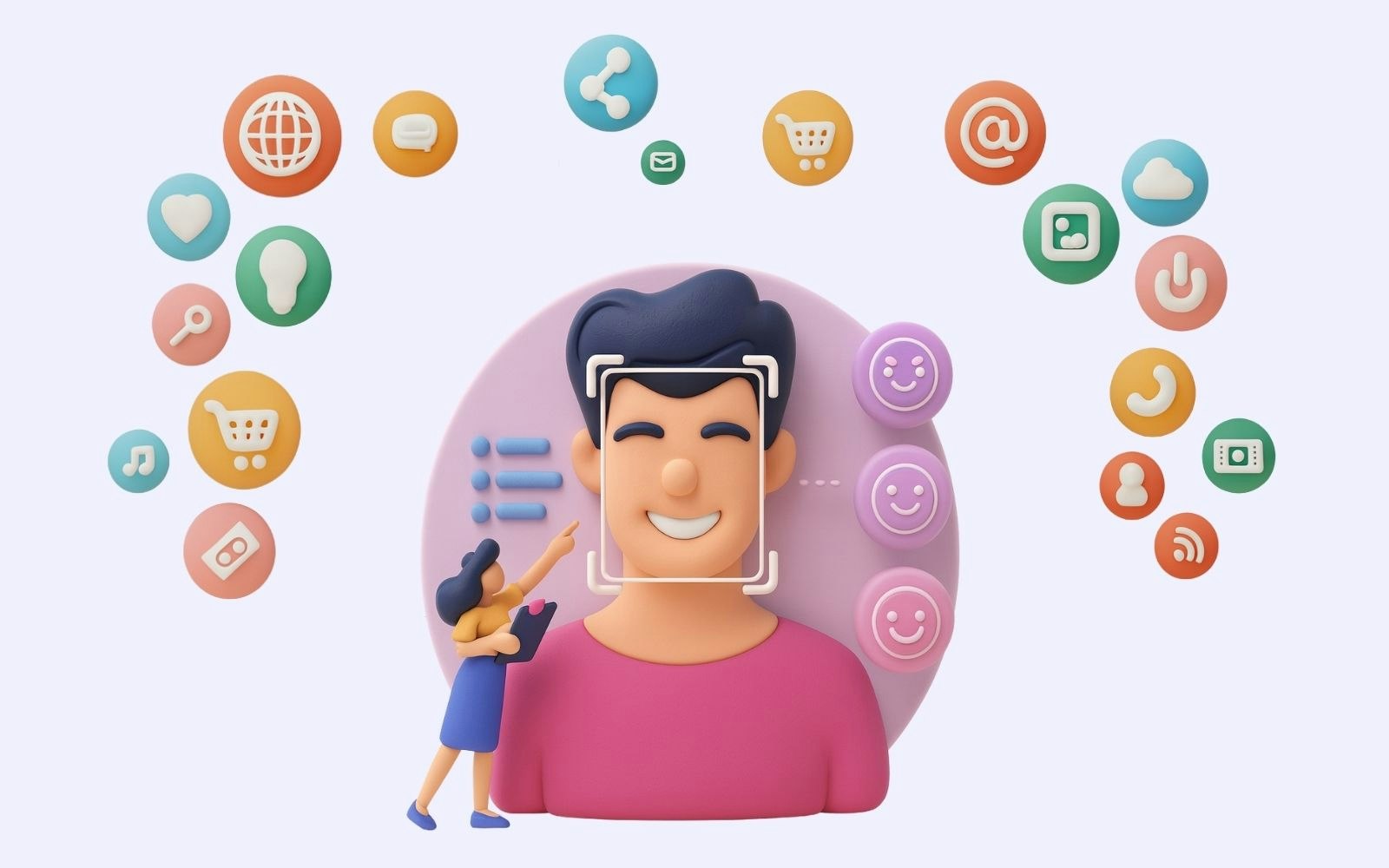
Customer 360, centralising all customer data
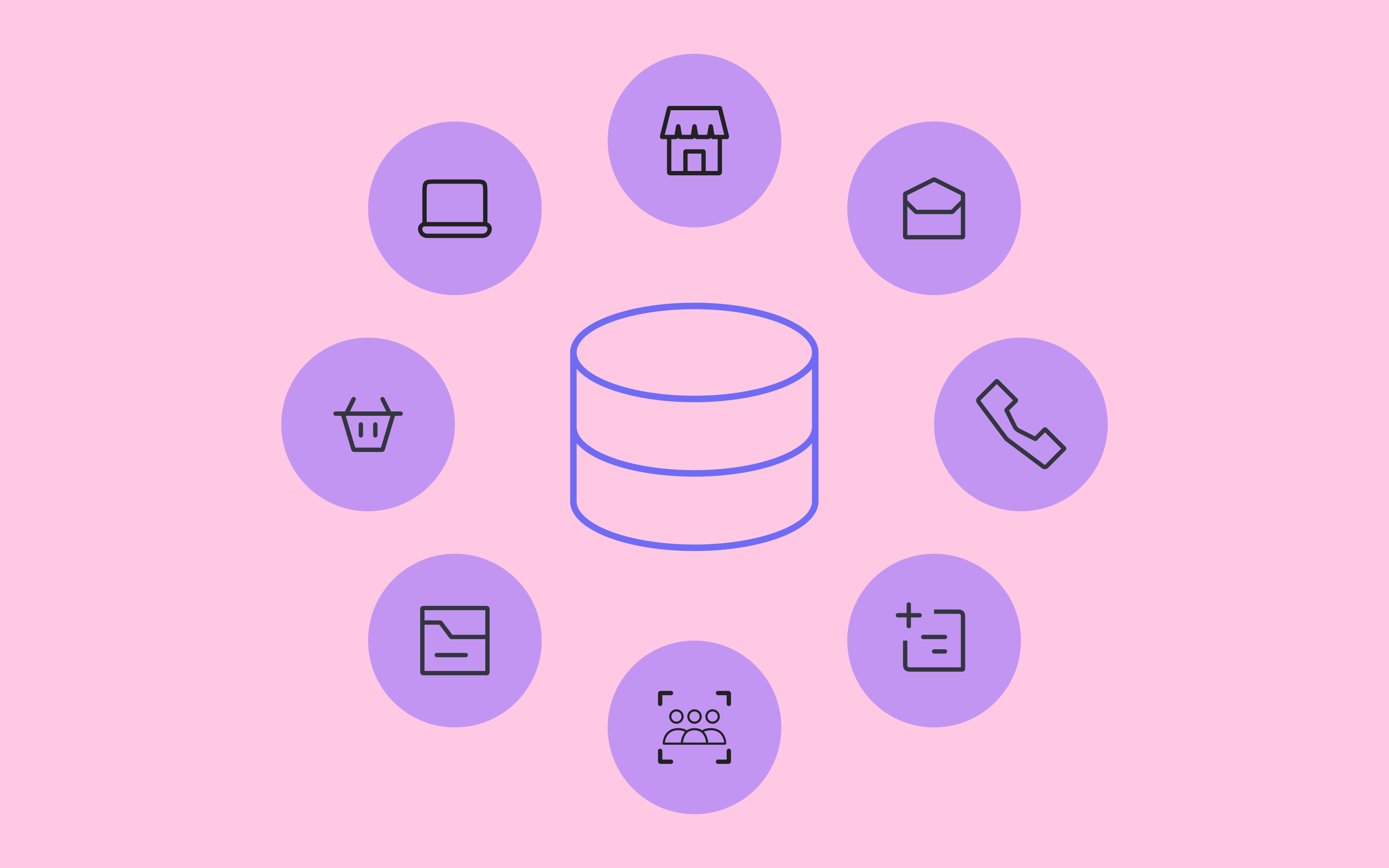
In practice, the SCV aggregates all customer data sources (website, mobile app, CRM, e-commerce platform, marketing tools, customer support, etc.). It makes it possible to bring together information that describes the same person, remove duplicates, and correct inconsistencies.
In this way, it becomes a single source of truth for the entire company:
For marketing and CRM teams, it serves as the basis for segmentation, personalisation and campaign management.
For sales and support teams, it provides a complete view of the customer at every interaction.
For finance or product teams, it offers a consolidated view of customer value, usage and revenue.
The single customer view is a key component of the information system. It feeds customer knowledge, analysis, dashboards, as well as marketing activation scenarios and artificial intelligence (AI) use cases.
Identity resolution, ID graph, SCV, Customer 360: What’s the Difference?
Closely related and sometimes confused, these concepts actually play complementary roles.
Identity resolution is the technical process that reconciles several identifiers so they can be associated with the same individual.
The identity graph represents the links between these identifiers and the devices, accounts or channels used by a customer.
The Single Customer View organises customer data, defines reference identifiers and holds the attributes that describe each person.
The Customer 360 is the consolidated customer view accessible to business teams in a CRM, support tool or Customer Data Platform (CDP).
Concept | Main role | For whom? |
|---|---|---|
Identity resolution | Group identifiers belonging to the same person | Data, IT, teams in charge of data quality |
Identity graph | Model links between identities, devices and channels | Data, IT, analytics |
Single Customer View (SCV) | Reference registry of customer data, deduplicated and trusted | Data, IT, marketing, finance |
Customer 360 | Consolidated view of a customer in business tools | Marketing, sales, support, product |
ID resolution and the identity graph feed the SCV, which then becomes the foundation on which to build the Customer 360 view used by teams in their tools.
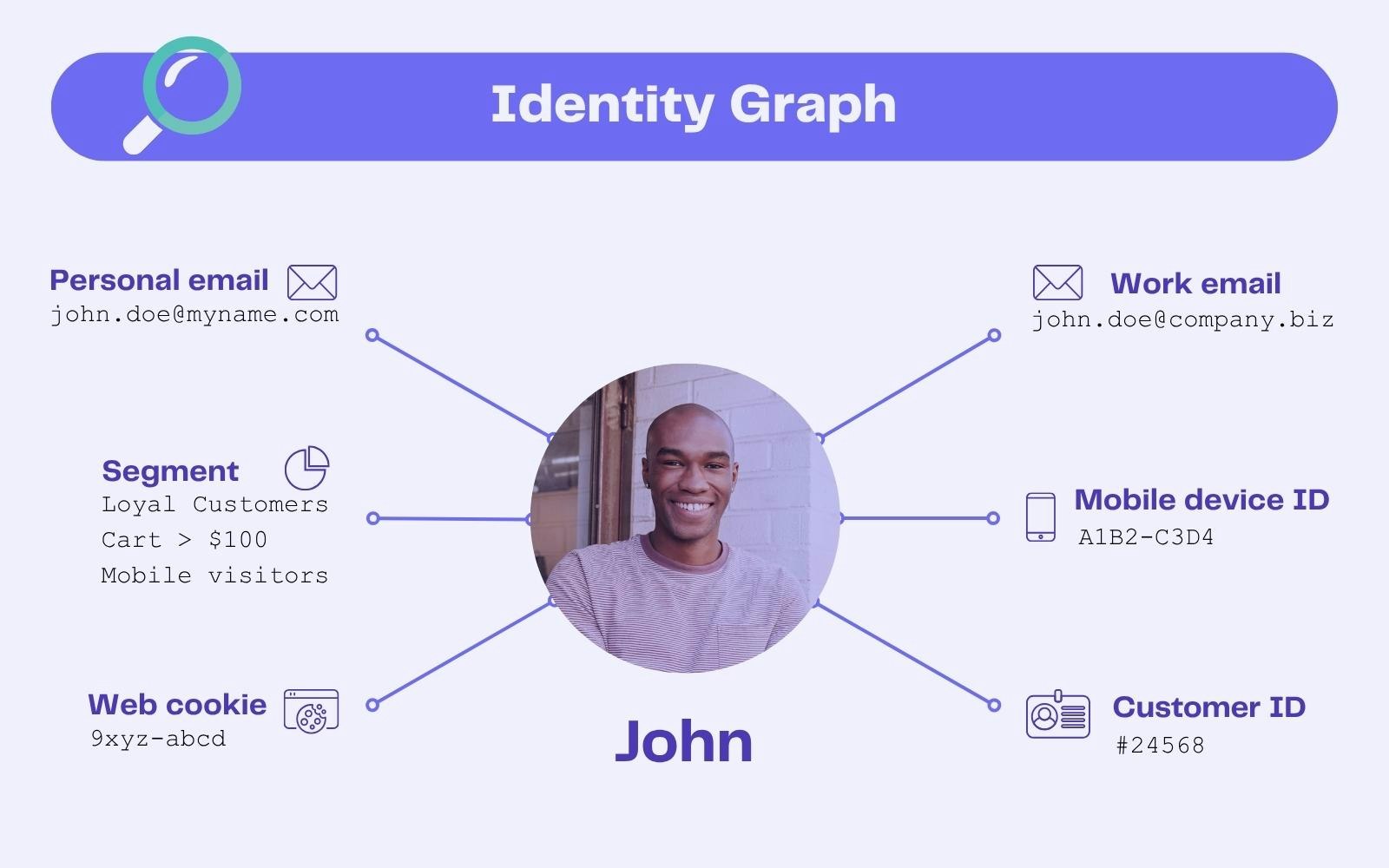
ID graph identifiers
Why implement an SCV?
Customer data is often scattered across CRM, email tools, e-commerce site, mobile app, support platform and analytics solutions. Each channel only sees part of the customer journey, profiles are incomplete, and duplicates multiply.
For marketing and CRM managers, it is difficult to deliver a truly personalised experience without reliable customer knowledge. They need to be able to build relevant segments and rely on accurate indicators (customer value, churn, purchase frequency) to optimise their campaigns accordingly.
Implementing a Single Customer View allows you to start again from a clear, shared foundation. All teams align on the same customer data, making personalisation easier, improving overall performance and laying the groundwork for future AI use cases.
Main use cases
Marketing and CRM: segmentation, personalisation, campaigns
A Single Customer View provides a coherent picture of the entire journey: purchases, browsing, reactions to emails, interactions with support. Marketing teams can refine their segmentation, adapt messages to the customer lifecycle, reactivate inactive customers via dedicated CRM journeys.
Campaigns are better targeted, more relevant and easier to analyse, because all KPIs are based on the same customer data.
AI Marketing: Scoring, Recommendations, AI decisioning
A robust SCV provides the essential foundation for scoring and recommendation algorithms. Models can use trusted data to estimate churn risk, customer lifetime value (CLV), or product affinity.
Artificial intelligence leverages these signals to define the Next Best Action: delivering the right message, at the right time, on the right channel for each profile, at scale.

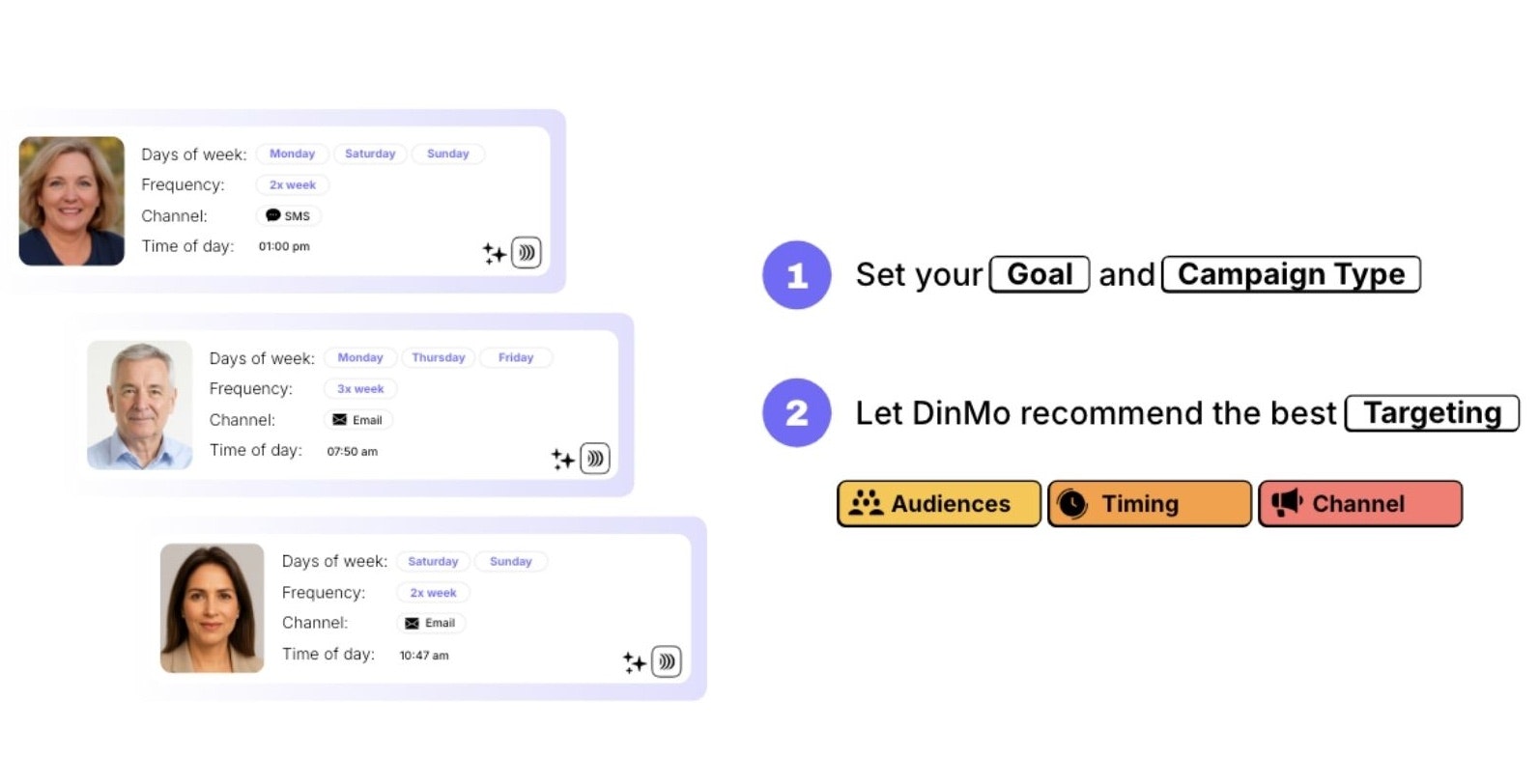
AI decisioning in DinMo
Sales, support and product: Beyond marketing
Sales teams access a consolidated view before each interaction, making it easier to handle leads and prepare meetings. Support teams benefit from complete profiles to prioritise requests.
Product teams, meanwhile, use the SCV to personalise the in-app experience and analyse usage more precisely.
How to build your SCV?
Implementing a single customer view is a project that spans data, processes and business practices.
Key steps and tools
Start by collecting customer data from different systems: CRM, e-commerce site, app, email tool, support, points of sale, analytics or tracking solutions.
The aim is to centralise this data in a same environment.
Next comes unification. Using identity resolution, you reconcile different identifiers (emails, logins, CRM IDs, device IDs) to build a unique customer profile (golden record).
The data model describes the main entities (customers, accounts, households), events (visits, purchases, tickets) and derived attributes (scores, segments, value indicators).
The final pillar is quality and reliability. Standardising formats, eliminating duplicates, handling missing values, monitoring data flows and observability all help keep the SCV trusted over time.
Start from business objectives before choosing technology. You’ll often be advised to choose between a CDP and a data warehouse to build the SCV.
Our view is that you shouldn’t set them against each other, but rather see the composable CDP as an extension of the DWH.
The data warehouse as the foundation of the SCV
Since the mid-2010s, cloud data warehouses (CDW) such as BigQuery, Snowflake, Redshift or Databricks have been widely adopted by companies. In a Modern Data Stack, they act as the single source of truth for customer data.
Data from different systems is integrated there (via ETL or ELT), consolidated and historised. Building the single customer view within the CDW improves consistency, cost control, governance and security.
The composable CDP then harnesses the full power and flexibility of the data warehouse.

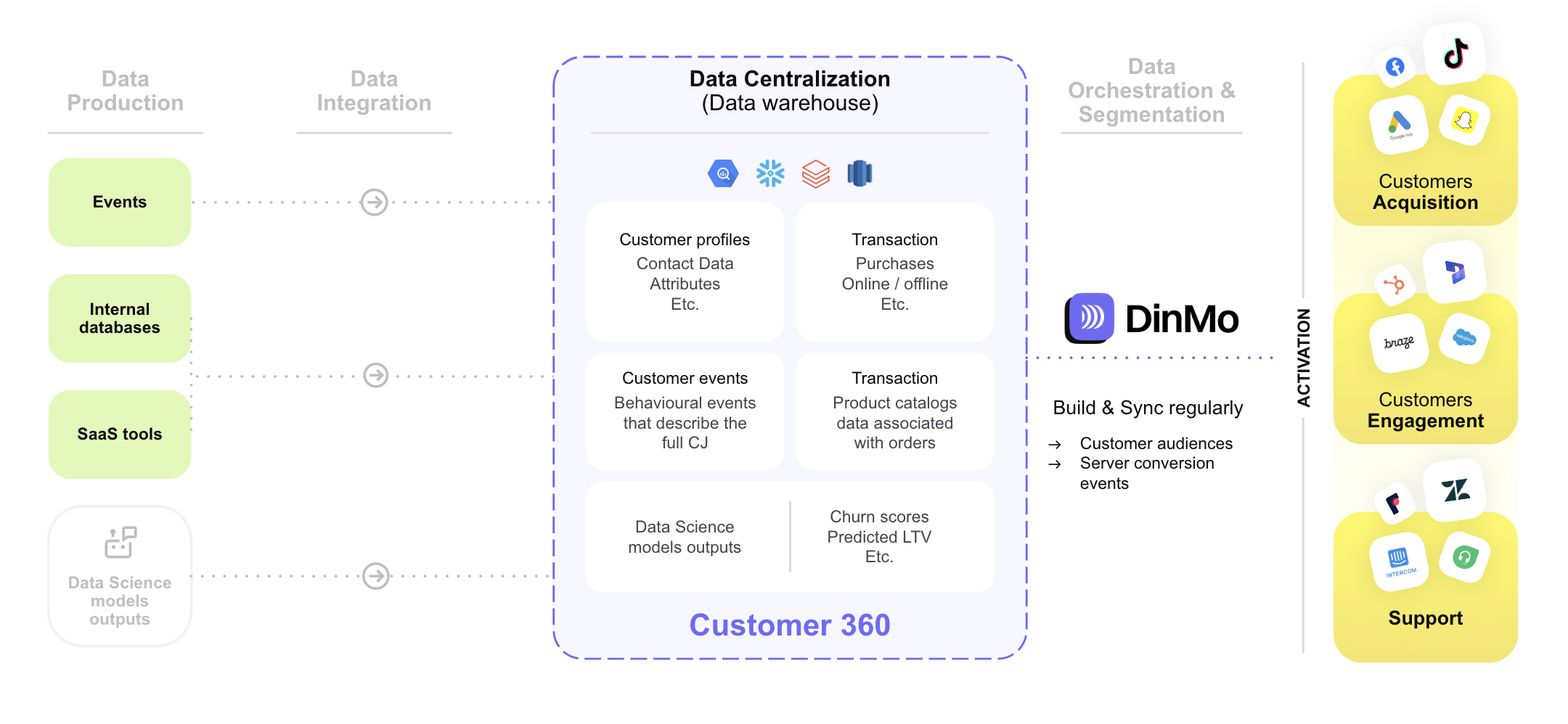
The data warehouse can be used as a Customer 360, as it already centralises data from many sources
From technical foundation to activation
Where a packaged CDP duplicates data into its own database, a composable CDP relies on the data already present in the data warehouse, without making a copy. The customer reference lives in the warehouse, which remains the only source of truth.
In simple terms, the role of the Customer Data Platform is threefold: unify, enrich, activate. To do this, it must have access to data that is reliable and up to date.
DinMo offers a no-code interface to create segments and define calculated fields directly from the Single Customer View.
Our CDP adds an intelligence layer: churn and LTV scores, product recommendations, as well as channel and best-timing signals compatible with AI decisioning scenarios. It then synchronises these segments and attributes to operational tools: CRM, marketing platforms, CEP, ad networks, product tools, support.
Towards data-driven marketing
In this model, DinMo acts as a bridge between the data foundation, AI and activation. With our Customer Hub, marketers have a true cockpit for tracking performance by segment and by use case.
They can set up control groups, run A/B tests and measure the incremental impact of their campaigns. By relying on a Single Customer View built in the data warehouse, our composable CDP enables companies to fully capitalise on their customer data, without technical complexity.
Conclusion
The Single Customer View is the prerequisite for better understanding your customers, personalising journeys across channels, and preparing your AI use cases.
The data warehouse + composable CDP combo offers the best way to leverage the SCV: reliable, unified data, ready to activate in a few clicks. It also forms the basis for more advanced use cases around agentic AI.
Keen to build your SCV within a modern data stack? Discover how DinMo can support you in your project.