


Balancing personalisation and privacy
7min • Last updated on Sep 21, 2026


Yomna Sfaxi
Growth & Marketing Manager
More than 6 in 10 consumers are willing to pay more when a brand offers a personalised experience (Medallia). A powerful lever to boost both performance and satisfaction, especially given that only around a quarter of consumers say they have actually experienced true personalisation, according to the same study.
For businesses, the challenge is even greater as privacy requirements have tightened in recent years. This is both a regulatory and a technical issue, with a direct impact on marketing performance and measurement.
Among the tools available to marketers, first-party data stands out as a key asset to improve audience strategies without relying on third-party signals.
Key takeaways:
Customer experience personalisation means adapting messages, content and offers to each profile, based on needs, preferences and interactions.
It is possible to reconcile privacy compliance with effective marketing personalisation.
First-party data offers a double benefit: better customer understanding and lower acquisition costs.
The DinMo composable CDP helps activate this data while staying compliant with regulations.
👉 Discover what customer personalisation really is and how it impacts satisfaction and sales. Learn how to leverage your data to tailor your messages while protecting privacy. 🎯
What is customer experience personalisation
Customer experience personalisation consists of tailoring interactions between a brand and its customers based on their needs, preferences and behaviours.
The goal is to deliver a personalised experience at every stage of the customer journey, rather than a one-size-fits-all message.
💡 How it differs from marketing personalisation
Although closely related, the two concepts are distinct.
Marketing personalisation focuses mainly on campaigns and messages (emails, ads, content).
Customer experience personalisation spans all touchpoints: website, app, customer support, offers, recommendations and communications.
This can range from a website highlighting products based on browsing or purchase history, to a customer service advisor accessing a client’s context to provide a relevant response.
In all cases, this approach relies on smarter use of customer data to make every interaction more useful and more consistent.

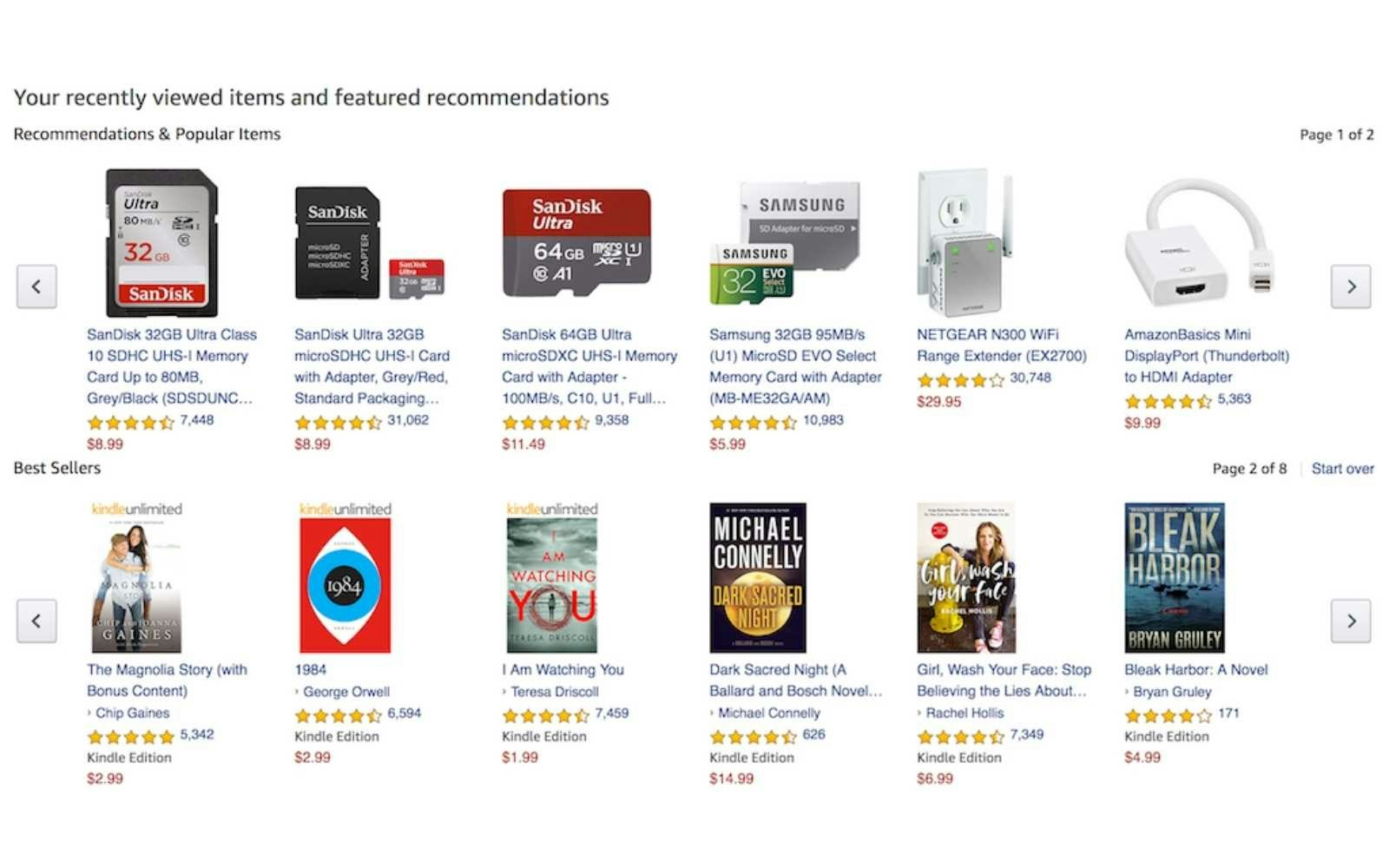
Personalised recommendations (Source: Amazon)
Why personalise the customer experience
Consumers expect brands to deliver experiences that reflect their habits and preferences. A brand that understands its customers is better equipped to offer more relevant interactions.
Every interaction, however small, has a direct impact on customer satisfaction. A well-targeted message is perceived as helpful, whereas generic communications increase the risk of disengagement.
Personalisation also supports customer loyalty. Customers who feel recognised and understood are more likely to return, helping increase customer lifetime value (LTV).
Finally, personalisation improves the effectiveness of marketing actions. Budgets are allocated more efficiently, and teams can focus on the levers that generate the greatest impact.
Methods for personalising the experience
Collect relevant customer data: the first step is to identify which information can actually be used.
A common distinction is made between declared data (such as preferences or profile information collected via a form) and behavioural data (browsing activity, purchase history, interactions with emails or customer support, in-store visits).
First-party data (CRM, website, support, marketing tools) provides a strong foundation, as it is directly linked to your business activity.
Segment your customer base: segments can be built based on behaviours (visits, purchases, engagement), intent, customer lifecycle stage or specific attributes.
The goal is to create segments that are both relevant and actionable. Overly granular segmentation can quickly become difficult to operate.
Adapt the customer journey: personalisation can be applied at every stage of the journey.
Before purchase: tailored content, recommendations or targeted highlights.
During purchase: product or service suggestions, contextual assistance.
After purchase: follow-up communications, customer support, replenishment offers or, of course, loyalty programmes.
Every touchpoint is an opportunity to deliver a personalised experience.
Leverage customer feedback: reviews, surveys and support enquiries are valuable signals. They help identify what works, where friction occurs, and how scenarios and messages can be refined accordingly.

Zero vs First vs Second vs Third party data
Available tools
Several technology layers typically support a personalisation strategy:
CRM: focuses on customer relationship data.
Analytics tools: provide insights into website or app behaviour.
CDP (Customer Data Platform): unifies customer data from multiple sources and makes it actionable.
Marketing automation / CEP tools: orchestrate scenarios and campaigns.
With a composable approach, the DinMo CDP activates data stored in the data warehouse to feed marketing tools and deliver a personalised experience across all channels.
KPIs to track
All of these actions should lead to measurable outcomes.
Customer experience and relationship metrics: Net Promoter Score (NPS), Customer Satisfaction Score (CSAT), retention rate and churn rate.
Business metrics: conversion rate, average order value, lifetime value (LTV).
To gain a reliable view, analyse these indicators by segment and by stage of the customer journey. This makes it easier to identify what is working well and where friction points remain.
Impact of privacy restrictions on the volume of available data
Privacy regulations
Since 2018, different privacy laws have been adopted across the world, regulating the collection and use of personal data. These regulations are particularly restrictive in Europe, especially with the GDPR ones.
In the UK, guidance from the Information Commissioner’s Office (ICO) on cookie consent banners has significantly lowered average consent rates. This has had a direct impact on the volume of data available to advertisers.


Technological barriers
Beyond these legal restrictions, big techs are more and more aggressive towards privacy concerns, threatening online advertising use cases. Indeed, the use of cookies and traditional trackers (client-side tags) is jeopardised by technical evolutions from web browsers.
While restrictions on third-party cookies have already been initiated by Apple and Firefox since 2017, Google Chrome was planning to phase them out by 2025.
This decision has now been cancelled. Despite this, marketers will have to adapt to a world without cookies.
Furthermore, Apple started tough actions regarding privacy on the app universe (iOS devices), impacting the advertising and emailing tracking and blocking push notifications.


Why adopt a strategy based on first-party data?
Reduce the risk of cost increases
According to a KPMG study, around 85% of customers are concerned about data privacy. At a time of major data breaches, they want to be sure that their data is protected and kept safe.
At the same time, consumers expect brands to deliver personalised experiences and, in particular, interactions that genuinely address their needs. This can be achieved, for example, through a clienteling strategy.
Customer knowledge is crucial to perform personalised marketing campaigns and experiences. More than ever, marketers must leverage first-party data to address these new privacy challenges.
According to McKinsey, companies that fail to build a robust first-party data strategy will see their acquisition costs surge. They are expected to spend 10–20% more on sales and marketing efforts to achieve the same results.
Send conversions to your media platform
To keep a satisfactory level of customer knowledge, it is necessary to inject personal data - that is stored in your datawarehouse - in your marketing tools.
Composable CDPs or Reverse ETL allow you to send any type of conversion (regardless of the channel or the stage of the customer journey) to your social platforms:
Offline data (store sales, calls, etc.)
Ad CRM data (email opening, subscription, sign-up, sales, …).
Sending these conversions allows to have events which could not be collected because of user consent.
👇

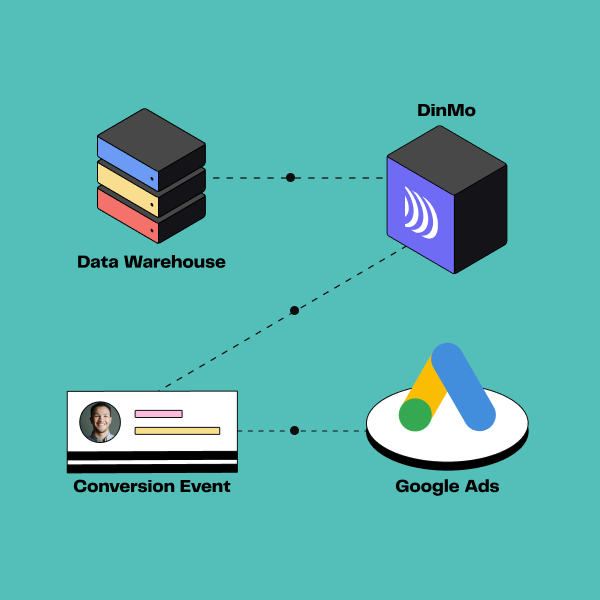
Google Conversion API: The Complete Guide
It allows you to obtain a 360° overview of your consumers, especially by integrating data at the bottom of the conversion funnel, while maintaining privacy. You can then improve campaign performance and measurement by relying on this valuable data.
For example, Facebook observes a reduction in CPA by 8% on average for enterprises that send their first-party data (through Meta Conversions API).

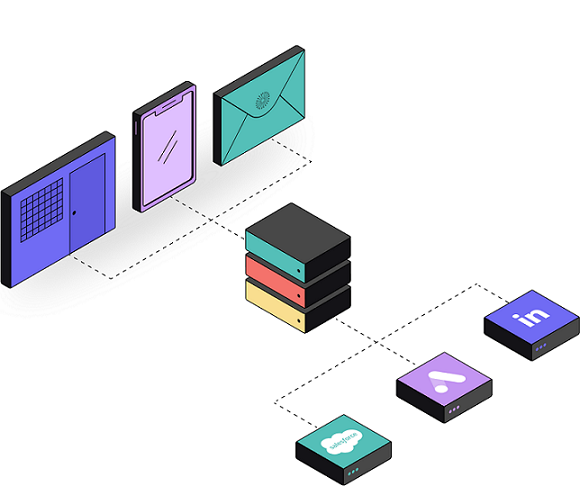
Define high-value audiences using first-party data
By mixing online and offline data throughout the whole customer journey, more relevant customer audiences can be built from your first-party data. Tools like DinMo help you to synchronise these audiences in your media platforms.
You can then easily activate them to improve acquisition through lookalike strategies and personalised and cross-environment retargeting. For instance, using high lifetime value similar audiences can improve your ROAS by up to 33%.
Want some help and advice on the best way to navigate into a cookieless world? Do not hesitate to contact us to set up a free consultation with our experts.
FAQ
What is the best alternative to third-party cookies for marketing personalisation?
What is the best alternative to third-party cookies for marketing personalisation?
First-party data is the main alternative. It comes from channels the company directly controls: website, mobile app, CRM, etc.
This proprietary data enables segmentation and personalisation without relying on third-party cookies.
Solutions such as CDPs, conversion APIs (Meta CAPI, Google Enhanced Conversions…) and server-side tracking allow these data to be activated in full compliance.
What pitfalls should you avoid when implementing a first-party strategy?
What pitfalls should you avoid when implementing a first-party strategy?
Among the common mistakes are:
- Failing to consider the needs of business teams,
- Overlooking the quality of collected data,
- Skipping a unified foundation, such as a data warehouse.
An effective first-party strategy relies on structured data collection, clear governance, and tools suited to omnichannel activation. A data warehouse combined with a composable CDP allows you to centralise and activate this data across all marketing and sales tools in full compliance.