

CPM (Cost Per Mille): definition, calculation and when to use it
5min • Last updated on Mar 6, 2026


Alexandra Augusti
Chief of Staff
Before the click, before the conversion, there is exposure. CPM — Cost Per Mille — is one of the oldest metrics in online advertising. Born alongside the first display banners in the 1990s, it remains an essential reference for measuring the effectiveness of large-scale ad delivery.
In an environment where brands multiply their channels — social media, video, programmatic display, Google Display — CPM answers a straightforward question: how much does it cost to be seen? That is precisely why it remains central to brand awareness campaigns, product launches, and audience-building strategies.
This article gives you a clear understanding of CPM: what it measures, how to calculate it, when to use it, and — crucially — how to interpret it alongside other KPIs to turn it into a genuine decision-making lever.
Key takeaways
The CPM is an advertising pricing model based on the cost of 1,000 impressions.
How to calculate it: (Total budget / Number of impressions) × 1,000.
When to use it: brand awareness, product launches, broad retargeting — and when to avoid it: direct conversion objectives.
How to interpret it: always in conjunction with CTR, conversion rate, and cost per acquisition.
What is CPM (Cost Per Mille)?
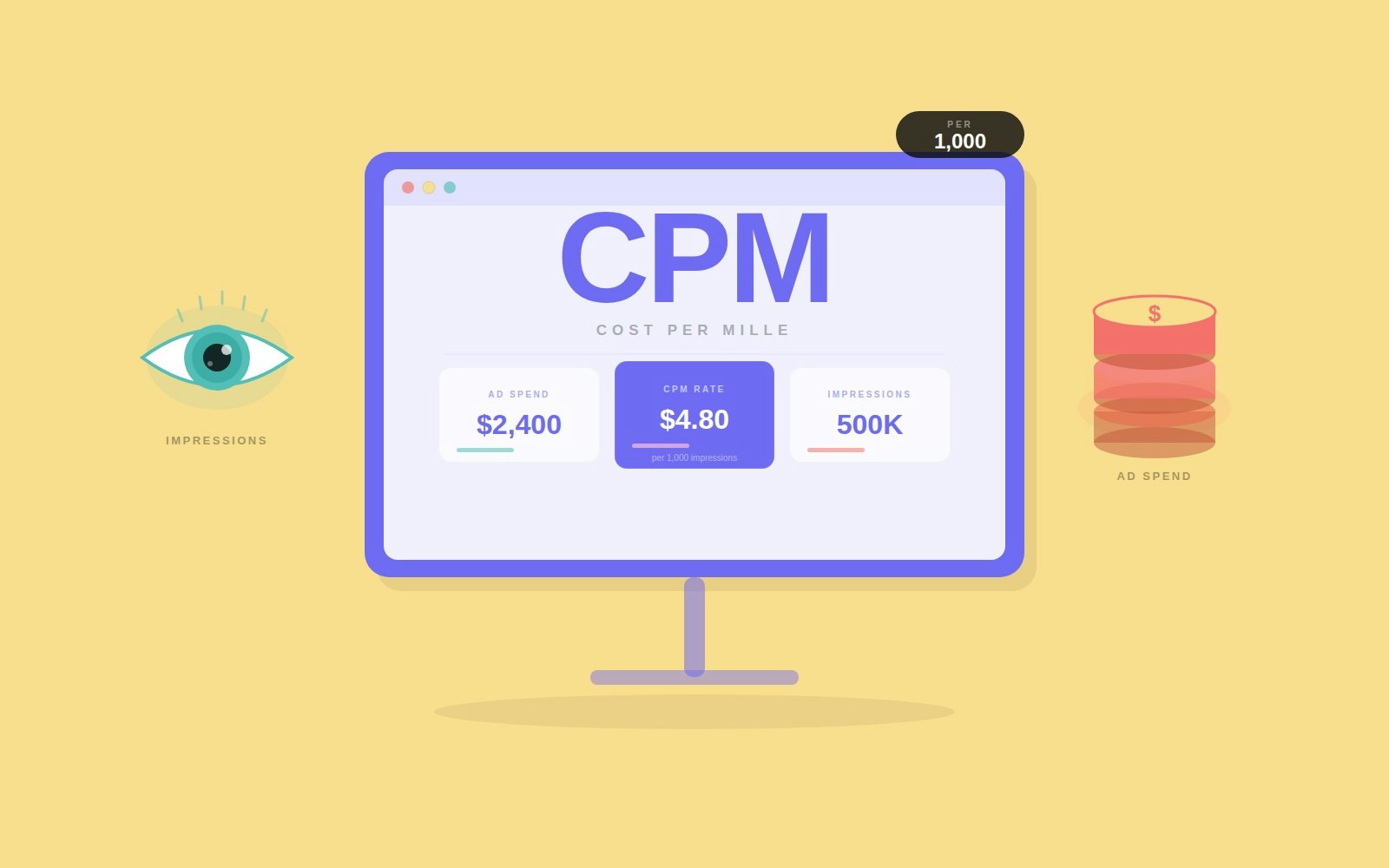
CPM, or Cost Per Mille (from the Latin mille, meaning 'thousand'), refers to the cost an advertiser pays for their ad to be displayed 1,000 times. It is the standard unit for buying advertising space on a delivery basis, regardless of how users actually behave.
An 'impression' is counted each time an ad is served on a user's screen. Whether or not that user interacts with the content is irrelevant — the views are logged. It is a measure of exposure, not engagement.
CPM operates on two distinct levels. On one hand, it is a pricing model: many advertising platforms transact on this basis. On the other hand, it is a performance indicator (KPI) that enables you to compare the relative efficiency of different campaigns, formats, or audiences.
How to calculate CPM
The formula is simple and universal:
CPM = (Total budget / Number of impressions) × 1,000
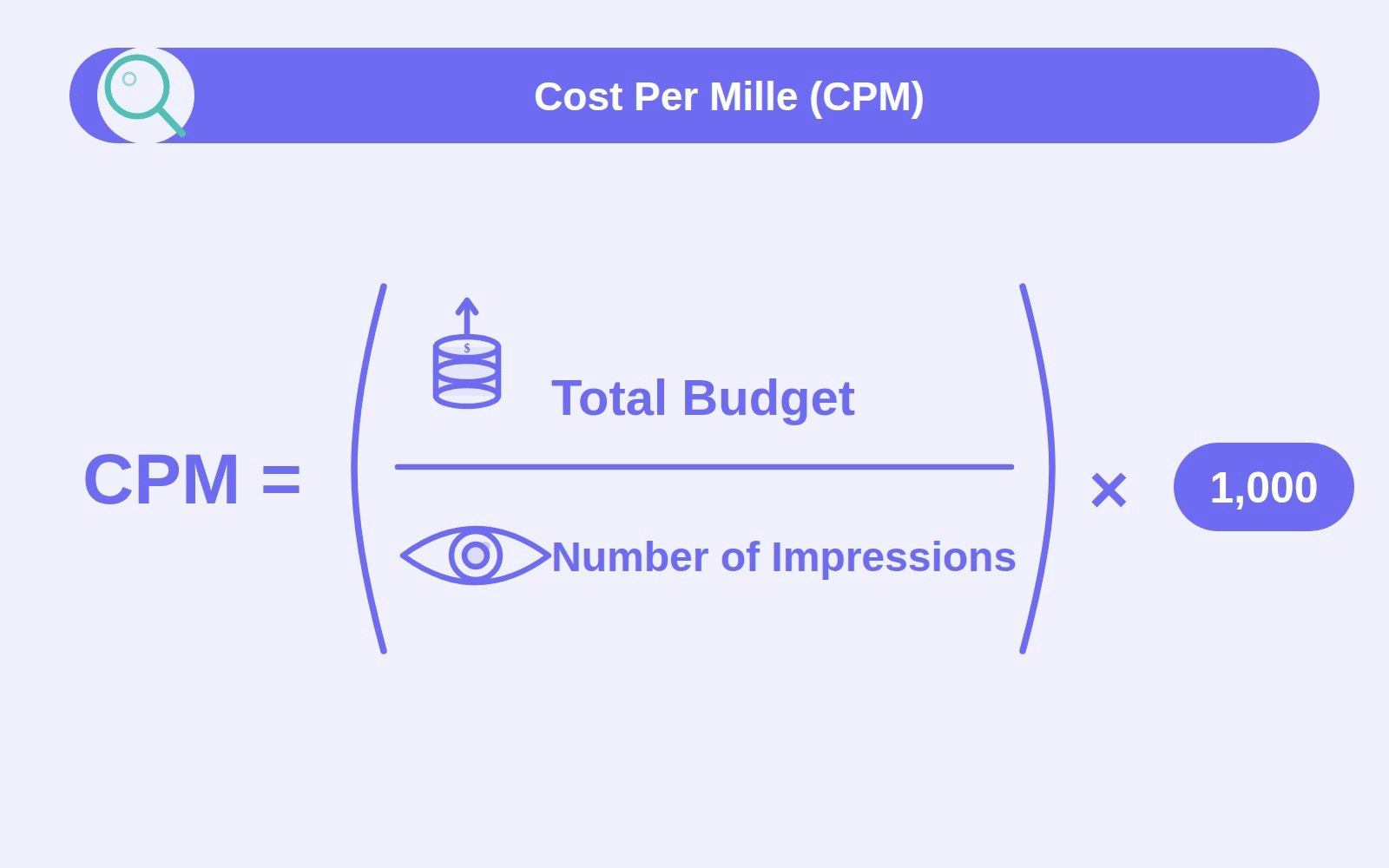
A practical example: a display campaign has a budget of £5,000 and generates 2,000,000 impressions. The CPM is therefore: (5,000 / 2,000,000) × 1,000 = £2.50. Every 1,000 ad displays cost £2.50.
One important nuance: vCPM (viewable CPM) is a variant that only counts impressions that were actually visible on screen (i.e. views), in line with IAB standards (at least 50% of the ad unit visible for a minimum of 1 second for display, 2 seconds for video). It is a more reliable quality indicator than raw CPM.
CPM, CPC, CPA, CPL: what are the differences?
CPM is just one of several available models, that charges for exposure. The right choice depends directly on the objective of the campaign.
CPC (Cost Per Click) charges for each click on the ad. The advertiser only pays when a user demonstrates active interest.
CPA (Cost Per Acquisition) and CPL (Cost Per Lead) charge for a concrete action: a purchase, a completed form, or a sign-up. These are the most performance-orientated models.
Model | Objective | Billing trigger | Primary use case |
|---|---|---|---|
CPM | Awareness / Visibility | 1,000 impressions | Display, video, branding campaigns |
CPC | Traffic / Engagement | Click on the ad | Search, click-focused social ads |
CPA | Conversion | Purchase / qualified action | E-commerce, revenue generation |
CPL | Lead generation | Form submission / sign-up | B2B, SaaS, services |
The differences between CPM, CPC, CPA and CPL
The key principle: each model corresponds to a stage in the funnel. CPM operates at the top of the funnel, where the goal is to build presence. CPC and CPA take over lower down, once purchase intent has been established.
When should you use CPM in your marketing strategy?
CPM is particularly well suited to situations where the priority is reach rather than immediate conversion.
Brand awareness campaigns
When a brand wants to reach a broad audience — launching a new product range, entering a new market — CPM maximises advertising contacts at a low unit cost.
Product launches
Before any conversion activity can succeed, a product must first be recognised. Display and video campaigns bought on a CPM basis ensure maximum coverage across defined target audiences.
Audience building
CPM is useful for creating or feeding remarketing audiences: exposing prospects who can then be retargeted with more direct, conversion-focused messages.
Broad retargeting
To remind users who have already interacted with a brand — a website visit, a social media engagement — CPM offers an economically efficient lever for staying visible.
⚠️ CPM can be less appropriate in specific cases. When the objective is a direct conversion — a purchase, a form submission, a download — CPC or CPA are generally more suitable. A CPM campaign with a low CTR and no conversion tracking produces spending without measurable ROI.
Advantages and limitations of CPM
Advantages
Broad reach: CPM enables a large number of people to be reached within a controlled budget.
Controlled exposure: advertisers can precisely manage how many times their message is displayed.
Simplicity: CPM is an immediately comparable metric across campaigns, channels, and formats.
Limitations
No guarantee of clicks or conversions: an impression is not an interaction. CPM tells you what visibility costs, not what it generates.
Highly dependent on impression quality: a non-viewable, off-target, or low-quality inventory impression undermines performance.
Must be read alongside other KPIs: in isolation, CPM says nothing about the actual impact of a campaign.
How to interpret CPM correctly
A low CPM is not automatically a sign of efficiency. It may simply mean the campaign is targeting a broad, poorly qualified audience, or that the ad inventory is of lower quality.
To make sense of CPM, it must be read alongside other metrics:
CTR (click-through rate): a high CPM combined with a strong CTR can indicate a well-qualified audience and a relevant creative.
Conversion rate: do the impressions generate visits that convert?
CPA (cost per acquisition): the ultimate indicator of whether media spend is delivering a business return.
Frequency is also a critical variable: the same user exposed too many times (overexposure) leads to ad fatigue. Conversely, too low a frequency undermines brand recall. Managing frequency caps is a key lever in campaign optimisation.
CPM and audience strategy: turning a media cost into a useful indicator
CPM becomes genuinely useful when viewed in light of audience knowledge. Too often, marketing teams analyse campaign performance at an aggregate level, without drilling into performance by segment.
A data-driven approach to CPM involves:
Segmenting audiences by customer profile (new visitors, active customers, high-value customers, cold prospects) and comparing CPM across each segment.
Identifying the audiences on which exposure delivers the greatest return, by cross-referencing CPM, CTR, and conversion rate.
Prioritising media budgets towards high-potential-value segments, rather than broadcasting indiscriminately.
Reading CPM not as an isolated media cost, but as one component of a broader equation that includes LTV, ROAS, and cost of acquisition.
The role of a composable CDP in CPM analysis
The principal limitation of CPM is that it remains a media metric: it measures exposure, not business impact. To move beyond this limitation, marketing teams need to unify their exposure data with their customer data.
This is precisely what a composable CDP enables. By building on the company's existing data warehouse, it provides the ability to:
Unify exposure data (impressions, frequency, reach) with customer data (purchases, behaviours, value).
Connect impressions to conversions, and conversions to actual customers, to measure the real impact of a CPM campaign on revenue.
Build dynamic segments from behavioural and transactional signals to sharpen targeting.
Activate these segments directly on advertising platforms (Meta, Google, programmatic) with continuous synchronisation.
Measure beyond CPM: customer value generated, average order value, retention, ROAS by segment.
This approach transforms CPM from a media cost into a business decision lever — provided the right tools are in place to connect exposure data to customer data.
Conclusion
CPM remains a structuring metric in digital advertising. It provides a simple, universal reading of the cost of visibility, and enables comparison of the relative efficiency of different channels, formats, and audiences.
But it realises its full value when integrated into a data-driven strategy: connected to customer data, contextualised with business KPIs, and analysed by audience segment rather than in aggregate.
Moving from CPM as a media metric to CPM as a decision lever is precisely the shift from exposure to activation — and that is where the true value of customer data lies.
👉 Find out how DinMo can help you better leverage your data to increase revenue and customer lifetime value (LTV). 🚀