


CPC: Turning cost per click into a lever for your audience strategies
6min • Last updated on Mar 3, 2026


Olivier Renard
Content & SEO Manager
[👉 Summarise this article using ChatGPT, Google AI or Perplexity.]
According to the Digital Report from We Are Social and Meltwater, global advertising spend reached almost $1,100 billion in 2024. Driven by year-on-year growth of 10.3%, digital now accounts for nearly 73% of that spend.
Competition between brands is fiercer than ever to gain visibility on Google, Bing, social networks and new generative search engines. To manage their campaigns, marketing teams rely on different KPIs and billing models, depending on their objectives, audiences and the channels they use.
Key Takeaways:
Cost per click (CPC) measures how much you pay on average for each click on your ads.
It is one of the main performance indicators used to manage campaigns, and is also associated with a billing model: pay-per-click (PPC).
Easy to interpret, CPC must always be considered alongside conversion rate, ROAS (Return On Ad Spend) and the actual value of your customers.
Campaign ROI can be improved with unified customer data and better targeting. A Customer Data Platform (CDP) makes this approach easier.
👉 What is cost per click and how do you calculate it to assess the performance of your activity? Discover how to integrate it into your audience strategies and leverage your data to make every click more profitable. 🔍
What is cost per click?
Cost Per Click (CPC) is the average amount an advertiser pays each time a user clicks on one of their ads.
It is used both on search engines (Google, Bing) for sponsored results and on social platforms such as Meta, LinkedIn, TikTok, X or Pinterest.
In practice, the platform uses a bidding system to set the price of each click: with every interaction, a portion of the budget is spent. You obtain CPC by dividing the total campaign spend by the number of clicks generated.
In day-to-day usage, the term CPC refers both to a pricing model (pay-per-click, or PPC) and to a KPI measuring the cost of a visit coming from an ad. It is therefore a central indicator for comparing your campaigns and adjusting bids in line with your marketing objectives.
CPC, CPM, CPA, CPL: what’s the difference?
Advertising platforms offer several media buying models, tailored to different objectives: visibility, traffic, conversions or lead generation. Here are the main pricing models:
Model | What you pay for | Main objective | Limitations |
|---|---|---|---|
CPC (Cost Per Click) | Each click on the ad. | Generate qualified traffic to your website or landing page. | Does not guarantee conversion or click quality. |
CPM (Cost Per Mille / thousand impressions) | 1,000 impressions of the ad. | Maximise visibility and brand awareness. | No guarantee of clicks or engagement. |
CPA (Cost Per Action / conversion) | Each defined action (purchase, sign-up, form submission). | Obtain conversions at the best possible cost (direct performance). | Sometimes higher cost, requires sufficient data volume. |
CPL (Cost Per Lead) | Each lead generated (form, demo request, contact). | Generate qualified leads to feed the sales pipeline. | Lead quality can vary, and sales cycles can be long. |
CPC vs CPM vs CPA vs CPL
Focused on engagement and traffic, CPC offers a good compromise between CPM (primarily visibility-oriented) and CPA (conversion-oriented). It remains essential, however, to link it back to conversions, ROAS and the actual value of the customers you acquire.
How do you calculate CPC?
To calculate cost per click (CPC), you simply divide the amount spent by the number of clicks generated by the campaign:
CPC = total budget spent / number of clicks

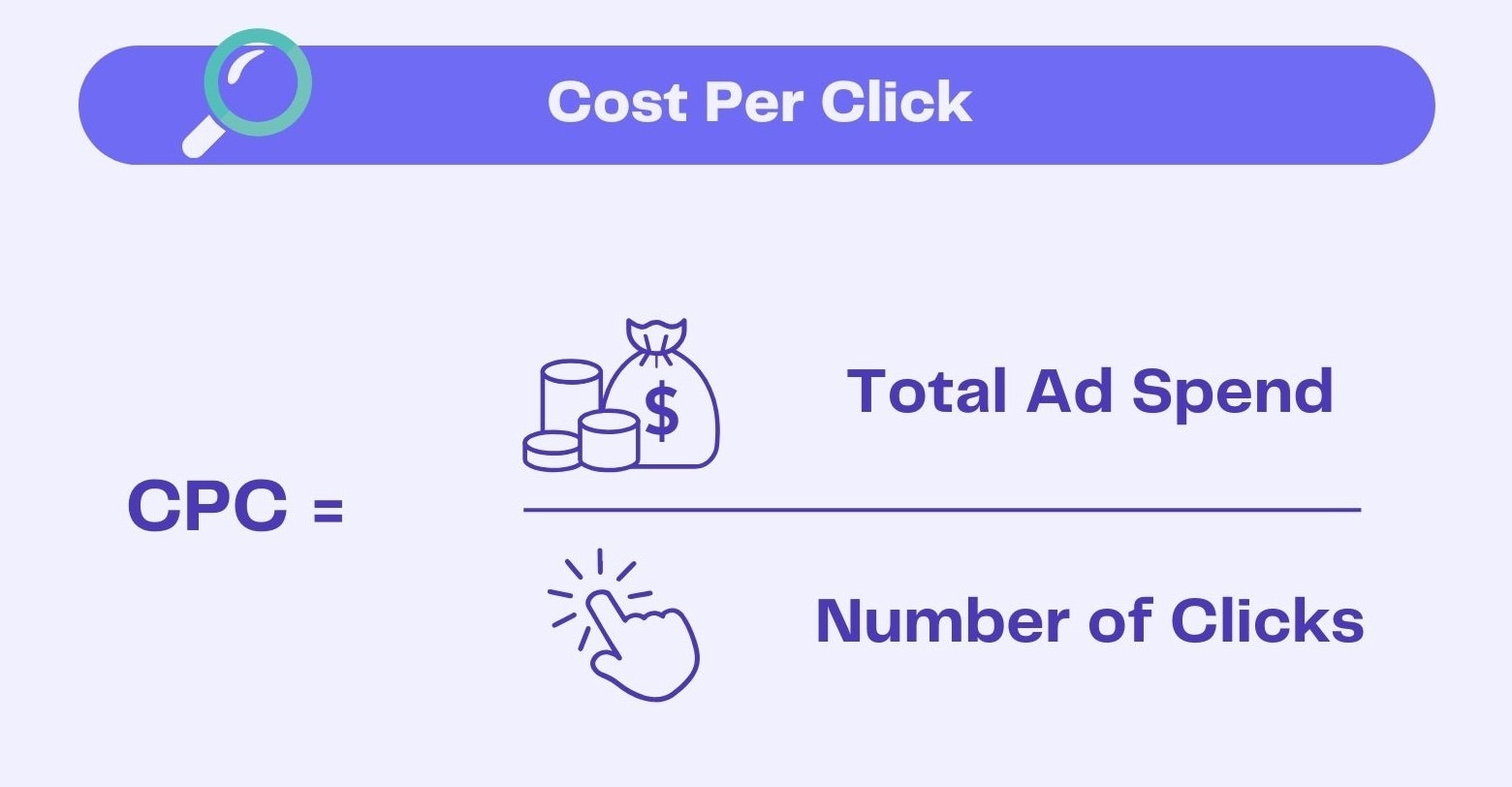
How to calculate CPC?
💡 If you invest £1,000 in a campaign and obtain 2,500 clicks, your CPC is: (1000 / 2500) = £0.40. This figure tells you how much you are paying on average for each visit generated by your ad.
In practice, platforms distinguish several notions:
Max CPC: the maximum bid an advertiser is willing to pay for a click.
Actual CPC: the price actually charged for each click, determined by the auction-based bidding system and competition.
Average CPC: the average observed over a period or campaign, used as a reference for performance analysis.
The platform adjusts click prices based on competition and ad quality. On Google Ads, the Quality Score gives each keyword a rating from 1 to 10 that takes into account keyword relevance, expected click-through rate and the experience offered on the landing page.
How do you track it?
CPC is available in most advertising platforms: Google Ads (Search, Shopping, YouTube), Meta Ads, LinkedIn Ads, TikTok Ads, X, etc.
You’ll find it in standard reports, alongside click-through rate (CTR), conversion rate and cost per result. It is a basic indicator for comparing your campaigns, audiences and creatives.


How useful is it for your campaigns?
Measure the cost of paid traffic: CPC indicates how much, on average, each visit generated by your ads costs. It’s a simple benchmark to compare the performance of your campaigns, keywords, audiences and creatives across channels.
An intermediate KPI to compare with CPA and ROAS: by relating it to conversion rate, average basket and margin, you can assess profitability. A campaign with a higher CPC may be more profitable if it converts better or targets higher-value customers.
The importance of customer value: the same CPC can have very different impacts depending on the audience targeted. You need to differentiate between new customers, existing customers and high-LTV profiles to interpret cost per click and adjust your strategies.
Optimisation strategies
Since 2020, advertisers have seen a steady increase in their costs across major platforms. CPCs are rising faster than budgets, placing growing pressure on campaign profitability.
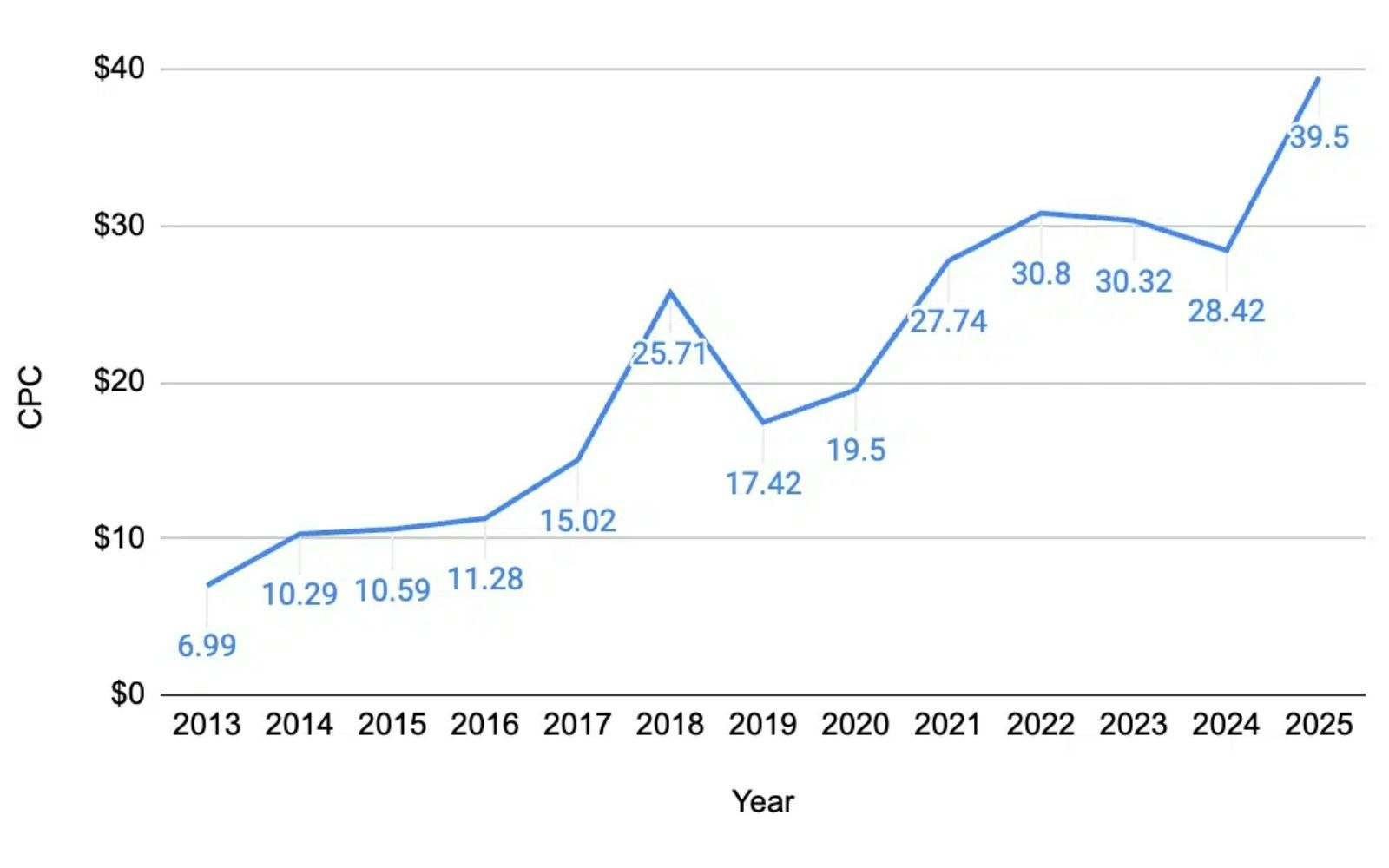
CPC inflation in travel industry (Credit: Search Engine Land)
What factors influence CPC?
Market and competition. Cost per click is closely tied to your competitive context. Some verticals are structurally more expensive than others: insurance, finance, SaaS, etc.
Seasonality, device type and geography can also influence average click prices.
Quality of your ads and landing pages. Clear copy, relevant visuals and coherent messaging help improve click-through rate and your Quality Score.
A landing page aligned with the ad promise and optimised for conversion also contributes to lowering actual CPC.
Targeting and artificial intelligence (AI) algorithms. More precise targeting can cost more but deliver better conversions. Automated bidding strategies (tCPA, tROAS, fully automated campaigns) continuously adjust click prices based on conversion probability.
The goal isn’t necessarily to pay the lowest possible price, but to pay the right price for the right profiles.
Optimising your budget without sacrificing profitability
The first levers remain the classic best practices. Clean up your campaigns regularly (underperforming audiences and keywords), test multiple ad variants and improve your landing pages to increase conversion rates.
Beyond raw CPC, the key is to focus on your business objectives. A slightly higher CPC on a high-value audience is far more profitable than a cheaper click on a poorly qualified segment.
The DinMo composable Customer Data Platform (CDP) makes this approach easier.
Exclude customers who have already converted, target high-LTV profiles, and set up dedicated campaigns for reactivation or loyalty to maximise the return on every euro invested.
By unifying customer data, DinMo enables the creation of advanced segments (RFM, churn risk, product affinity) and syncs them to Google, Meta, LinkedIn or TikTok. Our platform connects to conversion APIs to send reliable signals to ad platforms, in a context where third-party cookies are gradually disappearing. At equal CPC, each click contributes more effectively to your results.
Towards AI- and data-driven marketing
The main advertising platforms now rely on AI to adjust bids and cost per click in real time. Automated bidding strategies, Performance Max campaigns on Google or Advantage+ on Meta: the algorithm decides who sees the ad, when, and at what price, according to conversion probability and available signals.
In 2025, Meta rolled out Andromeda, an AI engine that pre-selects ads before the auction. As a result, the quality of conversion signals and creative assets plays an even greater role in performance.
The challenge is no longer just to reduce CPC, but to feed these systems with better data. DinMo lets advertisers add their own intelligence layer on top of what the platforms provide.
Marketing teams benefit from predictive scores (churn, LTV, product affinity, recommendations) and advanced segments they can activate. Our Customer Hub becomes your cockpit to track metrics by segment and measure the real impact of campaigns.
In a landscape where agentic commerce is emerging and search, data and creative are converging (as illustrated by Adobe’s acquisition of Semrush), keeping control of your customer data remains the best way to master the performance behind CPC.

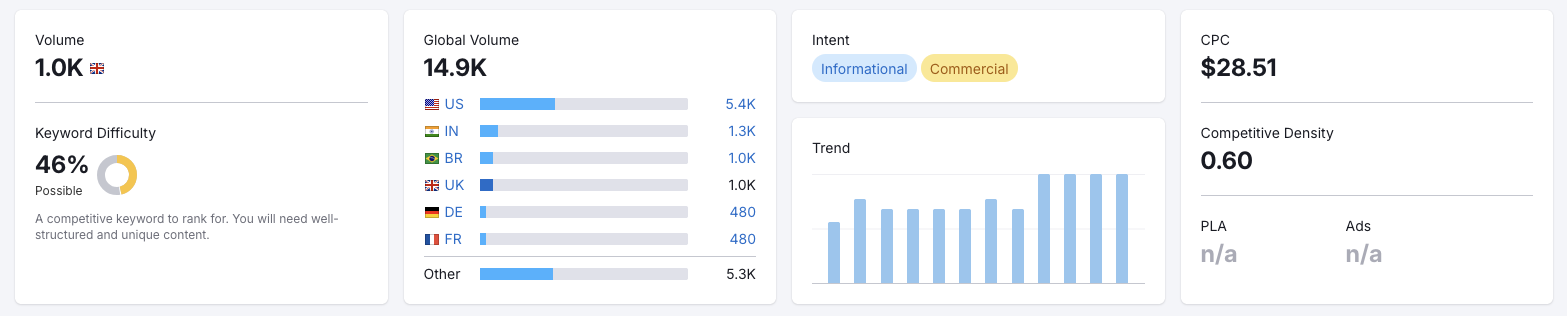
Cost per click in Semrush (Credit: Semrush)
Conclusion
Cost Per Click (CPC) remains a key indicator for tracking the cost of your paid traffic. It helps you compare your campaigns, channels and audiences.
To assess the profitability of your investments, you must relate CPC to conversion rate, ROAS and customer value. First-party data and the quality of your audiences make all the difference.
The DinMo composable CDP brings your customer data together around a unified profile, builds relevant segments and feeds platforms with reliable signals. More than just a KPI, CPC becomes a strategic lever serving your business objectives.
Keen to go further? Discover how DinMo improves targeting and the profitability of your paid campaigns.