



More than 60% of corporate data is hosted in the cloud (Statista). Yet, only a small fraction of this information is truly leveraged to guide marketing and business decisions.
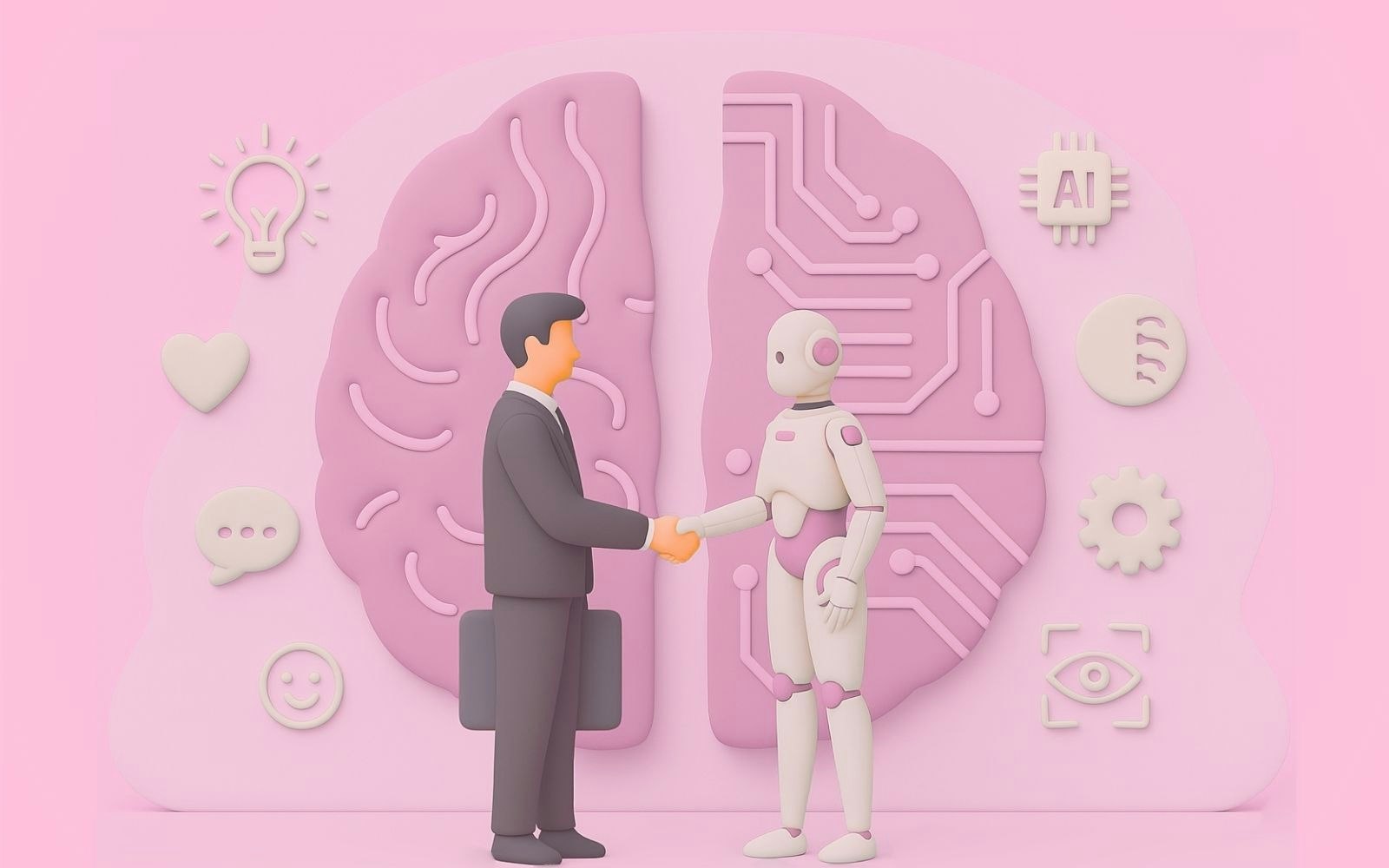
Artificial Intelligence (AI) is emerging as a powerful solution to turn raw data into actionable outcomes. The challenge now lies in integrating this technology seamlessly into business processes while keeping human oversight.
Key Takeaways:
AI Decisioning automates decision-making through data. It relies on machine learning models to recommend or trigger the best action in real time.
It applies across the value chain: marketing, product, sales, and support.
It combines business rules, predictive models, and machine learning to continuously adapt to customer behaviour.
DinMo’s composable CDP facilitates AI decisioning with embedded AI capabilities and seamless integration into your data stack, without technical complexity.
🔍 Discover what AI Decisioning is and how it works ? How a composable CDP unlocks its full potential to help you achieve your business goals ? 🚀
What is AI Decisioning?
AI Decisioning is the process of making decisions automatically using artificial intelligence and data.
It analyses the available information, evaluates possible options, and selects the best action to meet a specific goal. In marketing, this might mean increasing conversion rates, improving customer satisfaction, reducing churn, or prioritising leads.
It typically follows this cycle: collection → analysis → decision → execution → learning.
Machine learning models predict likely behaviours, while business rules ensure decisions remain coherent, governed, and compliant. The system continuously improves via feedback loops.
AI Decisioning sits within the broader concept of Decision Intelligence, which connects data, analytics, and action. It goes beyond predictive analytics by choosing and triggering the optimal decision.

At the end of his five matches against AlphaGo, the Korean champion Lee Sedol acknowledged that the machine had made more creative decisions than him (credit: Lee Jin-man/AP).
How is AI Decisioning different from Generative AI and Agentic AI?
These three concepts are related but serve distinct purposes:
Generative AI, widely known by the general public, delivers creativity and contextual understanding. It can analyse text, summarise conversations, or make recommendations. However, it doesn’t ensure adherence to business rules or governance frameworks.
Agentic AI is currently a trending topic in AI. It refers to systems capable of acting autonomously.
These agents observe, plan, test, adjust, and continuously learn across all areas. This has given rise to disciplines like agentic marketing, agentic commerce, agentic SEO, and more.
AI Decisioning acts as the decision layer between data and action. It applies predictive models, business rules, and optimisation logic to make reliable, coherent, and goal-oriented choices.
Advantages of this approach
This process enables businesses to turn data into fast, actionable decisions at scale. It enhances decision accuracy and empowers operational teams with greater autonomy.
The customer experience becomes more relevant through fine-tuned personalisation, while governance remains strong thanks to full transparency.
How does AI Decisioning work?
AI Decisioning relies on several complementary building blocks to move from data to action:
1️⃣ Data Unification
All customer data (web, mobile, CRM, transactions, support interactions) is gathered into a single environment, typically a data warehouse or lakehouse. This step ensures consistency, quality and freshness of the information.
2️⃣ AI engine and business rules
Predictive models anticipate behaviours (e.g. likelihood to purchase, risk of churn, product interest). Business rules frame these forecasts to ensure they remain compliant, coherent, and explainable.
Together, they help select the best course of action based on context and operational goals.
3️⃣ Omnichannel activation
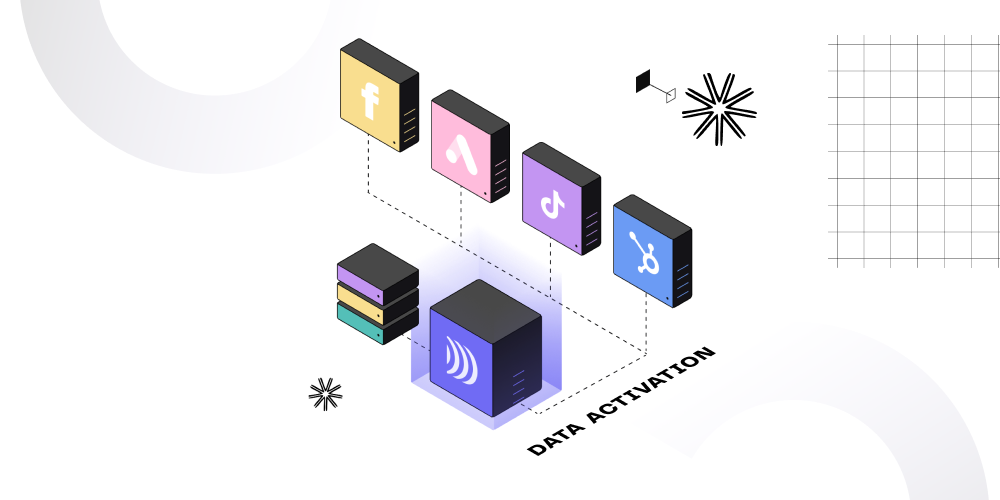
Once the decision is made, actions are triggered in real time and must stay consistent across all channels. Data is activated within the company’s tools (CRM, ad platforms, email systems, mobile apps), ideally via Reverse ETL.
4️⃣ Feedback loop
Each action generates new data, which is reintegrated into the system to adjust models, refine rules, and improve outcomes. Over time, the decision engine becomes increasingly accurate.

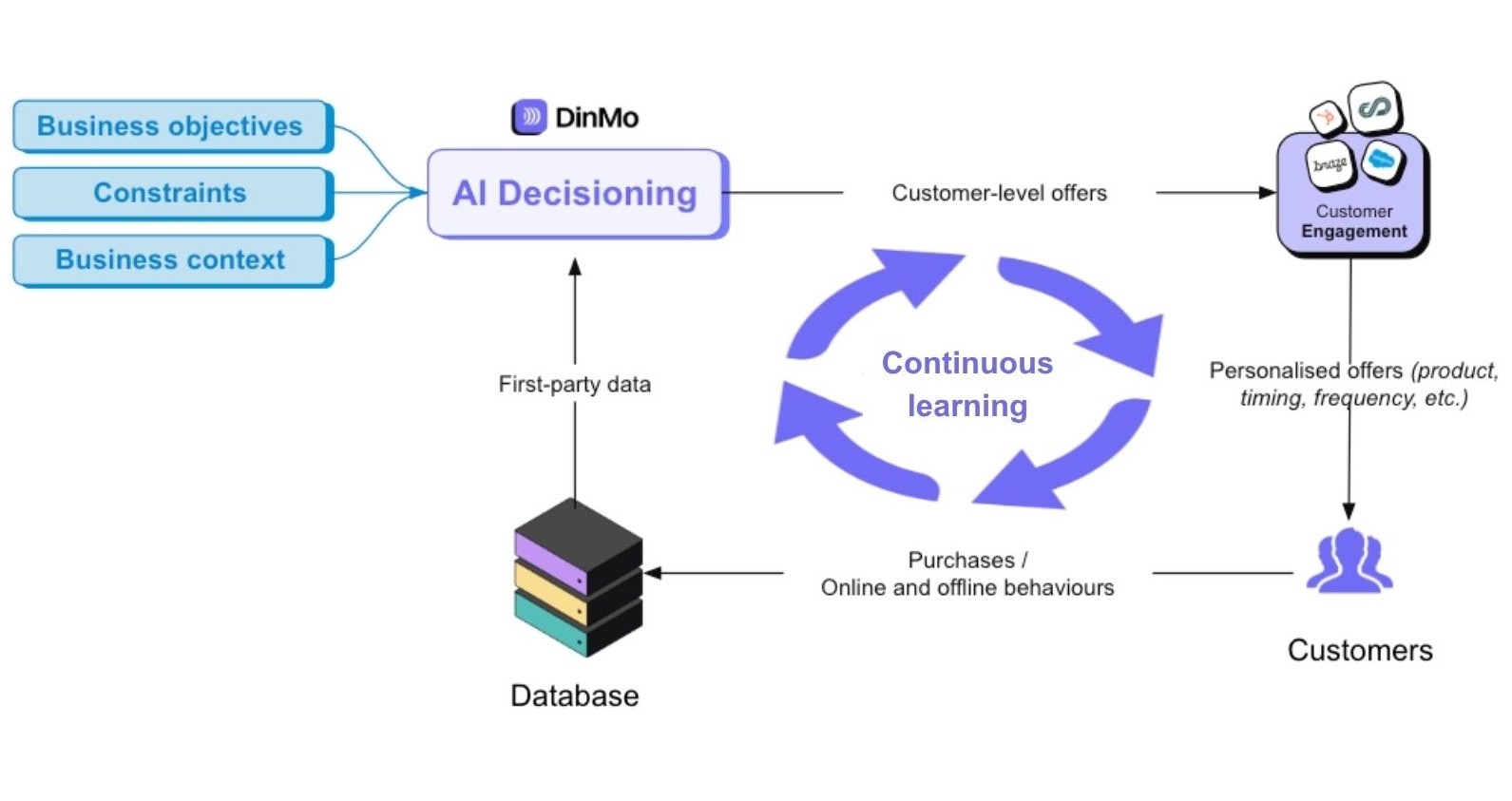
AI decisioning with DinMo
Modular architecture and governance
AI Decisioning fits naturally within a Modern Data Stack. All data remains centralised in a single source of truth, no unnecessary duplication.
This modular, no-copy-by-design infrastructure provides flexibility and maintains control over access rights. Each component can evolve independently without disrupting the whole system.
Governance also plays a crucial role: decision transparency, traceability, and regulatory compliance (e.g. GDPR). Businesses retain full control over their data and the system’s decision-making.
Main use cases
Acquisition and performance
AI Decisioning enhances acquisition efforts by automatically selecting the most effective recommendation or message for each potential customer.
Predictive models identify the most likely buyers. The Next Best Action adjusts multichannel campaigns in real time based on customer journey stage.
💡 Amazon example: the e-commerce giant uses decision engines to recommend the most relevant products based on purchase history, browsing behaviour and behavioural signals. This approach increases conversion while personalising the experience.

Personalised recommendations (Source: Amazon)
Customer relationship and loyalty
AI Decisioning helps anticipate churn, tailor communications, and adjust journeys based on signals. Teams can activate targeted actions before the relationship deteriorates.
💡 Airbnb already personalises user experiences based on search preferences and likely destinations.
With its upcoming loyalty programme, AI will play a key role in identifying high-value travellers and offering tailored benefits.
Product and user experience
Artificial intelligence enhances product usage by dynamically adjusting features based on each user’s context. The aim is to provide an enriched experience without manual intervention.
💡 Netflix not only personalises recommended content, but also display order, category prominence, and even film thumbnails. These choices rely on decision engines trained on billions of interactions.


Netflix: Stranger things covers
Sales and customer support
Sales teams benefit from better-qualified leads that are automatically prioritised based on their likelihood to convert. Meanwhile, support teams use AI to triage tickets, suggest answers, or route complex requests more effectively.
For the company, this means higher productivity and improved customer satisfaction.
👉 In practice, we recommend starting with a clearly defined use case, such as churn reduction or predictive lead scoring. Test it, measure the results, then gradually expand the decisioning scope.
Combining AI Decisioning with a Composable CDP
AI Decisioning becomes most effective when built on reliable, unified, governed data. This is exactly the core principle of a composable Customer Data Platform (CDP).
The data warehouse as the source of truth
Automated decision-making requires consistent, up-to-date data. This information comes from all of the company’s systems: web browsing, CRM interactions, transactions, in-app behaviour, and more.
With a composable CDP, the data warehouse becomes the single source of truth. All information is consolidated in one environment, without duplication.
Interoperable and scalable, this architecture is better suited to the needs of AI decisioning. It ensures consistency, quality and traceability. It also guarantees fast processing, fine-grained access control and full compliance.
DinMo’s contribution
Our composable CDP connects customer data directly to your decision engine, with no technical complexity. Teams can create segments using natural language and enrich them with AI attributes, no code required. These features accelerate new use cases.
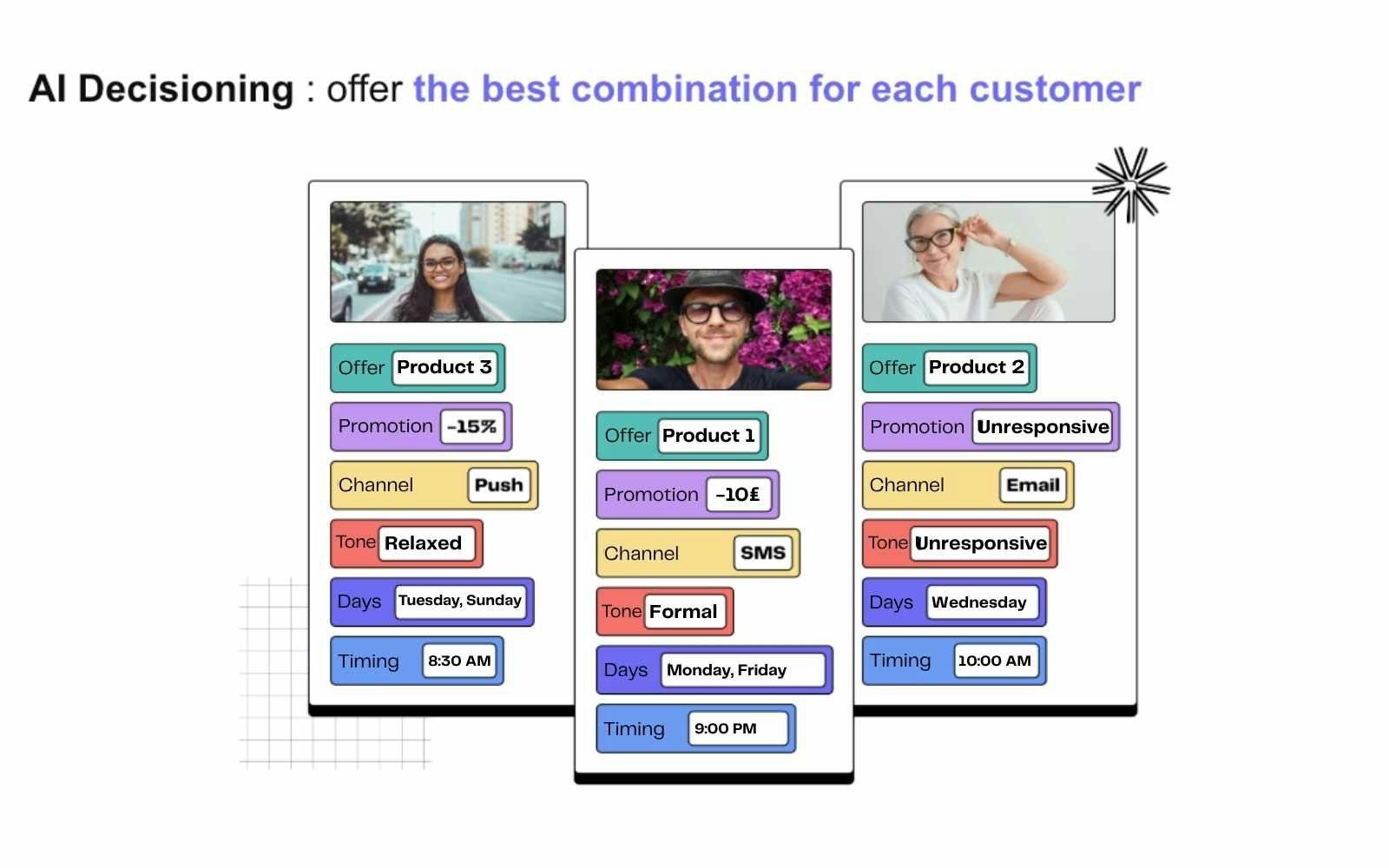
Offer the best combination for each customer based on their stage in the journey
Once decisions are generated, DinMo instantly activates the data across business tools. Our Reverse ETL module ensures seamless synchronisation across all destinations.
Decisions remain supervised and aligned with business strategy. Teams can control and adjust actions while maintaining full transparency.
Conclusion
AI Decisioning marks a new stage in intelligent automation: organisations harness AI and data to select and trigger the best actions continuously. They transform raw data into coherent, actionable decisions across their ecosystem.
When combined with a composable CDP, this approach becomes even more powerful. Unified data within the data warehouse becomes the engine for large-scale personalisation.
With DinMo, AI decisioning becomes concrete, accessible, and easy to implement. Marketing, product, and support teams gain autonomy while keeping full control over the decisions made.
👉 Discover how DinMo integrates artificial intelligence to power real-time marketing decisions.