

Predictive segmentation: from scoring to marketing activation
7min • Last updated on Jan 21, 2026


Olivier Renard
Content & SEO Manager
[👉 Summarise this article using ChatGPT, Google AI or Perplexity.]
The global predictive analytics market is estimated at $18.89 billion in 2024 and is expected to reach $82.35 billion by 2030 (Grand View Research). Companies have stepped up investment in these technologies, and marketing is following suit.
For teams, the challenge is to prioritise and personalise by moving towards customer segmentation that anticipates future behaviour.
Key takeaways:
Predictive segmentation involves grouping customers based on their likelihood of adopting a future behaviour (purchase, churn, reactivation).
It relies on machine learning–driven scores to prioritise audiences and steer campaigns.
A range of solutions is available on the market. You can start with simple use cases before moving on to more advanced models.
The DinMo composable CDP offers a unified data–centric approach to building predictive segments and activating them, without technical complexity.
👉 What is predictive segmentation, and how can you use it without adding complexity to your stack? Discover key use cases, a simple method and real-world examples to better target your campaigns. 🔍
What is predictive segmentation?
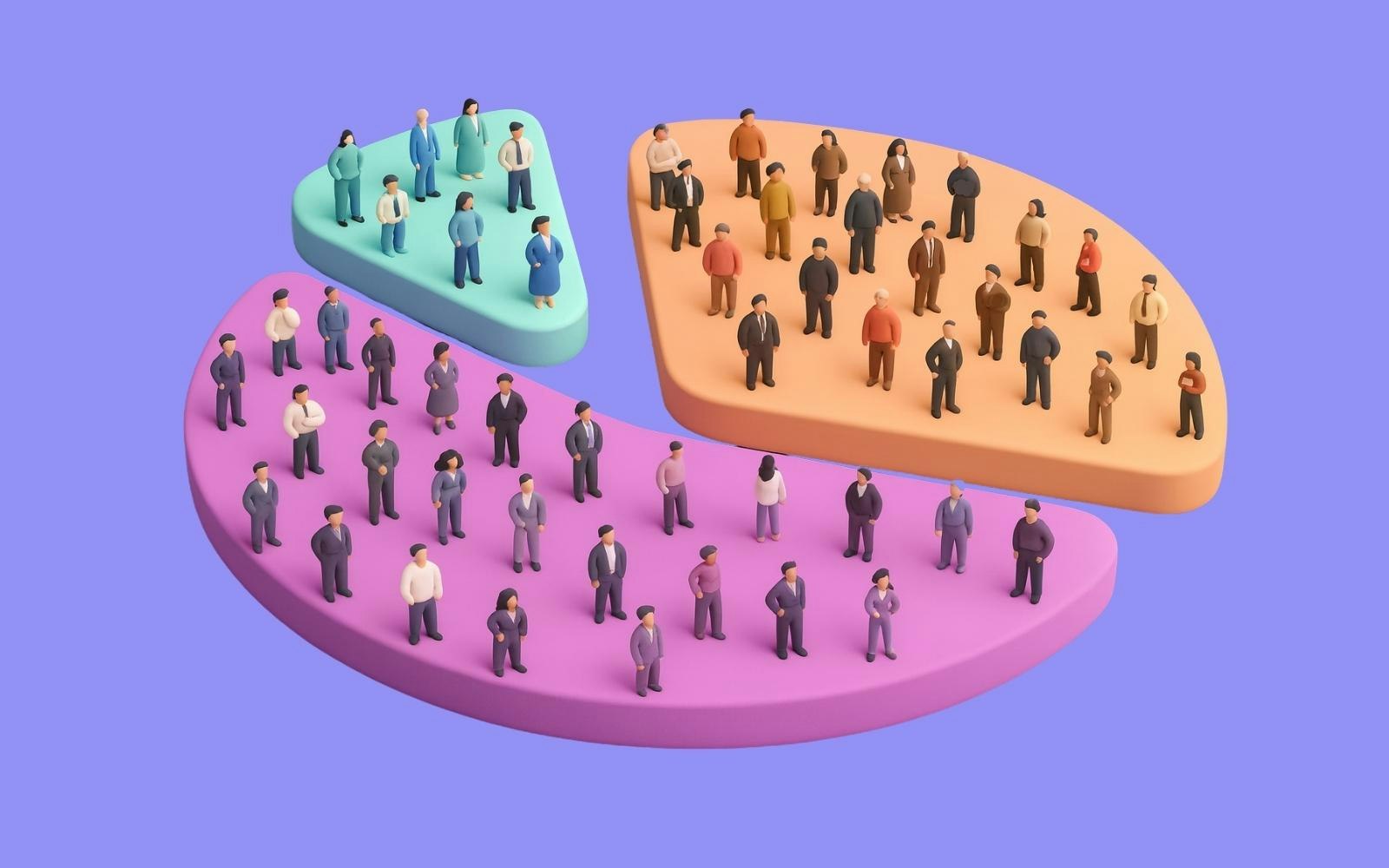
Predictive segmentation involves grouping customers based on their likelihood of taking a specific action within a given timeframe: purchasing, reactivating, churning, clicking or returning to a store.
Rather than describing past behaviour, the goal is to anticipate future actions so marketing efforts can be focused more effectively.
This is what sets it apart from more traditional segmentation approaches based on static or descriptive attributes (demographics, geography, historical behaviour, etc.). While these methods remain useful, they do not always make it possible to prioritise audiences or anticipate the right moment to act.
The differences can be summarised simply:
Approach | Strengths | Limitations |
|---|---|---|
Rule-based segmentation | Governable, easy to explain to teams | Leads to too many segments and quickly becomes complex |
RFM (Recency / Frequency / Monetary) | Fast, easy to read, effective in many cases | Focuses on past behaviour, hard to adapt as patterns change |
Predictive segmentation | Anticipates behaviour, helps prioritise and target at the right time | Requires reliable, accessible and up-to-date data |
Traditional segmentation methods vs predictive segmentation
In practice, many companies adopt a hybrid approach. They keep their existing segmentations (RFM, ABC, simple rules) and enrich them with predictive scores to improve prioritisation, personalisation and overall marketing performance.
Key benefits
Predictive segmentation delivers tangible benefits when it comes to managing campaigns and customer relationships.
It helps prioritise the right effort at the right time by focusing budget and marketing pressure on customers who are genuinely most likely to act.
It enhances personalisation without requiring manual segmentation or adding complexity to the marketing stack.
It contributes to churn reduction by identifying at-risk customers and triggering targeted retention actions.
It helps increase customer lifetime value (CLV) through more relevant upsell and cross-sell scenarios.
It strengthens performance management by enabling teams to better link targeting decisions to KPIs and campaign ROI.
Overall, the goal is to make better marketing decisions based on these predictions.
👇

AI-powered customer segmentation
Common predictive models in marketing
In practice, most companies start with a small number of straightforward models that are directly aligned with their business priorities.
Retention segments (churn risk)
These group together customers who are at risk of attrition or showing declining engagement. Such models are commonly used to identify profiles that need to be retained and to adjust the frequency and intensity of outreach.
Value segments (future CLV)
These are based on a customer’s expected future value. This makes it possible to distinguish high-potential customers, VIPs to protect, or customers whose future profitability appears more uncertain.
These insights help allocate resources more effectively, whether for acquisition or retention.
Propensity-to-act segments
These are built around the likelihood of a customer taking a specific action within a defined time window. This could include activating a feature, making a purchase, requesting a demo, upgrading, or reactivating after a period of inactivity.
The approach involves defining a target event (the expected action), choosing a time horizon, and then using the propensity score to build activatable audiences. In some cases, the goal is to identify who is genuinely likely to act as a result of the campaign, and who might instead respond negatively.

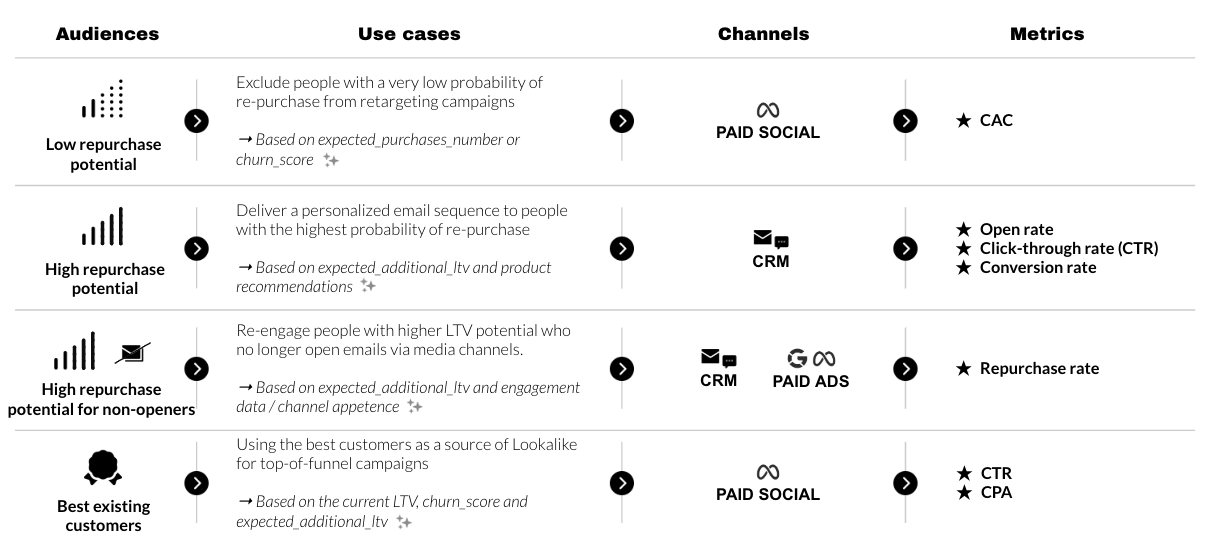
Most common use cases based on predicted CLV/Churn
How it works and how to implement it?
Predictive segmentation follows a simple logic: define an objective, calculate a score, turn it into target groups, activate and measure. The goal is to make better marketing decisions based on data.
Key steps
Define the objective and the time window. For example: “purchase likelihood within 30 days”, “churn risk within one month”, or “propensity to reactivate within 15 days”.
Calculate a score based on customer data. Often generated using machine learning, this score represents an estimated probability derived from historical data and customer behaviour.
Turn the score into activatable segments. To make the score actionable, simple thresholds are defined to support decision-making. Multiple signals can then be combined to prioritise actions (e.g. low disengagement risk + high upsell / cross-sell propensity).
Activate on the right channels. Segments are then used across the available marketing tools: email and CRM, paid media campaigns, on-site personalisation and notifications.
Measure and adjust. Each segment should be linked to a small number of clear KPIs, such as conversion rate, retention rate or incremental margin.
💡 Let's take, for example, an e-commerce site looking to grow cross-selling. Based on behaviour observed over the past 90 days (purchases, browsing, interactions), a propensity score estimates the likelihood that a customer will make an additional purchase within the next 30 days.
This score is then used to build priority audiences and serve them the most relevant offer (also known as Next Best Offer, or NBO), while measuring the actual impact of the action.

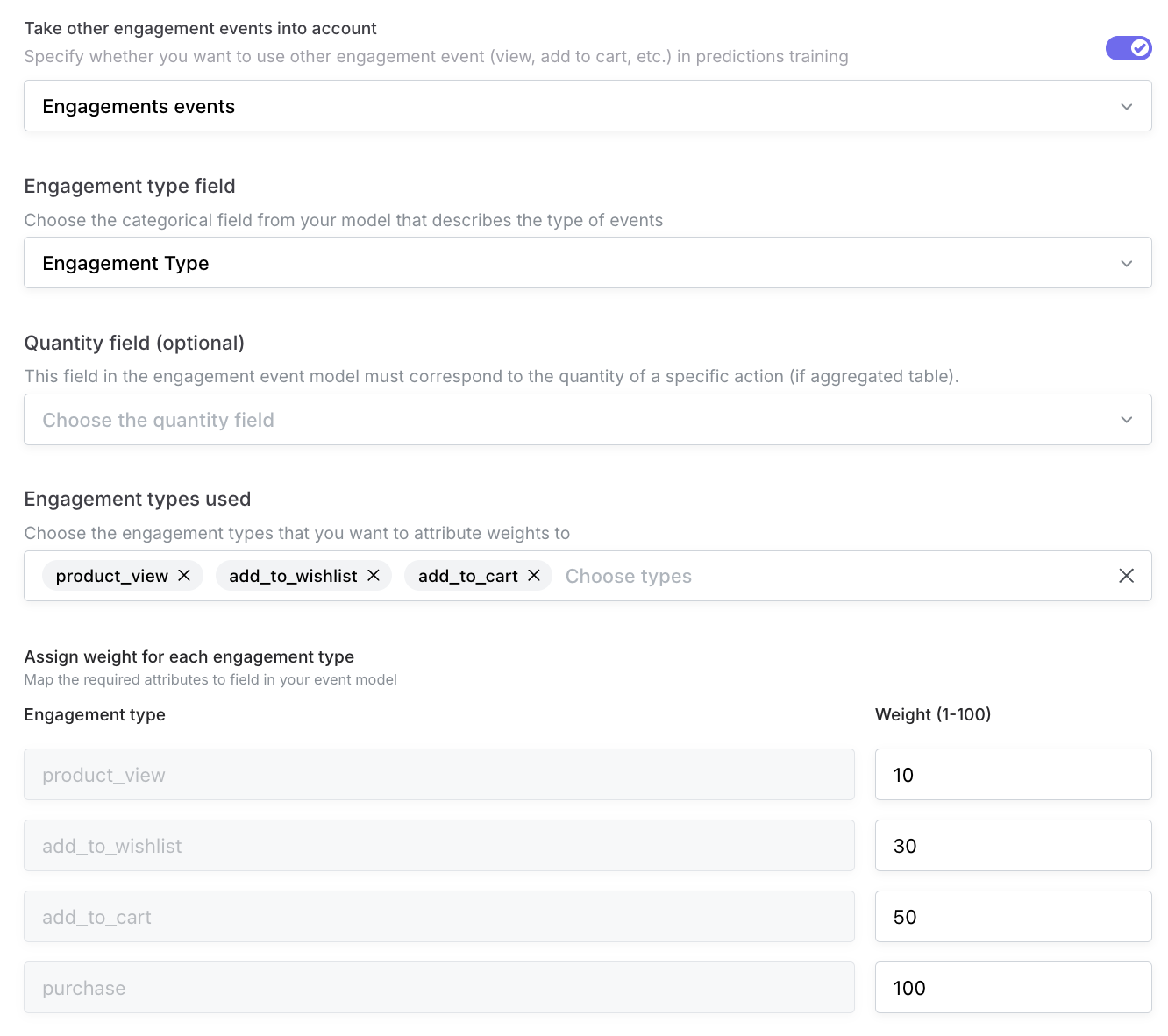
Engagement events for predictive segmentation in DinMo
Implementation: best practices
Start with simple, high-impact use cases to demonstrate value quickly: churn reduction, upsell, reactivation, targeted acquisition. This approach makes adoption easier for teams.
Check data readiness. To be actionable, predictive segmentation relies on reliable customer data.
Scale progressively. Once early results are validated, the practice can be stabilised and new use cases added without weighing down the stack.
Avoid common pitfalls. Over-targeting, poorly calibrated thresholds or incomplete data can distort results.
What solutions are available on the market?
Several tools can be used to run predictive segmentation. However, they do not offer the same level of governance, flexibility or marketing activation capabilities.
Option 1: CRMs and Customer Engagement Platforms (CEPs)
Some teams build their segmentation directly within their CRM or Customer Engagement Platform (CEP). The main advantages include: creating and activating segments in a single tool, straightforward implementation for operational campaigns, and a quick way to test ideas.
While appealing on paper, this approach quickly shows its limits as data volumes grow or use cases become more advanced:
Data remains fragmented by channel or tool,
Governance becomes more complex (multiple versions, duplicates),
Interoperability with other components of the stack is limited, with rigid architectures.
Predictive capabilities are often limited, as these solutions do not have visibility into the full dataset (lack of historical data).
These platforms are primarily designed for campaign orchestration, but they are not sufficient on their own to build and scale predictive scoring and segmentation.
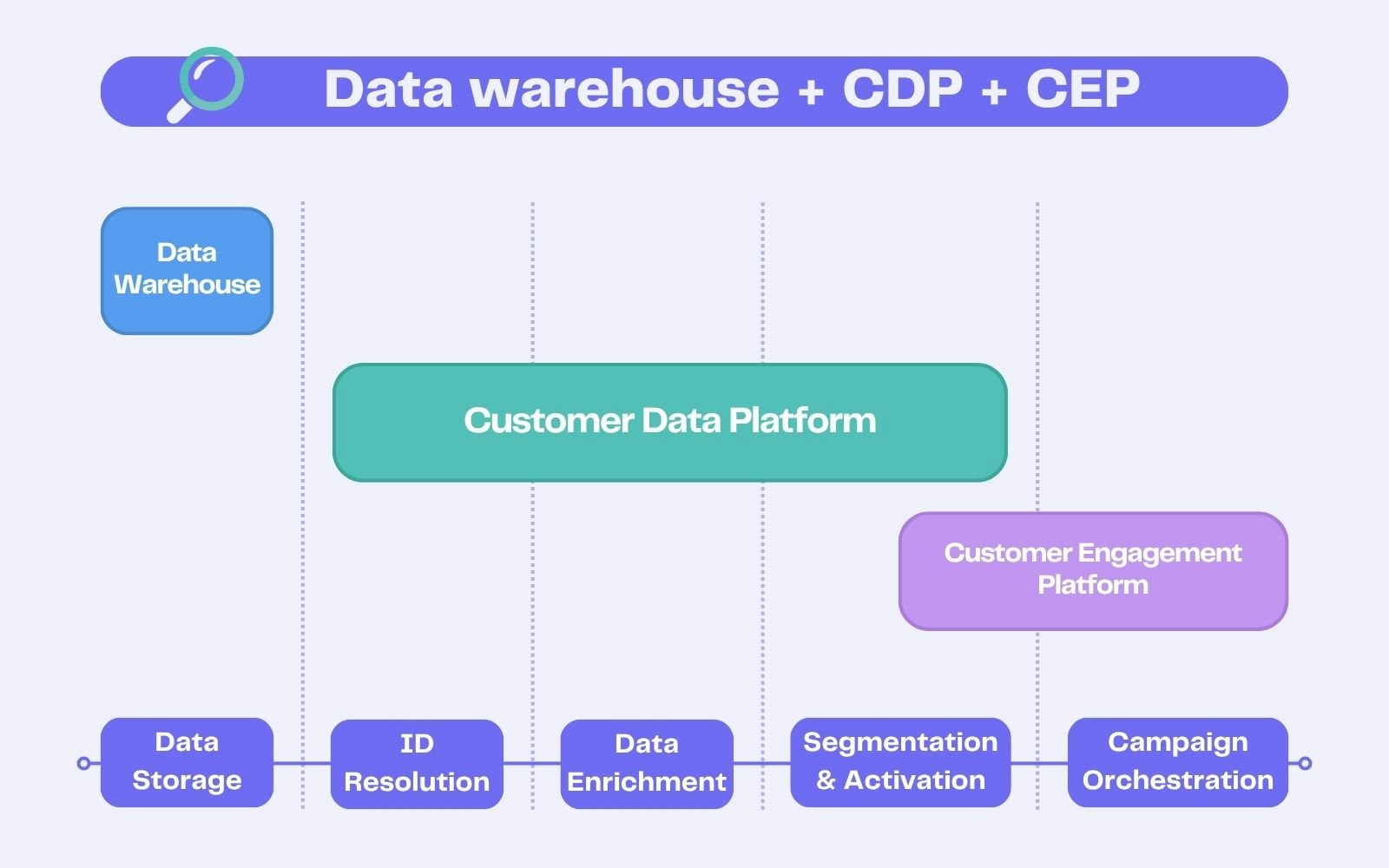
Data warehouse, CDP and CEP
Option 2: Packaged CDP vs composable CDP (warehouse-centric)
More and more companies therefore rely on a Customer Data Platform to centralise and structure their customer data. Two approaches currently coexist.
Packaged CDP
This model offers an ‘all-in-one’ solution with out-of-the-box capabilities: data collection, storage, segmentation and activation.
However, it comes with several limitations:
Data is duplicated within the CDP’s own infrastructure, in addition to the data warehouse,
Strong dependency on the vendor’s ecosystem,
Limited flexibility for data teams.
This rigid architecture quickly becomes a constraint when organisations want to move towards more advanced, data-driven decision-making.
Composable CDP (warehouse-centric)
By contrast, the composable approach works directly from the data warehouse, without creating additional copies. Data remains in a governed, secure environment shared by both data and marketing teams.
Key benefits include:
Reliable, unified data for predictive scoring
Greater flexibility when connecting activation channels,
Controlled costs and improved interoperability,
Natural alignment with a Modern Data Stack.
In this modular model, the CDP acts as the bridge between data, segmentation and activation.
DinMo’s strengths for predictive segmentation
With DinMo, marketing teams can leverage predictive attributes based on customer data stored in the data warehouse (churn risk, future CLV, product affinity, etc.). Machine learning turns these signals into actionable probabilities that marketing teams can use directly.
Beyond prediction, the goal is to activate at the right time and on the right channel, aligned with a clear objective: churn reduction, smarter budget allocation or improved ROI.
Our CDP also includes generative AI capabilities (DAN) that make it easier to identify strategic audiences before activation. In addition, the platform makes it possible to analyse the impact of actions using control groups, enabling incremental value measurement.
Our mission: help business teams trigger the actions that genuinely create value.
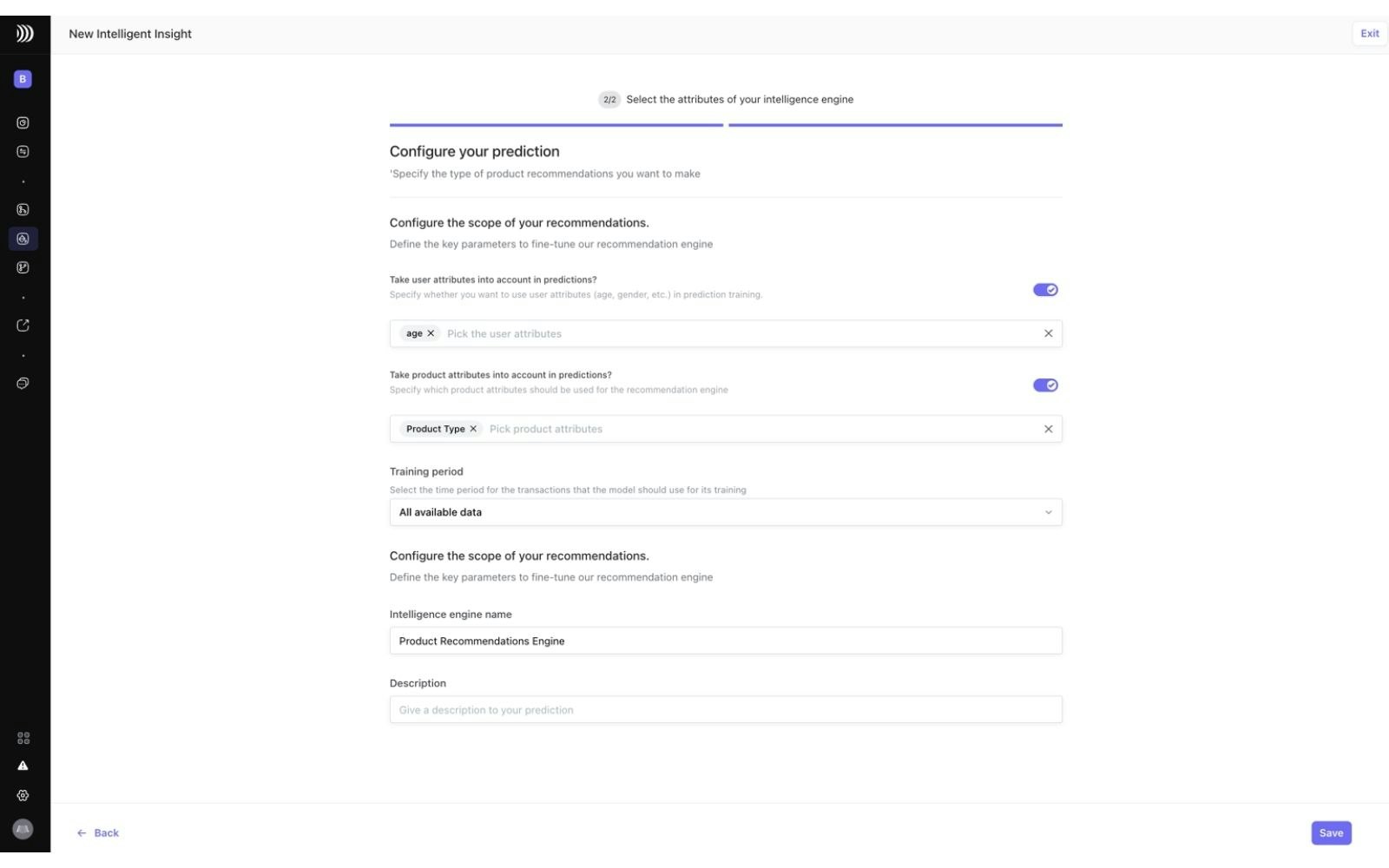
Configure your prediction in DinMo
How to choose the right approach?
To determine the most suitable solution, a few criteria can guide your decision:
Marketing objectives: retention, upsell, acquisition, personalisation.
Activation channels: email, ads, on-site, CRM, sales.
Data governance and quality: unification, reliability, consent.
Resources and organisation: level of data maturity, marketing/data collaboration.
In most organisations, the combination of a composable CDP and engagement tools (CEP / CRM) proves to be the most effective. Data remains in your data warehouse, segmentation is reliable, and activation stays flexible and omnichannel.
Conclusion
Predictive segmentation helps anticipate behaviour, turn scores into activatable audiences, and measure the real impact of marketing actions. DinMo brings this intelligence as close as possible to the data warehouse, enabling marketing teams to act effectively without technical complexity.
Our CDP paves the way for agentic marketing, where decisions no longer rely solely on static campaigns but continuously adapt at the individual customer level.
If you’re ready to take this next step, feel free to get in touch.