


CDPs for publishers: how to activate and monetise your data
7min • Last updated on Jan 30, 2026


Olivier Renard
Content & SEO Manager
The rise of digital has significantly reshaped the media industry. According to the latest World Press Trends Outlook Report, print newspaper distribution now accounts for less than a quarter of total industry revenue.
At the same time, digital revenues are growing by 7% year on year. An overwhelming majority of consumption (86%) now happens on mobile devices, whether via websites or apps*.
Key takeaways:
Data is a strategic asset for media companies. It helps improve audience understanding and supports long-term customer relationship management.
The challenges are multiple: subscriptions, engagement, monetisation and privacy. First-party data is essential to activate these levers in a compliant way.
A Customer Data Platform (CDP) unifies data and makes activation across marketing channels easier. It offers clear benefits for publishers.
A composable approach makes the difference. DinMo leverages data from the data warehouse to deploy use cases quickly, without adding complexity to the stack.
👉 Discover the benefits of a CDP for the media industry. What are the key use cases for publishers, and what best practices help you maximise the value of your audiences? 🚀
What is a CDP for the media industry?
A Customer Data Platform (CDP) is a solution that brings together and unifies an organisation’s customer data so it can be activated across business tools. For media companies, this means consolidating data from multiple sources to build a single, actionable view of each reader or subscriber.
This approach takes on particular importance in the media sector. Before the rise of digital, publishers distributed content through physical channels, with only an indirect relationship with their audiences.

There is only one remaining newspaper hawker in Europe today.
Distribution relied on intermediaries and a volume-driven model. The shift to digital radically changed usage patterns and, in doing so, transformed the underlying challenges.
Like D2C retailers, publishers now interact directly with their audiences through their marketing channels. Audiences, subscriptions, content, advertising inventory: media companies must develop a deep understanding of user behaviour, personalise journeys and monetise their audiences with advertisers.
By unifying data from websites, apps, CRM systems, advertising platforms and customer support, a CDP addresses these needs. Thanks to identity resolution capabilities, data from different sources is stitched together into a single customer profile.
CRM, DMP, CDP: what’s the difference
A CRM is primarily designed to manage customer relationships. It centralises information about a company’s contacts (customers and prospects) and supports sales and service interactions.
DMPs, mainly used for advertising purposes, rely largely on user identifiers and anonymous data to target audiences.
A CDP focuses more heavily on first-party data (user accounts, subscription history, marketing interactions, browsing behaviour). It is built for long-term use cases centred on customer understanding, personalisation and omnichannel activation.
CRM | DMP | CDP |
|---|---|---|
Expanded in the 1990s | 2000s | From 2016 onwards |
Designed for sales and customer success teams | Designed for advertising | Designed for all marketing use cases |
First-party data from customer interactions | Third-party data, temporarily stored, used to build audience-based personas | First-party, second-party, and third-party data |
Often criticised for weaknesses in data privacy | Criticised for lack of transparency and privacy limitations | Stronger compliance with data protection regulations |
Limited data integration | Limited flexibility for non-technical users | Comprehensive, cross-channel data integration |
Member ID | Anonymous ID | Known PII (Personally Identifiable Information) |
Registered customers | Anonymous profiles | Unified customer data |
Scalability limited to contacts and declared data | Scalable for large volumes of anonymous audiences | Scalable for multi-source first-party data and activation |
CRM vs DMP vs CDP
Benefits of a Customer Data Platform for publishers
As third-party cookies are gradually phased out and privacy regulations continue to tighten, a CDP helps publishers retain control over their data.
In practice, data is often scattered across multiple tools: website, app, CRM, email platforms, ad operations, customer support or advertising platforms. Acquisition signals are becoming less reliable, and customer journeys are increasingly fragmented.
A reader (or listener) might discover an article on social media, consume content via a mobile app, sign up for a newsletter, and later subscribe on desktop.
From a commercial perspective, pressure on advertising revenues remains high, while subscription-based models are shifting decisively towards digital. Personalisation has become a key differentiator.
A CDP provides a shared foundation. It makes it easier to build actionable segments and activate them across marketing, CRM, advertising and support tools.
For media companies, it is a critical layer for managing audiences, subscriber relationships and monetisation in a consistent, unified way.
Media organisations have access to exceptionally rich data, and DinMo enables them to unlock its full potential without technical complexity.
Our mission is to make business teams fully autonomous when it comes to activating their data.
Oussama Ghanmi, CEO DinMo
Key use cases
A CDP turns publishers’ data into operational levers. It helps them gain a deeper understanding of their audiences, manage subscriber relationships and activate the right messages across each channel.
1️⃣ Build a 360° reader / subscriber view
A CDP unifies all data related to each customer. Subscription status, history, editorial engagement, marketing interactions and channels used are brought together into a single profile.
Teams gain a clear, shared view of their audiences: which content is consumed, how often, and in what context. This insight supports better personalisation and more informed decision-making.
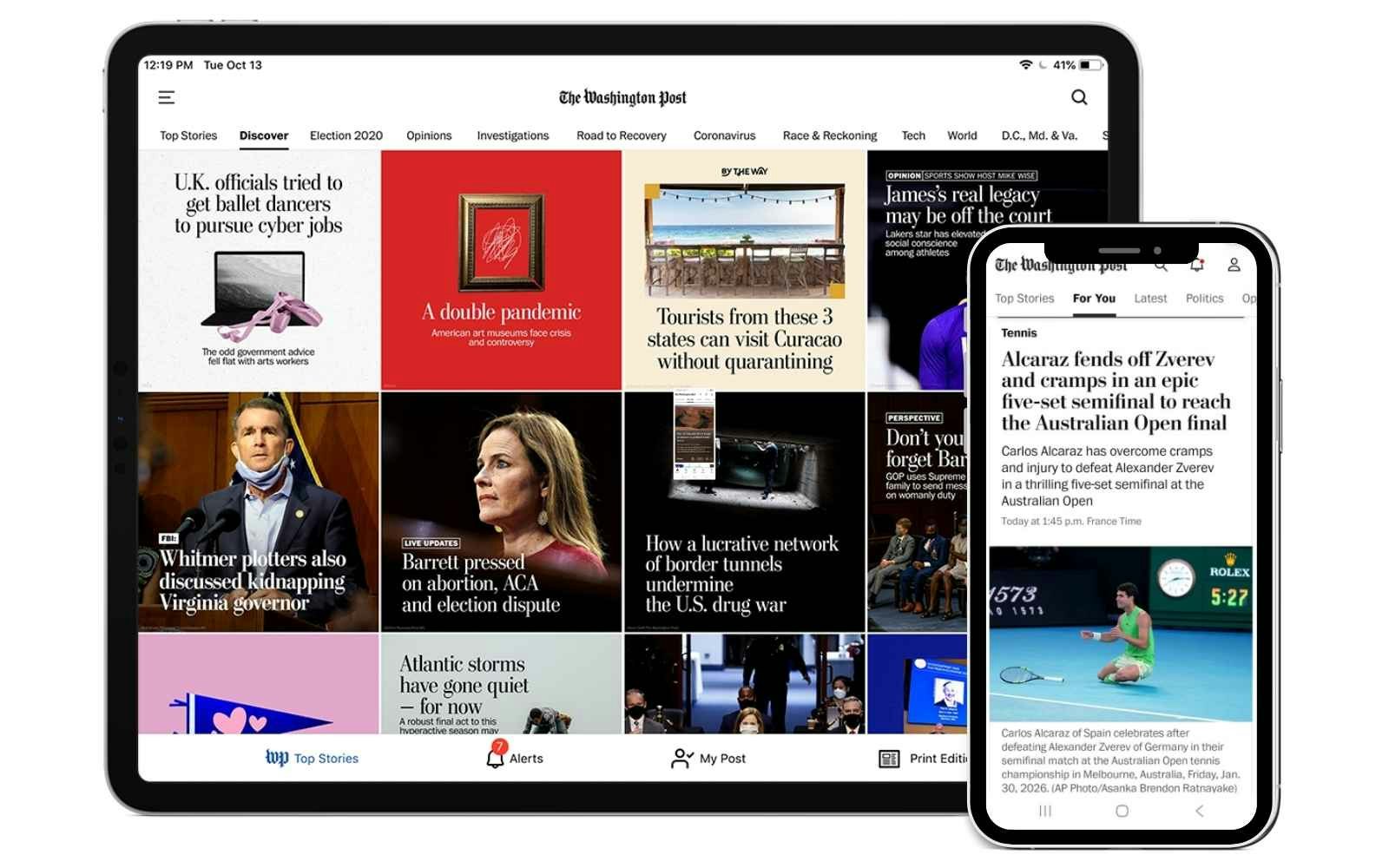
Personalised content on the Washington Post mobile app (credit: WP)
2️⃣ Fine-grained segmentation and audience activation
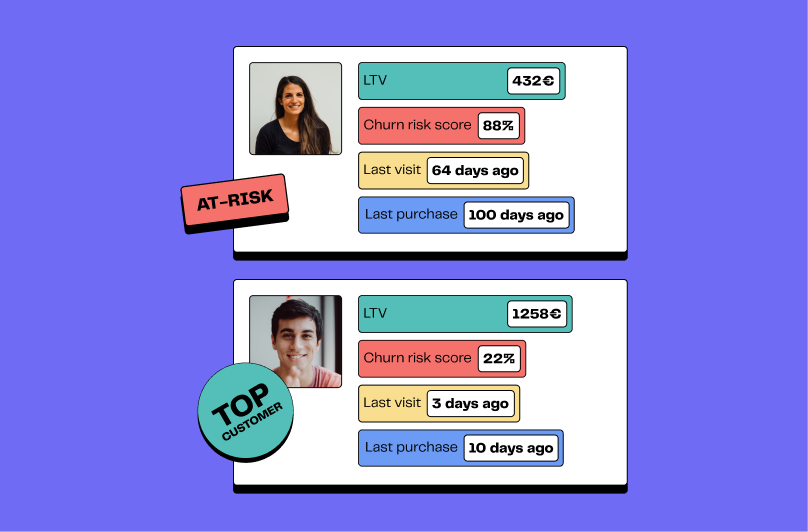
A CDP makes it easy to create actionable segments from these profiles. Examples include churn-risk subscribers, highly engaged readers who are not yet subscribers, premium subscribers, and more.
These segments are updated dynamically and used to trigger targeted campaigns, tailored to the engagement level and potential of each audience.
3️⃣ Managing the subscriber relationship
A CDP allows publishers to tailor journeys at every stage of the lifecycle: onboarding after sign-up, retention scenarios, reminders before trial expiry or subscription renewal.
By relying on actual usage data, messages become more relevant and communications are better aligned with real reader behaviour.
4️⃣ Orchestrating push and email
The CDP feeds CEP-type tools with up-to-date data, enriched with dynamic attributes such as interests, subscription status, reading frequency or preferred channel. Marketing pressure is better controlled.
Highly targeted automated scenarios can then be set up, for example:
Re-engagement after X days without reading,
Premium push notifications reserved for subscribers,
Targeted breaking news alerts.
5️⃣ Activating audiences in paid media
CDP segments can be synchronised with advertising platforms for retargeting, subscriber exclusion, or lookalike audiences built from high-value subscribers.
Sharing conversion data improves campaign optimisation, ensuring paid media works in alignment with subscription and retention strategies.
6️⃣ Enhanced customer support
The CDP supplies support tools with relevant customer data: subscription status, billing history, channels used and recent incidents. Support agents immediately have the full context, leading to smoother interactions and faster ticket resolution.
7️⃣ Monetisation via ad operations
A CDP enables ad operations teams to better leverage first-party data and offer more precise targeting to advertisers. It makes it easier to create and activate audiences in programmatic platforms, while retaining full control over the data.
Deals IDs : the publisher builds deals based on its own audiences (subscribers, engaged readers, interest-based segments) and shares them with agencies. Advertisers then target these deals in their DSP (Demand-Side Platform) to buy the publisher’s inventory.
Curated deals : the publisher’s audiences feed into pooled deals, managed by a third-party platform, across multiple publishers. Advertisers buy a cross-site audience, and the publisher is remunerated based on its contribution.
Extension d’audience : the publisher’s data is packaged with partner inventory to reach these profiles beyond its owned properties.
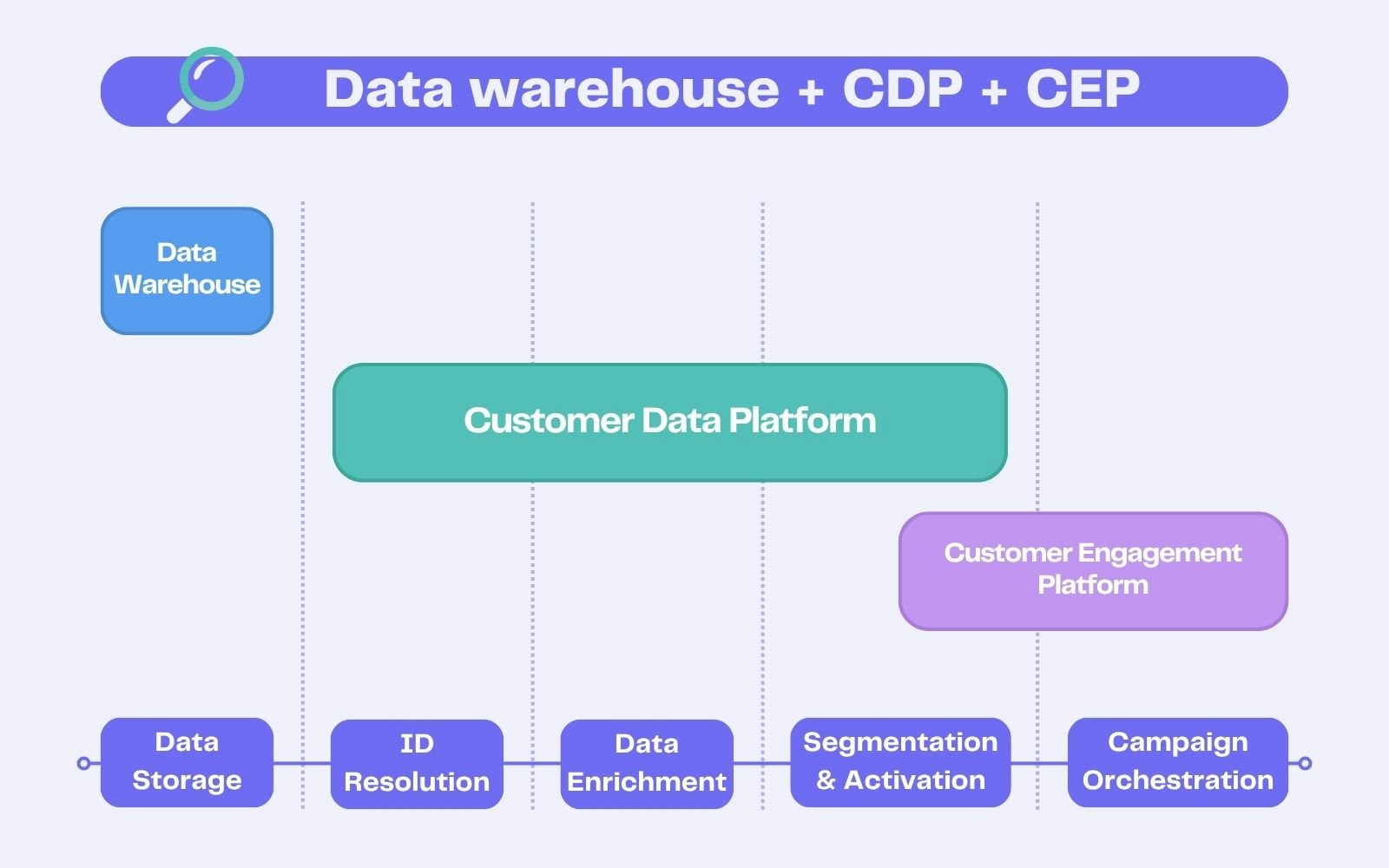
Data warehouse, CDP and CEP
Why choose a composable CDP
A composable CDP is built on a simple principle. It leverages data where it already lives: in the company’s data warehouse, a technology that is now widely adopted across the media industry.
This modular architecture gives marketing teams greater autonomy while making life easier for data teams. Data is not duplicated in the CDP’s own database, and the data model remains flexible.
Faster to deploy, a composable CDP accelerates time-to-value and simplifies activation across all channels: CRM, email, push, ads, customer support and ad operations.
After deploying early generations of DMPs or “packaged” CDPs, media companies that have invested in a data warehouse are now increasingly turning to composable approaches.
Bayard chooses the DinMo composable CDP
Bayard is one of France’s leading media groups. Its flagship titles include La Croix, Le Pèlerin, Notre Temps, J’aime Lire, Astrapi, Discovery.
Before adopting DinMo, the group relied on a DMP that came with several limitations: audience leakage, limited activation of CRM data, and heavy manual processes.
Bayard chose DinMo to build a composable CDP connected directly to its data warehouse. Teams can now:
Build precise audience segments,
Automatically feed advertising platforms,
Exclude subscribers from acquisition campaigns,
Target prospects and create lookalike audiences,
Monetise on-site and off-site audiences.
From the very first rollout, teams reported significant time savings on the data side, alongside improved acquisition performance.
Within one hour, we were able to set up the connections, which is incredible in terms of timelines compared to the DMP era, when projects would take months.
Jade St-Laurent, Product owner data Bayard
Other major media players, such as L’Équipe and Libération, also trust DinMo.
Business benefits for media companies
A composable CDP has a direct impact on key performance indicators:
Increased subscription conversion rates,
Reduced churn,
Higher ARPU and LTV,
Better audience monetisation with advertisers,
Operational efficiency gains for marketing and data teams.
The role of artificial intelligence
Artificial intelligence helps publishers deliver the right content and the right offer at the right time. Powered by machine learning, the CDP fuels content recommendations, adapting journeys based on interests, reading frequency, content formats consumed and preferred channels.
👉 DinMo includes Event Propensity Scoring capabilities. These scores estimate the likelihood that a user will take a specific action: subscribe, renew, upgrade, churn or sign up for a newsletter.
They help teams prioritise actions towards the most sensitive audiences. Messages become more relevant, and marketing resources are allocated more efficiently.
💡 Example : a reader regularly consumes premium articles several times a week but is not yet a subscriber. Their “propensity to subscribe” score increases. They can then receive a targeted message featuring a trial offer and a selection of articles aligned with their favourite topics.
Conversely, a subscriber whose reading frequency drops sharply can be identified as “at risk” and entered into a lighter retention journey, with editorial recommendations tailored to their interests.

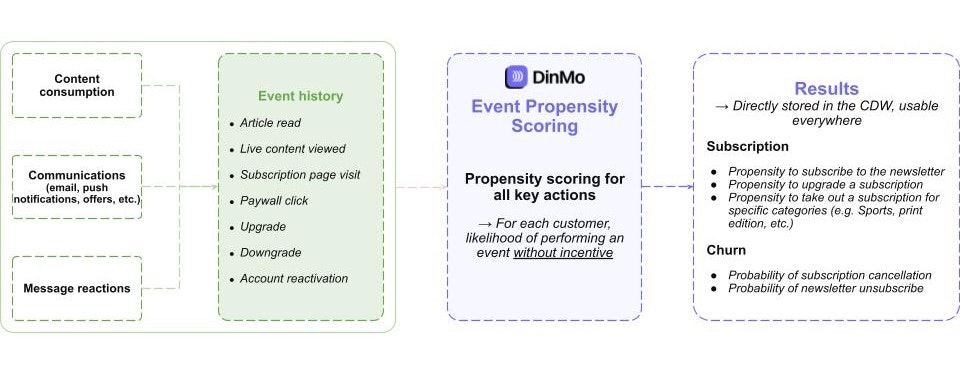
Event Propensity Scoring process for media with DinMo
How to get started with a CDP project in a media group
A CDP project starts with a clear vision. Define your priority objectives: subscriber acquisition, retention, advertising monetisation or improving the reader experience.
Next, connect your core data sources (subscription system, CRM, website, app) to a cloud data warehouse, then link your activation channels through a composable CDP.
The goal is to launch a small number of high-value use cases quickly, such as:
Re-engagement after a drop in reading or listening activity,
Trial-end reminders,
Excluding subscribers from acquisition campaigns,
Message personalisation.
Finally, measure impact using business KPIs and iterate: conversion, churn, engagement, LTV and advertising revenue.
A CDP helps media companies better leverage their first-party data and manage audiences with an omnichannel mindset. With DinMo, you move faster from data to action, without adding complexity to your stack.
*ACPM report on press circulation and readership