

Best alternatives to GrowthLoop
7min • Last updated on Jan 20, 2026


Olivier Renard
Content & SEO Manager
The global cloud data warehouse market is estimated at $11.56 billion in 2025, reflecting growing adoption across organisations (The Business Research Company). GrowthLoop is one of the warehouse-first platforms promising to accelerate marketing activation using data stored in the warehouse.
Despite this positioning within the Modern Data Stack, the solution is not suited to every context. The right choice depends on your business objectives, data architecture and governance requirements.
Key Takeaways:
GrowthLoop is positioned as a composable CDP focused on audience building and marketing activation.
It enables teams to leverage data from the data warehouse to segment audiences and activate campaigns across multiple channels (CRM, ads, messaging, etc.).
Alternatives to GrowthLoop span several categories: composable CDPs with Reverse ETL, packaged CDPs, MarTech solutions, and even CEPs or CRMs.
To choose the right solution, start with your priority use cases and the level of autonomy expected from marketing teams.
👉 Discover our selection of the best alternatives to GrowthLoop and the key differences between these solutions. Compare their strengths and limitations using a simple framework to identify the approach best suited to your organisation. 🎯
What is GrowthLoop?
GrowthLoop is a platform founded in 2015 by two former Google employees, Chris Sell and David Joosten. Based in New York, it was initially known as Flywheel before rebranding as GrowthLoop in 2023.
Designed to make data more accessible to business teams, the platform positions itself ‘on top of the data cloud’. In other words, it aims to accelerate marketing activation by working directly with data stored in the cloud data warehouse.
GrowthLoop presents itself as a composable CDP and a Compound Marketing Engine. Its goal is to enable teams to build audiences, orchestrate campaigns and iterate faster, without relying on data teams.
The platform is mainly used by organisations with large data volumes and multiple activation channels (ads, CRM, messaging, etc.). Well-known customers include Indeed, Costco, Ford and NASCAR.
Key features
In terms of use cases, GrowthLoop primarily targets audience creation for paid media, lifecycle campaigns, cross-channel orchestration through journeys, and performance analysis.
1️⃣ Connection to the data cloud (DWH)
GrowthLoop connects to the data warehouse (Google BigQuery, Snowflake, Databricks or Amazon Redshift). The platform leverages data stored in the warehouse to power segmentation and activation.
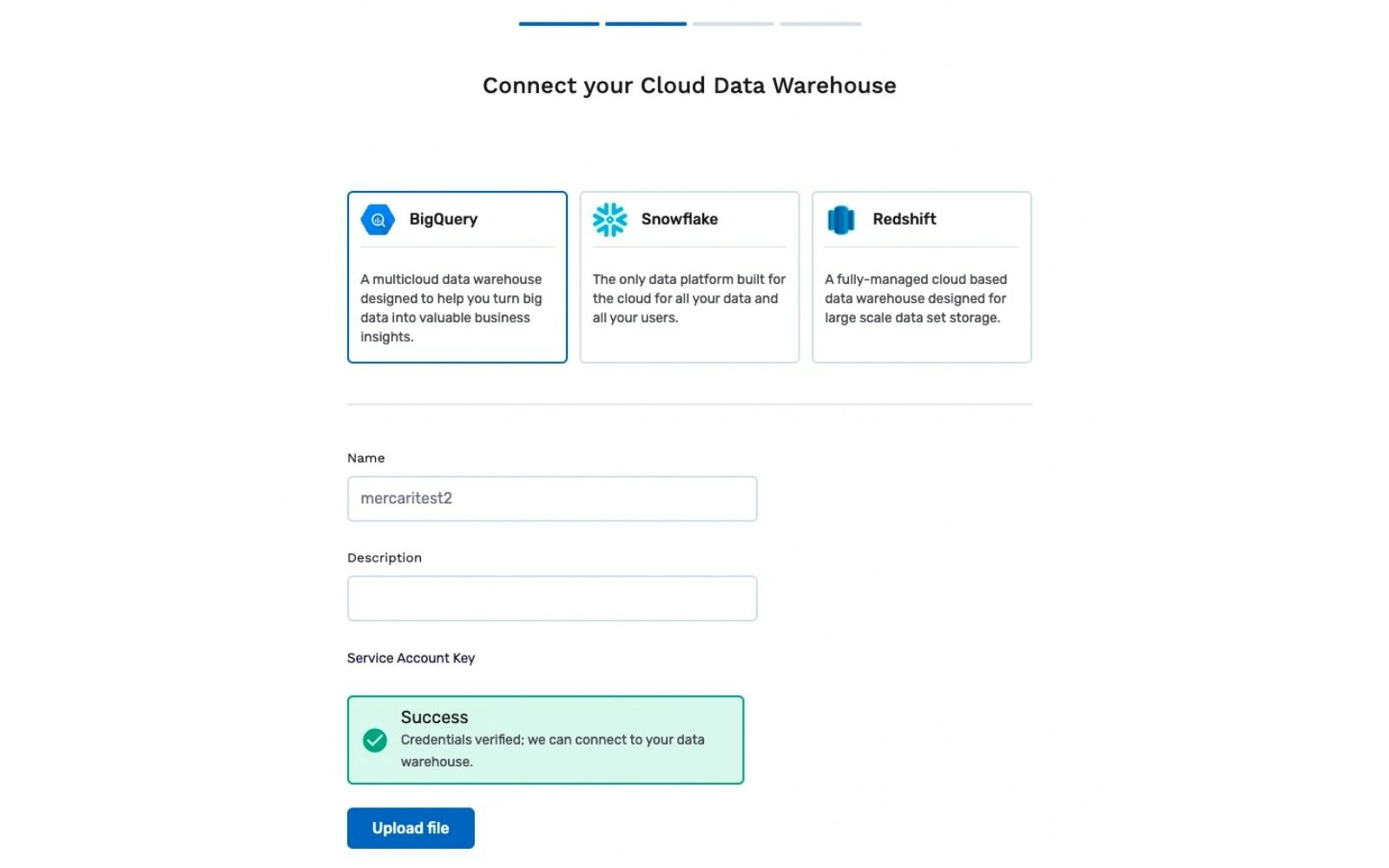
Connect your cloud DWH to GrowthLoop (Credit: GL)
2️⃣ Audiences (segmentation)
The audience hub allows teams to create activatable audience segments using data from the warehouse. The goal is to make segmentation accessible to marketing teams, with a visual approach and easy-to-use filters.
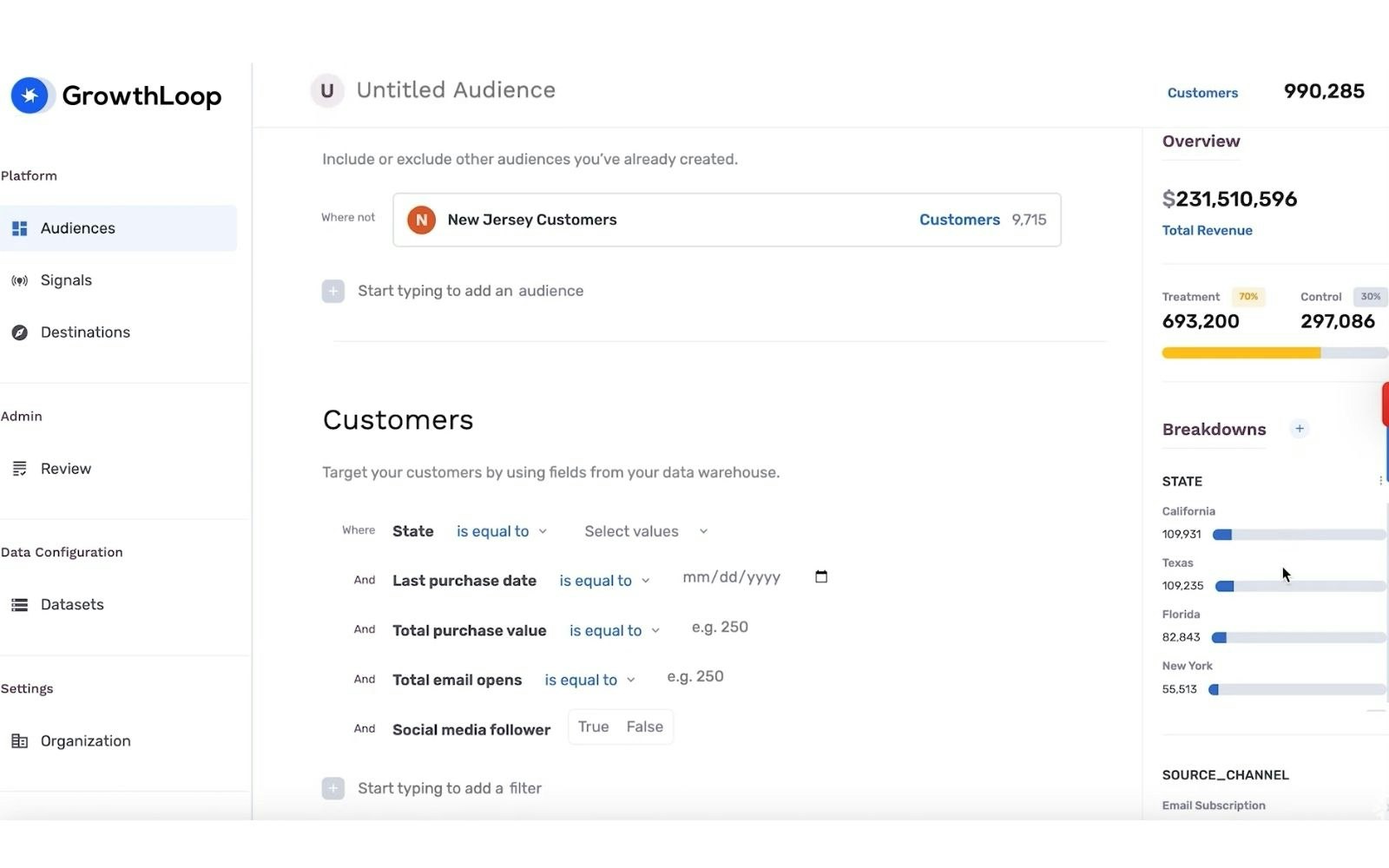
Credit: GrowthLoop
3️⃣ Activation & orchestration
Once audiences are built, GrowthLoop sends them to different channels: ad platforms, CRM systems, email/SMS/push solutions, and more. The vendor highlights a Journeys layer designed to orchestrate actions over time.
4️⃣ Insights + AI Studio
Finally, GrowthLoop includes an Insights component to analyse campaign performance, understand what works and support iteration.
The AI dimension is, of course, part of the offering, with assistants (Marve, The Loop) designed to:
Suggest audiences,
Help build journeys,
Make exploration and decision-making easier.
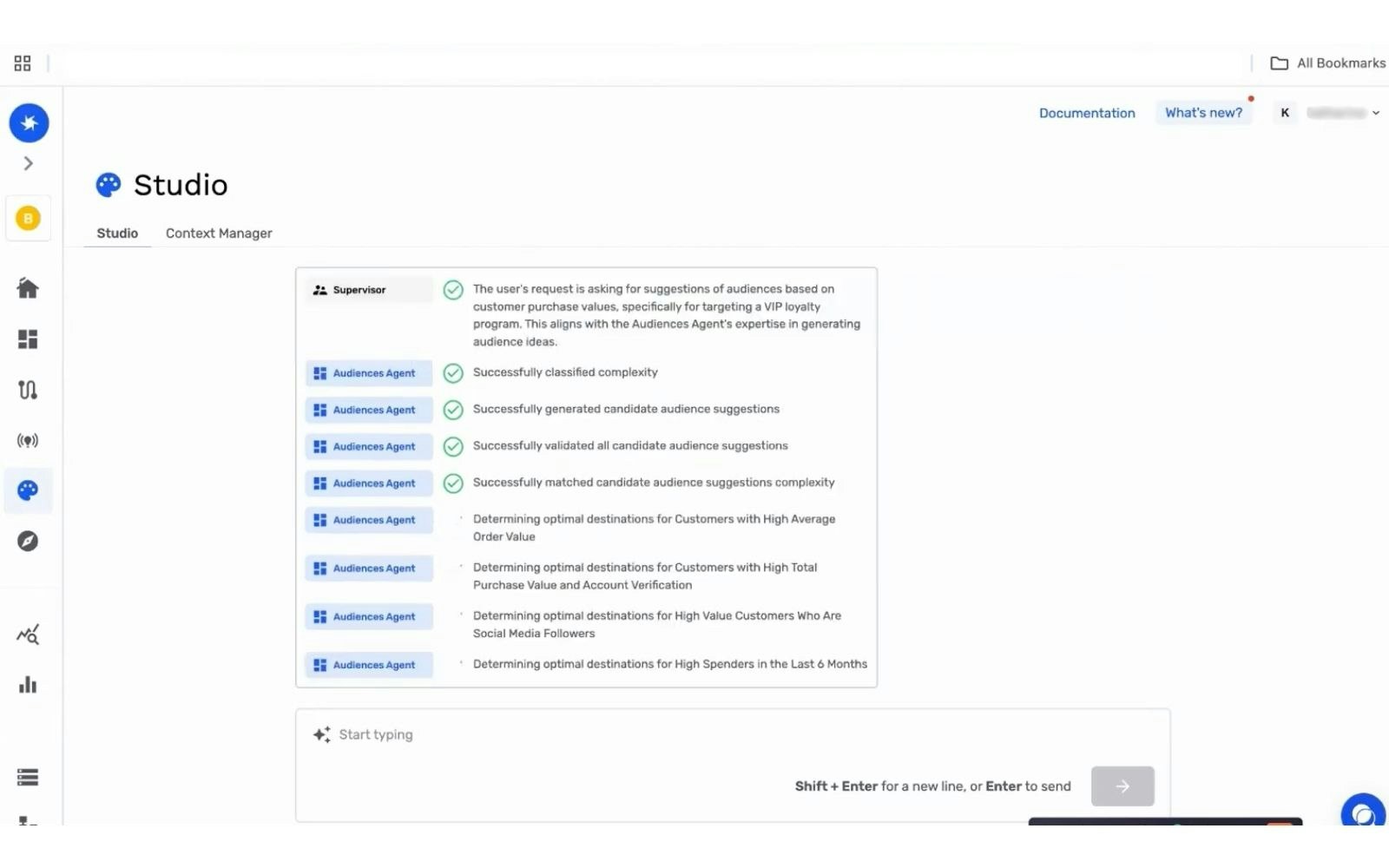
Credit: GrowthLoop
Strengths and limitations
GrowthLoop highlights its ability to bring data closer to marketing use cases. The platform is often positioned as a modern alternative to traditional CDPs.
That said, GrowthLoop also comes with limitations that are important to understand before committing.
Strengths highlighted by the vendor
A marketing-first experience: a business-oriented interface with a no-code segmentation approach.
Cross-channel activation from the data warehouse: paid media, CRM, email and messaging tools.
An AI layer (AI Studio / agentic marketing): the platform promotes its natural language interface and AI agents to speed up audience creation, journey setup and optimisation.
Points to watch
Onboarding and initial setup: feedback across various forums suggests that implementation can be complex and time-consuming. Connecting to the data warehouse, structuring tables, mapping identifiers and organising datasets all require upfront work and planning.
Filter reuse and audience logic: some user feedback indicates that audience creation becomes more complex as use cases multiply (for example, reusing filters or scaling similar audiences).
Comments around latency and UX also come up regularly.
Exports and attribute management in certain scenarios: when pushing richer attributes (scoring, recommendations, custom fields), additional configuration or data modelling may be required, depending on the data structure.
In addition, the approach built around ready-to-use predictive attributes (churn risk, future LTV, product affinity, etc.) is not a core part of their positioning. Several users point to a lack of insights to further refine marketing strategy.
Handling complex data: performance and ease of use naturally depend on data quality. In very large organisations (large historical datasets, complex business definitions, etc.), segmentation can require significant preparation and resources.
⚠️ Pricing: some features are limited to the Enterprise plan. Access to advanced capabilities is a key consideration, as many features highlighted in GrowthLoop’s messaging are tied to the Enterprise tier.
Be sure to check in advance the availability of the following features:
AI agents (AI Studio / Growth Agents) and advanced recommendations.
Incrementality (uplift) measurement.
Advanced journeys and experimentation.
Access controls, security and governance features (SSO, RBAC, compliance).
Level of support (solution architect, data engineering support vs email and Slack support for Basic and Growth plans).
These factors can weigh heavily in the decision, especially if you are looking to deploy quickly and at scale.
What alternatives to GrowthLoop?
Other composable (or modular) CDPs
GrowthLoop follows a warehouse-first approach. Composable CDPs are a natural alternative for organisations looking to activate customer data without creating a new silo.
Unlike traditional CDPs, they do not store data in a proprietary environment. This architecture is particularly well suited to organisations with a modern data stack, as it simplifies governance, security and compliance.
Another key advantage is modularity. Composable CDPs remain interoperable with existing CRMs, engagement platforms and ad tools.
👇

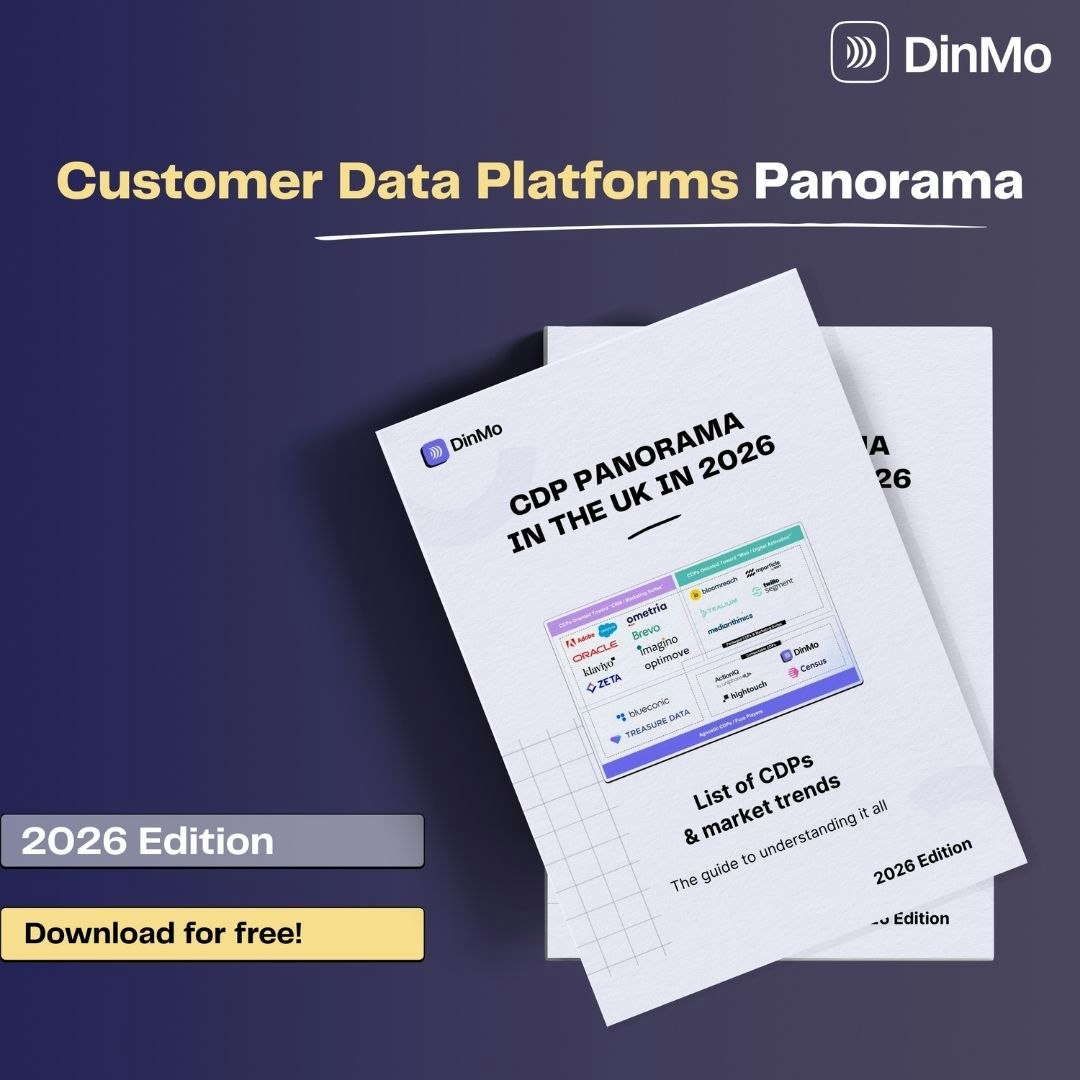
Overview of Customer Data Platforms
Key vendors on the market
DinMo is a composable CDP that brings marketing and data teams together around a single source of truth: your data warehouse. The platform enables no-code audience creation and activation across multiple channels, with a strong operational focus.
DinMo also stands out for its predictive attributes (churn risk, future LTV, product affinity, etc.) and its AI capabilities to analyse signals, prioritise actions and measure the real impact of campaigns. The Customer Hub provides a marketing cockpit that allows teams to track the results of their actions.
Hightouch was initially built around Reverse ETL. The platform has since expanded its offering with a marketing-oriented layer (audiences, activation), while remaining deeply connected to the data ecosystem. It is a strong option for organisations looking to quickly activate segments directly from their warehouse.
Criteria | GrowthLoop | DinMo |
|---|---|---|
Approach type | Warehouse-first approach | Warehouse-first / zero-copy approach |
Segmentation | Marketing-oriented audience management system, no/low-SQL segmentation | No-code Audience Builder, activation-oriented segmentation with no technical skills required |
Omnichannel activation | Activation across marketing channels (ads, CRM, messaging, etc.) | Flexible omnichannel activation (CRM, Ads, on-site, etc.), seamless stack integration |
AI capabilities | Strong focus on AI agents / AI Studio (Enterprise plan) | Predictive attributes + recommendations (NBA/NBO) + performance-oriented AI decisioning |
Impact measurement | Measurement/performance-driven approach (advanced features on Enterprise plan) | Real impact measurement (uplift logic / ROI-driven steering) |
Governance & security | Enhanced governance and security on Enterprise plan | Governance and security adapted to customer context (RBAC / SSO, GDPR, CCPA, SOC 2). Data processed in Europe. |
Time to value | Highly dependent on initial setup (DWH, datasets, configuration) | First use cases live in under one hour. Measurement and optimisation via the Customer Hub |
Support & enablement | Email and Slack support only for Basic and Growth plans (teams based in North America) | Personalised support and enablement |
GrowthLoop vs DinMo
Traditional CDPs and ‘all-in-one’ packaged solutions
Traditional CDPs, like ‘all-in-one’ MarTech solutions, centralise customer data within their own environments. This data duplication means maintaining two sources of truth: the CDP database and your data warehouse.
Governance also becomes more complex, as their data models are generally more rigid than those of modular CDPs. Well-known players such as Twilio Segment and mParticle remain long-standing market references.
Large marketing suites have also integrated their own CDPs to strengthen personalisation, such as Salesforce Data Cloud or Adobe Real-Time CDP. While these solutions can accelerate certain use cases, they also tend to increase vendor lock-in within the publisher’s ecosystem.

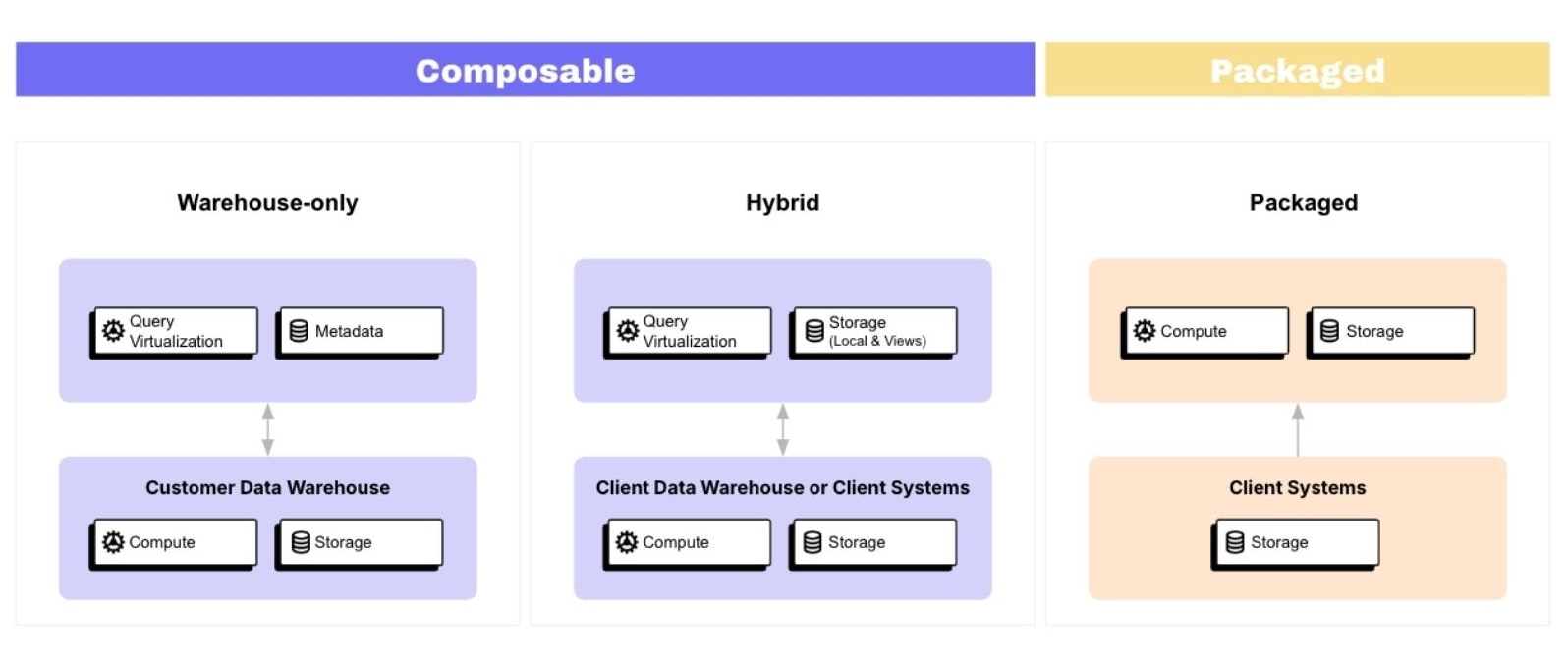
CDP and data hosting
Hybrid CDPs
Hybrid CDPs (such as Simon Data or Treasure Data) aim to combine the flexibility of the data warehouse with the capabilities of a packaged CDP. In practice, these are usually traditional CDPs that have shifted towards a more composable model.
This ‘best of both worlds’ promise can be appealing for speeding up specific use cases. However, it often comes with trade-offs: varying compatibility depending on the data warehouse, dependence on the vendor’s ecosystem, and an architecture that is not truly zero-copy.
Before choosing this route, it is therefore essential to clearly assess where data actually lives and how it will be activated.
CEPs and marketing automation
Customer Engagement Platforms (CEPs) and marketing automation tools are designed to execute campaigns: email, SMS, push, in-app messaging and lifecycle scenarios. Solutions such as Braze or Klaviyo are highly effective for orchestrating journeys and managing marketing pressure.
However, they do not replace a CDP, as their role is not to collect, unify, enrich and segment all customer data. In most organisations, they are an excellent complement to composable CDPs.
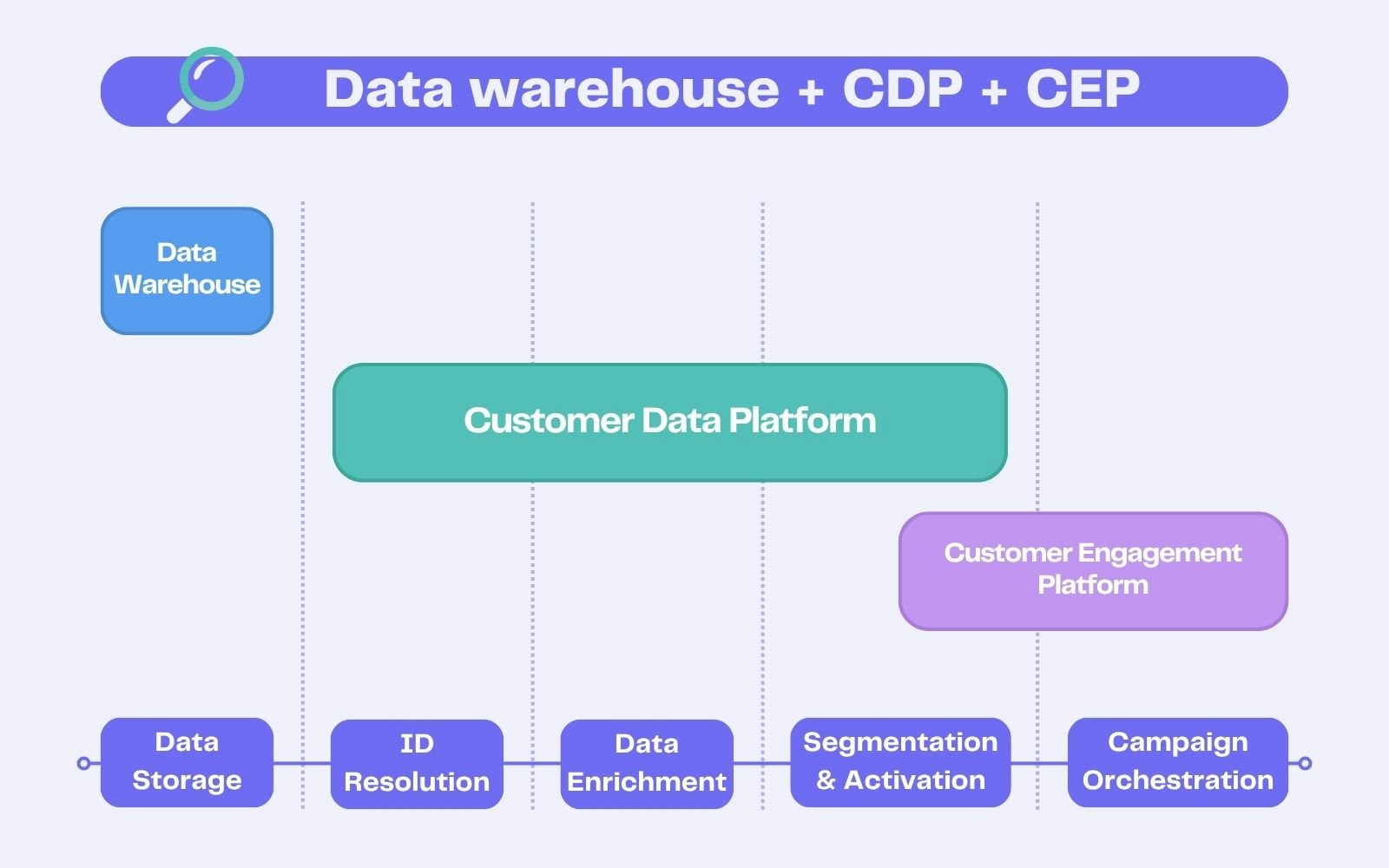
Data warehouse, CDP and CEP
Build or buy ? Building a bespoke CDP can seem attractive for organisations with very strong data teams.
In reality, it involves long timelines, ongoing maintenance and a heavy reliance on technical teams. At scale, this option is often too complex and costly to be truly viable.
How to choose?
The right choice depends on your organisation, your stack and your objectives.
Key questions to ask
Before comparing tools, start by clarifying a few points:
Where does your customer data live? In a data warehouse, a CDP, a CRM, or across multiple systems?
Who builds audiences? Marketing teams working autonomously, or with a required hand-off to data teams?
Which channels do you need to activate? Ads, CRM, email/SMS, on-site… and at what scale?
What level of governance is required? Access controls, compliance, traceability, cross-team sharing.
Do you need native intelligence? Scoring, predictive attributes, recommendations, AI decisioning.
Why a composable CDP is often the best fit
In many organisations, challenges stem from fragmented data. Quality degrades, governance becomes more complex, and teams spend more time on technical work than on optimising campaigns.
A composable CDP that uses the data warehouse as a single source of truth helps eliminate these frictions. Audiences are built on reliable, up-to-date data, making it easier to deliver the right message, at the right time, through the right channel.
DinMo integrates at the core of your data ecosystem and acts as an extension of your data warehouse. Our platform gives marketing teams the ability to innovate, while simplifying life for data teams.
Discover how DinMo turns your customer data into activatable audiences, ready to be used across all your channels.