


Technical debt: definition, examples and risks
6min • Last updated on Jul 29, 2026


Alexandra Augusti
Chief of Staff
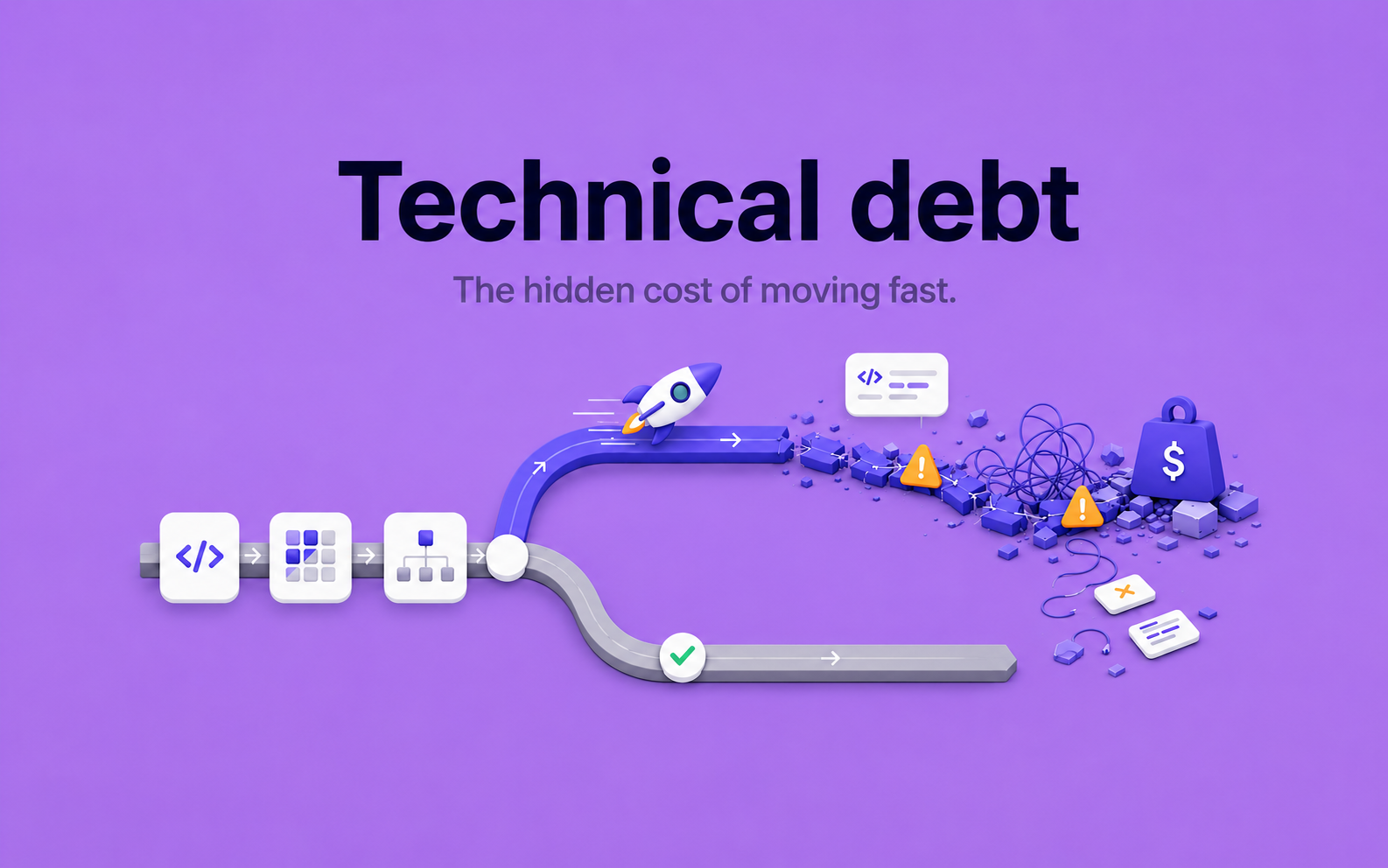
Technical debt is a common issue in digital projects. It appears when a team chooses a quick, imperfect, or temporary solution in order to deliver faster. In the short term, that decision may be perfectly rational. Over time, however, it makes software maintenance harder, slows down development, increases costs, and makes future changes more difficult to manage.
In most organisations, technical debt is not limited to code. It also affects software architecture, systems, processes, documentation, testing, security, and data quality. The result is always the same: teams spend more time working around technical limitations than delivering features and creating value.
Key takeaways
Technical debt is the future cost created by short-term technical choices.
It can affect code, software, systems, workflows, and data foundations.
It reduces quality, speed, maintainability, and long-term flexibility.
It can be managed through prioritisation, governance, refactoring, and progressive remediation.
What is technical debt?
Technical debt refers to the additional future effort caused by technical shortcuts. The debt metaphor works well because it reflects a trade-off: you save time now, but you pay it back later with interest.
In practice, that interest appears as:
more bugs;
slower development cycles;
more complex testing;
higher security risk;
stronger dependency on a few key experts;
higher maintenance costs;
harder refactoring when requirements change.
Technical debt is not always a mistake. In some cases, it is a conscious trade-off. The real problem begins when it is neither documented nor monitored nor addressed.
Why does technical debt build up?
Short-term delivery pressure
The first cause is straightforward: teams need to ship quickly. When deadlines are tight, a product launch is near, or an incident must be resolved fast, teams often choose the quickest option rather than the most sustainable one for the software, the code base, or the wider system design.
Example: a developer adds business logic directly into an application without revisiting the overall architecture. The feature works, but future changes become harder and riskier.
Systems grow in layers
Many software environments evolve through accumulation: one more tool, one more service, one more API, one more business rule. Without regular clean-up, the stack becomes inconsistent.
Over time, new tools, new features, and changing business requirements make the software stack harder to read, harder to test, and harder to maintain.
This often leads to:
poorly connected components;
outdated dependencies;
unclear architecture;
duplicated logic across systems.
Missing documentation and testing
A large technical debt problem is not always visible in the code itself. It often lives in what surrounds the code:
incomplete documentation;
weak automated test coverage;
inconsistent engineering standards;
poor monitoring;
fragmented workflows between product, data, and engineering.

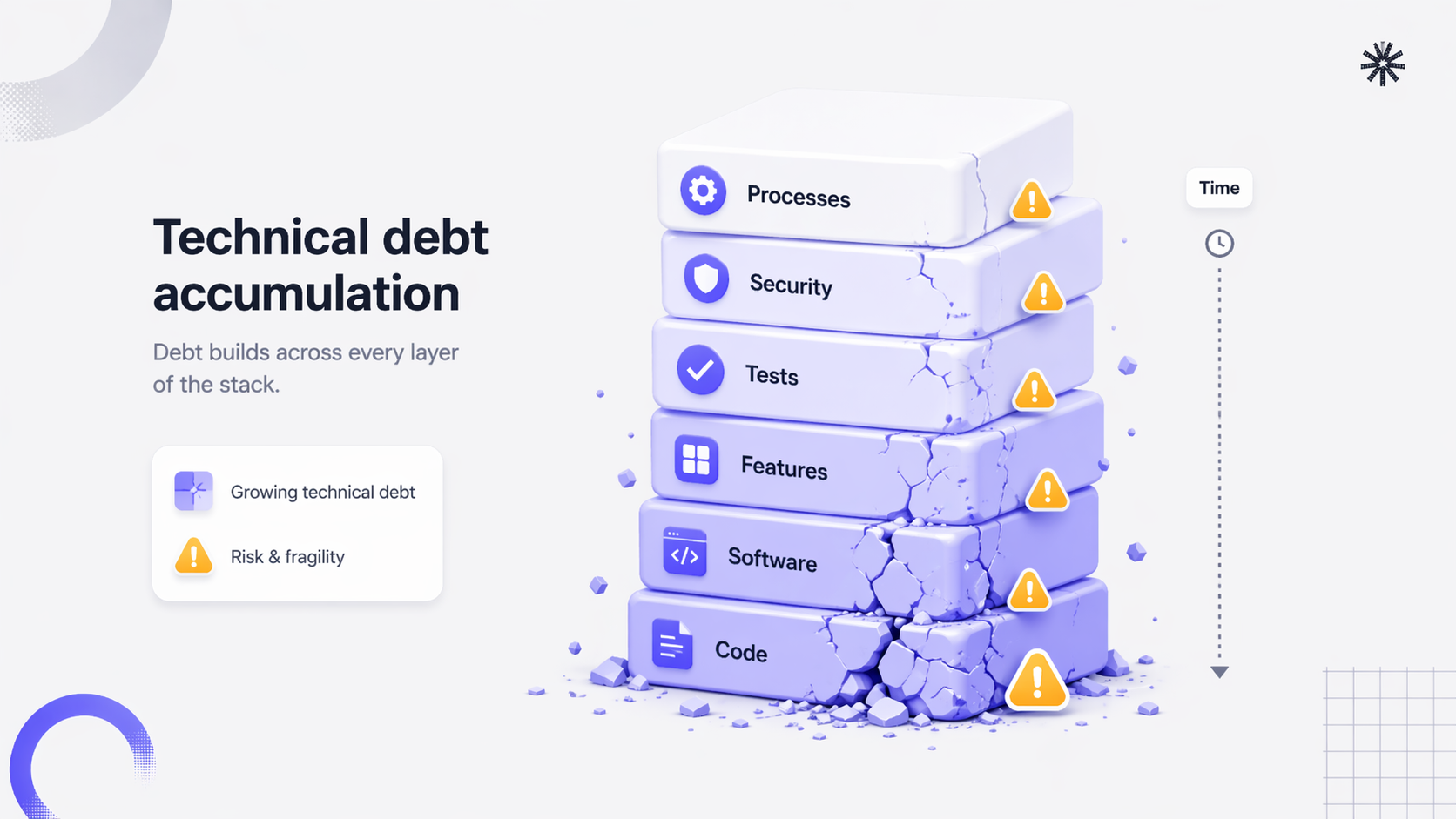
Technical debt accumulation
The main types of technical debt
Code debt
This is the most familiar form. It includes duplicated logic, hard-to-read code, fragile modules, and components that are difficult to test.
Example: several teams copy the same calculation logic into different services. As soon as the business rule changes, every copy must be updated.
Architecture debt
Architecture debt appears when the system structure no longer matches real usage. An application designed for a small scope suddenly has to support more users, more integrations, more requirements, and more data.
Example: one database handles transactional operations, analytics, and external synchronisations at the same time. Performance drops and incidents become more frequent.
Data debt
In data and marketing environments, this is especially common. Unstable schemas, duplicated tables, unclear ownership, and inconsistent definitions all slow teams down.
Example: the same customer exists under several identifiers across tools. CRM, product, and acquisition teams are no longer working from the same reality.
Security debt
An unpatched vulnerability, excessive permissions, or weak access controls create hidden but critical debt.
It may not disrupt daily work straight away. But it dramatically increases risk during audits, compliance reviews, or security incidents.
Process debt
When workflows depend on repeated manual actions, recurring tickets, or unclear approvals, the debt is no longer purely technical. It becomes organisational.
Example: every new marketing audience requires a specific request to the data team. Campaigns are delayed, testing slows down, and operational teams lose autonomy.
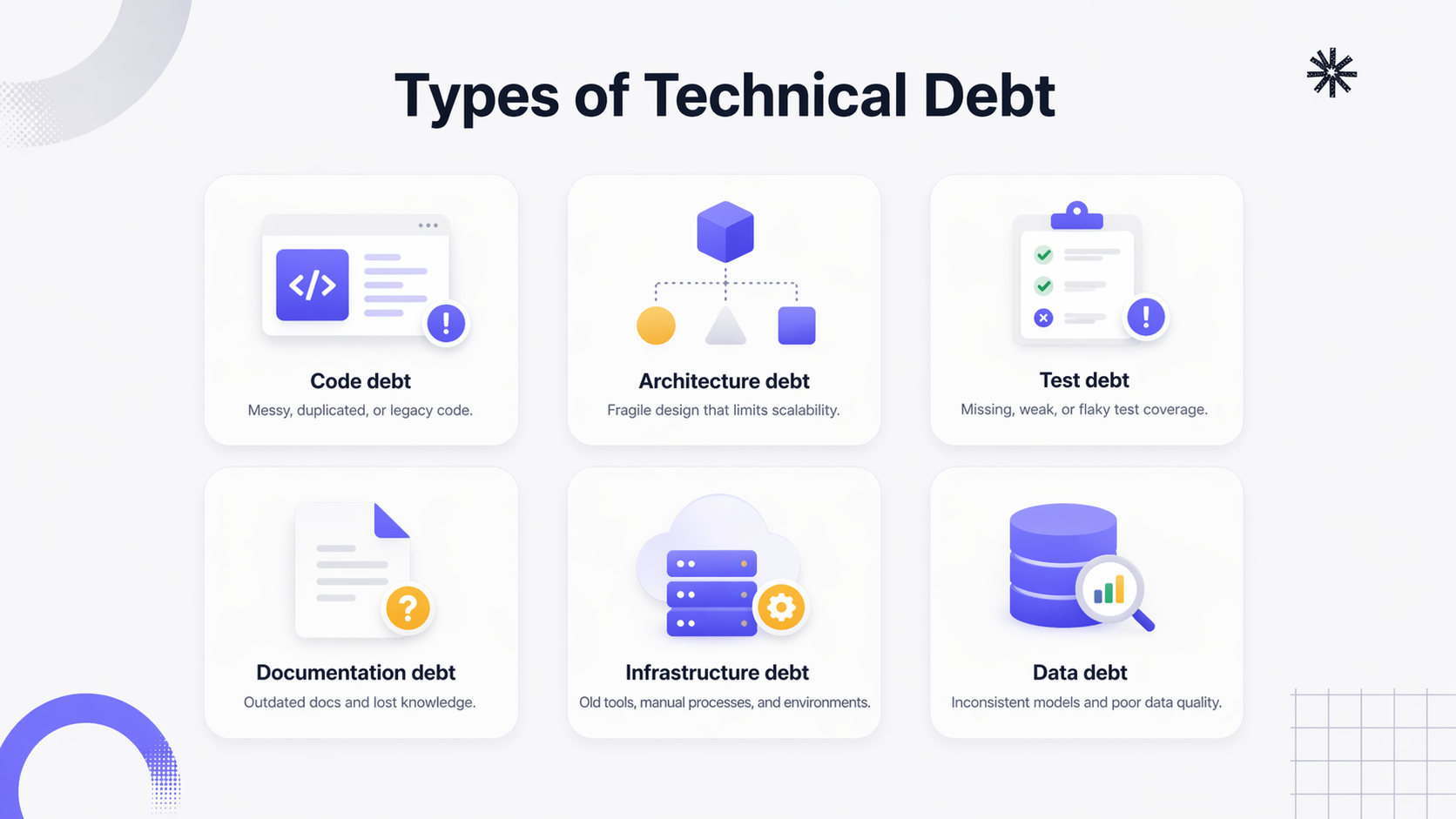
Types of Technical Debt
How can you spot technical debt?
Several warning signs should raise concern.
Delivery keeps getting slower
A simple change suddenly takes days instead of hours. Historical complexity starts consuming the team’s available time. Even small changes require more testing, more coordination, and more caution.
The same bugs keep returning
One fix breaks another part of the system. Regressions become common. This usually points to fragile foundations or weak test coverage.
Teams avoid certain parts of the product
When people say, “Nobody wants to touch that module”, there is usually significant technical debt behind it.
Hidden costs keep rising
Technical debt is not only visible in engineering backlogs. It also appears in:
maintenance budgets;
support workload;
slower strategic projects;
recruitment difficulty on ageing stacks.
What are the consequences of technical debt?
Technical debt can lead to:
reduced team velocity;
lower software quality;
slower innovation;
higher costs;
increased security risk.
The total cost goes far beyond a future refactor. It also includes lost productivity, delayed decisions, and reduced ability to ship new features.
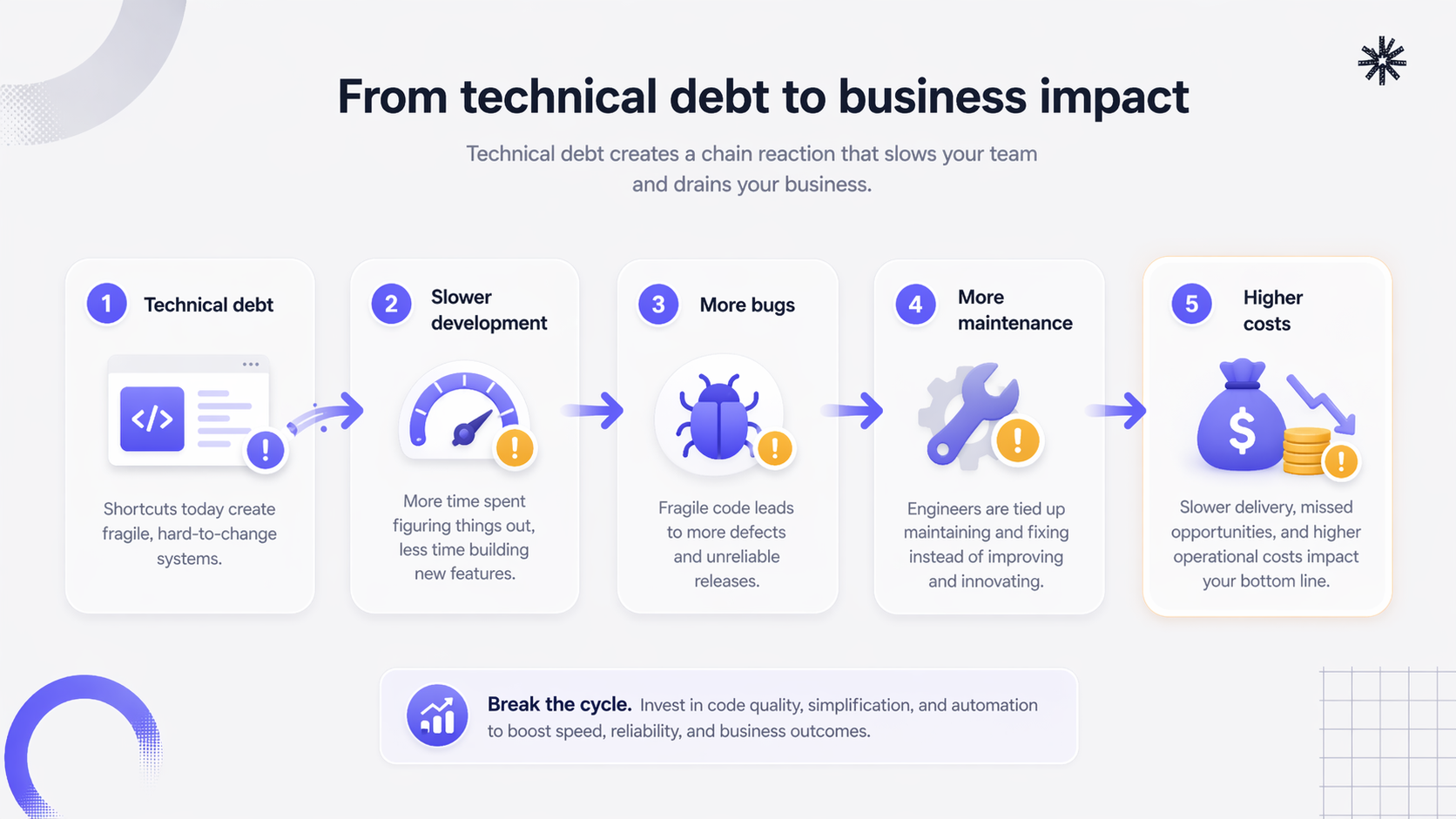
Business impact of technical debt
How to reduce technical debt
Start by making it visible
You cannot reduce debt you cannot see. The first step is to map it clearly.
Useful questions include:
which modules slow the team down the most?
which systems create the most incidents?
which dependencies are outdated?
which workflows remain too manual?
which components are critical for product delivery or security?
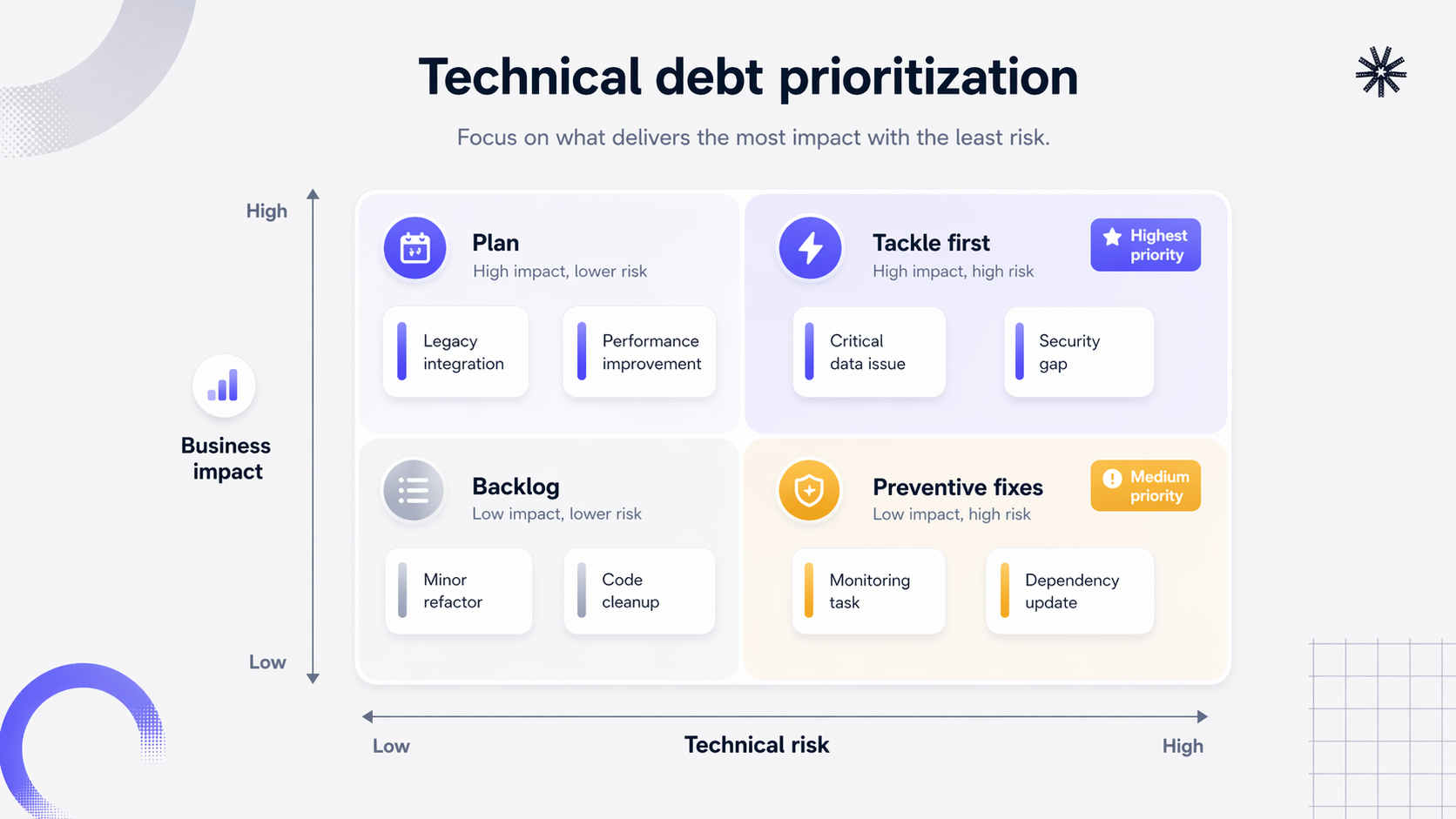
Prioritise based on business impact
Not everything needs to be refactored immediately.
Technical impact
Fragility, complexity, risk, maintainability, refactoring effort.
Business impact
Usage frequency, product importance, revenue effect, customer experience impact.
Protect time to repay it
Technical debt will never shrink if every sprint is consumed by urgent delivery.
Many organisations reserve:
a fixed share of each sprint;
a quarterly remediation track;
or a progressive refactoring roadmap.
Strengthen engineering standards
Long-term reduction depends on healthy foundations:
code reviews;
shared conventions and taxonomy;
automated tests;
up-to-date documentation;
dependency governance.
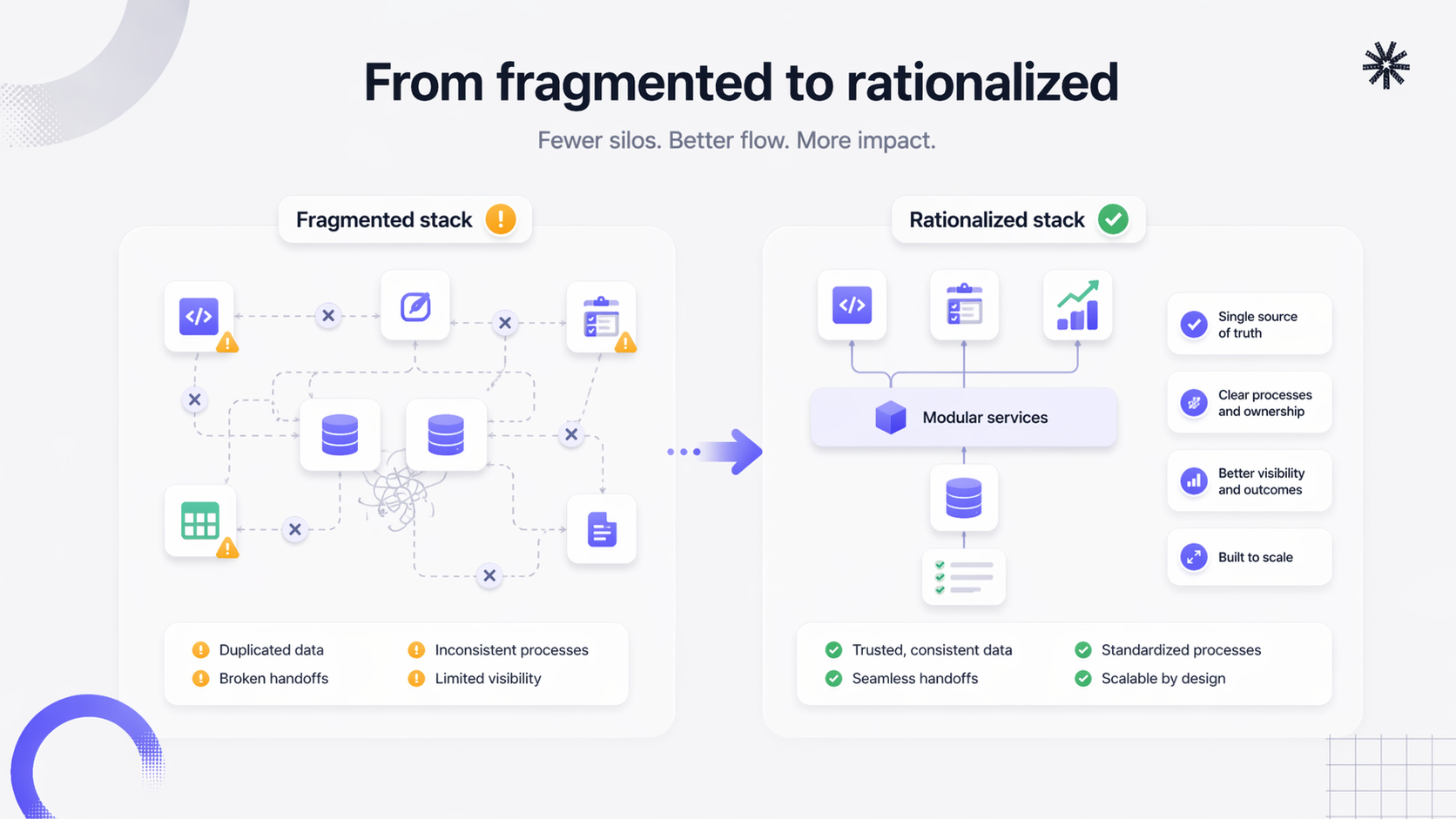
Simplify the architecture where possible
Reducing technical debt often means removing what no longer provides value.
That may include:
reducing data duplication;
clarifying the source of truth;
limiting unnecessary synchronisations;
separating storage, modelling, and activation more clearly.
Technical debt prioritization
Why clean data infrastructure matters for reducing technical debt
Technical debt does not only emerge in applications or software development. It can also accumulate in poorly structured data infrastructure.
Common examples include:
duplicated data;
unstable schemas;
fragmented identity models;
fragile pipelines;
business logic spread across multiple tools.
These issues create technical complexity, slow teams down, and make business use cases harder to scale.
By contrast, a clean data infrastructure — built around a data warehouse as a source of truth, robust modelling, and clear governance — reduces complexity and supports business use cases more effectively.
This is especially true for use cases a Composable CDP can address, such as:
advanced segmentation;
real-time personalisation;
omnichannel activation;
predictive use cases such as churn or LTV;
audience orchestration across CRM, marketing, and product systems.
A Composable CDP does not just improve activation. It can also help reduce certain forms of technical debt by separating storage, modelling, identity resolution, and data activation more clearly.
Importance of a rationalized stack
Conclusion
Technical debt is not just a developer problem. It is a question of software quality, security, systems, costs, and long-term performance.
When managed well, it stays under control. When ignored, it slows teams down, weakens software, increases costs, and limits growth.
The right approach is strategic: identify the most critical areas, prioritise them by business impact, improve engineering standards, use AI carefully, and simplify architecture over time.
Looking to reduce technical debt across your data and marketing stack? Explore how a more modular architecture can improve governance, reduce duplication, and speed up data activation.
Should you eliminate all technical debt?
Should you eliminate all technical debt?
No. The goal is not technical perfection. The goal is controlled debt.
A deliberate debt can make sense if:
- it is documented;
- it solves a real speed constraint;
- its future cost is understood;
- there is a plan to address it later.
But unmanaged debt nearly always becomes more expensive than an earlier correction.
Why technical debt matters to marketing teams too?
Why technical debt matters to marketing teams too?
Technical debt is often viewed as an engineering issue. In reality, marketing teams face its consequences on a daily basis.
Examples include:
- segmentation that requires a support ticket every time;
- inconsistent audiences across channels;
- slow reporting;
- long delays before a test can go live;
- limited personalization caused by weak data structures.
In this context, technical debt becomes a business performance issue. It slows time to market and limits how effectively first-party data can be leveraged.
Can AI reduce — or increase — technical debt?
Can AI reduce — or increase — technical debt?
Artificial intelligence can help reduce some forms of technical debt when used in a controlled way.
AI-assisted development tools can support:
- code reviews;
- anomaly detection;
- refactoring suggestions;
- better test coverage;
- faster documentation.
In that context, AI can reduce maintenance effort, improve software quality, and support more sustainable development practices.
However, AI can also create a new form of debt.
Risks include:
- poorly reviewed generated code;
- fragile AI integrations added without governance;
- models deployed without observability;
- hidden dependencies created by AI agents;
- new security and compliance exposure.
In practice, adopting AI without strong engineering standards may shift — or even amplify — technical debt rather than reduce it.
What are real life examples of technical debt?
What are real life examples of technical debt?
Example 1: a feature shipped too quickly
A product team needs to launch a new sign-up flow. To hit the deadline, they duplicate part of the server logic and add some business rules directly in the front end.
Short term, the launch succeeds. Medium term:
- logic becomes inconsistent;
- testing becomes harder;
- each future feature change costs more.
Example 2: a layered marketing stack
A company gradually adds a CRM, an email platform, a CDP, several ad platforms, an analytics tool, and a few custom scripts.
Without a clear architecture, the result is predictable:
- duplicated segments;
- conflicting data;
- fragile synchronisations;
- heavy reliance on technical teams.
- At that point, the debt is no longer only software debt. It affects the whole activation chain.
Example 3: migration without rationalisation
During a stack migration, an organisation decides to replicate everything “as is” in order to move faster.
The new system inherits the same structural limitations. The migration has moved the debt instead of reducing it.