

PESTEL: Turning external factors into market opportunities
7min • Last updated on Mar 3, 2026


Olivier Renard
Content & SEO Manager
[👉 Summarise this article using ChatGPT, Google AI or Perplexity.]
In February 2024, Gartner published a study that sparked a lot of reactions. Traditional search engine volume (Google, Bing, etc.) is expected to drop by 25% by 2026, challenged by artificial intelligence (AI)*.
A paradigm shift for brands, which now have to adapt to changing consumer habits. And this disruption is only one facet of a broader external environment in flux.
New regulations, international competition, ecological transition: other factors are constantly being added to the mix. To anticipate changes and adapt their marketing strategies, professionals need a clear, up-to-date analysis framework.
Key Takeaways:
PESTEL analysis helps identify and monitor the 6 macro-environmental factors that impact a company’s activity.
It is a strategic monitoring tool that goes hand in hand with the SWOT matrix. It feeds strategic thinking by highlighting external opportunities and threats.
Changing consumption patterns, generative AI, the end of third-party cookies, GDPR: technological, economic and legal dimensions are currently the most critical for marketers.
A modern data architecture provides the agility needed to turn these external constraints into activation levers.
👉 What is PESTEL analysis and how can you use it to adapt your strategy? Discover how data modernises this method to anticipate changes and seize new opportunities. 🔍
What is PESTEL analysis?
The PESTEL model is a strategic analysis tool used to assess the external influences affecting a business.
The acronym covers six key dimensions that shape our environment: Political, Economic, Sociocultural, Technological, Environmental and Legal.
More than a simple mnemonic, this framework acts as a radar for the company. Its purpose is to scan the macro-environment to identify factors likely to affect its activity, positively or negatively.
💡 PESTEL focuses on macro elements over which the company has no direct control. This is what sets it apart from internal audits or competitive intelligence.
Example: A general rise in inflation is a PESTEL (macro) factor. A one-off price drop from your direct competitor falls under competitive monitoring (micro).
In practice, this method works hand in hand with SWOT analysis (Strengths, Weaknesses, Opportunities, Threats). It provides the raw material to fill in the opportunities and threats blocks, before these are crossed with internal strengths and weaknesses.

The 6 factors to consider in a PESTEL analysis
Importance for business strategy
PESTEL provides a framework for understanding that helps organisations anticipate market developments rather than simply endure them. It is also a key stage when launching a company or a new offering.
The analysis strengthens your business plan by confronting the project’s viability with market realities. Several options are available to companies:
An offensive vision (Growth): analysis helps detect market opportunities before competitors do, in order to stand out. A new regulation may open up an unexplored sector, just as a societal shift may create demand for a new product.
A defensive vision (Risk Management): the matrix helps identify and avoid threats, whether a sudden technological disruption (such as generative AI) or tighter standards.
Beyond marketing and sales, PESTEL is also a governance tool that is very useful for data teams. It helps justify structural investments (security, GDPR compliance) needed to absorb external shocks.
The 6 components of PESTEL
PESTEL analysis is not a one-off exercise: an innovation can disrupt an industry within months. Who would have imagined that generative AI would so quickly become part of our daily lives before ChatGPT 3.5 was released to the general public at the end of 2022?
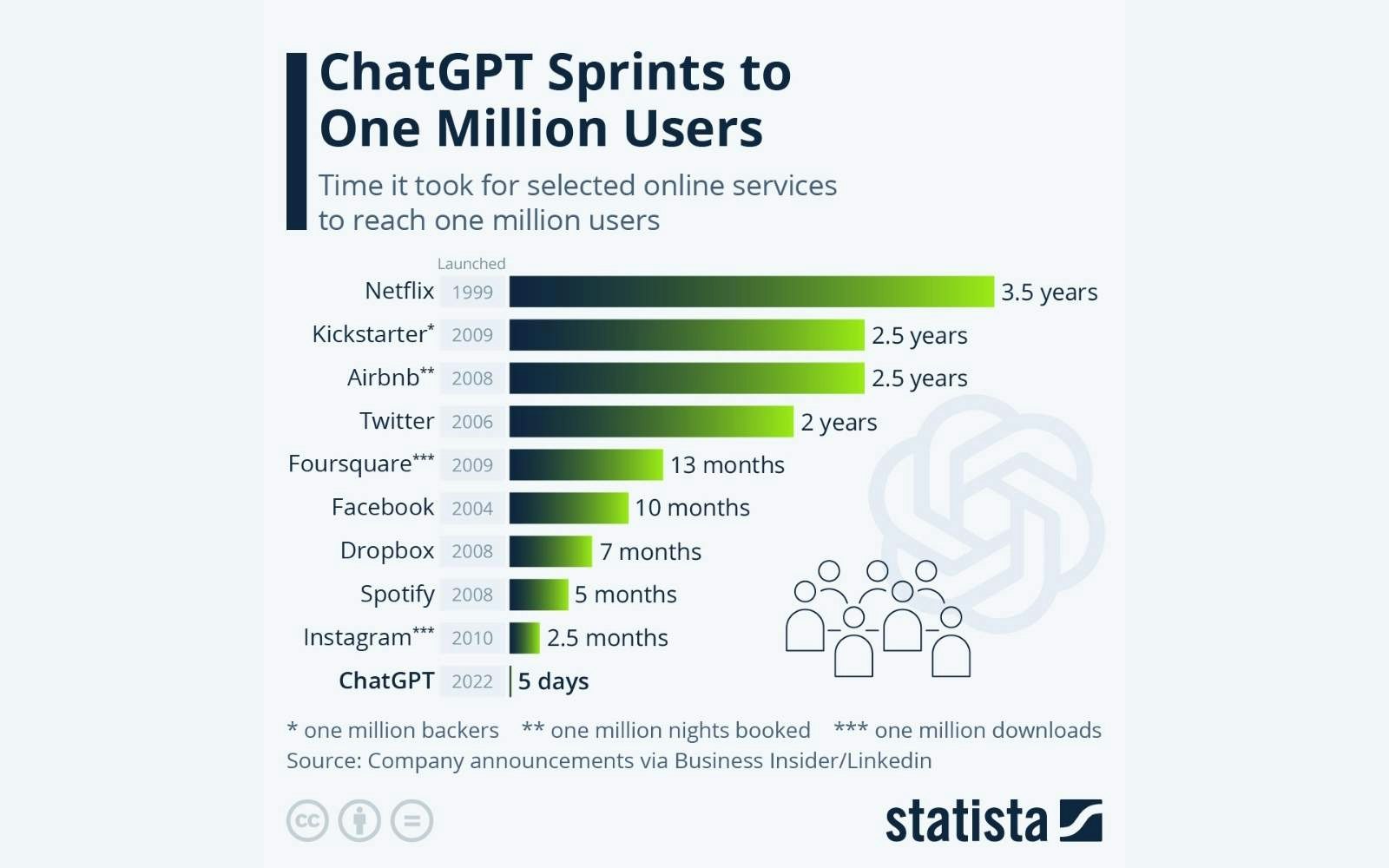
ChatGPT reached 1 million users just five days after its launch (Credit: Statista)
There’s no point listing generic talking points about the global political climate. To build an actionable model and draw real insights from it, each letter must be examined through the lens of your actual business challenges.
Here’s how to interpret the six factors from a data marketing perspective.
P - Political: data sovereignty
The political factor traditionally includes government stability, tax policy or regional conflicts. In our field, it is essential to take into account geopolitics of data.
Tensions between major powers directly influence your infrastructure choices.
Sovereignty: Disagreements between the United States and Europe (Cloud Act) are pushing companies to secure their data on sovereign or tightly controlled infrastructures.
Dependence on platforms: Threats to ban certain social networks (such as TikTok in the US) pose a major political risk if you rely on these channels for acquisition.
E - Economic: pressure on ROI
This pillar focuses on key indicators such as inflation, interest rates or changes in purchasing power. For marketing teams, this translates into heavy budgetary impacts.
The equation is as follows: media costs are rising while budgets are tightening. Using reliable, recent and unified data makes it possible to target the right audiences and optimise Customer Acquisition Cost (CAC).
S - Sociocultural: the demand for immediacy
Beyond classic demographic data, this factor analyses behavioural changes and lifestyles.
Today, consumers expect a personalised, seamless experience across all channels: website, mobile app and physical store. They seek both trust and immediacy. To meet this expectation, brands must build a 360° customer view in order to adapt journeys in real time.
T - Technological: major disruption
This is often the dimension that involves the fastest-moving changes. It covers innovation, R&D and access to new technologies. Two major shifts are currently reshaping the landscape:
The gradual disappearance of third-party cookies, driven by ad blockers, regulation and browser policies. To keep measuring and targeting effectively, you need to pivot towards first-party data strategies and conversion APIs.
Artificial intelligence: autonomous agents can now orchestrate campaigns. To operate effectively, agentic AI must rely on a data infrastructure that provides the right customer context in real time.
E - Environmental: digital sobriety
Corporate social responsibility (CSR) and climate issues concern organisations of all sizes and sectors.
Water and energy consumption, carbon footprint: data storage and AI usage have a significant ecological impact. It is possible to reduce “data waste” by limiting the storage of useless, obsolete or duplicated data.
💡 Unlike monolithic solutions, the DinMo composable CDP is built on a truly zero-copy architecture. It uses data stored in the company’s data warehouse rather than copying it into its own database.
L - Legal: compliance as a prerequisite
The legal factor covers labour law, security standards and sector-specific regulations. For marketing, it has become a critical issue.
The regulatory framework has tightened significantly in order to protect consumers: GDPR and DMA (Digital Markets Act) in Europe, CCPA in California, or the AI Act for artificial intelligence. Consent management (opt-in/opt-out) and security are essential for activating your customer data without legal or financial risk.
How to carry out a PESTEL analysis: step-by-step methodology
To move from theory to action, the PESTEL method relies on a rigorous, multi-step approach.
1️⃣ Collecting reliable information
The quality of your diagnosis depends on the quality of your sources. To avoid basing your analysis on intuition, focus on factual, sourced data.
External sources: rely on recognised organisations. ONS, Statista, Mintel or Gartner for technology trends; Legislation.gov.uk, ICO for official regulatory monitoring.
Internal sources: your own customer data often contains weak signals of societal or economic change.
2️⃣ Weighting and prioritisation
Start by clearly defining your market scope. To prioritise, use an impact matrix that evaluates each trend along two axes: its probability of occurrence and its potential effects on your business.
The goal is to identify the most impactful factors. This may be a forthcoming regulatory tightening or a local economic specificity.
3️⃣ From PESTEL to the SWOT matrix
This is where you shift from analysis to strategy. PESTEL focuses on external factors. It feeds the Opportunities (O) and Threats (T) sections of your SWOT matrix.
Opportunities: identify avenues to test a project or explore new markets.
Threats: should you activate a mitigation plan or pivot strategy? The external diagnosis is then cross-referenced with your internal Strengths (S) and Weaknesses (W).
Taken together, this provides a guide for building your action plan.

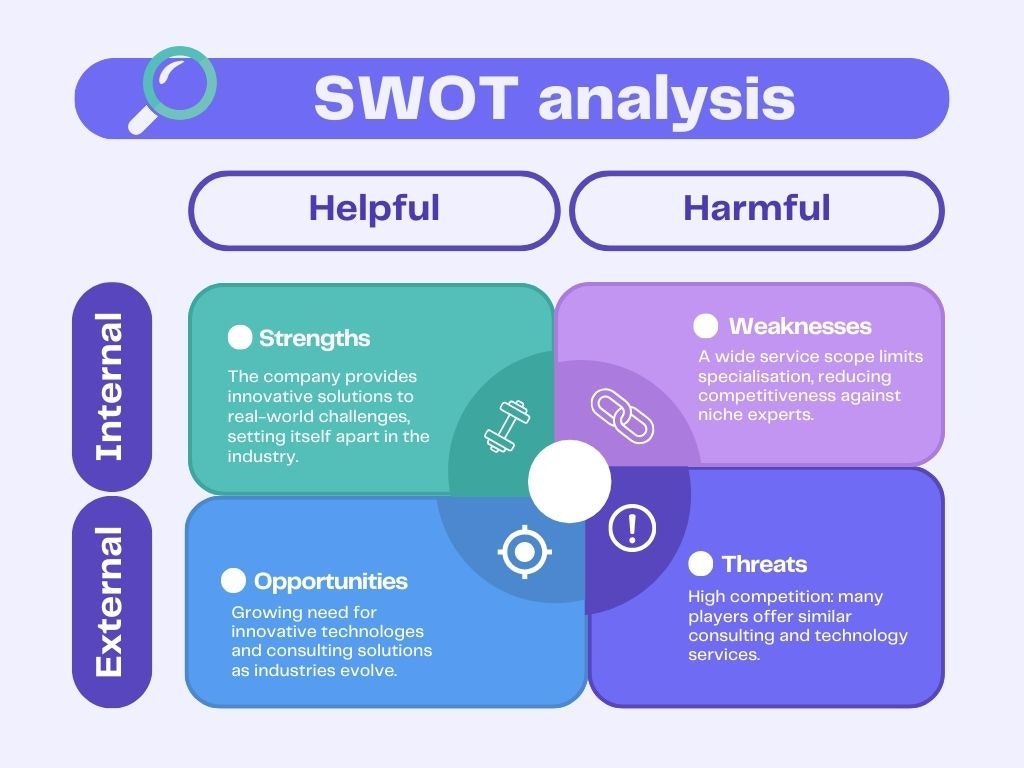
Example of a SWOT analysis
Best practices for success
A few simple rules help turn your study into a strategic steering tool:
Connect the analysis to business decisions: translate each insight into a short-, medium- or long-term roadmap.
Focus on what matters most: concentrate on the most structuring factors, those that carry immediate risks or major growth levers.
Update regularly: the market and macro-environment evolve quickly. A review every 6 to 12 months is recommended.
Visualise to decide: use prioritisation tables or collaborative tools (Notion, Miro) to share the vision with your teams and the board.
Acting on change: the contribution of a Modern Data Stack
From a data marketing perspective, your ability to adapt depends heavily on the flexibility of your technical infrastructure.
The inertia of traditional systems
The cloud data warehouse is emerging as the new centre of gravity for corporate data. At the same time, activating first-party data has become a priority to address privacy concerns.
Organisations are looking for flexible, scalable architectures that can integrate AI and meet new consumer expectations. Cost optimisation, security, CSR: they want to rationalise their technical choices and regain agility.
In the face of these challenges, monolithic solutions are showing their limits. They recreate silos, require costly and energy-intensive data duplication, and lack flexibility. For companies, this technical debt creates inertia.
The agility of the composable approach
A Modern Data Stack offers the flexibility needed to navigate this new environment:
Adaptability (Technological): your warehouse remains the only source of truth. You build your stack according to your business needs, following a best-of-breed approach.
The DinMo composable CDP integrates natively with your environment and lets you launch your first use cases within a matter of minutes.
Compliance (Legal): governance is simplified. Consent is managed at a single level and data never leaves your cloud, ensuring maximum security.
Efficiency (Economic): this rationalisation reduces technical costs and allows you to activate segments in real time. You improve your ROI while meeting consumers’ expectations for personalisation in an omnichannel context.
Conclusion
PESTEL analysis serves as a guide for identifying external factors—positive or negative—that impact your business. It is an indispensable tool for anticipating change, making coherent decisions and adapting your strategy.
To turn this plan into concrete action, your PESTEL study must remain dynamic and up to date. Data plays an essential role in this process, supported by an agile technical infrastructure. Companies equipped with a modern stack will be able to adapt more quickly to market developments.
Does your PESTEL analysis reveal technological or legal challenges? Discover how the DinMo composable CDP turns these constraints into growth levers.
*Source: Gartner