

The complete guide to personalising at scale
8min • Last updated on Mar 23, 2026


Alexandra Augusti
Chief of Staff
Netflix recommends the exact series you were about to search for. Spotify generates a playlist that matches your current mood. Amazon surfaces the products you were considering before you even searched for them.
This isn't magic. It's hyper-personalisation.
Behind these seamless experiences lie systems capable of analysing millions of behavioural and customer data points in real time, modelling individual preferences and activating highly targeted messages across every channel. A paradigm shift for marketing teams — and a considerable opportunity for businesses ready to embrace it.
Key takeaways:
Hyper-personalisation goes far beyond traditional personalisation: it uses real-time behavioural data to tailor every individual interaction.
It relies on the combination of first-party data, machine learning and coherent omnichannel activation.
Its benefits are measurable: improved conversion rates, reduced customer acquisition costs (CAC) and increased customer lifetime value (LTV).
Its implementation raises critical challenges around compliance, data governance and customer experience management.
What is hyper-personalisation?
Personalisation means adapting a message or offer to an audience segment. You send a promotion to consumers who have been inactive for 90 days, a welcome communication to first-time buyers. Useful, but limited.
Hyper-personalisation goes much further. It uses behavioural, transactional and contextual data collected in real time to create a unique experience for each individual, at every stage of the customer journey.
The goal is no longer to address a segment. It's to address a single person — with the right content, at the right moment, on the right channel.
Personalisation vs hyper-personalisation: What's the difference?
Criteria | Traditional personalisation | Hyper personalisation |
|---|---|---|
Granularity | Segment or cohort | Individual |
Trigger | Planned campaign | Behavioural event or signal |
Data used | Declared data, purchase history | Real-time behaviour, contextual signals |
Channel | Email, SMS | Omnichannel, real-time |
Technology | CRM, email platform | CDP, artificial intelligence |
Differences between personalisation and hyper personalisation
Why has hyper-personalisation become strategic?
Several structural trends have made hyper-personalisation a priority for brands and businesses.
Content saturation
A consumer is exposed to around 15,000 commercial stimuli per day. In this context, only genuinely relevant messages capture attention. Generic communications are ignored — or worse, trigger unsubscribes.
Hyper-personalisation enables brands to cut through the noise by delivering offers and content that precisely match each user's preferences and purchasing behaviour.
The decline of third-party cookies
With the gradual phase-out of third-party cookies, businesses can no longer rely on external data to target audiences. They must now leverage their own first-party data — browsing history, past purchases, product interactions, CRM data — to maintain a high level of relevance across their campaigns.
Rising consumer expectations
Today's consumers expect seamless, consistent experiences tailored to their needs. According to McKinsey, 71% of consumers expect personalisation from brands — and 76% feel frustrated when they don't receive it.
This expectation translates directly into purchasing behaviour: an experience perceived as generic pushes consumers towards competing brands that have invested in leveraging their customer data.
How does hyper-personalisation work?
Hyper-personalisation relies on a sequence of four key steps, from data collection through to activation across marketing channels.
1. Real-time behavioural data collection
Hyper-personalisation requires rich, fresh data: pages visited, products viewed, session duration, email interactions, purchasing behaviours, location, transaction history, customer service interactions, and more.
This data can come from multiple sources: website, mobile app, CRM, loyalty programme, physical stores, and social media. A Customer Data Platform (CDP) plays a central role by centralising and unifying these inputs into a coherent view.
2. Customer profile unification
To personalise at an individual level, you need a unified view of each customer — what is known as the Customer 360. This involves resolving identity across channels and devices, and aggregating all available signals: profile data, browsing behaviour, purchase history, and declared preferences.
Without this unification, messages sent across different channels risk being inconsistent. A customer who has just purchased a product in-store should not receive an advertisement for that same product on their mobile the following day.

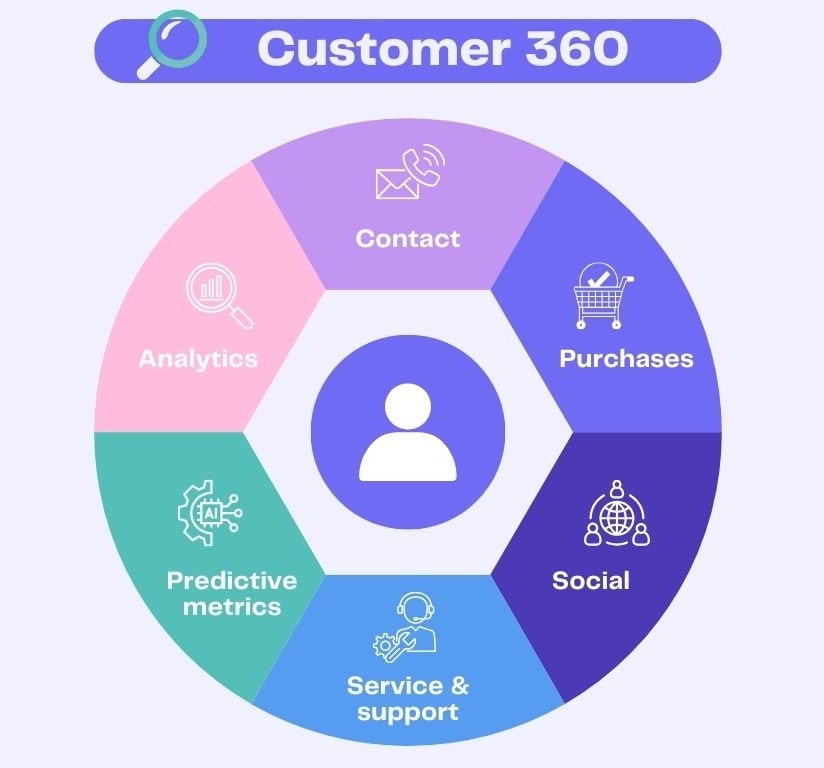
Customer 360
3. Predictive analysis and modelling
Raw data alone is not enough. Machine learning and artificial intelligence models enrich profiles and anticipate behaviour: calculating churn probability, estimating customer lifetime value (LTV), product affinity scoring, and dynamic recommendations based on history and real-time context.
This analytical layer transforms raw data into actionable insights for marketing teams.
4. Omnichannel activation
The final step is to activate these insights in the right tools, at the right time and on the right channel: email, SMS, push notifications, targeted advertising, dynamic website content, mobile app, in-app messages. This is where Reverse ETL solutions come in, synchronising data from the warehouse to activation tools — email platforms, advertising networks, CRM systems.
The goal: every interaction, on every channel, should reflect the same customer knowledge and deliver a coherent experience.

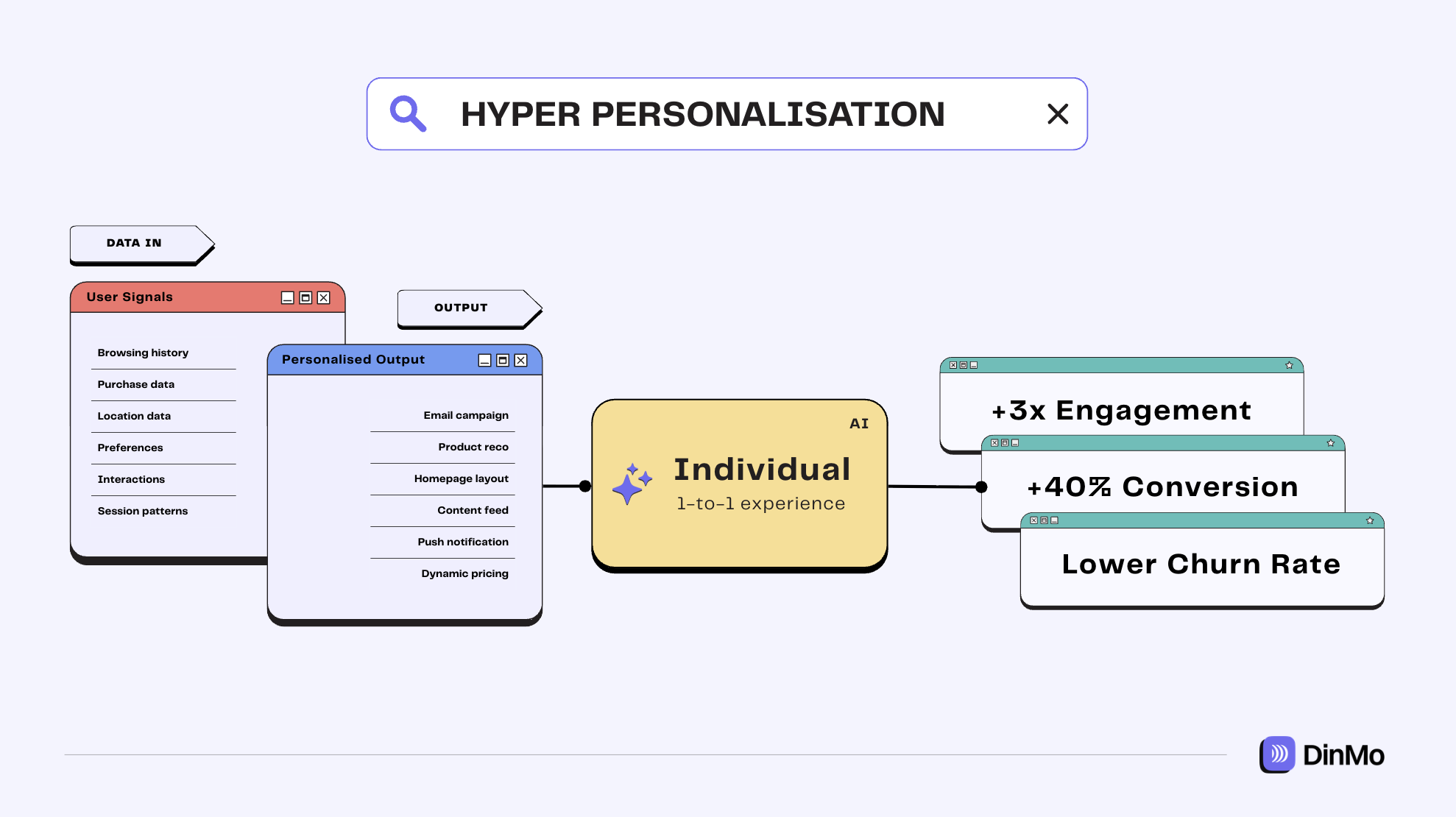
The principle of hyper-personalisation
Practical applications by sector
Hyper-personalisation applies across many sectors, with distinct use cases depending on available data and consumer behaviour.
E-Commerce and Retail
This is where hyper-personalisation was born. Amazon has built a significant portion of its revenue on recommendation engines. Suggested products are calculated based on browsing history, past purchases, frequently bought together items, and real-time behaviour during the session.
Beyond product recommendations, hyper-personalisation enables e-commerce brands to:
Dynamically adapt homepages and category pages based on the visitor's profile and history
Trigger highly targeted abandoned basket follow-ups, personalised according to the products browsed and navigation behaviour
Offer differentiated promotions based on loyalty status, purchase frequency and customer value
Personalise newsletters and CRM messages according to individual preferences, recent purchasing behaviour and seasonality

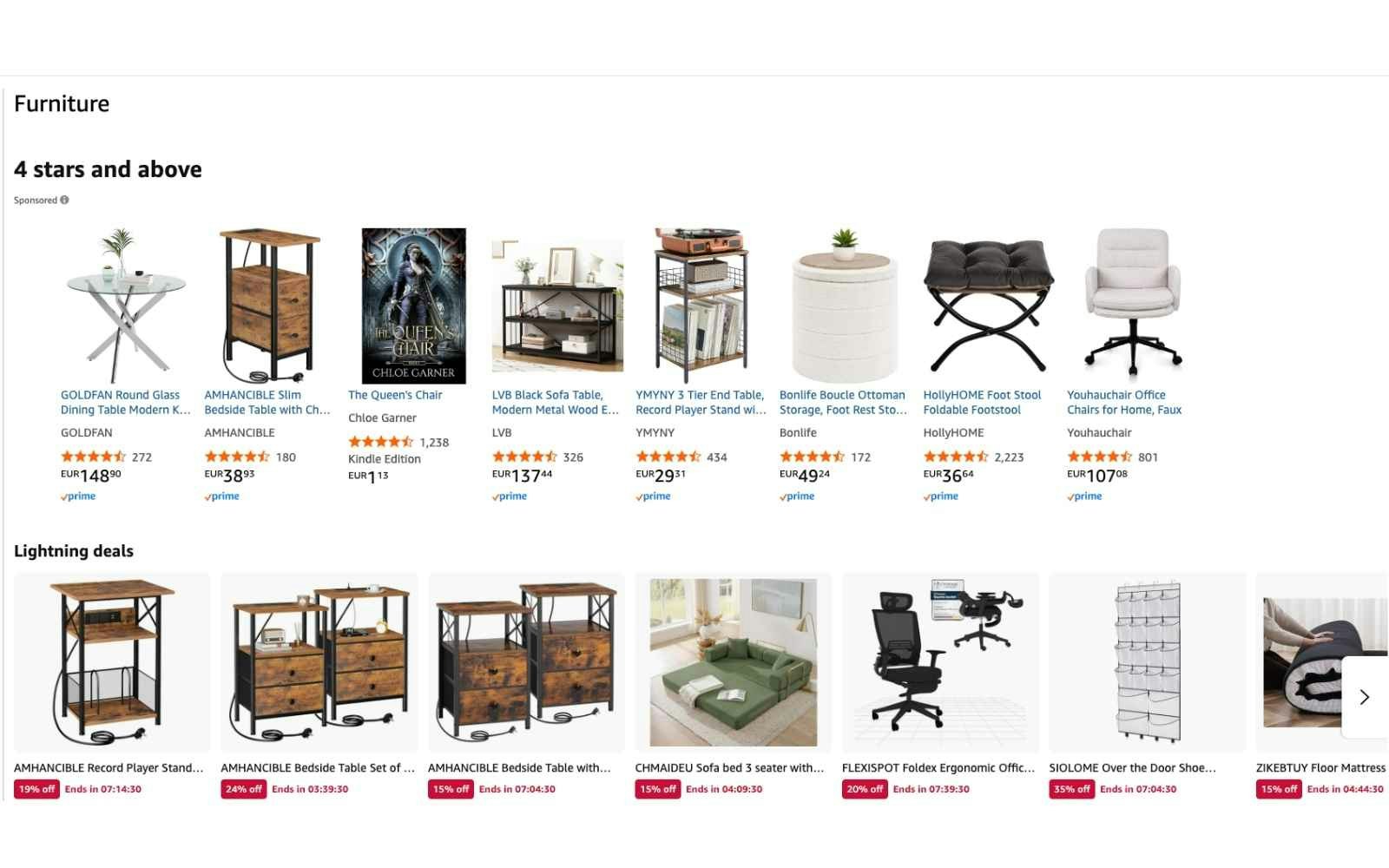
Sponsored products on Amazon
In physical retail, hyper-personalisation translates into offers sent via SMS or mobile app when a consumer is near a store, or into personalised product recommendations delivered to in-store sales staff via their CRM tools.
Streaming and Media
Netflix and Spotify are the undisputed references for hyper-personalisation. Every user sees a different interface: thumbnails adapted to the user's psychological profile, personalised content ordering, playlists generated algorithmically from listening history and context.
Both platforms have demonstrated that individual-level personalisation creates an irreplaceable user experience that drives engagement and significantly reduces churn.


Netflix: Stranger things covers
Banking and Financial Services
In the banking sector, hyper-personalisation enables brands to offer each customer financial products tailored to their actual situation and behaviour: credit proposed at the right moment based on spending habits, insurance calibrated to risk profile, personalised advice based on transaction analysis and customer service interactions.
Players like Revolut and N26 integrated this logic from day one, using every in-app interaction to refine recommendations and personalise messages. Personalised spending notifications are a concrete example: the message is adapted to each user's habits, not to a generic segment.
Luxury and Fashion
Luxury brands leverage hyper-personalisation to recreate online the boutique relationship experience. The stakes are high: luxury has historically relied on a personal, near-exclusive relationship between the brand and its customer.
Some houses send ultra-targeted communications based on stylistic preferences, past purchase occasions, frequency of in-store or online visits, or life events detected in CRM data. Others personalise the entire browsing journey on their website, adapting content, visuals and product recommendations to each profile.
Travel and Hospitality
In the travel sector, platforms like Booking.com and Airbnb use hyper-personalisation to tailor recommendations based on travel history, destination preferences, navigation behaviour and even seasonality. The result: a search and booking experience that feels bespoke for every user.
Hyper-personalisation and ROI: A measurable lever
Effective first-party data activation, combined with precise segmentation, enables brands to target audiences more accurately and reduce wasteful advertising spend across all channels.
Concretely, businesses that implement a solid hyper-personalisation strategy can:
Automatically exclude recent customers and consumers unlikely to convert from acquisition campaigns, avoiding unnecessary spend
Build lookalike audiences based on best customers — those with the highest LTV and most favourable purchasing behaviours
Personalise re-engagement scenarios based on recent behaviour, customer journey stage and product preferences
Adapt advertising messages to each segment, or even each profile, to maximise relevance and conversion rates
The result: significantly higher-performing campaigns at a controlled budget. Some brands report up to a 30% reduction in customer acquisition cost (CAC) through better activation of their proprietary data.
Risks and limits of hyper-personalisation
Like any powerful lever, hyper-personalisation carries risks that must be anticipated and managed carefully.
The "creepy" effect and loss of trust
Personalisation taken too far can generate a sense of intrusion. If a user realises that a brand knows precisely their browsing behaviour, conversations or location, the reaction can be strongly negative and lead to lasting loss of trust.
The line between relevance and surveillance is thin. Brands must find the right balance — using data to be helpful, not omnipresent.
Compliance, data protections and governance
Hyper-personalisation relies on collecting and processing personal data at scale. It must sit within a strict compliance framework aligned with (UK) GDPR and relevant data protection regulations. This requires informed consent, rigorous management of user preferences, a clear data retention policy and transparent governance of access to customer information.
Businesses must also ensure that their tools and technology partners meet these requirements, particularly regarding data storage and transfer.
Technical complexity and organisation
Implementing a hyper-personalisation strategy requires a solid data infrastructure: data warehouse, CDP, activation tools, machine learning models. This demands investment in time, budget and expertise. Marketing and data teams must work closely together to define use cases, build segments and maintain data quality.

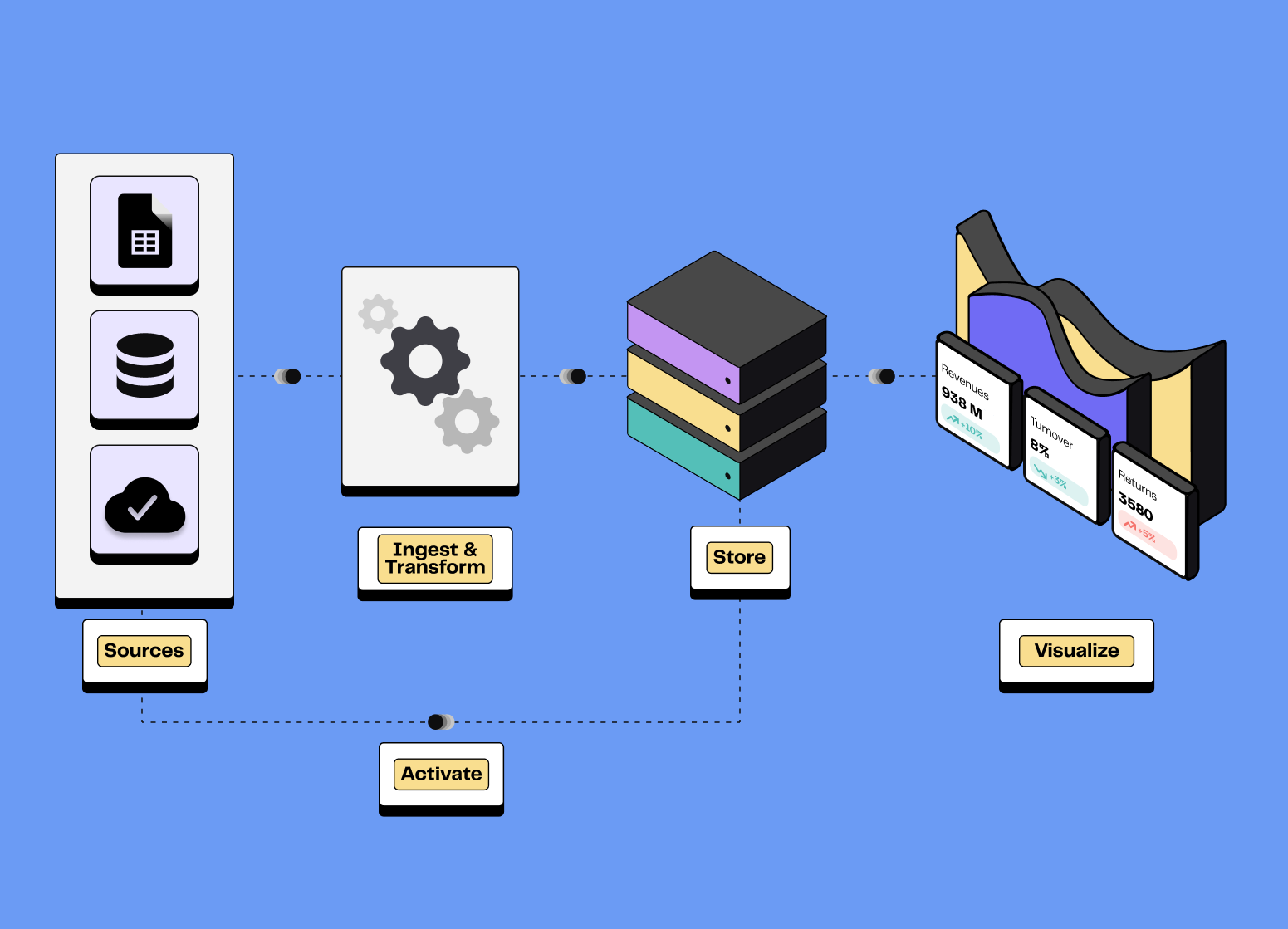
The filter bubble risk
By only surfacing what the algorithm deems relevant for each user, there is a risk of confining consumers within a confirmation loop. Some customers value discovery, surprise and variety in their experience. Hyper-personalisation must not sacrifice diversity in pursuit of narrowly defined relevance.
How to Implement a hyper-personalisation strategy
Step 1: Unify your customer data
The first prerequisite is having a single source of truth for your customers and consumers. This typically requires a cloud data warehouse (Snowflake, BigQuery, etc.) that centralises all data — transactions, browsing behaviour, customer service interactions, CRM data, in-store history — and a CDP to unify profiles and resolve identity across channels.
Step 2: Define priority use cases
There is no need to personalise everything at once. Identify the stages of the customer journey where personalisation has the greatest impact: the homepage, the basket, post-purchase follow-up, product recommendations, reactivation campaigns. Focus your efforts on use cases that combine strong revenue potential with technical feasibility.
Step 3: Segment and enrich profiles
Build precise segments based on actual user behaviour, and enrich them with predictive attributes: churn probability, estimated LTV, product affinity scoring, sensitivity to promotions. A composable CDP like DinMo simplifies this step by working directly from data stored in your warehouse, without duplication or loss of governance.

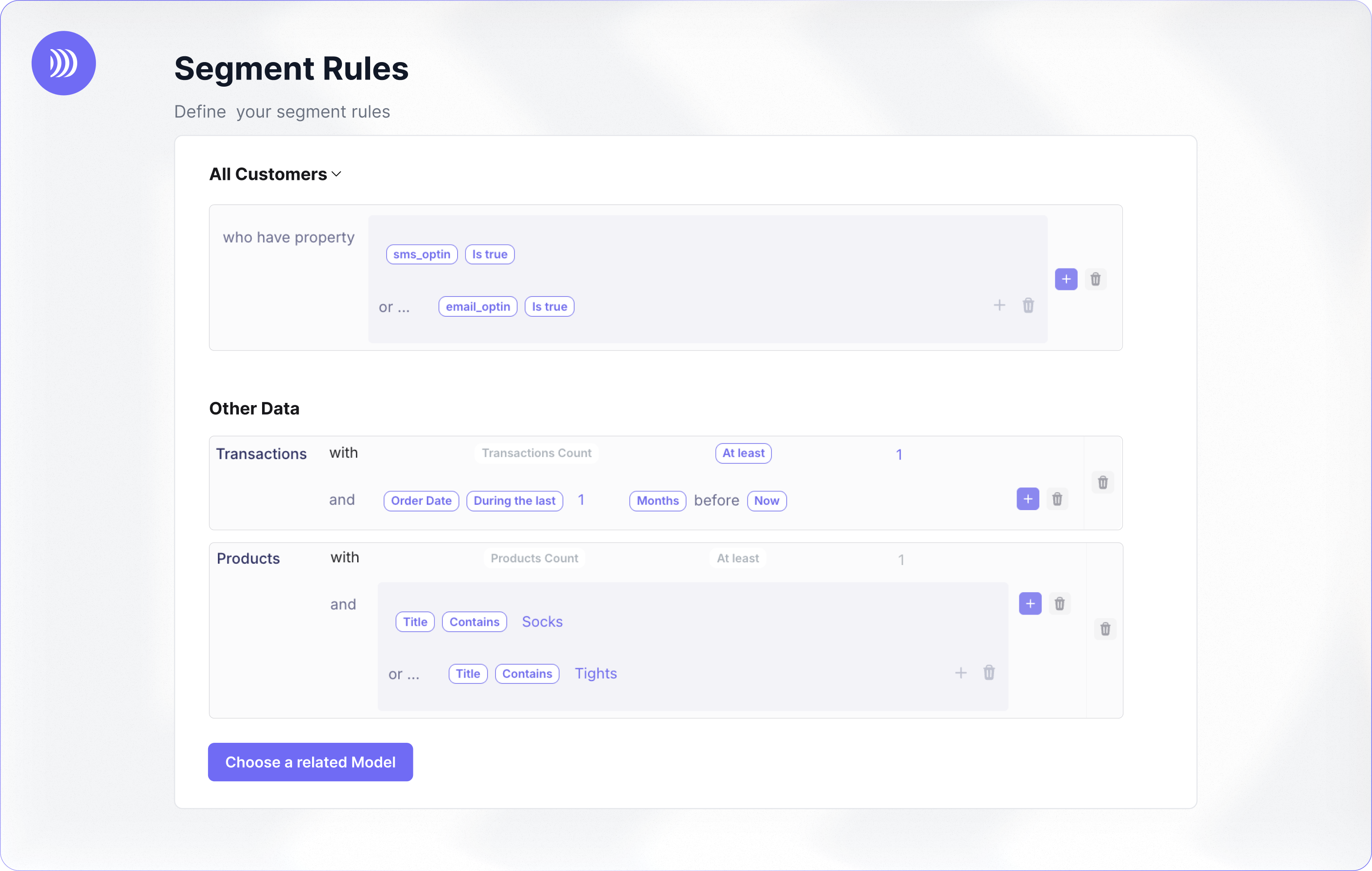
Step 4: Activate on the right channels
Synchronise your enriched segments to your activation tools: email platform, marketing automation suite, advertising networks (Meta, Google), CRM, messaging tools. Ensure consistency of messages across channels to deliver a seamless experience to your consumers, whether they interact via your app, website, store or advertising campaigns.

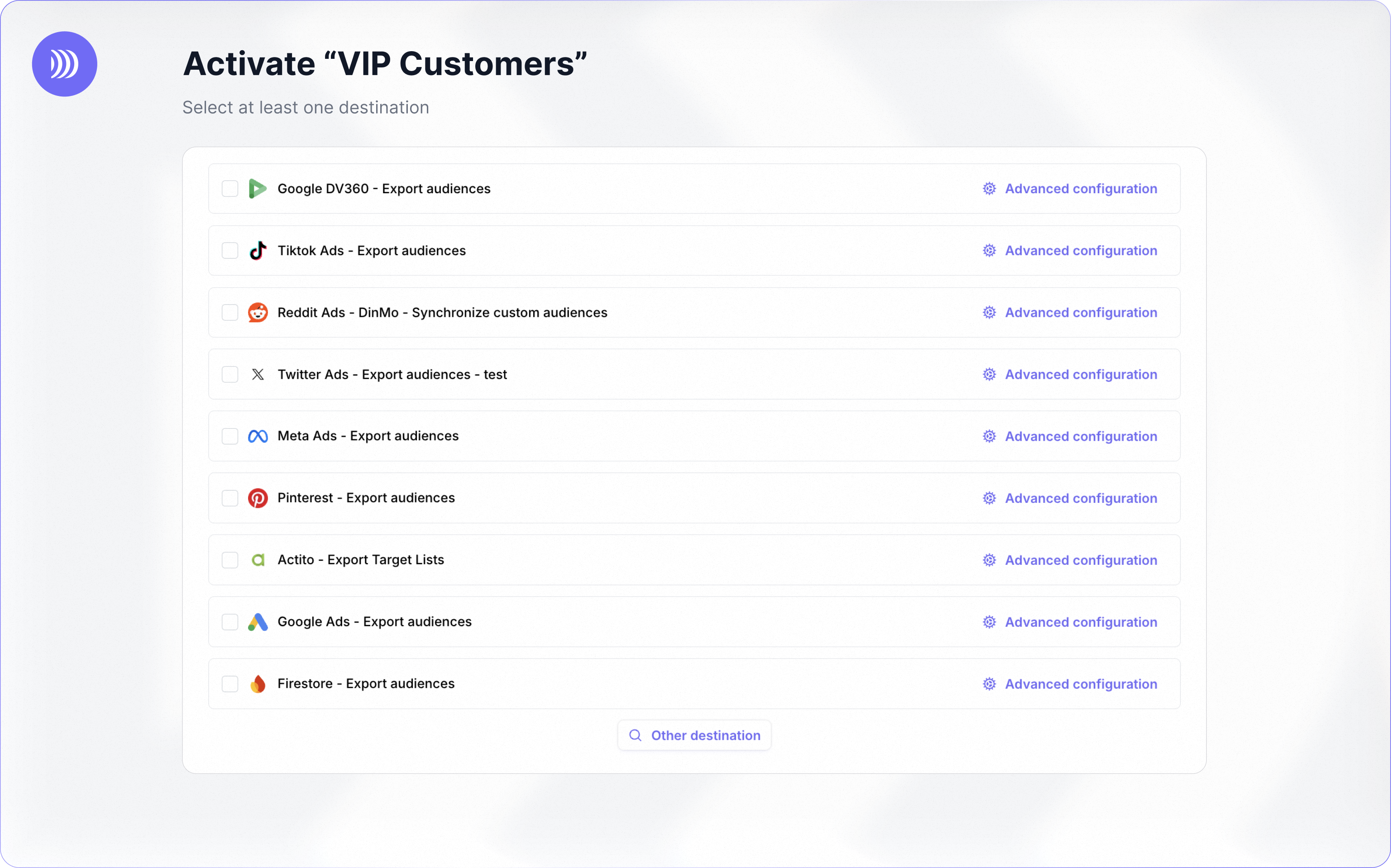
Step 5: Measure, test and optimise continuously
Define clear metrics: conversion rate, ROAS, LTV, retention rate, engagement on personalised content. Test continuously with A/B experiments on messages, offers and send timing. Set up control groups to isolate the real impact of personalisation.
Hyper-personalisation is not a one-off project — it is an ongoing cycle of improvement, fed by data and the constantly evolving behaviour of your customers.
Conclusion
Hyper-personalisation is no longer the preserve of digital giants. Thanks to the democratisation of cloud data warehouses and composable CDPs, businesses of all sizes can now personalise their customer relationships at the individual level.
It is a powerful lever for improving the consumer experience, increasing loyalty, optimising marketing spend and improving campaign performance across all channels — provided you have the right data, tools and governance in place.
At DinMo, we help marketing teams activate their data directly from their data warehouse to implement concrete, measurable hyper-personalisation strategies. Get in touch to discuss your use cases.
What is the difference between personalisation and hyper-personalisation?
What is the difference between personalisation and hyper-personalisation?
Traditional personalisation tailors a message to an audience segment (e.g. "customers inactive for 90 days"). Hyper-personalisation goes further: it creates a unique experience for each individual, in real time, based on their current behaviours, purchase history, context and preferences. The granularity shifts from the segment to the individual person.
Do you need a CDP to implement hyper-personalisation?
Do you need a CDP to implement hyper-personalisation?
Not necessarily a traditional CDP. But you do need an infrastructure capable of unifying customer data from multiple sources, creating dynamic segments enriched by artificial intelligence models, and synchronising them to activation tools. A composable CDP, built on an existing data warehouse, often offers the best balance of flexibility, cost and governance.
Is hyper-personalisation compatible with UK GDPR?
Is hyper-personalisation compatible with UK GDPR?
Yes, provided you respect the fundamental principles: explicit consent, data minimisation, the right to erasure, and traceability of data processing. Robust governance is essential. Composable CDPs, which leverage the company's existing infrastructure without duplicating data, make compliance considerably more straightforward and strengthen the protection of consumers' personal information.